Trust is the conversion variable that most media plans don’t account for. In Los Angeles, where trend-setting market that amplifies campaigns through organic social sharing, brands that invest in guerrilla marketing earn local credibility that digital-only campaigns cannot replicate. When Los Angeles consumers see your brand present in their neighborhoods, not just in their feeds, the physical investment registers as authenticity. American Guerrilla Marketing designs guerrilla marketing campaigns around that trust-building objective in Los Angeles’s commercial environment.
The ROI arithmetic for guerrilla marketing in Los Angeles improves as campaign duration increases. Short-burst campaigns generate initial brand awareness. Extended campaigns, running four to eight weeks in high-traffic Los Angeles locations, build the frequency that converts awareness into preference and preference into purchase intent. American Guerrilla Marketing structures Los Angeles campaigns around this frequency-building logic, not just raw impression volume. The brands that get the highest return from street-level advertising in Los Angeles are those that stay visible long enough for the frequency effect to fully develop.
The sections below address the questions Los Angeles brands ask most often about guerrilla marketing: which neighborhoods generate the best ROI, how long campaigns need to run to build genuine frequency, what the permitting space looks like, how AGM documents field execution, and what outcomes are realistic at different budget levels. This is practical campaign intelligence built from actual Los Angeles field work, not theoretical marketing frameworks.
Why Guerrilla Projections Work in California
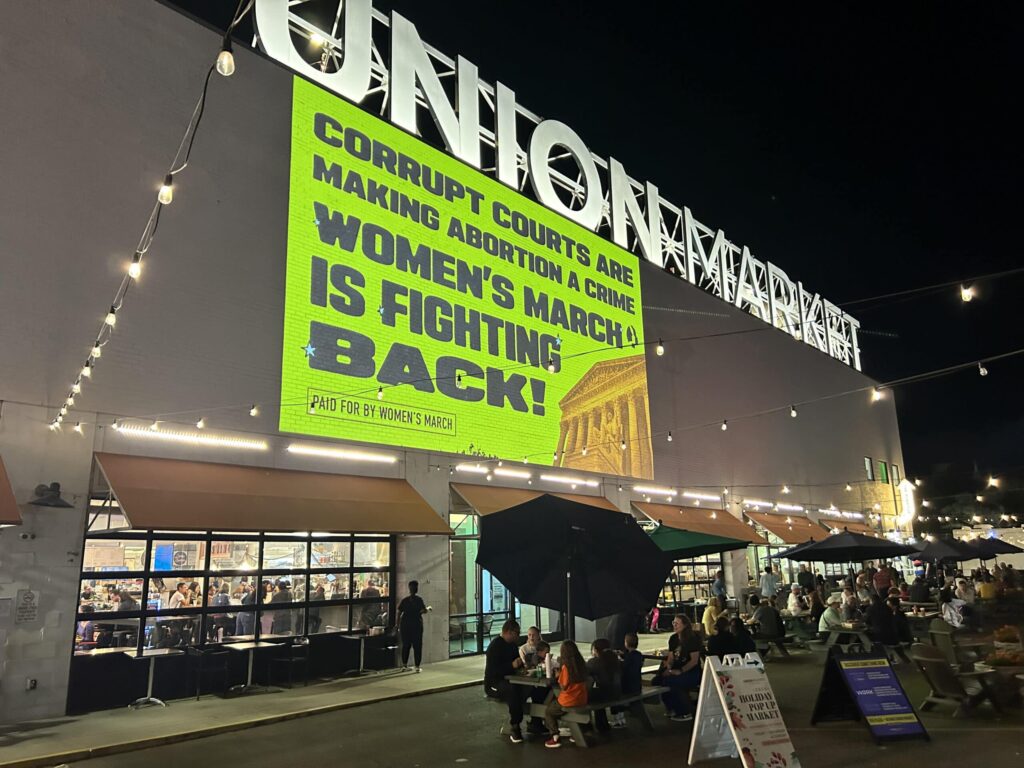
California’s combination of dense urban environments, active nightlife culture, image-conscious populations, and the world’s largest social media audience base creates the ideal conditions for guerrilla projection advertising to perform at its maximum potential. Several specific characteristics of the California market make projections uniquely effective here.
First, California’s outdoor culture keeps people in its streets through the evening and night in ways that weather-constrained markets cannot sustain. Los Angeles’s mild evenings, San Francisco’s summer and shoulder season nights, San Diego’s year-round moderate climate, these weather patterns sustain active pedestrian presence in California’s entertainment and commercial corridors well past the hours when most cities have emptied their sidewalks. That extended evening foot traffic creates longer windows of direct impression generation for projection activations.
Second, California’s creative and entertainment industry concentration creates an audience that is unusually sensitive to visual production quality and creative originality. Los Angeles in particular is saturated with audiences who work in creative industries, entertainment, advertising, design, technology, and who evaluate the visual work they encounter with professional-level critical faculties. A projection that meets this bar with genuine creative quality earns the organic documentation and sharing that drives earned media multipliers. Work that doesn’t meet the bar earns the same crowd but generates little organic amplification.
Third, California’s social media user density is among the highest in the world. The convergence of young, tech-connected, visually oriented populations in California’s major urban centers creates a social amplification infrastructure that no other U.S. state can match. A projection that generates organic social sharing in Los Angeles’s Silver Lake or San Francisco’s Mission District doesn’t just reach the people on that block, it reaches their networks across California, the country, and internationally through the visual richness of content that genuinely commands attention on a feed.
Los Angeles: The Urban Canvas of the West
Los Angeles is the largest guerrilla projection market in California and one of the most dynamic projection environments in North America. The city’s extraordinary inventory of industrial buildings, warehouse structures, large-format commercial facades, and blank walls in high-traffic entertainment and creative industry corridors creates projection surface options that few cities in the world can match.
The city’s active nightlife geography, distributed across multiple distinct entertainment districts from Hollywood to Santa Monica, from Downtown to Silver Lake, means that high-quality projection activations don’t need to compete for a single concentrated nightlife zone. Los Angeles’s multiple active evening environments each provide substantial foot traffic windows, enabling projection campaigns to target specific audience segments by neighborhood rather than concentrating all impact in a single location.
Arts District and Downtown LA
The Arts District is Los Angeles’s most projection-native environment. The neighborhood’s dense inventory of repurposed industrial buildings and warehouses, many with large, blank exterior walls that have historically hosted murals and street art, creates an aesthetic context where projection advertising in California feels not just appropriate but expected. The Arts District’s concentration of galleries, restaurants, bars, and creative businesses generates consistent evening and weekend foot traffic from the city’s creative professional demographic.
The industrial architecture of the Arts District provides surfaces ideal for large-scale projections, massive blank warehouse walls that can display imagery at 40-50 foot scales, visible from blocks away and creating the kind of genuine visual impact that stops traffic (literally, on some streets) and commands organic documentation. For brands with creative industry positioning or cultural authenticity claims, Arts District projections establish visual brand context in the physical environment that most directly aligns with those positioning claims.
Downtown LA’s Bunker Hill area, the financial district, and the South Park residential zone create complementary projection environments for brands seeking broader downtown Los Angeles reach beyond the creative district character of the Arts District.
Silver Lake, Echo Park, and the East Side
Silver Lake is Los Angeles’s creative cultural epicenter, a hillside neighborhood dense with independent restaurants, bars, music venues, vintage shops, and the kind of urban creative energy that sets cultural trends for the broader city and, through Los Angeles’s outsized cultural influence, for the country. Sunset Boulevard through Silver Lake is one of the highest-profile evening corridors in the city for young creative professional foot traffic.
The architectural density and building scale of the Silver Lake commercial corridors, particularly the stretch of Sunset between Fountain and Glendale, creates strong projection surface availability in an audience environment of extraordinary cultural influence. Brands that project in Silver Lake are communicating in a cultural language that carries weight far beyond the immediate foot traffic numbers.
Echo Park, adjacent to Silver Lake and connected to it through the Sunset corridor, mirrors its neighbor’s creative character with additional access to the Echo Park Lake park environment and its community programming. Los Feliz, further east along Hillhurst Avenue and Vermont, extends the East Side creative corridor through a slightly more established neighborhood character with outstanding independent dining and entertainment density.
West Hollywood and Hollywood
West Hollywood is Los Angeles’s most active nightlife district, the Sunset Strip’s concentration of live music venues, nightclubs, restaurants, and hotels generates some of the highest sustained evening foot traffic in the city. The Strip’s east-west orientation and the density of entertainment businesses on both sides of Sunset create a projectable corridor with consistent audience presence from early evening through the early morning hours on weekends.
Hollywood’s central commercial corridors, Hollywood Boulevard around the Walk of Fame, the Cahuenga entertainment cluster, attract both the significant tourist population that makes Hollywood a daily visitor destination and the local entertainment industry workforce that uses the neighborhood as both a work and play environment. Hollywood projections reach an unusual mix of international tourist audiences and entertainment industry professionals simultaneously.
San Francisco: Architecture Meets Nightlife
San Francisco’s compact, hilly geography concentrates extraordinary amounts of nightlife, culture, and foot traffic in relatively small areas, creating projection environments where a single well-positioned display can generate impressions from multiple pedestrian flows simultaneously. The city’s Victorian and Edwardian architectural heritage provides distinctive projection surfaces that photograph beautifully and create visual images that are immediately identifiable as San Francisco, a location-signaling quality that significantly increases organic social documentation rates.
San Francisco’s technology industry creates a specific projection audience demographic that is both highly influential and highly active on the social platforms where organic campaign content travels. A projection that generates engagement from San Francisco’s tech professional community reaches the social networks of individuals whose sharing carries significant platform amplification weight.
SoMa and Mission District
SoMa (South of Market) is San Francisco’s largest neighborhood and home to the city’s most significant concentration of technology companies, event venues, nightclubs, and the density of commercial and residential activity that generates year-round evening foot traffic. The neighborhood’s industrial heritage, repurposed warehouses, large commercial buildings, and the infrastructure of a formerly manufacturing-oriented district, creates abundant large-format projection surfaces.
The Mission District, immediately south of SoMa, is San Francisco’s most vibrant neighborhood, a culturally rich, Latino-heritage community with an extraordinary density of murals, independent restaurants, bars, and the Mission’s 24th Street and Valencia Street commercial corridors generating consistent high foot traffic. The Mission’s muraled character creates a natural visual context for projection activations, and the neighborhood’s cultural engagement means audiences here are more likely than average to photograph and share visually striking brand content.
Pacific Heights, Nob Hill, and Marina
Pacific Heights and Nob Hill provide access to San Francisco’s most affluent residential demographics, neighborhoods where the projection surface inventory is more limited than in SoMa but where the audience concentration per block represents some of the highest household income and brand influence in the state. For luxury brand categories and premium lifestyle brands, projection activations in Pacific Heights and Nob Hill commercial corridors reach the specific consumer demographic that most directly drives their revenue.
Marina District, along Chestnut Street and the Marina Green waterfront corridor, hosts one of San Francisco’s most active young professional evening scenes, bars, restaurants, and outdoor social gathering spaces that generate consistent foot traffic from the affluent, active young adult demographic that is a priority audience for many consumer brands.
San Diego: After Dark in the County
San Diego’s projection markets are smaller in scale than Los Angeles and San Francisco but offer specific audience concentrations and creative environments that make them highly effective for targeted campaigns. North Park’s walkable commercial corridor and its established street art culture create a natural projection environment in the city’s most creative neighborhood. The Gaslamp Quarter provides access to San Diego’s most active nightlife district with tourist and local audiences in the highest-density evening environment in the city.
Hillcrest and the adjacent neighborhoods provide access to San Diego’s LGBTQ+ community and urban professional demographics in a concentrated evening corridor. The Midway and Point Loma neighborhoods, adjacent to the active Little Italy area, add additional projection possibilities for campaigns seeking San Diego County reach beyond the downtown core.
Sacramento: The Capital After Dark
Sacramento’s Midtown and East Sacramento neighborhoods have evolved into vibrant entertainment and creative districts that create genuine projection opportunities in a market that is significantly less advertising-saturated than Los Angeles or San Francisco. The lower competitive density of Sacramento’s outdoor advertising environment makes projection activations stand out more dramatically against the ambient visual environment than in the state’s larger markets.
Midtown’s R Street corridor and the surrounding arts district provide industrial-character projection surfaces with strong evening foot traffic from the Sacramento creative and professional communities. East Sacramento’s restaurant and bar density along Folsom Boulevard and Broadway creates additional evening activation windows with established audience patterns.
Creative Strategy for California Projections
California’s visually sophisticated audiences demand creative production that earns their attention rather than simply occupying it. The creative bar for guerrilla projections in California, particularly in the Arts District, Silver Lake, the Mission, and other neighborhoods where design literacy is deeply embedded, is meaningfully higher than in less creatively concentrated markets.
The fundamental creative principle for effective California projections is the same as for any large-scale, brief-exposure advertising: bold visual impact, minimal complexity, and immediate brand recognition. The audience at a projection site has 3–15 seconds of direct visual contact before their movement carries them past. The creative that generates the most impact in that window is not the one with the most information, it is the one with the most visual force, the clearest brand identity, and the most distinctive aesthetic that claims the building facade as an unmistakably branded space.
Motion graphics significantly outperform static imagery in both direct audience engagement and organic social documentation rates. A looping animated projection, even a simple, elegantly executed animation of a brand’s visual identity, generates more camera activity from passersby than the equivalent static image. For video content, projections work best with 10–30 second loop content that creates a satisfying viewing experience for the audience who stops to watch rather than requiring the extended attention that television-length content demands.
California-specific visual references, imagery that signals specific neighborhoods, coastal landscapes, cultural identifiers of the specific community where the projection runs, generate higher engagement rates than generic brand content. A San Francisco projection that incorporates the city’s iconic visual vocabulary reaches the audience’s local identity as well as their brand awareness, creating an emotional connection that brand-only content misses.
Technical Requirements and Surface Selection
Projection advertising requires specific technical considerations that determine both the visual quality of the activation and the practical logistics of field deployment. Surface selection is the foundational technical decision, the wrong surface for a given projector and distance configuration can significantly degrade creative quality regardless of content quality.
Large blank walls with flat, matte surfaces produce the highest image quality and the most visually striking results. Brick and stucco surfaces work well with appropriate projector brightness and positioning. Highly reflective surfaces, glass, polished metal, glossy paint, are generally problematic and should be avoided unless the surface characteristics are specifically incorporated into the creative concept. Textured surfaces add visual interest to the projected image but can obscure fine detail in complex content, another reason that bold, simple creative outperforms detailed content in most projection contexts.
Projector brightness (measured in ANSI lumens) determines the effective projection distance and ambient light tolerance. Urban environments in California’s entertainment districts have significant ambient light competition from streetlights, signage, and neighboring businesses, requiring high-brightness projector specifications (10,000+ lumens for most street-level applications) to maintain visual impact against the competing light environment. California’s urban density and the specific lighting characteristics of each target neighborhood should inform projector specification decisions before equipment is sourced.
Campaign Strategy & Market Considerations
Guerrilla projection campaign strategy in California requires the same strategic discipline that drives effective marketing in any format: clear audience targeting, precise location selection, timing optimization, and integration with the broader campaign’s objectives and formats.
Market selection within California should be driven by audience alignment rather than geographic ambition. A Los Angeles projection campaign and a San Francisco projection campaign reach fundamentally different audiences with different cultural contexts, different demographic profiles, and different social network dynamics. Brands with distinct California market priorities should make deliberate market selection decisions rather than defaulting to simultaneous multi-market deployment that dilutes impact across each individual market.
Location selection within each California market is the most consequential tactical decision. The neighborhood, the specific block, the building surface, the viewing distance, and the ambient environment all affect how the projection performs in terms of audience encounter quality, visual impact, and organic documentation propensity. AGM’s California location intelligence, built from projections actually executed in these markets, identifies the specific sites where all these variables align most favorably for each campaign type and audience objective.
Timing optimization starts with the obvious: projection works best in darkness. In California’s major cities, meaningful darkness typically begins between 8:00 and 9:00 PM depending on season. Peak pedestrian foot traffic in entertainment districts typically runs from 9:00 PM to midnight on weekends and 8:00 to 11:00 PM on weekdays. The window between sunset and the trailing edge of peak foot traffic is the maximum impact deployment period, and campaigns should be designed to deploy fully within this window rather than extending through the lower-traffic hours of the early morning.
Coordination with California’s specific urban event calendars, concert nights at major venues, sports event schedules, neighborhood art walk programs, festival dates, enables deployment during the highest foot traffic windows available in each market. A projection executed on the same night as a major concert at the Hollywood Bowl, positioned in the corridor where concert-goers flow before and after the event, reaches dramatically more audience than the same projection on a random Tuesday evening.
Maximizing Earned Media from California Projections
The earned media potential of guerrilla projections in California is extraordinary, but it is not automatic. Maximizing organic social documentation and sharing requires deliberate creative and logistical design decisions that create the conditions for organic amplification rather than leaving it to chance.
Designed-for-photography moments are the most reliable earned media generators. Projection content that creates a compelling visual when captured by a smartphone camera, with clear brand identity, dramatic scale, and visual quality that reads well in a social media format, generates significantly higher documentation rates than content that looks impressive from the street but photographs poorly on mobile devices. Testing projection content for smartphone camera quality before deployment is a production discipline that directly affects earned media returns.
Location selection for organic sharing potential is a dimension of location intelligence beyond basic foot traffic volume. Neighborhoods where the target demographic is most active on social media, where the visual context makes the projection’s setting part of the compelling story, and where the audience’s social networks have the highest reach and engagement, these factors should inform location selection alongside the basic metrics of foot traffic and surface quality.
Professional field documentation, dedicated campaign photographers capturing the projection during deployment, provides both campaign accountability documentation and a content asset library for the brand’s own social channels. The professional photographs and video from a well-executed projection activation, published through the brand’s owned channels during or immediately after the deployment, seed the social conversation that organic documentation by passersby amplifies.
Integration with Broader Campaign Strategy
Guerrilla projections perform their strongest work as part of integrated campaigns that include complementary formats supporting the same campaign objective. The visual impact of an after-dark projection is amplified by the ambient brand presence that Wheat Paste Poster Campaigns build in the same neighborhood corridors during daylight hours. The projection’s earned media generates social awareness that makes subsequent brand ambassador encounters with the same audience feel familiar rather than cold.
For campaign sequences tied to specific events or launches, projections serve ideally as a dramatic high-impact moment within a larger deployment architecture. A product launch campaign might deploy Wheat Paste Poster Campaigns in target neighborhoods two weeks ahead of launch, execute guerrilla projections on the nights immediately before and on launch day, and sustain post-launch awareness through sidewalk activations and ambassador programs in the same corridors. Each format reinforces the others, creating cumulative brand impact that exceeds what any single format could achieve independently.
Measuring Projection Campaign Performance
Projection campaign measurement combines quantitative impression estimation with qualitative earned media assessment. Direct impression estimation is based on verified foot traffic data for the specific location during the deployment window, crowd counts from event data, pedestrian traffic studies, or AGM’s location-specific field estimates from prior deployments in the same corridors.
Earned media measurement tracks the organic social documentation generated by the projection: social media monitoring for location tags, brand mentions, and content captures associated with the activation; estimated reach from documented shares; and platform-specific engagement metrics for identified organic content. For campaigns with dedicated activation hashtags or location tags, these digital signals can be systematically tracked and aggregated to produce earned media valuation estimates.
AGM delivers complete post-campaign documentation within 48 hours: professional photography and video of the deployment, impression estimates, social media monitoring summary, and a performance narrative that contextualizes the campaign’s results within the broader campaign objectives. This documentation serves both immediate reporting purposes and the content library that compounds the value of projection investment over time.