Guerrilla Marketing San Antonio: The Neighborhoods, the Streets, the Campaign Formats
San Antonio is a city of deeply rooted communities, major tourism infrastructure, and rapidly developing creative districts. This guide maps the campaign formats and neighborhoods that deliver real results for street-level marketing in the Alamo City.
San Antonio is the second-largest city in Texas and one of the most visited cities in the United States. Over 40 million tourists visit the city annually, concentrated along the River Walk and the historic downtown core. That tourism foundation, combined with a growing creative class population in neighborhoods like Southtown and the Pearl District, creates strong conditions for guerrilla marketing campaigns across multiple demographic targets.
We’ve run campaigns in San Antonio for real estate developers, music festivals, restaurant groups, and entertainment brands. The city’s distinct cultural identity, rooted in its Tejano and Mexican American heritage, means that the most effective campaigns feel genuinely connected to local culture rather than generic national creative dropped into a Texas market.
San Antonio’s concentration of tourism on the River Walk creates opportunities for campaigns that reach visitors and locals simultaneously. The Pearl District development has created one of the strongest emerging pedestrian neighborhoods in Texas, with a farmers market, brewpub, hotel, and restaurants that draw consistent weekend foot traffic. Southtown’s South St. Mary’s Street corridor offers access to a younger creative demographic with strong local pride.
The city’s military presence (four major military installations) creates a significant consumer market that is often overlooked in campaign planning. The corridors around JBSA-Lackland, Fort Sam Houston, and Randolph create distinct audience clusters that can be productively targeted with appropriate campaigns.
AGM Field Note: San Antonio’s events calendar creates significant campaign opportunities. Fiesta San Antonio (April) is one of the largest festivals in the US, drawing over 3 million attendees over 11 days. The NBA All-Star Game, Spurs playoff runs, and major convention events at the Henry B. Gonzalez Convention Center are all strong campaign anchor points.
Key Neighborhoods and Campaign Opportunities
Southtown and South St. Mary’s
Southtown is San Antonio’s most creatively vibrant neighborhood. The South St. Mary’s Street corridor from Commerce Street south through the King William Historic District is the anchor of the local arts scene, with galleries, bars, restaurants, and live music venues. Wheat paste campaigns and sidewalk stencils here reach a 21-40 creative demographic with strong community identity.
The Pearl District
The Pearl, built around the historic Pearl Brewery complex, is one of Texas’s most successful urban redevelopment projects. The mix of market hall, restaurants, hotel, apartments, and the Saturday farmers market creates extremely high-quality foot traffic. Campaigns here reach an affluent, lifestyle-oriented demographic that’s receptive to premium brand experiences.
Downtown and the River Walk
The River Walk is the city’s top tourist draw, and the downtown core is the most-visited part of San Antonio. Campaigns targeting visitors specifically should concentrate here. Local brands targeting residents should be cautious about over-weighting downtown, which can feel generic to long-term San Antonians.
Alamo Heights and Broadway Corridor
Broadway Street from downtown north through Alamo Heights is San Antonio’s most affluent commercial corridor. The Lincoln Heights shopping area and the concentration of restaurants and boutiques along Broadway reach a high-income, established demographic. This corridor is optimal for luxury goods, real estate, and lifestyle brand campaigns.
St. Paul Square and Historic East Side
St. Paul Square’s revitalization has brought restaurants, event venues, and creative businesses to the historic East Side. The area near the Esplanade and the restored buildings along Commerce Street East create a campaign environment that’s less competitive and reaching a community-rooted African American and Latino demographic.
Near North Side and Monte Vista
The Monte Vista neighborhood and the near north side along San Pedro Avenue have strong community character and residential stability. Campaigns here work best for brands with genuine community relevance and local appeal. The area around Trinity University also creates a college-adjacent audience cluster.
Format Performance Across San Antonio
Format
Best Neighborhoods
Primary Demographic
Recommended Duration
Wheat Paste Poster Campaigns
Southtown, Pearl District, Broadway
21-45, creative, affluent
2-4 weeks
Sidewalk Stencils
Southtown, Pearl, River Walk adjacent
22-45, event attendees
1-2 weeks
Street Team Distribution
River Walk, Convention Center, AT&T Center
Tourists, sports fans, broad
1-5 days
Brand Ambassador Programs
Pearl Market, major events, venues
Audience-specific by zone
1-4 weeks
LED Billboard Trucks
Downtown loop, I-35 feeders, AT&T Center
Commuters, tourists, event crowds
1-7 days
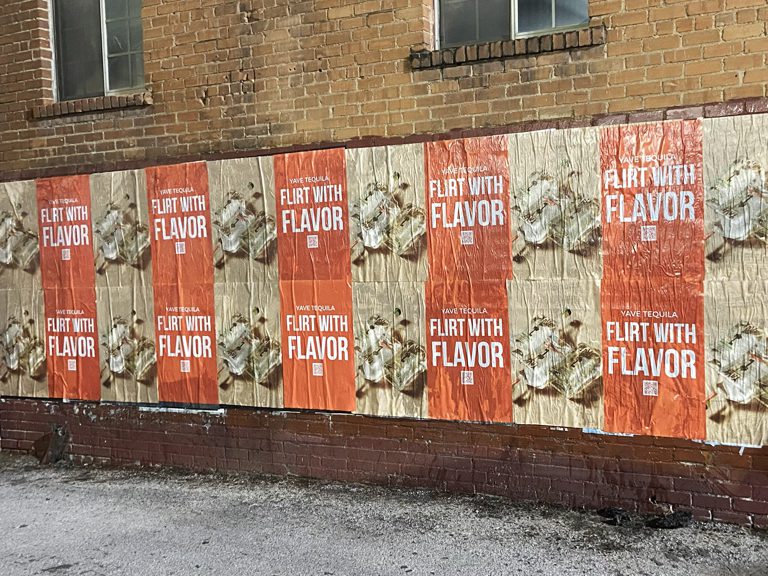
Wheat Paste Poster Campaigns in San Antonio
Wheat paste poster campaigns in San Antonio perform strongest in Southtown, the Pearl District, and the St. Paul Square area. The South Alamo Street corridor through Southtown is the city’s most active creative pedestrian environment. The Pearl Brewery grounds and surrounding streets reach a premium demographic with genuine dwell time and strong social media documentation culture.
Our installation crews know which surfaces in San Antonio hold paste longest, which corridors see fastest cleanup, and which walls consistently deliver the best impression-to-cost ratio. That operational knowledge is what separates a professional campaign from a waste of print budget.
Print Spec: Standard wheat paste poster campaign sizes in San Antonio run 24″x36″ and 40″x60″. We also execute full-sheet and oversized formats for high-impact placements. UV-coated stock is recommended for most markets.
Street Teams and Brand Ambassador Programs
Street team activations in San Antonio are most effective at the Pearl Farmers Market (Saturday mornings draw thousands), along the River Walk during peak tourist season, at the Convention Center during major events, and in the approach corridors to AT&T Center for Spurs games. Fiesta San Antonio creates the single largest street team deployment opportunity in the city.
Every street team deployment includes GPS-verified check-ins, photo documentation, distribution count verification, and a post-campaign summary report. We don’t just deploy teams. We report on them with the specificity you’d expect from a digital campaign.
Industries Running the Most San Antonio Campaigns
San Antonio’s campaign environment reflects its economic identity: tourism and hospitality, healthcare (the South Texas Medical Center is one of the largest medical complexes in the country), military (four major installations), and a growing tech sector around Port San Antonio. Fiesta-adjacent campaigns for food, beverage, and entertainment brands are a seasonal staple.
Music and entertainment: Album drops, tour announcements, streaming platform campaigns
Food and beverage: Restaurant and bar openings, CPG sampling, spirits launches
Fashion and retail: Product launches, seasonal campaigns, store openings
Cannabis: Brand awareness where other advertising channels are restricted
Tech startups: Pre-launch awareness, app downloads, user acquisition
Real estate: Development launches, community branding, rental campaigns
Nonprofits and causes: Awareness campaigns, fundraising drives, community outreach
Campaign Planning and Lead Times
For San Antonio campaigns, we recommend a minimum of 3 weeks lead time from brief to first installation for single-format campaigns. Multi-format campaigns involving multiple neighborhoods and formats require 4-6 weeks of planning, production, and crew coordination.
Campaigns tied to specific dates (launches, events, album drops, film releases) should be planned with buffer time for print production delays, weather contingencies, and surface availability. We build backward from your target date and identify the critical path at the outset.
What Reporting Looks Like After Your Campaign
Every AGM campaign in San Antonio is documented with geo-tagged photography for each placement, a coverage map showing installation distribution, and a written summary report. Street team campaigns include count data, zone-by-zone breakdowns, and hourly distribution logs. Reporting is delivered within 48-72 hours of campaign completion.
How to Plan a Guerrilla Marketing Campaign in San Antonio
Effective guerrilla marketing in San Antonio starts with a clear understanding of the city’s geographic and cultural environment. The neighborhoods that deliver the strongest campaign performance are not always the ones that make the shortlist in a first meeting. We’ve found that the most successful San Antonio campaigns come from clients who trust local market knowledge over generic assumptions about where their audience spends time.
A well-planned San Antonio campaign begins with a brief that answers four fundamental questions: Who is the specific audience we’re trying to reach? Where does that audience concentrate in San Antonio? What behavior do we want to drive with this campaign? And what does success look like in a measurable way? From those four answers, we build a campaign architecture that matches format to audience environment and objective to format capability.
Creative Considerations for San Antonio Campaigns
Creative quality matters more in guerrilla marketing than in most other advertising formats. Unlike a digital banner that a user can scroll past in milliseconds, a wheat paste poster campaign or a sidewalk stencil occupies physical space in someone’s daily environment. It competes for attention against the rest of the visual environment of the city, not just other ads. The standard for noticeability and engagement is correspondingly higher.
In San Antonio, we recommend creative that feels indigenous to the specific neighborhood where it’s deployed. Creative that’s designed in a boardroom and deployed without adaptation to local visual culture consistently underperforms creative that feels genuinely rooted in the community it’s reaching. We advise clients to consider the aesthetic character of the target neighborhoods, the cultural references that resonate with the target demographic, and the tone that aligns with local expectations before finalizing campaign creative.
Creative Tip: For wheat paste poster campaigns, high-contrast imagery and a single clear message perform significantly better than complex multi-element designs. At street level, you have 1-2 seconds to capture attention. Simplicity wins.
Campaign Formats: Choosing the Right Mix for San Antonio
Not every guerrilla marketing format works equally well in every city. San Antonio’s specific pedestrian culture, neighborhood structure, and regulatory environment determine which formats deliver the strongest return on investment. We recommend format mix after assessing:
Pedestrian density: How many people walk the target corridors daily, and at what times?
Surface availability: What wall inventory exists in target neighborhoods, and what’s the competitive clutter from other campaigns?
Audience behavior: Does the target demographic move through the city primarily on foot, by transit, or by vehicle?
Regulatory environment: What formats are permissible in the target zones, and what risk profile is acceptable for the client?
Campaign duration: Is this a short burst campaign or an ongoing presence program? Different formats deliver differently over time.
Operational Excellence: What Sets Professional Campaigns Apart
The difference between a professional guerrilla marketing campaign and an amateur attempt is almost entirely operational. Professional campaigns have:
Pre-campaign surface scouting that identifies the specific walls and locations that deliver best in target neighborhoods
Print production quality standards that ensure materials look sharp in real-world conditions, not just in a design mockup
Installation crews with local market knowledge who know which surfaces to prioritize and how to execute efficiently
Real-time deployment tracking that ensures the campaign plan is being executed as designed
thorough photo documentation of every placement, organized for client reporting
When campaigns miss on any of these operational elements, the gap between creative potential and actual performance is significant. We’ve rescued campaigns that started poorly executed by other vendors and seen firsthand how much operational quality affects real-world campaign performance.
Budget Allocation for San Antonio Campaigns
Guerrilla marketing campaigns are not uniform in their cost structures. The four primary cost components in any campaign are: production (print, materials, fabrication), media or surface access (property owner agreements, licensed posting sites), labor (installation crews, street teams), and reporting (photo documentation, reporting compilation). Understanding how these components are allocated in your specific campaign helps avoid unpleasant budget surprises.
In San Antonio specifically, labor costs reflect local market wage rates. Surface access costs vary significantly by neighborhood: high-traffic creative districts command premium access rates while emerging neighborhoods may offer strong surfaces at lower cost. We provide detailed budget breakdowns before campaign execution so clients understand exactly what each component costs.
Multi-Format Campaign Architecture
The most effective guerrilla marketing campaigns we run in San Antonio combine multiple formats into a layered strategy that reaches the target audience at multiple touchpoints. A typical multi-format program might include:
A wheat paste poster campaign covering 3-5 target neighborhoods, running for 2-4 weeks as the awareness foundation
Sidewalk stencils at 10-20 high-foot-traffic intersection points providing ground-level impressions in the same zones
A street team deployment at 2-3 high-traffic transit hubs or event venues during peak audience hours, delivering direct touchpoints with the target demographic
LED billboard truck routing through the campaign neighborhoods during peak evening hours, amplifying visual presence for the nighttime audience
This architecture creates a campaign that’s visible at multiple times of day, across multiple surface types, and in multiple interaction modalities. Frequency across different contexts is what drives brand recall, and multi-format campaigns achieve this systematically.
Seasonal and Event Timing Considerations
San Antonio has specific seasonal and event dynamics that affect campaign planning. Understanding when the target audience is most present in the target zones, and what events concentrate that audience in specific locations, allows for campaign timing that maximizes reach and frequency within a given budget.
We maintain a calendar of major events, festivals, sports seasons, and cultural moments in San Antonio that affect campaign deployment. Campaigns timed to peak audience concentration moments consistently outperform campaigns timed by client preference alone. We advise on optimal timing as part of every campaign planning process.
The Business Case for Guerrilla Marketing
Guerrilla marketing consistently delivers strong return on investment when executed professionally. The reasons are structural: physical campaigns operate in an environment with far less competitive saturation than digital advertising, where millions of brands compete for the same inventory. A well-placed wheat paste campaign in the right neighborhood reaches a concentrated target audience with a physical brand impression that persists in the environment for days or weeks, generating repeated exposures at a cost structure that’s highly competitive with comparable digital reach.
The second structural advantage is memorability. Research consistently shows that physical advertising generates stronger brand recall than digital advertising. When a consumer sees your brand on their street, in the neighborhood where they live and walk, it creates a real-world context for the brand that digital advertising cannot manufacture. That physical-world familiarity translates into greater receptiveness when the consumer encounters the brand in other contexts, including digital ones.
Third, guerrilla marketing creates organic social media amplification that multiplies the paid investment. Compelling street-level creative gets photographed and shared by the audiences who encounter it. In markets with strong social media documentation culture, like New York, Los Angeles, Miami, and Austin, this organic amplification routinely extends campaign reach by multiples of the original physical footprint. We track this amplification as part of our post-campaign reporting.
Understanding Your Target Audience at Street Level
The most common planning failure we see in guerrilla marketing is demographic targeting that isn’t specific enough to drive useful campaign decisions. “18-34 urban professionals” describes tens of millions of people across hundreds of neighborhoods. The campaign planning question is: where do the specific 18-34 urban professionals who are likely to buy your product actually walk, congregate, and spend their time in the target city?
Answering that question requires neighborhood-level audience intelligence, not just broad demographic data. We assess pedestrian corridor demographics using a combination of census tract data, business category mapping (what kinds of businesses are in this area and who do they attract?), public transit ridership profiles, and our own accumulated market knowledge from years of campaign execution. That neighborhood-level specificity is what allows us to allocate campaign budget to the corridors where the actual target audience is, not just the corridors that sound strategically appealing in a presentation.
We also consider behavioral targeting beyond demographics. The 32-year-old professional who goes to CrossFit, drinks craft beer, and browses sneaker releases is a different campaign target than the 32-year-old professional who goes to the farmers market, shops at Whole Foods, and attends gallery openings, even if their demographics are identical. Behavior-based geographic targeting, using the types of businesses in a neighborhood as a proxy for the behavioral profile of the audience, allows for precision that demographic data alone cannot provide.
Campaign Timing: When Guerrilla Marketing Lands Hardest
Timing is one of the most underappreciated variables in guerrilla marketing campaign planning. The same creative, in the same location, at the wrong time of year or the wrong point in the consumer’s decision journey, delivers dramatically weaker results than the same campaign at the optimal moment. We analyze timing as a core component of every campaign plan.
For brand launches, timing guerrilla campaigns to coincide with the beginning of the target audience’s consideration cycle is critical. For entertainment campaigns, the timing window before ticket sales open is optimal for awareness, while the final week before the event is optimal for action driving. For retail campaigns, the weeks immediately preceding peak shopping seasons (spring fashion, holiday, back to school) capture consumers at their highest purchase intent moment.
We also consider competitive timing. If a major competitor is known to be planning a campaign launch in the same market, getting your campaign into the market first creates the visual context for the subsequent competitive presence rather than the other way around. Early mover advantage in street-level marketing is real and worth planning around.
What Happens After the Campaign: Sustaining Momentum
One of the most common questions we hear after a successful campaign launch is: how do we maintain this momentum? The answer depends on the campaign objective, but generally involves a sustained presence program that keeps the brand visible in the target market without the full investment of a launch campaign.
For brands targeting ongoing consumer awareness in a specific market, monthly or quarterly wheat paste campaigns in core neighborhoods maintain the visual presence that builds long-term brand familiarity. For brands that launch seasonally, recurring pre-season campaigns create the anticipation that accelerates each new season’s sales velocity. For brands that have achieved initial awareness and are focused on retention, community event presence programs and ongoing brand ambassador activities maintain human-level brand connection in the target communities.
We design ongoing campaign programs that fit our clients’ budgets and objectives. The most effective ongoing programs are designed at the campaign launch stage, building the maintenance program into the initial campaign architecture rather than treating it as an afterthought.
The AGM Difference: What Sets Our Campaigns Apart
American Guerrilla Marketing executes street-level campaigns differently from most vendors in the market. The differences that matter most to our clients are: operational depth (we have installation crews with specific local knowledge in every major US market and many international cities, not a patchwork of subcontractors we’ve never met), documentation standards (every placement is photographed with geo-tagging, not a representative sample), creative collaboration (we bring format-specific expertise to every campaign brief, not just execution of whatever the client sends us), and campaign architecture experience (we design multi-format, multi-neighborhood campaign programs based on what actually works, not what sounds good in a proposal).
We’ve run campaigns for brands at every scale, from independent restaurant groups running their first neighborhood awareness program to major entertainment companies executing simultaneous 30-market campaigns. The process is the same regardless of scale: a detailed brief, a thoughtful campaign architecture recommendation, precise execution with real-time oversight, and thorough documentation that proves value delivered.
If you’re considering a street-level marketing campaign, we’d be glad to talk through what the right approach looks like for your specific brand, market, and objective. Contact us at the link below.
Frequently Asked Questions
What are the best areas for guerrilla marketing in San Antonio?
Southtown, the Pearl District, and the Downtown/River Walk corridor are the most productive guerrilla marketing environments in San Antonio. Neighborhood selection depends on whether you’re targeting locals, tourists, or specific demographic communities. We recommend strategy after understanding your objectives.
Can you run campaigns timed to Fiesta San Antonio?
Yes. Fiesta San Antonio is one of the largest events in the US with over 3 million attendees over 11 days in April. We specifically plan street team, wheat paste, and ambient campaigns around Fiesta. These campaigns require early booking given the surge in campaign demand during this period.
Is San Antonio a good market for wheat paste poster campaigns?
Yes. Southtown, the Pearl District, and the Broadway corridor all have strong surface availability and receptive audiences for wheat paste campaigns. San Antonio’s warm climate extends poster longevity, and the city has less competitive clutter than larger coastal markets, which increases the visibility of each placement.
How do you reach the tourist population with guerrilla marketing in San Antonio?
River Walk-adjacent activations, street team deployments at the River Walk and Alamo approaches, and LED billboard truck routing through the downtown tourist corridor are the most effective ways to reach San Antonio’s 40 million annual visitors. Convention Center approaches are also strong for event-specific campaigns.
What makes San Antonio unique as a guerrilla marketing market?
San Antonio’s combination of massive tourism infrastructure (40 million annual visitors), a growing creative class in Southtown and the Pearl, a strong military community, and deeply rooted Tejano cultural identity creates a multi-layered campaign landscape that rewards strategic thinking. The relative lack of campaign competition compared to coastal cities also increases per-placement visibility.
Do you run campaigns in the San Antonio suburbs?
Yes. We cover the full San Antonio metro including New Braunfels, Schertz, Universal City, and the Stone Oak corridor. Suburban formats typically emphasize door hanger distribution, direct mail, and event-based activations.
What reporting do you provide for San Antonio campaigns?
All campaigns include geo-tagged photography, placement coverage maps, and written summary reports. Street team campaigns include distribution count data, zone breakdowns, and hourly logs. Reporting is delivered within 48-72 hours of campaign completion.