Guerilla Advertising Definition: What It Is, How It Works, and Why It Matters
Guerilla advertising is not simply advertising in unusual places. It is a specific strategy for creating brand encounters that feel like discoveries, generate organic amplification, and produce exposures that no standard media buy can match.
The definition of guerilla advertising matters because the term gets misapplied. A brand that places a poster on a busy wall without strategy or precision is not running a guerilla advertising campaign. A brand that runs a predictable social media contest and calls it guerilla is not running a guerilla advertising campaign. Guerilla advertising is a specific approach with specific structural requirements, and understanding those requirements is the difference between a campaign that works and one that uses the right vocabulary to describe something unremarkable.
At American Guerrilla Marketing, we have built our entire practice around guerilla advertising in its most precise and effective form. This guide is our attempt to give that term a definition rigorous enough to be useful, and a practical explanation grounded enough to be actionable. Whether you are evaluating guerilla advertising for the first time or looking to build on prior experience, this is the framework we use.
Guerilla advertising is an unconventional advertising strategy that uses surprise, environmental specificity, and creative intelligence rather than purchased media scale to create strong brand exposures with a target audience.
That definition has four components, each of which is necessary and none of which is sufficient alone.
Unconventional. Guerilla advertising operates outside the defined formats and channels of standard media. It does not purchase media slots. It does not follow the conventions of display advertising, television, or digital. It deliberately departs from those conventions to create encounters that the audience does not recognize as advertising in the standard mode.
Surprise. Guerilla advertising depends on the element of surprise to generate its stronger-than-average audience response. The encounter must be unexpected in the specific context where it occurs. A brand poster in a location where brand posters are common is not a guerilla advertising encounter. The same poster in a location where the audience did not expect to find advertising creates a genuinely different quality of attention.
Environmental specificity. Guerilla advertising is designed for a specific environment, not for a generic public space. The best guerilla advertising could not be placed anywhere else because its effect depends on its relationship with the specific physical context of its placement. Environmental specificity is what separates genuine guerilla advertising from just placing an unusual ad in any available location.
Creative intelligence over media scale. Guerilla advertising produces results through the quality and precision of its concept and execution rather than through the volume of its media spend. This is the most important characteristic in practical terms because it means the format is genuinely accessible to brands at any budget level. A small brand with a precise concept and a well-executed deployment can outperform a large brand with a generic concept and a large budget in a guerilla advertising context.
The Etymology of Guerilla Advertising
Understanding where the term comes from helps understand what it means. Guerilla warfare refers to small-scale, unconventional military operations that use surprise, knowledge of terrain, and tactical precision to achieve results disproportionate to the resources deployed. Guerrilla fighters operate outside formal military structures, using unconventional tactics against larger, more conventionally organized forces.
Jay Conrad Levinson applied this military analogy to marketing in his 1984 book Guerrilla Marketing. Levinson’s argument was that small businesses could compete with larger, better-funded competitors by using unconventional tactics that were not available through conventional media channels: tactics that substituted creative intelligence and precise audience knowledge for the spending scale that larger competitors could deploy.
The analogy extends cleanly to advertising specifically. Guerilla advertising uses unconventional formats and unexpected placements to create brand exposures that conventional advertising budgets cannot replicate through sheer spending. A brand that places a genuinely surprising, precisely targeted installation in the right neighborhood for its target audience creates a stronger impression than a brand that buys the same neighborhood’s standard outdoor inventory at many times the cost.
The Key Characteristics That Define Guerilla Advertising
The definition of guerilla advertising becomes more useful when its key characteristics are described in enough detail to allow evaluation of whether a specific campaign actually qualifies. Here are the five characteristics we use to evaluate whether a campaign approach is genuinely guerilla in nature.
1. Unconventional Format or Placement
The campaign must use a format or placement approach that differs meaningfully from standard media. A standard outdoor billboard on a highway is not unconventional. The same brand message delivered through a large custom sculpture placed in a public plaza is unconventional. A sponsored social media post is not unconventional. A branded installation that generates organic social documentation is unconventional. The unconventionality must be genuine, not cosmetic.
2. Genuine Surprise Potential
The campaign must have the potential to create genuine surprise in the specific audience it targets in the specific environment where it is deployed. The surprise must be evaluated from the audience’s perspective, not from the brand’s perspective. What seems unexpected to the brand’s marketing team may be entirely expected by the target audience based on what they have seen from other brands in their environment. The surprise must be real surprise for the target consumer.
3. Clear Environmental Specificity
The campaign must be designed for a specific physical environment rather than for a generic public space. The creative, the format, and the placement logic must all reflect knowledge of the specific neighborhood, location, and cultural context where the campaign will appear. A campaign that could be placed anywhere without modification is not genuinely guerilla in spirit, even if it uses an unconventional format.
4. Clear Brand Attribution
The campaign must make the brand immediately and clearly identifiable. This is both a definitional and a practical requirement. Definitionally, advertising that does not attribute to a brand is not advertising. Practically, guerilla campaigns that are visually interesting but not clearly branded generate interest in the campaign without generating brand awareness, which defeats the purpose of the advertising investment.
5. Organic Amplification Potential
Effective guerilla advertising generates organic amplification through consumer documentation and sharing, press coverage, and word-of-mouth. A guerilla campaign that is surprising and well-executed but not shareable misses one of the format’s primary advantages. The design of the campaign should include explicit consideration of what about it will motivate the audience to document and share.
Characteristic
What It Requires
What Failure Looks Like
Unconventional format
Genuine departure from standard media
Standard ad in a slightly unusual location
Genuine surprise
Unexpected by the specific target audience
Unexpected to the brand team, expected by the audience
Environmental specificity
Designed for the specific location
Could be placed anywhere without change
Brand attribution
Immediately identifiable brand
Visually interesting, brand unclear
Organic amplification
Worth documenting and sharing
Noticed but not shared
What Guerilla Advertising Is Not
The definition of guerilla advertising is clearer when understood in contrast to what it is not. Several common misconceptions about the term lead brands to call campaigns guerilla when they are something else.
Guerilla advertising is not simply cheap advertising. The term is sometimes used to describe low-budget advertising campaigns as if “guerilla” is a synonym for “inexpensive.” It is not. Guerilla advertising can be executed on a small budget, but small budget is not what makes it guerilla. What makes it guerilla is the unconventional, surprise-based approach to reaching the audience. A high-budget campaign can be guerilla. A low-budget campaign that uses standard media in a standard way is not guerilla.
Guerilla advertising is not internet marketing. The term is sometimes applied to digital marketing tactics that are aggressive or unconventional in a digital context: viral content, social media stunts, influencer campaigns. These may share some characteristics with guerilla advertising, but guerilla advertising specifically refers to the physical environment. It is a street-level discipline, not a digital one.
Guerilla advertising is not simply outdoor advertising. Outdoor advertising includes any advertising in the outdoor environment: billboards, transit ads, street furniture. Not all outdoor advertising is guerilla. Guerilla advertising is outdoor advertising that uses unconventional formats or placements to create a surprising encounter. Standard outdoor advertising in standard formats in standard locations is not guerilla regardless of its outdoor placement.
The definitional test: Apply the five-characteristic test to any campaign before calling it guerilla advertising. If it does not use an unconventional format or placement, if it does not create genuine surprise in the target audience, if it is not specifically designed for its environment, if the brand is not immediately clear, or if it has no organic amplification potential, it is not guerilla advertising by any useful definition of the term. The term should be reserved for campaigns that actually meet the standard.
Guerilla Advertising in Practice: What It Looks Like on the Street
The abstract definition becomes more concrete when translated into the specific tactics that constitute guerilla advertising in practice. Here is how the definition maps to the tactical formats we use most frequently at American Guerrilla Marketing.
Large-Format Poster Campaigns in Unconventional Locations
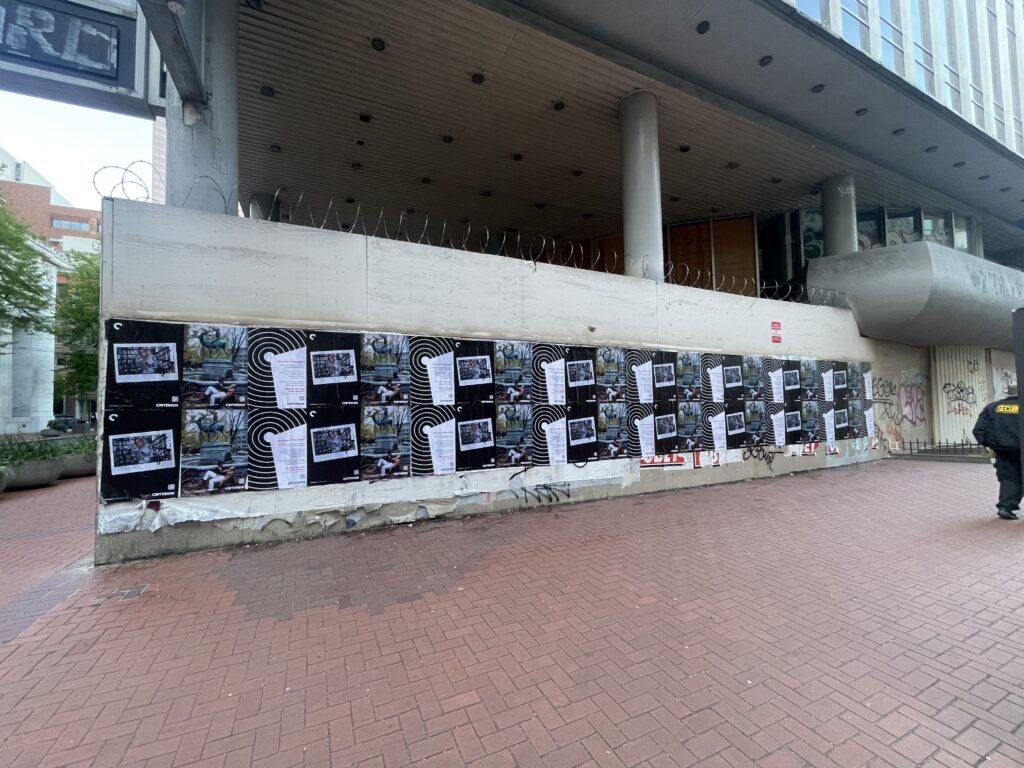
A poster campaign qualifies as guerilla advertising when the placements are in locations that the audience does not expect to find advertising, when the scale or creative approach is significantly beyond what standard outdoor advertising in the area looks like, or when the campaign has a concept that uses the specific neighborhood’s visual identity as a creative element. A standard poster in a standard location is outdoor advertising. A poster that is visually specific to its neighborhood and placed at a location the audience uses in ways that create a genuine discovery experience is guerilla advertising.
Ambient Installations in Public Spaces
An ambient installation qualifies as guerilla advertising when it uses elements of the physical environment as creative material, when it creates a brand encounter that feels specific to the location rather than imported into it, and when the brand attribution is built into the physical design in a way that is immediately identifiable. The best ambient installations make the audience feel that the environment itself is in on the campaign, which is the highest form of environmental specificity the definition requires.
Building Projection Campaigns
Building projections qualify as guerilla advertising when the projected content is specific to the building and the neighborhood where it appears, when the projection happens at a time and in a location where the target audience will encounter it, and when the concept is strong enough to generate organic documentation and sharing. A projection that is just a large logo on a building may be outdoor advertising. A projection that interacts with the building’s architecture in a visually surprising way and creates a social moment the audience wants to share is guerilla advertising.
Why the Definition of Guerilla Advertising Matters to Practitioners
The precision of the definition matters because it determines the quality of the campaigns that are planned and executed under the label. When the definition is loose, anything unconventional gets called guerilla and brands invest in campaigns that have the vocabulary without the substance. When the definition is precise, campaigns are evaluated against a standard that requires genuine surprise, genuine environmental specificity, and genuine organic potential.
We use the definition as an evaluation tool in our planning process. Before we recommend a campaign approach to a client, we evaluate it against all five characteristics of the guerilla advertising definition. If the concept does not create genuine surprise in the specific environment, it goes back for development. If the brand attribution is not immediately clear, the creative needs revision. If the organic amplification potential is low, either the concept needs to change or we need to recommend a different approach.
The definition protects clients from paying for campaigns that use the guerilla advertising label without delivering the guerilla advertising results. It protects the format’s integrity by holding the campaigns executed under its name to the standard that makes the format valuable. And it keeps our own work honest: if we cannot defend a campaign against the five-characteristic test, we should not be recommending it.
The practitioner’s definition: Guerilla advertising is advertising that the audience discovers rather than receives. That discovery experience is what creates the stronger memory impression, the organic sharing impulse, and the cultural credibility that the format is known for. Everything in the definition points toward creating that discovery experience: the unconventionality, the surprise, the environmental specificity, the clear brand attribution, and the organic amplification potential. When all five are present, the discovery experience happens. When any of them is missing, it does not.
Guerilla Advertising and the Modern Media Environment
The guerilla advertising definition was formulated in a different media environment than the one that exists today. The 1984 media environment did not include social media, smartphones, or the organic content distribution infrastructure that transforms a strong physical brand moment into a national or global awareness event within hours. Those developments have not changed the definition of guerilla advertising, but they have changed its strategic value significantly.
The organic amplification potential that is one of the five definitional characteristics has become enormously more powerful as social media platforms have matured and as smartphone ownership has made every consumer a potential documentary photographer. A guerilla advertising campaign that generates strong organic documentation in 2026 can reach audiences that were not physically present at the activation by orders of magnitude more than was possible in 1984. The content generated by bystanders at a well-executed guerilla campaign often outperforms the content generated by the brand’s own documentation team, because it carries the authentic perspective of genuine discovery rather than the intentional framing of brand-produced media. Both types of documentation have value, but the bystander content is what makes guerilla advertising campaigns genuinely viral.
This amplification dynamic has made the “organic amplification potential” characteristic more important in the definition than it may have seemed when the term was coined. In the current media environment, a guerilla advertising campaign that is brilliant in person but not shareable is only half of what the format can achieve. The definition has always included this characteristic. The current media environment makes it essential rather than supplementary. We now design every guerilla campaign with the social photograph in mind as a primary deliverable: what does this look like at phone camera resolution, and is it compelling enough to make someone stop, pull out their phone, and post it? If the answer is yes, the campaign has the potential to reach far beyond the physical audience. If the answer is no, the campaign is underperforming the definition regardless of how strong it is in person.
Frequently Asked Questions About the Guerilla Advertising Definition
Frequently Asked Questions
What is the definition of guerilla advertising?
Guerilla advertising is defined as an unconventional advertising strategy that places brand messages in public spaces through surprising, often low-cost tactics designed to create a strong, memorable impression with the target audience. It operates outside defined media channels, using the physical environment of cities and communities as its medium. The defining characteristics are surprise, environmental specificity, clear brand attribution, and organic amplification potential.
Where does the term guerilla advertising come from?
The term derives from guerrilla warfare, which refers to small-scale, unconventional tactical operations that achieve outsized results through surprise and precision rather than force or scale. Jay Conrad Levinson applied this military analogy to marketing in his 1984 book Guerrilla Marketing, and the term has been applied to unconventional advertising strategies ever since.
What are the key characteristics of guerilla advertising?
The key characteristics are: unconventional format or placement, the element of surprise that creates a stronger audience response than expected advertising, environmental specificity that anchors the campaign in a particular physical context, clear brand attribution so the brand benefits from the encounter, and organic amplification potential that extends the campaign’s reach through consumer documentation and sharing.
How is guerilla advertising different from traditional advertising?
Traditional advertising places brand messages in defined, purchased media slots. Guerilla advertising places brand messages in the physical environment without purchased media slots, using unconventional formats and unexpected locations to create encounters that feel like discoveries rather than standard advertisements. The audience relationship to the encounter is fundamentally different in quality and memorability.
What are examples of guerilla advertising?
Examples of guerilla advertising include large-format poster campaigns in cultural neighborhoods, building projections on urban facades, brand installations in public plazas, coordinated brand ambassador programs at transit hubs, pavement stencil campaigns near event venues, vehicle wrap campaigns through target-audience neighborhoods, and social stunt activations that create unexpected public moments and generate organic social documentation.
What is the purpose of guerilla advertising?
The purpose of guerilla advertising is to create a stronger, more memorable brand impression than conventional advertising can achieve, at a lower cost per quality impression. It accomplishes this by reaching consumers in their physical environment through unexpected means that engage natural curiosity rather than triggering habitual ad-avoidance behavior. Secondary purposes include generating organic social media amplification and building cultural credibility in specific communities.
Is guerilla advertising effective?
Yes. Guerilla advertising is consistently effective for building brand awareness in specific urban geographies, generating organic social media reach, establishing cultural credibility with specific audience communities, and creating press coverage that conventional advertising cannot produce. Its effectiveness is highest when the concept is genuinely surprising, the brand attribution is clear, and the execution quality meets the standard the audience applies to their visual environment.
Contact American Guerrilla Marketing at (646) 776-2770 or [email protected]. We plan and execute guerilla advertising campaigns in New York, Los Angeles, Chicago, Miami, Austin, and cities across the US. We start with your audience geography and build from there through format selection, creative review, execution, and performance measurement.