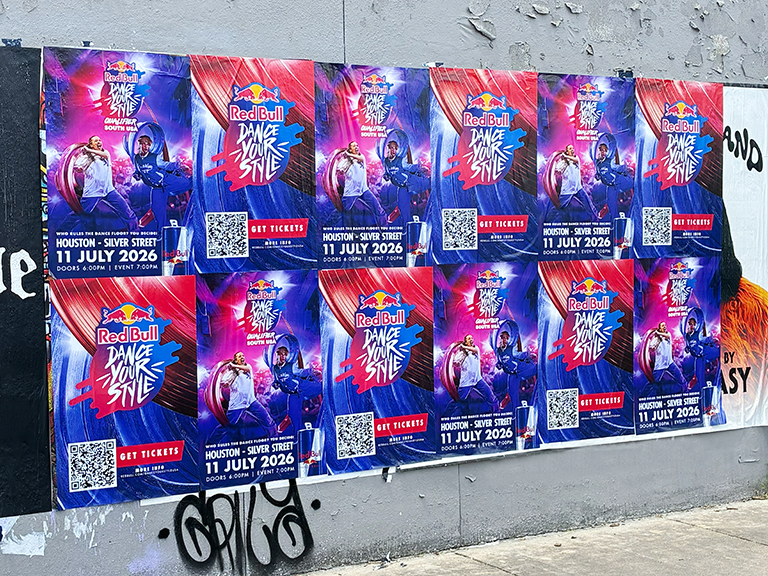
A guerilla ad is not a bigger version of a regular ad. It is a fundamentally different thing that operates outside expected channels, appears in unexpected places, and produces a reaction that conventional advertising cannot replicate.
A guerilla ad is not a bigger version of a regular ad. It is a fundamentally different thing. It operates outside the expected channels, appears in unexpected places, and produces a reaction that conventional advertising simply cannot replicate. The goal is not exposures in the media-buying sense. The goal is a genuine, memorable human response that stays with people after the moment has passed.
We have been creating guerilla ads for brands of all sizes for over a decade. We have placed oversized prints on the walls of buildings in SoHo. We have run flash campaigns on the walls along Fairfax in Los Angeles on launch morning. We have put street teams in neighborhoods in Chicago and Miami that reached the exact communities our clients needed to connect with. This guide breaks down what a guerilla ad actually is, the formats that work best, what makes the difference between one that lands and one that disappears, and how we build campaigns around this approach.
The term comes from Jay Conrad Levinson, who coined “guerrilla marketing” in 1984 to describe a philosophy of unconventional, low-cost, high-impact marketing tactics aimed at small businesses competing against larger competitors. The concept has evolved considerably since then. Today, guerilla advertising is used by brands of all sizes, from solo founders to global corporations. Nike, Apple, Netflix, and Spotify all run guerilla campaigns alongside their conventional media spend.
A guerilla ad shares certain characteristics regardless of its specific format. It is unexpected. It appears in a context where the viewer does not anticipate advertising. It demands attention through creativity and placement rather than through media spend. And it generates a response, whether that response is surprise, delight, conversation, or a photograph posted to social media. That response is the currency of the format. If a guerilla ad does not produce a genuine human reaction, it has failed regardless of how clever the concept looked in the brief.
The best guerilla ads feel like they belong in the space where they appear, but make that space slightly more interesting. A sticker that adds a clever visual moment to an existing piece of street infrastructure. A large-format image that turns a blank construction wall into something people stop to look at. A human interaction that delivers a brand message in the context of a real experience rather than an obvious sales pitch. These are all guerilla ads, and they all work by the same core principle: earn attention rather than buy it.
The Main Formats of Guerilla Ads
Street-Level Print Campaigns
Large-format print is one of the most reliable and scalable guerilla advertising formats. We print posters, panels, and full-wall coverings and place them in high-traffic urban locations where the target audience moves daily. The scale creates presence that smaller-format advertising cannot achieve. A twenty-foot image on a blank wall in a neighborhood that your target audience walks through every day is more than an impression. It is a moment that the viewer registers and carries with them.
Print campaigns are most effective when the design is calibrated to the street environment. We review all print creative against street-scale specs before production is approved, because a design that reads brilliantly on a laptop screen can disappear at thirty feet on a textured brick wall. Bold, high-contrast, minimal text, one strong visual element. These are not aesthetic preferences. They are performance requirements for the format.
Ambient Advertising
Ambient advertising places brand messaging in the context of existing physical environments. Branded floor graphics at transit hubs. Custom treatments on existing street furniture. Installations that use the architecture of a space to communicate a brand message. The best ambient work is so well integrated into its environment that people do not realize they are looking at an advertisement until a second after they have already engaged with it.
The cognitive experience of ambient advertising is different from conventional advertising precisely because it bypasses the defensive processing that people apply to recognized advertising. When someone encounters an ambient installation and registers it first as something interesting in their environment before they register it as a brand message, the impression is formed without the skepticism that explicit advertising triggers. That is a significant psychological advantage that no conventional ad format can replicate.
Human-Powered Activations
Street teams, brand ambassadors, and organized human performances all qualify as guerilla advertising when they appear in unexpected contexts and deliver brand messages through direct human interaction. A branded street team handing out samples in a neighborhood where the target audience shops is a guerilla ad. An organized performance in a public space that incorporates brand messaging is a guerilla ad. The human element creates personal connection that print and digital cannot match because humans, by definition, trust and respond to other humans more than they trust surfaces.
We recruit and train street teams locally in every market we operate in. Local staff know the neighborhood culture, understand how to read body language and adjust their approach, and have a natural conversational style that reads as genuine rather than scripted. The difference between a well-trained local street team and an untrained crew showing up from out of town is immediately visible in the quality of consumer interactions and the resulting brand exposures.
Stunt-Based Campaigns
Stunts are the highest-risk, highest-reward category of guerilla advertising. When a brand creates a genuinely surprising event or spectacle in a public place, the reaction can be explosive. The key to a successful stunt is that it feels authentic and generous rather than calculated and self-promotional. The best stunts benefit the people who witness them in some way, whether through entertainment, surprise, or direct value delivery. Stunts that feel like they exist purely for the brand’s benefit at the expense of the audience’s patience or time consistently generate backlash.
Interactive Installations
Interactive street installations invite direct participation. They transform passive observation into active engagement. A branded installation that pedestrians can interact with, photograph, and share is a guerilla ad that multiplies its own reach. Every interaction creates a piece of content. Every photograph shared is a new impression for an audience the brand did not pay to reach. The key to a successful interactive installation is that the interaction itself is genuinely satisfying, not just a mechanism for collecting user-generated content.
Format
Strength
Reach Mechanism
Best Use Case
Street Print
Scale, durability, saturation
Physical + organic social sharing
Brand awareness, launches, event promotion
Ambient
Integration, cognitive surprise
Word of mouth, press, social
Creative brand statements, cultural campaigns
Human Activation
Personal connection, trial conversion
Direct interaction, sampling
Product trials, community building, launches
Stunt
High impact, press generation
Press, social, word of mouth
Brand launches, major cultural moments
Interactive Install
Engagement depth, participation
Social sharing, earned media
Brand experience, product education
What Makes a Guerilla Ad Effective
Not every unconventional ad is a good guerilla ad. The format does not guarantee effectiveness. Execution does. Here is what separates guerilla ads that work from those that do not.
Audience Specificity
Guerilla advertising that tries to speak to everyone usually speaks to no one. The most effective campaigns we execute are built around a very specific audience in a very specific place. We know who we are trying to reach. We know where they are and what they care about. We design and place the work accordingly. That specificity is what creates the feeling of recognition and resonance that converts a passive observer into an active brand advocate.
Creative Clarity
A guerilla ad communicates one thing clearly. Not five things. Not a complex message that requires thirty seconds of reading to parse. One thing, delivered with visual and conceptual clarity, at a scale and in a context that guarantees it will be noticed. The brands that struggle with guerilla advertising are often the ones that try to pack too much information into a format that rewards simplicity and rewards it decisively.
Location Intelligence
Where a guerilla ad appears is as important as what it says. We treat location selection as a creative decision that is equal in importance to the creative concept itself. The right wall, the right intersection, the right neighborhood all amplify the message in ways that the wrong location would negate regardless of the creative quality. We spend as much time on location strategy as we do on creative development. This is not an efficiency sacrifice. It is a quality investment that pays back in campaign performance.
Timing and Cultural Context
Guerilla ads that respond to or participate in a current cultural moment land harder than those that operate in a vacuum. A campaign that goes up the week a product launches, timed to coincide with a relevant cultural event or media moment, benefits from the energy already in the environment. We help clients think about timing as part of the overall campaign strategy, not as an afterthought to the creative direction.
AGM Field Note: The most common reason guerilla ads underperform is that the brief defined the format before it defined the audience. When a brand comes to us knowing it wants a “street activation” or a “pop-up” before it has defined who it is trying to reach, where those people are, and what a meaningful encounter with the brand would look like for them, we rewind the brief. Format follows audience. Always.
Guerilla Ads vs. Traditional Advertising
Understanding the difference between a guerilla ad and conventional advertising helps clarify when each approach is appropriate and how they can work together effectively.
Traditional advertising operates through established channels: television, radio, print publications, digital platforms. It buys access to audiences that those channels have already aggregated. The economics are generally predictable. You know roughly how many people will see your ad based on the channel’s audience data. The creative is developed within the constraints of the medium’s format requirements.
Guerilla advertising does not buy access to pre-existing audiences. It creates its own audience by going where people already are and doing something remarkable enough to earn their attention. The economics are less predictable in terms of raw impression counts, but the quality of engagement is typically much higher. Someone who stops on a sidewalk to look at a striking piece of street advertising is having a fundamentally different experience with a brand than someone who passively sees a banner ad between paragraphs of an article they are reading for another purpose entirely.
The two approaches are not mutually exclusive. The brands that use both most effectively let each reinforce the other. The guerilla campaign creates physical presence and cultural conversation in the target neighborhoods. The digital campaign captures and converts the awareness that the physical campaign generates. Together, they create a loop of reinforcing exposures that is more powerful than either element alone.
Guerilla Ads in the Age of Social Media
Social media has changed guerilla advertising in a fundamental way. Before social platforms, a guerilla ad’s reach was essentially limited to the people who physically encountered it. Today, a compelling guerilla ad in a well-trafficked location can reach millions of people who were never physically present, carried there by the organic social sharing of the people who were.
Every compelling guerilla ad is potentially a piece of shareable content. The people who encounter it become distributors. They photograph it, post it, tag their friends, and send it to people they think will appreciate it. The organic reach this generates can dwarf the paid media value of the physical placements when the creative is genuinely strong and the placement is genuinely surprising.
We design guerilla ad campaigns with this social dimension as a deliberate design constraint. The question is not only whether the work is visually interesting in person. The question is whether it is compelling enough to photograph and share. Those are related but distinct criteria, and understanding the difference between them is part of what makes AGM effective at building campaigns that earn both physical presence and social amplification.
Industries That Benefit Most from Guerilla Advertising
Guerilla advertising works across industries, but certain sectors have particularly strong fit with the format and see disproportionately strong results from well-executed campaigns.
Entertainment is the clearest example. Music labels, film studios, streaming platforms, and live event promoters all use guerilla advertising to build cultural buzz around releases and performances. Street-level advertising is part of the DNA of how entertainment is marketed, and the authenticity signals it sends are particularly valuable in a media environment saturated with promotional content.
Fashion and streetwear brands have used guerilla advertising for decades. The format signals authenticity and cultural alignment in a way that conventional advertising cannot. A fashion brand that shows up on a wall in the right neighborhood is communicating something about its values and its understanding of culture that a magazine ad simply cannot convey. The street presence is itself a brand statement about where the brand belongs in the cultural environment.
Consumer packaged goods brands use guerilla advertising to create local brand familiarity that supports retail velocity. When a brand has visible street presence in the neighborhoods where its retail distribution is concentrated, the familiarity consumers develop through those street encounters directly affects their behavior at shelf. They pick the brand they recognize over the brand they have never seen.
Technology and app brands launching in specific markets use guerilla advertising to create the offline social proof that makes online conversation feel more organic. A tech brand that shows up on walls in the neighborhoods where its target user concentrates creates a cultural presence that purely digital marketing cannot replicate. That physical presence signals commitment to a market that digital-only campaigns never create.
Food and beverage brands, particularly those launching into new markets or trying to build brand familiarity ahead of retail rollout, use guerilla advertising combined with sampling to create the dual brand exposure and product trial combination that drives conversion from awareness to purchase faster than either tactic alone.
AGM Field Note: We build guerilla ad campaigns from the ground up. Creative strategy, location intelligence, print production, crew deployment, and post-campaign documentation are all managed in-house. That integration means the campaign that gets executed is the campaign that was designed, not a version of it filtered through multiple handoffs between vendors who do not talk to each other.
How to Brief a Guerilla Advertising Agency
The quality of a guerilla advertising campaign is heavily determined by the quality of the brief that precedes it. Agencies that receive clear, specific briefs produce better campaigns in less time. Here is what to include in a strong guerilla advertising brief.
Start with the audience. Who specifically are you trying to reach? Not a demographic category but a real description of the person: where they live, where they spend time, what they care about, what their daily movement patterns look like. The more precisely you can describe the person, the more precisely we can put the campaign where that person will encounter it.
Define the moment. Is this a launch, an event, a sustained brand-building program, or a specific cultural moment? The timing and nature of the brand moment shapes the format recommendations. A launch calls for a flash approach. A sustained brand-building program calls for a layered, multi-wave strategy. An event calls for concentration and urgency. Tell us which one you are working within.
Describe the creative territory. Not necessarily the final creative, but the visual and emotional territory where the campaign should live. What brands do you admire, not in your category but in terms of how they show up in the physical world? What is the feeling you want someone to have when they encounter your campaign on the street?
Set a clear objective and a realistic success definition. What does this campaign need to accomplish to be considered successful? Define it before the campaign starts, because a campaign without a defined success standard cannot be evaluated honestly, and a campaign that cannot be evaluated honestly cannot be improved.
The Creative Brief for a Guerilla Ad Campaign
A great guerilla ad starts with a great brief. The brief is where the creative territory gets defined before anyone touches a design tool, and the quality of the creative that comes out of the process is directly proportional to the specificity of what went into the brief. Vague briefs produce generic creative. Specific briefs produce work that feels inevitable for its location and audience.
A strong guerilla ad brief starts with a precise audience description that goes beyond demographic categories. Not “18-34 urban millennial” but a real description of a specific person: where they live in the city, which coffee shops they use, which subway stations they pass through, which cultural events they attend, what they care about this week. The more precisely the brief defines the person, the more precisely the creative can speak to them. This precision is what produces the “how did they know?” reaction that marks the best guerilla ad work.
The brief also needs to define the encounter. Where and when will the target person see this ad? What are they doing at that moment? What is the emotional and physical context of the encounter? A person who encounters a guerilla ad while walking to a coffee shop on a Saturday morning is in a different state than a person who encounters it during a weekday commute. The context shapes what the creative needs to do: what feeling it needs to create, what it can assume the viewer already knows, how much cognitive load it can ask the viewer to carry. Good briefs answer these questions explicitly.
Case Types: How Different Brands Use Guerilla Advertising
Understanding how different brand categories use guerilla advertising effectively helps in building the right approach for a specific campaign brief. The tactics, neighborhoods, and creative approaches vary significantly by category.
A music label launching an album uses guerilla advertising to create the cultural signal that the release is significant. The campaign concentrates in the specific neighborhoods where the target listener base is densest. The creative is bold and direct: artist image, album name, release date. The placement density creates the sense that this release is happening right now and that everyone in the scene already knows about it. The campaign does not try to explain the music. It signals that the music is culturally important and lets the listener’s curiosity do the rest.
A food brand launching into a new city uses guerilla advertising to establish neighborhood-level familiarity before the brand is on shelves. The campaign concentrates near the specific retail locations where the brand will be distributed. The creative communicates what the product is and why it is worth trying, but the primary goal is creating the recognition that makes the in-store encounter feel like meeting someone you already know rather than meeting a stranger. That pre-existing familiarity is the conversion driver that makes the street campaign pay commercial dividends at retail.
A fashion brand uses guerilla advertising to establish cultural positioning in a specific city’s creative community. The campaign concentrates in the neighborhoods where that community is densest, using walls and surfaces that carry visual authority. The creative is intentionally sparse: strong visual, minimal text, the brand mark. The campaign does not explain the brand’s aesthetic. It demonstrates it by choosing to appear in the right locations with the right visual quality. The presence itself is the message.
What to Bring to the First Guerilla Ad Conversation
The brands that get the most from a guerilla advertising brief are the ones that arrive at the first conversation with a clear objective, a specific audience description, and an honest account of what has and has not worked in their marketing previously. Those three inputs are all we need to produce a campaign proposal that is genuinely calibrated to the brand’s situation rather than a template adapted to fit.
The objective should be specific and measurable. Not “increase brand awareness” but “increase aided brand awareness among 25-35 creative professionals in Brooklyn from X% to Y% within 60 days of campaign launch.” Specific objectives produce specific campaign designs. Vague objectives produce vague campaigns that cannot be evaluated honestly after they run.
The audience description should be a real person, not a demographic category. Who walks through the specific neighborhoods where you want to run? What do they care about? What relationship do they already have with your brand, if any? What would a genuinely meaningful encounter with your brand look like for this person? Answering these questions before the brief starts is the work that makes the difference between a campaign that resonates and one that generates exposures but no real connection.
Frequently Asked Questions
What is a guerilla ad?
A guerilla ad is a non-traditional advertisement that creates brand exposures by appearing in unexpected contexts, earning attention through creativity and physical presence rather than through media spend. Guerilla ads include street print campaigns, ambient installations, street team activations, pop-up experiences, projection campaigns, and stunts designed to create genuine human reactions in real public spaces.
board“>What makes a guerilla ad different from a regular billboard?
A billboard buys access to eyeballs through a paid media placement in a conventional advertising context. A guerilla ad creates its own audience by going where people already are and doing something remarkable enough to earn their attention. The experience of encountering a guerilla ad is genuinely different from the experience of seeing a billboard, and that experiential difference is what produces the stronger impression and higher recall that guerilla campaigns deliver.
How do guerilla ads generate social media reach?
Compelling guerilla ads in well-trafficked locations get photographed and shared by the people who encounter them. This organic social content reaches audiences far beyond the physical footprint of the campaign without any additional paid media investment, and it carries credibility that branded content cannot replicate because it is generated by real people reacting genuinely to something they found interesting. We design campaigns to maximize this organic amplification by ensuring photogenic execution in locations with high social media activity.
What budget is needed for a guerilla ad campaign?
Guerilla advertising works across a wide range of budgets. A focused single-market street print campaign might run $5,000 to $15,000. A comprehensive multi-format campaign across a major city might run $25,000 to $75,000. Multi-city campaigns scale accordingly. We build campaigns to maximize impact within the available budget rather than scaling down a standard package.
What industries use guerilla advertising most effectively?
Entertainment, music, fashion and streetwear, consumer packaged goods, technology and apps, food and beverage, and fitness and wellness brands all see strong results from guerilla advertising. Any brand with a defined market, a specific audience that concentrates in identifiable geographies, and a genuine story to tell on the street is a good candidate for the format.
Can guerilla advertising work alongside conventional paid media?
Yes, and the combination is often more powerful than either channel alone. Street presence creates physical brand recognition that makes digital ads more effective by providing a real-world context for the brand before the digital ad lands. Digital campaigns can extend the reach of street campaigns to audiences who were not physically present. The two channels reinforce each other when deployed in the same geography with coordinated timing.
How quickly can AGM execute a guerilla ad campaign?
Timeline depends on format and market. A street print campaign can move from brief to installation in three to four weeks in markets where we have active crew and location inventory. More complex campaigns involving custom installations, production fabrication, or multi-market coordination require six to eight weeks minimum. We assess realistic timelines at the brief stage and flag any constraints before production spending is committed.
Does AGM handle creative development for guerilla ad campaigns?
Yes. We provide creative strategy and direction as part of our campaign development process. We also review client-provided creative against street-scale performance requirements before production is approved. Many of our most effective campaigns have involved creative adjustments at the street-scale review stage that the original design agency had not anticipated because they had not evaluated the work against real outdoor conditions.
What markets does AGM execute guerilla ad campaigns in?
New York, Los Angeles, Chicago, Miami, Atlanta, Austin, Houston, Boston, Philadelphia, Seattle, San Francisco, Denver, Nashville, Portland, and over 50 additional US markets. We also execute international campaigns through our partner network. Contact us at (646) 776-2770 to discuss your specific market needs.