Guarilla Marketing: The Complete Guide to Guerrilla Advertising in the Street
Guarilla marketing, guerrilla marketing, gorilla marketing. All the same idea. Here is how the actual tactics work and what brands get out of running them.
People spell it a dozen different ways. Guarilla. Guerrilla. Gorilla. Guerilla. The spelling varies but the concept does not. We are talking about advertising that goes where the audience is instead of waiting for the audience to come to it. No standard ad placements. No bought inventory. Just brand messages placed in physical spaces where specific people will encounter them.
We run these campaigns for a living. American Guerrilla Marketing has been executing street-level advertising across the United States for years. Our team handles everything from sidewalk stencil deployments in Williamsburg to projection campaigns on building walls in Silver Lake to street team activations outside venues in Chicago’s Wicker Park neighborhood. Every campaign starts with the same question: where does the target audience actually spend their time, and how do we put the brand there?
This guide covers the core guarilla marketing formats, how location strategy works, what creative requirements the format demands, how to measure results, and what brands can expect when they work with a professional street-level advertising company.
Guarilla marketing, properly spelled guerrilla marketing, is advertising that does not use conventional purchased media placements. Instead of buying a billboard, a bus shelter ad, or a digital banner, a brand uses unexpected formats in unexpected locations to create an encounter with the audience that feels different from standard advertising.
The psychological basis of the approach is simple. The human brain filters out recurring stimuli from predictable locations. A person who commutes through Times Square every day stops seeing the billboards. A person who scrolls social media for an hour a day stops registering the sponsored posts. The attention filter is calibrated to the environment. Standard advertising occupies standard positions, and the filter is trained to ignore those positions.
A brand message that appears on a surface or in a location outside those standard positions bypasses the filter. The brain encounters it as part of the environment before classifying it as an ad. By the time the audience member registers that they are looking at advertising, they have already processed the message. That sequence is fundamentally different from what happens with a banner ad, a pre-roll video, or a billboard.
The term comes from guerrilla warfare, which uses unconventional tactics to achieve goals that conventional approaches cannot. In marketing, the parallel holds: guerrilla tactics achieve brand awareness and audience engagement through unconventional placement and format rather than through outspending competitors in standard media channels.
The Core Formats of Guarilla Marketing
Guarilla marketing is not one tactic. It is a family of tactics, each with its own format requirements, installation process, duration characteristics, and ideal use cases. Understanding which format fits which campaign goal is the core competency of a professional guerrilla marketing agency.
Sidewalk Stencil Campaigns
Stencil campaigns are the most frequently executed guerrilla marketing format and often the most cost-effective for urban brand awareness. We cut custom stencils from durable Mylar, deploy a crew during overnight hours, and install a consistent brand mark across a set of pre-scouted locations in a concentrated geographic zone.
A stencil campaign in a dense urban neighborhood typically covers 20 to 50 locations within a radius of 10 to 20 city blocks. When the target audience is concentrated in that zone, those installations generate repeated exposure to the same individuals across multiple points in their daily movement pattern. Repetition builds familiarity. Familiarity builds recognition.
We run stencil campaigns most frequently in New York City, specifically in the blocks surrounding Union Square on 14th Street and Broadway, along the Williamsburg corridor between the Bedford Avenue and Lorimer Street subway stations, and on the approach routes to major entertainment venues. In Los Angeles, the Fairfax corridor, the Melrose and Fairfax intersection, and the blocks around the Palladium in Hollywood are consistently strong stencil locations.
Wheatpaste and Poster Installations
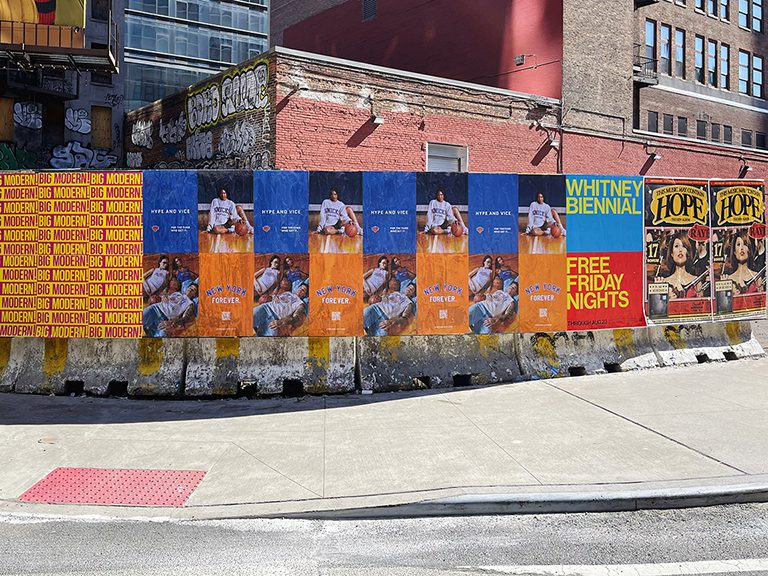
Wheatpaste poster campaigns use a paste adhesive to bond large-format printed posters to walls, construction barriers, and other vertical surfaces. Properly installed, a wheatpaste poster on a brick or concrete surface lasts two to six weeks. The format allows for more visual complexity than stencils, including full-color photography, detailed illustration, and layered design elements.
The best wheatpaste locations for guarilla marketing campaigns are surfaces that face pedestrian traffic at eye level, ideally on streets with a foot traffic pattern that matches the target demographic. In New York, the construction barrier boards along lower Broadway, the walls along Rivington Street and Delancey Street on the Lower East Side, and the surfaces along the Bowery are consistently productive wheatpaste locations for brands targeting the music, fashion, and arts audiences that populate those neighborhoods.
Mural Campaigns
Murals are the high-visibility, long-duration end of the guerrilla marketing spectrum. A hand-painted or printed mural on a prominent wall becomes a neighborhood landmark. It generates foot traffic specifically from people who want to see and photograph it. It appears in thousands of social media posts over its lifespan. It tells everyone who encounters it that the brand has enough investment in the community to put something permanent there.
We coordinate mural campaigns through a network of experienced muralists and wall-sourcing relationships in major markets. Our team handles the creative brief, wall selection, artist coordination, surface preparation, installation, and final documentation. Clients receive a mural that matches their brand standards and fits the visual culture of the neighborhood it occupies.
Projection Advertising
Projection advertising places a brand image on a building facade, bridge surface, or other large vertical structure using a commercial projector. The format is inherently temporary, which creates urgency. An image that appears for three nights on a major building in a dense urban neighborhood is a newsworthy event in a way that a static placement cannot be.
Projection campaigns work best during high-attention moments: product launches, album drops, film opening weekends, or major event dates. The combination of scale, novelty, and time-limited appearance drives social sharing and earned media attention in a way that other guerrilla formats rarely match.
Street Team Activations
Street teams are people, deployed as brand representatives, who create direct one-to-one encounters with the target audience. A trained street team at the entrance to a music festival, a marathon finish line, or a weekend farmers market can distribute samples, gather feedback, and create the kind of personal brand encounter that no passive format can replicate.
The quality of a street team activation depends almost entirely on the quality of the pre-deployment briefing. A team that understands the brand, the product, and the campaign goal creates genuine conversations. A team that was handed a flyer and told to smile creates paper litter. We brief every team member before every activation on the brand, the product, the target audience, and the specific goal of the deployment.
Format matching: No single guarilla marketing format is right for every campaign. We always match the format to the goal. Rapid saturation awareness for a product launch calls for stencils. Long-term brand presence in a specific neighborhood calls for a mural. Direct audience engagement with sampling calls for a street team. Getting this match right is the difference between a campaign that works and a campaign that just creates activity.
Location Strategy in Guarilla Marketing
Location strategy is where most guarilla marketing campaigns succeed or fail. The format can be perfectly executed. The creative can be outstanding. But if the installation is in a location where the target audience does not go, the campaign produces no useful exposures.
We start every campaign with a movement analysis. We map where the target audience is concentrated in the city. We look at what neighborhoods they live in, where they work, what entertainment destinations they frequent, what transit routes they use, and what time windows they are most active in those locations. From that map, we build a location plan that puts the brand where the specific audience is, not where the highest total foot traffic is.
Total foot traffic and target-audience foot traffic are different things. The intersection of 42nd Street and 7th Avenue in Manhattan has enormous total foot traffic. But the audience composition at that corner skews heavily toward tourists, not toward the young urban professionals that most brands targeting New York want to reach. A stencil campaign in Greenpoint or Long Island City with one-tenth the total foot traffic might generate ten times more exposures from the relevant audience.
Guarilla Marketing by Campaign Goal
Different campaign goals call for different guarilla marketing approaches. The table below maps the most common campaign goals to the formats and strategies that deliver against them most effectively.
Campaign Goal
Best Formats
Timeline
Key Metric
Product Launch Awareness
Stencil, Projection, Poster
2 to 4 weeks before launch
exposures, social sharing
Long-Term Brand Building
Mural, recurring stencils
Ongoing, quarterly cycles
Brand recognition surveys
Product Trial and Sampling
Street team with distribution
1 to 3 day deployments
Samples distributed, conversions
Event or Release Buzz
Projection, Stencil, Street Team
Opening week
Earned media, social reach
Neighborhood Saturation
Stencil, Poster, Street Team
2 to 3 week blitz
Location coverage, exposures
Cultural Credibility
Mural, Artist collaboration
Long-term installation
PR mentions, social exposures
Creative Requirements for Guarilla Marketing
Guarilla marketing puts brand creative into physical environments that conventional advertising design is not built for. The transition from a digital or print creative asset to a street-level guerrilla format requires specific adaptations that many brands overlook.
The first and most important requirement is readability at pace. A pedestrian moving at a normal walking speed has approximately one second of contact with a sidewalk stencil or a wall installation as they move through an intersection or down a street. The creative needs to communicate brand identity in that one second. That means one dominant graphic element, one clear brand mark, and a text element of six words or fewer. Any creative that requires the pedestrian to stop and read is too complex for the format.
The second requirement is contrast. Physical environments are visually noisy. A brand element needs sufficient contrast with the surface it occupies to register before it reads. This means thinking carefully about color selection in relation to the typical surface color in the target locations. Bright colors work on dark pavement. High-contrast black and white works on most surfaces. Medium-tone colors on similar-tone surfaces disappear.
The third requirement is scale. Street-level brand elements need to be larger than most brand teams expect. A logo that looks appropriately sized on a phone screen or a print layout needs to be significantly larger to register at the viewing distances typical in street environments. We always advise clients to see the creative at actual production scale before approving it for field deployment.
Creative review process: Before approving any creative for a guarilla marketing campaign, we print every element at actual installation size and conduct a walk-past test at normal pedestrian speed. If the brand mark and primary message do not register in a single pass, we revise the creative before production. This test has caught more problems than any other step in our review process.
Measuring Guarilla Marketing Performance
The measurement framework for guarilla marketing differs from digital advertising measurement because the formats do not generate trackable digital interactions by default. The right measurement approach looks at what the format actually produces: physical exposures, social amplification, earned media, and downstream business signals.
Impression Estimates
We calculate impression estimates for every installation location using foot traffic data from pedestrian count sources, transit authority ridership reports, and event attendance figures where applicable. We estimate daily exposures for each location based on the volume and proximity of foot traffic to the installation surface. We multiply by installation duration to produce a total impression estimate per location and for the campaign overall.
Organic Social Monitoring
Guerrilla marketing installations that attract photography generate organic social amplification at no additional cost. We monitor brand mentions, hashtags, and geotagged posts from installation locations throughout the campaign window. Strong social amplification from a guerrilla campaign is one of the clearest signals that the creative and location selection worked.
Earned Media Tracking
High-impact campaigns in major cities attract coverage from local media, advertising trade publications, and music, culture, and entertainment outlets. We monitor press mentions during and after every campaign. A single editorial pickup can generate reach equivalent to tens of thousands of paid exposures.
Attribution Elements
Where the campaign goal includes a downstream conversion action, we recommend including a traceable element in the creative. A unique URL, a QR code on a poster installation, or a promo code distributed by a street team creates a direct link between the physical campaign and measurable business outcomes. We include at least one attribution element in every campaign where direct conversion tracking is a client priority.
Why Brands Choose Guarilla Marketing Over Conventional Advertising
We hear the same reasons from clients again and again. Digital advertising costs are rising and effectiveness is falling. Standard outdoor placements are expensive in major markets and require long lead times. Social media organic reach has collapsed. Brands that need to move fast, reach a specific urban audience, and create a genuine cultural impression are finding that guarilla marketing delivers results that other channels cannot match at a comparable budget level.
The cost-per-impression comparison is often the first thing that surprises new clients. In a market like New York, a stencil campaign covering 40 locations in the right neighborhoods can generate 200,000 to 500,000 targeted exposures at a total cost that would buy a tiny fraction of that impression volume in standard digital or outdoor inventory. The efficiency gap is substantial, and it is driven by the combination of low media placement cost (since guarilla marketing does not pay to rent billboard space or buy digital inventory) and high targeting precision that concentrates exposures in exactly the right audience geography.
The quality gap is equally important. A digital impression lasts milliseconds. A pedestrian encounter with a brand stencil in a neighborhood they live in, on a sidewalk they walk every day, creates a different kind of memory trace. The physical reality of the installation, its presence in the same environment as the person’s daily life, creates associations that digital advertising cannot replicate.
Working with AGM on a Guarilla Marketing Campaign
Our process starts with a brief. We want to understand the brand’s current awareness level in the target market, the specific audience the campaign needs to reach, the geographic scope, the campaign timeline, and the budget. From that brief, we build a format recommendation and a location plan that we present to the client for review and approval.
After brief approval, we move to location scouting. Our field team goes into the target market and identifies specific installation locations that match the demographic brief and the format requirements. We deliver location maps, surface photographs, and foot traffic estimates for client review before any production begins.
Production and installation follow the approved location plan. Our crews are experienced in each format and work within the deployment timeline the campaign requires. Every installation is photographed with GPS timestamps within 24 hours of deployment. Clients receive a complete photo documentation report showing every location, every installation, and every surface in the campaign.
Post-campaign, we deliver a full impression report based on foot traffic data for each location and a social monitoring summary covering organic amplification during the campaign window. Clients leave with full visibility into what they got and documented evidence of where it ran. We also include a post-campaign debrief that covers what we observed in the field, which locations generated the strongest visible audience response, and what we would recommend doing differently or scaling up in a subsequent campaign. Every campaign makes the next one better, and that learning is captured in the debrief so clients have a strategic record to build from rather than starting fresh each time.
Frequently Asked Questions
What is guarilla marketing?
Guarilla marketing is a common alternate spelling of guerrilla marketing, which refers to unconventional advertising tactics that place brand messages in unexpected physical environments. Instead of buying standard ad placements, brands use formats like stencils, murals, posters, projections, and street teams to intercept their audience in public spaces.
Is guarilla marketing the same as guerrilla marketing?
Yes. Guarilla marketing and guerrilla marketing refer to the same discipline. The difference is spelling only. Both terms describe unconventional, physical, street-level advertising that uses surprise and context to create stronger brand exposures than conventional ad placements.
What are the most common guerrilla marketing formats?
The most common formats are sidewalk stencil campaigns, wheatpaste poster installations, hand-painted murals, projection advertising on building facades, street team activations with sampling or branded distribution, and chalk or reverse-graffiti campaigns. The right format depends on the campaign goal, target audience, market geography, and budget.
How much does a guerrilla marketing campaign cost?
Entry-level stencil campaigns in a single market start around $3,000 to $5,000. Multi-format campaigns covering stencils, posters, and street team activations in one city typically run $8,000 to $25,000. Multi-market national campaigns scale from $20,000 upward depending on the number of markets and formats involved.
What brands use guerrilla marketing?
Music labels, streetwear brands, food and beverage companies, tech startups, film studios, streaming platforms, and health and wellness brands are the most frequent users of guerrilla marketing. The format works best for brands targeting urban consumers, creative communities, and young professionals who respond to physical, street-level brand presence.
How do you measure guerrilla marketing results?
We measure guerrilla marketing through impression estimates based on foot traffic data at each installation location, organic social media amplification tracking, earned media monitoring, and where applicable, direct attribution elements like unique URLs or QR codes. Post-campaign documentation includes photo reports and location-by-location impression data.
How long does a guerrilla marketing campaign last?
Duration depends on format. Chalk stencils last 1 to 2 weeks. Paint stencils and wheatpaste posters last 2 to 6 weeks. Murals last months to years. Projection campaigns run 1 to 5 nights. Street team deployments run 1 to 3 days per activation. Multi-format campaigns layer these durations to maintain street presence across a longer window.
What cities does AGM run guarilla marketing campaigns in?
We run campaigns in New York City, Los Angeles, Chicago, Miami, Austin, Boston, Atlanta, Seattle, San Francisco, Denver, Washington DC, and other major US markets. We coordinate multi-market campaigns from a single brief with one point of contact for all markets.