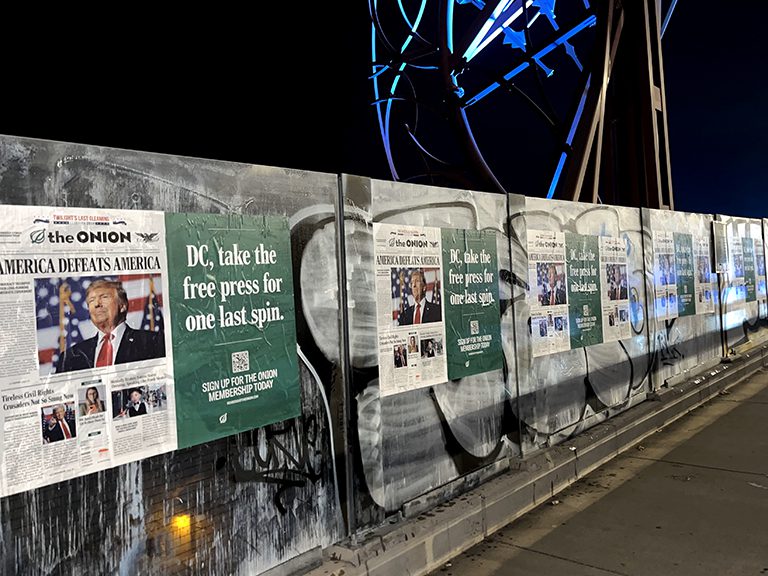
Seattle has the Pacific Northwest’s most active street poster and music promotion culture outside Portland — a city where the walls of Capitol Hill, the alleys of Pioneer Square, and the commercial strips of Fremont and Ballard have carried concert posters, arts announcements, and brand campaigns for decades. The city’s density of independent venues, arts organizations, and creative culture institutions has built a visual environment where street posters are a normal and expected part of the neighborhood landscape. For brands entering this market, flyposting is not an unusual or edgy tactic — it is the language that Seattle’s arts and culture audience already speaks.
Our team has managed poster campaigns in Seattle across music, entertainment, tech consumer, food and beverage, and lifestyle categories. What consistently determines campaign performance here is the combination of neighborhood selection and material quality. Seattle’s rain is real and relentless from October through April — campaigns that use standard paper stock in the wrong season look terrible within two weeks. And neighborhood selection matters because Capitol Hill’s audience and Fremont’s audience, while both culturally engaged, have different demographics, different aesthetic sensibilities, and different receptivity to different brand categories.
This guide covers the neighborhood-level strategy, material requirements, regulatory environment, and campaign logistics that define professional flyposting in Seattle — with the practical field detail that brands and promoters need to plan campaigns that maintain quality and effectiveness through the city’s challenging weather conditions.
Seattle’s Neighborhood Poster Landscape
Seattle’s neighborhoods each have distinct character, audience profiles, and posting environments. Understanding these differences is the foundation of effective campaign strategy in the market.
Capitol Hill: The Primary Arts and Culture District
Capitol Hill is Seattle’s most culturally dense neighborhood and the primary target for any brand seeking to reach Seattle’s arts, music, and LGBTQ+ communities. The Pike/Pine corridor — E Pike Street and E Pine Street between Broadway and 12th Avenue — anchors the neighborhood’s nightlife and arts activity with a concentration of independent music venues (Neumos, Chop Suey, The Comet), bars, restaurants, and arts spaces that generates consistent foot traffic from early afternoon through late night seven days a week.
The Capitol Hill Arts District, supported by the neighborhood’s longstanding arts infrastructure, has created a poster culture that spans music promotion, community arts announcements, and commercial brand campaigns. Surface availability on Capitol Hill includes private wall agreements with building owners who have established posting relationships through years of music promotion activity, construction hoarding from the ongoing development in the Pike/Pine corridor, and designated arts community posting surfaces maintained by Capitol Hill Seattle and the neighborhood arts organizations.
For music, entertainment, tech consumer, food and beverage, and lifestyle brand campaigns, Capitol Hill delivers the highest audience quality and concentration of any Seattle neighborhood for street poster investment.
Fremont: The Republic of Fremont
Fremont’s self-proclaimed status as the “Center of the Universe” is only half-joking — the neighborhood has a genuine and fiercely maintained independent creative identity that makes it one of Seattle’s most culturally distinctive districts. The commercial core along N 36th Street and Fremont Avenue N mixes independent restaurants, craft beverage businesses, vintage shops, and the Fremont Sunday Market into a neighborhood commercial strip that attracts a highly engaged, arts-committed resident and visitor base.
Fremont’s audience skews slightly older than Capitol Hill’s — 30 to 50 year old creative professionals, longtime Seattle residents with strong neighborhood identity, and the tech and design industry workers who have concentrated in the surrounding area. For campaigns targeting this demographic, Fremont delivers quality that Capitol Hill’s younger, more transient audience does not provide. Surface inventory on Fremont is more limited than Capitol Hill due to the neighborhood’s smaller geographic footprint, making advance surface planning essential for campaigns requiring comprehensive coverage.
Ballard: The Maritime-Creative District
Ballard has evolved from a Scandinavian-heritage maritime district to one of Seattle’s premier food and craft beverage neighborhoods, anchored by Ballard Avenue Landmark District’s concentration of independent restaurants, craft breweries, and boutiques. The Ballard Sunday Farmers Market draws significant foot traffic to the neighborhood weekly, and the concentration of craft brewery tap rooms along NW Market Street and Leary Avenue creates an evening and weekend audience with strong food-and-beverage category engagement.
For food, beverage, and lifestyle brand campaigns targeting 28 to 48 year old urban professionals with above-average household incomes, Ballard delivers one of Seattle’s strongest audience-to-cost ratios. The neighborhood’s building stock — older commercial buildings, former marine industry structures, and newer mixed-use development — provides diverse surface opportunities including brick walls, wood-panel facades, and construction hoarding from ongoing Ballard development.
Pioneer Square: The Arts Foundation
Pioneer Square is Seattle’s oldest neighborhood and its established arts district, home to galleries, artists’ studios, and the first Thursday gallery walk that has anchored Seattle’s visual arts community for decades. The neighborhood’s historic commercial buildings — red brick storefronts and larger masonry structures — provide high-quality posting surfaces with strong arts community context. Pioneer Square’s audience during gallery walk events and weekend afternoon hours concentrates Seattle’s visual arts community and arts-engaged consumer base in a small, walkable area.
University District: The Student and Academic Corridor
The University District around the University of Washington offers concentrated access to Seattle’s 40,000+ student population and the academic professional community associated with one of the country’s major research universities. The Ave (University Way NE) serves as the primary commercial and cultural corridor, with businesses, cafes, and entertainment venues catering to the UW community. For campaigns targeting the student and young adult demographic, the U District delivers the highest-concentration access in the Seattle market.
Seattle’s Regulatory Framework for Flyposting
Seattle Municipal Code Chapter 15.48 governs the placement of commercial materials on public property in Seattle. The code prohibits posting on utility poles, traffic signs, and city-owned structures and right-of-way surfaces without authorization. Fines up to $500 per violation apply. As in other major U.S. markets, our team operates exclusively within the private property permission framework for all Seattle campaign placements.
Private Surface Network in Seattle
Seattle’s private surface network is strongest in Capitol Hill, Fremont, and Pioneer Square, where the arts and music promotion culture has created established relationships between building owners and poster campaign operators over decades of live music and arts promotion. In Ballard and the University District, surface relationships are more distributed and require more direct outreach for new campaign placements. Our team maintains active surface agreements across all major Seattle campaign zones and develops new surface relationships as part of campaign planning for locations outside the established network.
Weather-Specific Material Requirements for Seattle Campaigns
Seattle’s climate is the dominant material planning consideration for outdoor poster campaigns. The city receives approximately 38 inches of rain annually, with the heaviest precipitation concentrated from October through April. Any campaign planned for the fall through spring window — which covers six to seven months of the annual marketing calendar — must account for sustained wet-weather exposure in material selection and installation specifications.
Fair-Weather Specification (May through September)
Seattle’s summer months (June through September) are legitimately mild and relatively dry — the Pacific Northwest summer that drives in-migration and outdoor culture. For campaigns running during this window, 80# to 100# cover stock with UV gloss coating provides adequate outdoor performance. Wheatpaste installation with a standard sealing overcoat maintains material integrity through the summer campaign window without additional weather protection investment.
Wet-Weather Specification (October through April)
The wet-weather specification for Seattle is non-negotiable for any campaign running October through April. Our standard is 100# cover stock minimum with UV gloss coating, wheatpaste application with a high-adhesion paste formulation, and a sealing overcoat with a secondary UV sealant layer. For the highest-value placements in the most exposed locations, synthetic substrate (polypropylene-based) printing provides waterproof material integrity that extends display quality through the full wet season without mid-campaign replacement.
Mid-Campaign Replacement Planning
For campaigns running more than three weeks during Seattle’s wet season, we build a mid-campaign replacement visit into the campaign plan. This visit, typically at the three-week mark, reinstalls materials at locations where weather damage has reduced brand quality below the acceptable threshold. The replacement visit budget is factored into campaign planning upfront rather than treated as a reactive expense, allowing clients to maintain consistent visual quality through the full campaign window.
Campaign Logistics in the Seattle Market
Seattle’s geography — a city built on hills between Puget Sound and Lake Washington — creates installation logistics that differ from flat-city markets. The neighborhoods where campaigns run (Capitol Hill, Fremont, Ballard, Pioneer Square) are spread across a larger geographic area than Portland or Philadelphia, requiring more transit time between zones in a single installation window.
Installation Timing
Our Seattle installation crews operate on overnight schedules (11:00pm to 5:00am) during non-weather-impacted installation windows. During rain events, installation of paper-based materials is rescheduled to the next dry window — a dry night during the wet season provides a critical adhesion window where paste sets properly before the next rain event. Synthetic substrate materials can be installed in wet conditions when weather delays become campaign-threatening.
Multi-Neighborhood Coverage Planning
A complete Seattle campaign covering Capitol Hill, Fremont, Ballard, Pioneer Square, and the U District typically requires two installation nights for a crew of two people to cover all zones at full density. Single-night installations are possible for smaller campaigns focused on one to two neighborhoods. Multi-crew deployment reduces the campaign timeline when the client’s schedule requires faster city saturation.
Integrating Seattle Poster Campaigns with Broader Street Marketing
Flyposting in Seattle generates the ambient awareness foundation. Street team activations and direct consumer engagement create the live interaction layer that posters alone cannot provide.
Street Teams on Capitol Hill and Fremont
Deploying our brand ambassador teams on Capitol Hill’s Pike/Pine corridor and Fremont’s 36th Street during weekend afternoon and evening hours — while a poster campaign runs in the same zones — creates multi-touchpoint brand encounters for consumers in those neighborhoods. For music event launches, product activations, and consumer brand campaigns, this combination consistently outperforms single-tactic campaigns on recall and conversion metrics.
Sidewalk Stencils in High-Density Pedestrian Zones
Sidewalk stenciling on Capitol Hill’s highest-traffic blocks — E Pike Street, Broadway, and Cal Anderson Park approaches — adds ground-level brand presence that reinforces poster campaigns at the pedestrian level. The combination of eye-level poster coverage and underfoot stencil presence creates above-and-below brand saturation that maximizes presence in Seattle’s most walkable campaign zones.
LED Trucks for Major Seattle Events
For major Seattle events — Bumbershoot, Capitol Hill Block Party, Seafair, and the annual Fourth of July celebrations — LED billboard trucks in the event corridors and surrounding neighborhoods deliver large-format moving brand presence to the concentrated audience assembled for those events. Combined with poster campaigns already installed in the same neighborhoods, LED truck coverage creates a campaign presence that reads as market saturation rather than a single tactic.
Frequently Asked Questions
Where are the best flyposting locations in Seattle?
The best flyposting locations include Capitol Hill’s Pike and Pine Street corridors, Fremont’s commercial strip along N 36th Street, the Ballard Avenue Landmark District, Pioneer Square’s arts district, the University District near UW, and the Belltown corridor. These neighborhoods combine high pedestrian traffic with arts and music cultures that make poster campaigns contextually effective.
Is flyposting legal in Seattle?
Posting on private property with owner permission is legal in Seattle. Seattle Municipal Code 15.48 prohibits posting on utility poles, traffic signs, city structures, and public property without authorization. Fines of up to $500 per violation apply. Professional campaigns use documented private surface agreements.
How does Seattle’s rain affect flyposting campaigns?
Seattle averages 38 inches of rain annually, with heavy rainfall from October through April. Standard paper stock without weather-resistant coating will fail within 1 to 2 weeks during rainy season. Our standard Seattle specification is 100# cover stock with UV gloss coating, with synthetic substrate printing recommended for campaigns running October through March.
What is the cost of a flyposting campaign in Seattle?
A professional campaign covering 50 to 100 surfaces across Capitol Hill, Fremont, and Ballard typically runs $3,500 to $8,000 including surface fees, installation labor, print, and documentation. Weather-resistant material specifications for rainy-season campaigns add 15% to 25% to print costs compared to fair-weather production.
How does Capitol Hill compare to Fremont for flyposting?
Capitol Hill is Seattle’s highest-concentration arts, music, and LGBTQ+ neighborhood with the densest foot traffic and most active poster culture in the city. Fremont is a smaller, more quirky creative neighborhood with a highly engaged, arts-committed residential base. Capitol Hill delivers higher volume; Fremont delivers higher audience cultural alignment for arts and independent culture campaigns.
What industries use flyposting most effectively in Seattle?
Music and entertainment campaigns, tech product consumer launches, outdoor and active lifestyle brands, food and beverage brands with craft or artisanal positioning, and arts and cultural organizations all perform well. Seattle’s highly educated, high-income, arts-engaged consumer base responds strongly to campaigns with genuine creative quality and cultural awareness.