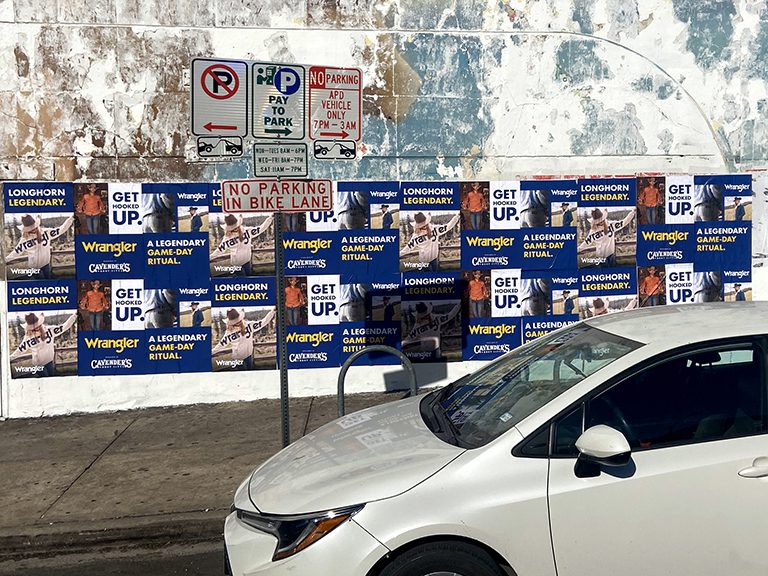
Philadelphia’s street poster culture is genuine and deep-rooted. From the murals that cover entire building facades in Fishtown to the concert poster landscape on South Street and the arts-organization postering that defines University City, Philly has a visual street culture that makes flyposting campaigns feel like participation rather than intrusion. For brands and promoters seeking to reach Philadelphia’s creative, music, and young professional audiences, street poster campaigns outperform almost any other format in cultural resonance and cost-efficiency.
Our team has run poster campaigns across Philadelphia’s major neighborhoods and understands the regulatory landscape, the surface ecosystem, and the audience geography well enough to place materials where they generate real impact rather than just physical presence. Philly’s compact, walkable neighborhood structure — the rowhouse blocks, the dense commercial corridors, the transit lines that thread through the city — creates a street poster environment where well-placed materials generate thousands of daily impressions at costs that no digital channel approaches.
This guide covers the specific neighborhoods, surfaces, and regulatory context that define professional flyposting in Philadelphia — and how our team structures campaigns that deliver genuine commercial and cultural outcomes in one of the country’s most street-marketing-friendly major cities.
Philadelphia’s Neighborhood Poster Landscape
Philadelphia’s neighborhoods each have distinct audience profiles, surface ecosystems, and cultural contexts for poster campaigns. Understanding these differences is the foundation of effective campaign planning in the market.
Fishtown: The Primary Arts and Culture Corridor
Fishtown is Philadelphia’s highest-concentration arts, music, and young professional neighborhood — a formerly working-class riverfront district that has transformed into one of the city’s most culturally dynamic zones. Girard Avenue and Frankford Avenue serve as the main commercial and cultural corridors, lined with independent restaurants, music venues, art studios, coffee shops, and boutiques. The building stock along these corridors — rowhouses, former industrial buildings, and commercial storefronts — offers both legal private surfaces and an existing poster culture that normalizes brand poster placements as part of the neighborhood visual environment.
For music, entertainment, fashion, food and beverage, and emerging consumer brand campaigns targeting 22 to 38 year old urban professionals, Fishtown is the highest-ROI neighborhood in Philadelphia for flyposting investment. Our team maintains active surface relationships in the Girard Avenue and Frankford Avenue corridors that allow rapid campaign deployment at lead times as short as one week.
South Street: The Entertainment and Night Economy Zone
South Street is Philadelphia’s legacy entertainment strip — a continuous block of bars, restaurants, vintage shops, tattoo studios, and music venues from South Broad Street to the Delaware River. The corridor attracts both local residents and visiting suburban audiences, creating a broader and somewhat older demographic mix than Fishtown. Surface availability on South Street spans building facade walls, construction hoarding in development zones, and retail property owner agreements along the main strip.
Poster campaigns on South Street are most effective for entertainment and night economy campaigns — concerts, club nights, festivals, and entertainment product launches — where the existing context of the corridor aligns with the brand message. For lifestyle and consumer brand campaigns, South Street works well as a secondary zone after primary Fishtown coverage, adding reach to a slightly different audience segment.
Northern Liberties: 2nd Street and the Development Corridor
Northern Liberties, immediately adjacent to Fishtown on the south, shares similar demographics and cultural character with a heavier concentration of young professional residents. The 2nd Street corridor and the blocks around the Piazza at Schmidt’s offer both retail adjacency posting surfaces and construction hoarding from the ongoing development activity that has characterized the neighborhood for the past decade. Construction hoarding in Northern Liberties represents some of the highest-quality legal posting inventory in the city: large, flat panels at pedestrian eye level on high-traffic sidewalks.
University City: The Student and Academic Corridor
The blocks surrounding Drexel University and the University of Pennsylvania — Walnut Street, Chestnut Street, and Sansom Street — offer concentrated access to a student and academic professional audience. University City bulletin boards, campus posting infrastructure, and the off-campus commercial corridors provide a mix of permitted posting surfaces with defined access rules. For campaigns targeting 18 to 26 year old students or academic professional audiences, University City delivers the highest-concentration access in the Philadelphia market.
East Passyunk: The South Philly Food and Lifestyle Corridor
East Passyunk Avenue has emerged as one of Philadelphia’s premier food and lifestyle corridors, anchored by independent restaurants, boutiques, and the Singing Fountain plaza. The corridor’s demographics skew slightly older than Fishtown — 28 to 45 year old urban homeowners and renters with disposable income and strong food and lifestyle purchase propensity. Poster campaigns on East Passyunk reach this demographic in the commercial environment where they make active consumption decisions, making the corridor particularly strong for food, beverage, hospitality, and lifestyle brand campaigns.
Surface Types and Regulatory Framework in Philadelphia
Philadelphia’s regulatory framework for poster placement follows the standard private/public property distinction. Philadelphia Code Section 10-107 prohibits the affixing of posters, handbills, or other materials to utility poles, traffic signs, or public structures. Posting on private property with owner permission is legal. Our team operates exclusively within the private property permission framework, maintaining documented surface agreements for all placements.
Rowhouse Facades and Commercial Building Walls
Philadelphia’s rowhouse building stock creates a particular surface dynamic: most exterior walls are shared party walls or face directly onto narrow sidewalks, limiting large-format placements. The highest-quality surface inventory comes from end-of-block rowhouse facades (which often have a full side wall visible to cross-traffic), former industrial buildings converted to commercial use, and purpose-designated posting walls on private commercial properties whose owners have established posting agreements.
Construction Hoarding in Development Zones
Philadelphia’s ongoing development activity — concentrated in Fishtown, Northern Liberties, Francisville, and parts of South Philly — generates rotating hoarding panel inventory that represents the city’s premium posting surface. Hoarding panels from 4 to 8 feet in height and 8 to 24 feet in length provide large-format, flat, pedestrian-facing surfaces at eye level. Our team tracks active construction projects and hoarding availability across the city’s development zones to maintain current surface inventory for client campaigns.
Campaign Logistics: What Professional Flyposting Looks Like in Philly
Philadelphia’s compact geography — the city fits within roughly 10 miles from North Philly to South Philly — allows efficient single-day installation of citywide poster campaigns that would require multi-day operations in sprawling markets like LA or Chicago. A well-planned installation crew can cover all major neighborhood zones in Philadelphia in a single overnight or early morning installation window.
Installation Timing
Our team installs Philadelphia poster campaigns during off-peak hours — typically 11:00pm to 5:00am or 6:00am to 9:00am — to minimize pedestrian conflict and allow clean installation work. Overnight installation also maximizes the morning-commute impression window: materials installed overnight are fresh and visible for the entire morning rush, generating peak impressions within hours of installation.
Wheatpaste Application Standards
For campaigns using wheatpaste application, our team prepares surface-appropriate paste formulations and applies backing paste before the poster is placed, then overcoats with a sealing paste layer that locks the material to the surface and provides UV and moisture protection. This application standard ensures materials maintain brand-quality appearance for the full campaign window rather than peeling or fading within the first week of installation.
Philadelphia Flyposting Campaign Costs
Philadelphia is one of the most cost-efficient major markets for flyposting campaigns. Compared to New York or Los Angeles, surface costs are lower, installation labor is less expensive, and the compact geography reduces logistics costs significantly.
Cost Structure
Surface fees for private property agreements in Philadelphia range from $20 to $100 per surface per campaign window depending on location quality, surface size, and duration. Installation labor runs $0.50 to $1.50 per poster depending on surface type and campaign volume. Print costs for standard 24×36 inch posters at 100 to 500 piece quantities run $2 to $5 per poster. An all-in campaign covering 75 to 100 surfaces across Fishtown, Northern Liberties, and South Street typically runs $3,500 to $8,000 for a four-week window including all surface fees, installation, print, and documentation.
Philadelphia Campaign Timing and Seasonal Considerations
Philadelphia’s entertainment and arts calendar creates distinct demand peaks for street poster campaigns. Aligning campaign timing with these peaks maximizes the relevance and audience receptivity of the materials.
Music and Festival Season
Philadelphia’s summer music festival season runs May through September, with Made in America on the Benjamin Franklin Parkway, numerous neighborhood block parties, and music events at venues like Union Transfer, The Fillmore, and World Cafe Live creating concentrated entertainment audience activity. Campaign installations timed to festival and major show windows reach the entertainment-engaged audience at peak moment of category interest.
University Semester Starts
September and January — the start of fall and spring semesters at Drexel, Penn, Temple, Jefferson, and other Philadelphia universities — represent peak consumer activity for brands targeting the student and young adult demographic. Campaigns installed in the final week of August and the first week of September reach the highest concentration of new and returning students in the University City and Center City markets.
Integrating Philadelphia Poster Campaigns with Broader Street Marketing
Flyposting in Philadelphia works best as part of a coordinated street campaign that extends brand presence across multiple touchpoints in the same neighborhoods. Our guerrilla marketing services in Philadelphia typically combine poster campaigns with one or more of the following for clients seeking maximum market saturation.
Street Teams in Fishtown and South Street
Deploying brand ambassador teams on Girard Avenue and South Street during weekend evening hours — when both corridors see their highest pedestrian traffic — creates live brand interaction in the same zones where poster campaigns are building ambient awareness. The combination of visual poster presence plus direct human brand encounter produces compounded brand recall that neither tactic achieves independently.
Sidewalk Stencils on High-Traffic Blocks
Sidewalk stenciling on the highest-traffic blocks in Fishtown, South Street, and University City adds a ground-level dimension to poster campaigns that reinforces the brand in the exact pedestrian path where target consumers move. Combined with the eye-level poster presence, stenciling creates above-and-below visual brand saturation that makes the campaign feel ubiquitous in the target zones.
Frequently Asked Questions
Where are the best flyposting locations in Philadelphia?
The best flyposting locations include Fishtown’s Girard and Frankford Avenue corridors, South Street and the surrounding South Philly arts zone, Northern Liberties’ 2nd Street corridor, University City near Drexel and Penn, and the East Passyunk commercial district. These zones combine high foot traffic with street art culture that makes poster placements contextually appropriate.
Is flyposting legal in Philadelphia?
Posting on private property with owner permission is legal in Philadelphia. Posting on public property without authorization violates Philadelphia Code Section 10-107 and can result in fines. Professional flyposting campaigns use documented private surface agreements to avoid enforcement exposure.
What is the cost of a flyposting campaign in Philadelphia?
A professional campaign covering 50 to 100 surfaces across key neighborhoods typically runs $2,500 to $7,500 including surface fees, installation labor, and campaign documentation. Print costs for standard 24×36 inch posters add $200 to $600 depending on volume and stock.
How does Fishtown compare to South Street for flyposting effectiveness?
Fishtown delivers a younger, arts-culture-heavy audience with high receptivity to music, entertainment, and emerging brand campaigns. South Street reaches a broader audience including visiting suburbanites alongside local residents. The best Philly campaigns use both corridors for different audience segments within the same campaign window.
What poster sizes work best for Philadelphia street campaigns?
Standard 24×36 inch posters are the most versatile format. Larger formats work well in South Philly and construction corridor locations. The narrow rowhouse facades in Fishtown favor 11×17 or 12×18 formats for supplementary coverage in tighter spaces.
Does Philadelphia have a street art culture that helps campaigns?
Yes. Philadelphia has a robust street art culture in Fishtown, Northern Liberties, West Philly, and South Street, where murals and poster installations are part of the visual culture. This makes poster campaigns contextually appropriate and improves audience receptivity compared to markets with less established street art traditions.