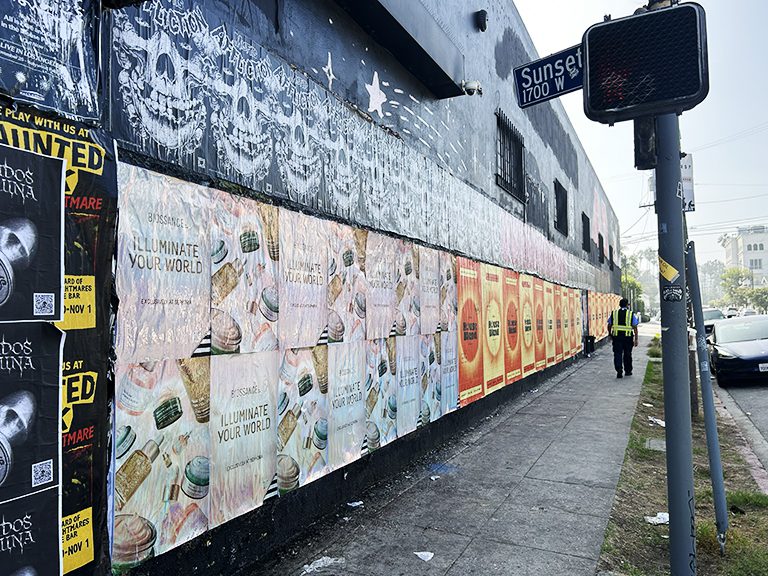
Los Angeles is one of the most important flyposting markets in the United States for a simple reason: it is the center of the American entertainment industry, and the entertainment industry is among the most consistent users of street-level poster campaigns for music, film, television, and streaming content promotion. The market’s characteristics are distinctive, though, and understanding them is essential to planning campaigns that deliver in this city’s unique urban geography.
Our team at American Guerrilla Marketing executes wheat paste poster campaigns in Los Angeles as part of our regular national campaign operations. We deploy across 50+ U.S. markets from our base at Industry City, Brooklyn, NY, and Los Angeles is one of our most active single-city markets. This guide covers the neighborhoods, surfaces, audience mapping, and execution considerations that define professional flyposting in the LA market.
Understanding Los Angeles as an Outdoor Advertising Market
Los Angeles is geographically massive and architecturally auto-dependent in ways that make it fundamentally different from the dense, walkable outdoor advertising environments of New York, Chicago, or San Francisco. The city does not have a single walkable core. It has dozens of distinct neighborhood clusters, each with its own pedestrian environment, its own demographic profile, and its own stock of posting surfaces.
A flyposting campaign in Los Angeles must be geographically deliberate in a way that campaigns in more compact markets do not require. Posting across a random geographic spread in LA reaches a fragmented, low-relevance audience mix. Posting with precision within two or three target neighborhoods reaches the specific audience clusters that make the campaign effective.
The Role of Foot Traffic Concentration
Walkable foot traffic in Los Angeles is not distributed uniformly. It is concentrated on specific blocks within specific neighborhoods. Melrose Avenue between La Brea and Fairfax has high pedestrian density. The stretch of Sunset Boulevard through Silver Lake and Echo Park has consistent foot traffic tied to the neighborhood’s restaurant and retail environment. Abbot Kinney Boulevard in Venice draws weekend pedestrian density that rivals the best East Coast shopping corridors. These specific corridors are where flyposting campaigns in LA generate meaningful impression volume.
The Target Neighborhoods for LA Flyposting
Effective flyposting in Los Angeles starts with neighborhood selection. Each of the city’s active posting neighborhoods serves a distinct audience type and campaign objective.
Silver Lake and Echo Park
Silver Lake and Echo Park are LA’s primary music and independent creative culture neighborhoods. The densely populated hillside residential neighborhoods feed an active street-level commercial corridor on Sunset Boulevard and its cross streets, with consistent foot traffic from the younger creative professional demographic that defines these areas. For music label campaigns, independent film promotions, and brand campaigns targeting creative industries, Silver Lake and Echo Park are among the most effective neighborhoods in the entire LA market.
Melrose Avenue and Fairfax
The Melrose Avenue corridor between La Brea and Highland, and the Fairfax District, are the center of LA’s streetwear and youth culture commercial scene. The heavy concentration of streetwear boutiques, vintage stores, and food operators along this corridor draws a young demographic with high engagement with fashion, music, and brand culture. Campaigns for consumer brands, fashion labels, and music with streetwear cultural associations perform strongly in this corridor.
The Arts District, Downtown LA
Downtown LA’s Arts District has emerged over the past decade as one of the city’s most active creative neighborhoods, with a dense cluster of galleries, restaurants, and creative businesses drawing a professional creative and hospitality audience. The Arts District has an active posting surface inventory on its warehouse and converted industrial building walls that supports both standard and large-format flyposting campaigns.
East Hollywood and Los Feliz
East Hollywood and Los Feliz reach a mixed creative and entertainment industry workforce audience. The neighborhoods are adjacent to major studio and production infrastructure and draw working creative professionals who represent an important secondary audience for entertainment and consumer brand campaigns. Posting in these neighborhoods complements a Silver Lake-focused campaign by extending reach into adjacent audience clusters.
Surface Types in Los Angeles
Los Angeles’ architectural character, with its mix of mid-century commercial buildings, warehouse conversions, and bungalow-scale retail blocks, produces a distinctive surface inventory for flyposting campaigns.
Building Walls
Building walls in Silver Lake, Echo Park, and the Arts District are the primary surface type for standard format flyposting campaigns. The Arts District in particular has an unusually dense concentration of large blank warehouse walls that support both standard and large-format installations. These walls are held by operators with established property relationships, and accessing the best surfaces requires working with an operator who has those relationships in place.
Construction Hoarding in Development Zones
Downtown LA and rapidly developing neighborhoods like Koreatown, Chinatown, and parts of the Eastside have active construction hoarding surfaces that provide temporary large-format opportunities. Development activity in these areas has accelerated significantly over the past decade, adding hoarding surface inventory in neighborhoods that are increasingly attractive to campaign planners.
Campaign Planning for Los Angeles
LA campaign planning requires explicit neighborhood selection as the first step. The campaign brief should identify two to four target neighborhoods, specify the audience type each neighborhood is being used to reach, and build a location list within each neighborhood based on scouted or database-confirmed surface availability.
Installation Logistics in a Spread-Out City
The geographic spread of LA’s active posting neighborhoods creates logistics considerations that compact markets do not require. Routing installation crews efficiently between Silver Lake, Fairfax, and the Arts District in a single night requires deliberate routing planning that accounts for LA’s traffic patterns, which are significantly different at 2am than they are at 6pm. Campaign planning for LA should build routing efficiency into the brief rather than leaving crew routing to be figured out on installation night.
Connecting LA Flyposting to Broader Entertainment Campaign Ecosystems
For entertainment industry campaigns that are running in Los Angeles, flyposting typically runs in parallel with transit advertising, digital out-of-home, and paid social campaigns targeting the same audience. The role of flyposting within this ecosystem is to create street-level physical presence in the specific neighborhoods where the target audience concentrates, providing an authenticity and physical real-world signal that digital and transit formats cannot replicate. Coordinating flyposting timing with the broader campaign launch window maximizes the cumulative impact of the multi-channel approach. Our team can coordinate flyposting with LED billboard trucks and other formats to create layered campaign presence in the LA market.
Frequently Asked Questions
What are the best neighborhoods for flyposting in Los Angeles?
The strongest performing neighborhoods for flyposting in Los Angeles are Silver Lake, Echo Park, East Hollywood, Melrose Avenue, Fairfax, and the Arts District in downtown LA. Each offers a distinct demographic and foot traffic profile suited to different campaign objectives.
Is flyposting in Los Angeles different from other major US cities?
Los Angeles flyposting differs from East Coast markets primarily in its geographic scale and automotive culture. Campaign geography must be deliberately mapped to specific target neighborhoods rather than relying on dense urban continuity. Foot traffic is more corridor-specific, concentrated on specific walkable blocks within neighborhoods.
How much does a flyposting campaign in Los Angeles cost?
A professional flyposting campaign in Los Angeles covering two to three neighborhoods typically ranges from $3,000 to $8,000 depending on poster count, format size, campaign duration, and documentation requirements.
What surface types are most common for flyposting in LA?
The most common surface types are painted building walls in creative neighborhoods, construction hoarding panels in development zones, and commercial building faces in walkable retail corridors. Silver Lake, Echo Park, and the Arts District have the most active and well-established posting surfaces.
How do you reach music and entertainment audiences through LA flyposting?
Music and entertainment audiences in Los Angeles are concentrated in Silver Lake, Echo Park, and Hollywood for music-focused campaigns, and East Hollywood and the Arts District for the broader entertainment industry creative workforce. Campaigns should prioritize posting corridors immediately adjacent to venues and cultural institutions where those audiences spend time.
What documentation does a professional LA flyposting campaign provide?
A professional Los Angeles flyposting campaign delivers GPS-tagged installation photographs for every placement, organized by neighborhood and formatted into a campaign report with a geographic map of all locations, delivered within 24 to 48 hours of installation completion.
How many locations does a typical LA flyposting campaign cover?
A standard flyposting campaign in Los Angeles covering two to three neighborhoods typically includes 20 to 60 individual placement locations depending on budget and format size. Larger campaigns targeting market saturation across four or five neighborhoods can include 80 to 150 locations. The LA market’s scale means that even a large number of locations can be spread thin if neighborhood selection is not deliberate, so quality of neighborhood concentration matters as much as raw placement count.