Fly Post: Street Poster Advertising for Urban Brand Campaigns | AGM
Fly posting has been the ground-level advertising method of choice for artists, brands, and campaigns that want real neighborhood presence. Here is how it works when done right.
Fly posting is the practice of placing printed posters on outdoor surfaces in urban environments to build street-level brand presence. The term is widely used in the UK and has gained currency in the US as a descriptor for high-volume, high-energy outdoor poster campaigns that create saturation within a target neighborhood or city. At American Guerrilla Marketing, we run fly post campaigns on authorized surfaces across New York City and major markets nationwide.
This guide covers the practical realities of fly posting as a marketing tactic: how it is executed professionally, what it accomplishes, where it works, how to design for it, and what to measure. If you are a brand, label, promoter, or marketer who wants to put a real street presence behind a campaign, this is your starting point.
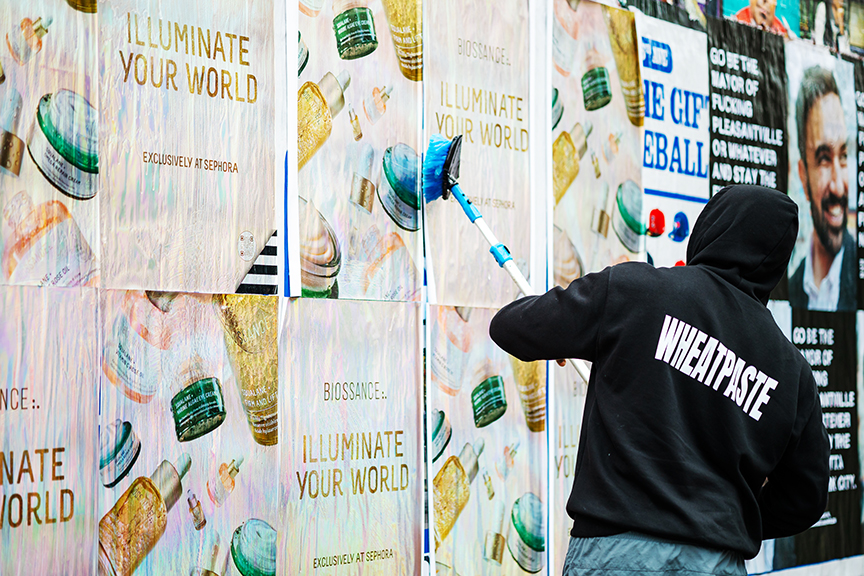
Fly posting means placing printed posters on available outdoor surfaces in your target neighborhood, typically using wheat paste or compatible adhesive for surface adhesion. The result is a campaign that creates multiple visible touch points for the same consumer as they move through the neighborhood. They see the poster on the board near the coffee shop on the way to work. They see it again on the outdoor board at the corner of Bedford and North 7th. They see it again on the construction barricade on the block where they get their haircut.
That repetition is the mechanism. Urban consumers encounter hundreds of advertising messages every day. Most go unregistered. Repeated exposure to the same message in the physical environment they move through daily creates registration and eventually recall. A brand that appears three times in a single neighborhood walk registers differently than a brand that appears once in a digital feed.
Authorized fly post campaigns work exclusively on surfaces where property owner permission has been secured in advance. We maintain a network of authorized locations across New York City neighborhoods. These include building exteriors, construction barricades, outdoor boards on fence lines, and partner business windows and surfaces. Working exclusively with authorized locations keeps campaigns clean, professional, and risk-free for clients.
The physical production side of a fly post campaign involves printing the posters, preparing the adhesive compound, routing the placement crew through the target area, and documenting each placement with GPS-tagged photography. A campaign that places 200 posters across a single neighborhood can be executed overnight and documented fully by morning.
The History of Fly Posting as an Advertising Format
Fly posting as an advertising practice has roots in the 19th century. The term “fly” refers to the speed with which original poster crews would plaster surfaces with promotional materials before anyone could intervene. Music hall promoters, patent medicine sellers, and political campaigns all deployed crews of poster placers to cover cities rapidly. The phrase captured the guerrilla character of the activity: move fast, cover the surface, disappear.
The format evolved through the 20th century alongside the music industry. Concert promoters, record labels, and independent artists used fly posting to build street-level presence that radio and print advertising could not provide in specific neighborhood communities. Punk, hip-hop, reggae, and electronic music all have strong traditions of fly post promotion tied to specific urban neighborhoods and distinctive poster design aesthetics.
Modern fly post campaigns combine the visual energy of that tradition with professional production standards, authorized locations, and documentation systems. The format is more sophisticated and more accountable than its predecessors, but the fundamental mechanics remain: place printed graphics in the physical environment of your target consumer and let repetitive exposure do the work.
The cultural legitimacy of fly posting in certain neighborhoods is itself part of its value as an advertising medium. A brand that appears in the streets of Williamsburg or the Lower East Side or the Fairfax corridor in Los Angeles is participating in the visual culture of those neighborhoods. That participation carries an implicit cultural alignment that cannot be purchased through any digital placement.
AGM Field Note: Digital advertising reach is essentially unlimited, but consumer attention is finite and fragmented. A consumer who sees your ad in a social feed has also seen 50 other ads in the same scrolling session. A consumer who sees your poster on their block encounters it in isolation, in their physical environment, without competing stimuli. Physical presence in a specific neighborhood creates a fundamentally different kind of impression.
Where Fly Post Campaigns Work Best
Fly post campaigns work best in dense urban environments where pedestrian foot traffic is consistent and the visual culture of the neighborhood is receptive to street-level graphics. New York City is the strongest fly post market in the United States: density, cultural richness, and a long tradition of street art and poster culture in its key neighborhoods make it the most productive market we operate in.
Brooklyn: Williamsburg and Bushwick
Williamsburg has been one of the most productive fly post neighborhoods in New York for two decades. The density of creative businesses, music venues, bars, and independent retail creates an environment where poster campaigns have high dwell time and culturally relevant context. Bedford Avenue from North 7th to Metropolitan is the core posting corridor for any campaign targeting the Brooklyn creative demographic. Bushwick, particularly around Jefferson Street and Wyckoff Avenue, carries a dense arts community and heavy weekend foot traffic that makes it a strong complementary market for any campaign in this space.
Manhattan: Lower East Side and East Village
The Lower East Side and East Village have a long history as posting neighborhoods for music, art, and culture. The blocks around Bowery Ballroom, Mercury Lounge, and the cluster of bars on Rivington and Essex carry the kind of pedestrian traffic that attends live events and actively engages with street-level marketing. The East Village maintains a strong poster culture tied to its history as a center of punk, no wave, and underground art movements.
Harlem
The 125th Street corridor in Harlem is one of the highest foot-traffic retail and cultural streets in upper Manhattan. It carries a broad demographic with high local consumer spending and deep community roots. For campaigns targeting Black urban consumers or those with broad popular culture appeal, 125th Street is a premium posting location with no equivalent in terms of neighborhood reach.
Los Angeles, Chicago, and Miami
We run fly post campaigns in Los Angeles (Arts District, Fairfax, Silver Lake), Chicago (Wicker Park, Logan Square), and Miami (Wynwood). Each city has its own posting neighborhoods and its own visual culture. We scout locations in advance, adapt the placement map to each market’s specific geography and demographic patterns, and execute each campaign with the same documentation standards we use in New York.
Fly Post Design: What Works on the Street
A fly post campaign is only as effective as the design of the poster being placed. Poor design wastes the placement. Strong design multiplies the effect of every location.
The design principles for fly post are similar to those for any outdoor format, but the context is specifically urban and specifically street-level. Here is what works and why.
Bold Visual Hierarchy
Every element on a fly post needs to be legible at a distance of 15 to 20 feet while a pedestrian is in motion. That means the primary visual or headline needs to be large enough to read in a single glance. Supporting information should be secondary and brief. The hierarchy should be clear before a viewer has consciously decided to look at the poster.
High Contrast and Minimal Complexity
Street environments are visually noisy. Posters compete with storefronts, vehicles, other signage, and the general visual texture of the city. High contrast designs, particularly black-on-white, white-on-black, or designs built around a single bold color, cut through that noise. Designs with multiple colors, gradients, or complex visual elements compete with the environment rather than standing out from it.
Single Message Focus
The most effective fly post designs communicate one thing. An event date. A product name. A URL. A face. When a poster tries to communicate multiple things simultaneously, it communicates nothing effectively. The goal is to create a single impression that persists after the viewer has walked past.
Typography as Visual Element
Typography on fly post posters functions as both information and image. Large, bold, well-chosen type creates visual interest and conveys information simultaneously. Many of the most successful fly post campaigns in the music industry have used text-dominant designs where the name or phrase itself is the visual. The letters become the image.
AGM Field Note: We review every creative before it goes to print. Our field team has seen what works on specific surfaces in specific neighborhoods across years of campaign execution. If your design will lose legibility on a construction barricade or compete with a busy storefront background, we tell you before the print run. Getting the creative right before production saves time, money, and campaign performance.
Fly Post Sizes and Format Options
The size of the poster affects placement options, production cost, and street visibility. We work with a range of standard formats depending on campaign objectives and available surface inventory.
Format
Dimensions
Best For
Notes
One-Sheet
24 x 36 in
General campaign, concert, event
Standard format, widest surface compatibility
Half-Sheet
22 x 14 in
Dense saturation runs, smaller surfaces
More placements per print budget
18 x 24
18 x 24 in
Urban boards, windows
Common for retail window placements
11 x 17
11 x 17 in
Snipe-style placements, high density
Works on small surfaces and utility structures
27 x 41
27 x 41 in
Anchor placements, high-visibility boards
Movie poster format, maximum street presence
Double-Sheet
48 x 36 in
Large construction barricades
Maximum impact on high-traffic surfaces
How We Plan and Execute a Fly Post Campaign
Every fly post campaign we run starts with a brief. We need to understand who the client is trying to reach, when they need to reach them, and what geographic area or areas they are focused on. That brief drives every decision that follows: the neighborhood selection, the placement count, the poster size, the timing, and the documentation format.
Location Scouting and Map Building
We do not place posters from a generic inventory list. We scout locations for each campaign and build a custom placement map based on the client’s targeting criteria. That map identifies specific surfaces: the board on the north side of this building on this block, the barricade running the length of this construction project, the series of boards along this retail corridor. Every placement on the map is intentional.
Print Production Coordination
We work with print vendors who understand the specific material requirements for wheat paste applications: the right paper weight, the right coating, the right ink specifications for outdoor durability. A poster that cannot survive its first night on the street is a wasted investment. We coordinate print specs, turnaround timelines, and delivery logistics as part of every campaign build.
Field Execution
Our field crews execute placements following the approved placement map. Each placement is documented with a GPS-tagged photograph that records the surface, the location, and the date of placement. That documentation becomes the campaign record: a visual proof of every location hit.
Campaign Monitoring
We monitor placements during the campaign window and refresh posters that have been compromised by weather, competing placements, or surface conditions. For multi-week campaigns, ongoing maintenance is built into the campaign plan from the start.
What Fly Posting Achieves for a Brand or Campaign
The question clients ask most often is: what does a fly post campaign actually produce? The honest answer is that it produces physical presence in a specific neighborhood at a specific time, and it produces that presence at a density and repetition rate that no other outdoor format matches at the same price point.
Fly posting works particularly well for:
Event promotion: Concerts, club nights, gallery openings, festivals, and sports events all benefit from street presence in the neighborhoods where their audience lives. The campaign runs in the weeks before the event and builds awareness through neighborhood saturation.
Album and product launches: Record labels, streaming platforms, and consumer brands use fly posting to create a sense of cultural momentum around a release. When your name or image is on the block, you have a presence that digital channels cannot replicate.
Brand awareness in new markets: A brand entering a new city or neighborhood can use fly posting to announce its arrival. Physical presence signals that the brand is real and invested in the community it is entering.
Political and advocacy campaigns: Issue campaigns, voter registration efforts, and community advocacy organizations use fly posting to reach urban audiences in specific districts with high physical presence.
Pop-up and retail launches: A new shop, restaurant, or experience space in a neighborhood is well served by fly posting in the blocks surrounding the location in the weeks before opening.
Fly Posting and the Rest of Your Campaign Mix
Fly posting is most effective when it is coordinated with the other elements of a campaign rather than run in isolation. The street presence created by a fly post campaign can be reinforced and amplified through coordinated digital activity, event-based promotion, and other physical media placements. Here is how that integration typically works.
Social media: A consumer who sees a poster on their block and then encounters the same campaign imagery in their social feed registers the repetition across physical and digital channels. The physical placement makes the digital placement feel more familiar and credible. The digital placement extends the reach of the physical campaign to consumers who did not pass the specific location but follow relevant accounts or hashtags.
Experiential activations: Fly posting can serve as the advance notice for an experiential campaign scheduled in the same neighborhood. The street-level visual presence builds anticipation for the live experience and gives passersby a reason to look up your brand before the event date.
Out-of-home placements: Fly posting supplements traditional out-of-home formats by filling gaps in the street-level visual environment that paid billboard placements cannot reach. Construction barricades, fence lines, and building exteriors that are not available through standard OOH vendors are accessible through our authorized fly post network.
Fly Post Campaigns for Music Industry Clients
The music industry has been the most consistent user of fly posting as an advertising format for decades. Record labels from major to independent, touring production companies, venue operators, and artist management teams all use fly posting as a component of release and tour promotion.
The logic is straightforward. Music audiences are often geographically concentrated in specific neighborhoods. A hip-hop artist with a strong Brooklyn audience should have posters in Flatbush, Crown Heights, and Bed-Stuy. A rock act playing Bowery Ballroom should have street presence in the Lower East Side, East Village, and Williamsburg. A DJ headlining a club in Miami’s Wynwood should have street presence in the blocks surrounding that venue and the residential neighborhoods nearby.
We have run campaigns for artists, labels, concert venues, and festival brands across genres and markets. The format is versatile: a small 100-poster campaign for an independent artist on a limited budget and a 500-poster multi-neighborhood campaign for a major label release can both be executed with equal care and professionalism.
Documenting and Reporting Fly Post Campaigns
Every fly post campaign we run is documented with GPS-tagged photographs of each placement. The campaign report includes images of every posted location, the address or intersection, the date of placement, and the poster format used. Clients receive this documentation as a complete visual record of the campaign.
Beyond the placement documentation, clients can track secondary performance signals during and after the campaign window:
Website traffic from the targeted geographic areas (via Google Analytics geographic segmentation)
Social media mentions and tags from within the targeted neighborhoods
Event ticket sales or redemption spikes in the campaign window
Retail foot traffic changes at nearby locations
Direct audience feedback from venues, retailers, or community partners in the area
None of these secondary signals provide a perfectly clean attribution of effect to the fly post campaign specifically. But taken together, they give clients a directional read on campaign impact that, combined with the placement documentation, supports future campaign planning decisions.
Fly Posting for Specific Campaign Types
The fly posting format adapts to a wide range of campaign contexts. The mechanics of placement, adhesion, and neighborhood targeting stay the same, but the strategy behind each campaign varies significantly by industry and campaign objective. Here is how we approach the format for the most common campaign types we execute.
Concert and Tour Promotion
Concert and tour promotion is the historical core of the fly post format. The relationship between music promotion and street poster placement goes back more than a century and continues because the format works for this use case in ways that other channels do not. A concert or tour campaign running in a city has a specific audience: people who live in specific neighborhoods, attend specific venues, and move through specific corridors. Fly posting those neighborhoods in the two to three weeks before the date creates the visual presence that turns an upcoming show from something consumers heard about once into something they have seen referenced repeatedly in their physical environment. That repeated contact with the campaign visual before the show date drives ticket purchase decisions at a meaningful rate, particularly for artists and events that already have a base of awareness in the target market.
For national or multi-city tours, we coordinate simultaneous fly post campaigns across all markets on a unified timeline, so that every market receives its street presence in the optimal pre-show window. Each city has its own placement map built from local knowledge, and each campaign is documented with GPS-tagged photography that the artist team, label, and promoter all receive as part of the campaign report.
Film and Streaming Releases
Film releases and streaming launches use fly posting to create street-level awareness that supplements the paid media buy. A film studio that purchases transit and digital advertising still has gaps in the street-level visual environment of the neighborhoods where its target audience lives. Fly posting fills those gaps with creative that reflects the key art of the campaign and creates the sense that the release is happening everywhere in the cultural environment simultaneously. The 27×41 poster format mirrors the traditional movie poster format that audiences already associate with cinematic releases, which gives street-placed film campaign posters an immediate visual legibility that newer formats sometimes lack.
Consumer Brand Launches and Retail Openings
A consumer brand entering a new neighborhood or a retail location opening in a new area benefits from fly posting in the blocks immediately surrounding the target location and in the residential neighborhoods where the potential customer base is concentrated. The street-level presence signals that the brand is real, locally present, and invested in the specific community it is entering. For retail openings, a fly post campaign in the two weeks before opening day creates a sense of anticipation and neighborhood familiarity with the brand before the doors open. Consumers who have seen the campaign on their walk to the subway feel the opening as a familiar arrival rather than an unexpected intrusion.
How to Brief a Fly Post Campaign
The quality of a fly post campaign begins with the quality of the brief. A clear brief produces a precise placement map, appropriate format selection, and an installation plan that matches the campaign’s actual objectives. A vague brief produces a campaign that spreads resources across too much geography without achieving meaningful density anywhere. Here is what a complete fly post brief contains.
Target Audience Profile
Who are you trying to reach? Not in the abstract demographic sense of a media plan, but in the specific sense of where these people are in the city on the days and times when the campaign will be running. A music fan who attends shows at the Bowery Ballroom lives in a different neighborhood than a young professional who shops on the Fairfax corridor in Los Angeles. Knowing where your audience is physically allows us to build a placement map that finds them, not a map that optimistically covers a wide area and hopes for intersections.
Campaign Timeline
When does the campaign need to be on the street? What is the event date, launch date, or campaign window end? Working backward from that date, we can identify the latest possible installation date, the required print delivery date, the scouting window, and the design review deadline. Campaigns that provide clear timeline anchors at the start of the planning process run more smoothly and produce stronger results than campaigns that compress all decisions into the final week before the installation date.
Geographic Scope
Which neighborhoods are in scope? Are we concentrating on a single neighborhood for saturation or spreading across multiple neighborhoods for broader reach? Is there a specific venue, retail location, or community anchor that should be the center of the placement map? The geographic scope decision determines the quantity of posters needed, the number of pasters required, and the installation timeline. Getting it right at the brief stage prevents over-planning for a budget that cannot support the geographic scope or under-planning for a scope that requires more resources than initially allocated.
Creative Assets
What creative is available and in what state? A brand with print-ready files in the correct format can accelerate the production timeline significantly. A brand that is still finalizing design needs to build design review time into the campaign plan. We review every creative file before it goes to print, and we will identify format issues, resolution problems, or design elements that will not translate well to street scale. Clients who build design review time into the schedule get better outcomes than those who do not.
Written by the American Guerrilla Marketing field team. AGM has designed and executed street-level poster campaigns for brands, record labels, venues, and agencies across New York City and the United States since 2008.
Frequently Asked Questions
What is fly posting?
Fly posting is the practice of placing printed posters on outdoor surfaces in urban environments to build street-level brand presence. Professional fly post campaigns use authorized locations and wheat paste adhesive to create multi-point exposure within a target neighborhood over a defined campaign window.
Where does fly posting work best?
Fly posting works best in dense urban neighborhoods with high pedestrian traffic and a strong visual street culture. In New York City, Williamsburg, Bushwick, the Lower East Side, and the East Village are consistently top-performing markets. We also run successful campaigns in Los Angeles, Chicago, Miami, and other major cities.
What size posters are used for fly posting?
Common fly post sizes include 24×36 inch (standard one-sheet), 18×24, and 11×17 formats. Larger formats like 27×41 are used for high-visibility anchor placements. The right size depends on available surfaces, campaign objectives, and print budget.
How long do fly post posters last on the street?
Properly wheat-pasted posters on authorized surfaces typically last 2 to 4 weeks depending on weather, surface type, and foot traffic. We monitor campaign placements and refresh as needed for multi-week campaign runs.
Are fly post campaigns authorized?
Every campaign we run places posters only on surfaces where we have secured property owner permission in advance. This includes dedicated outdoor boards, construction barricades with owner approval, and partner business surfaces. We do not place on unauthorized surfaces.
What is the best design for a fly post campaign?
The most effective fly post designs use bold visuals, minimal text, high contrast, and a single clear message. Street audiences are moving. The poster has about two seconds to register. Simplicity and scale are the primary design tools for this format.
Can fly posting campaigns be geo-targeted?
Yes. We build custom placement maps for every campaign based on client targeting criteria: neighborhood, demographic profile, venue proximity, and foot traffic patterns. Every placement is selected intentionally based on the campaign goal.
Do you run fly post campaigns outside New York City?
We run campaigns in Los Angeles, Chicago, Miami, San Francisco, Austin, Philadelphia, and other major markets. Each city has its own posting neighborhoods and visual culture. We adapt location strategy to each market’s specific geography and demographic patterns.
How do you measure a fly post campaign?
We provide GPS-tagged photo documentation of all placements. Clients track secondary metrics including web traffic from targeted neighborhoods, social mentions, event ticket sales movement, and direct audience feedback from the campaign area during the campaign window.
Contact us at (646) 776-2770 or [email protected]. We start with a brief covering your target audience, campaign timeline, and geographic focus, then build a custom placement map and production plan tailored to your objectives.