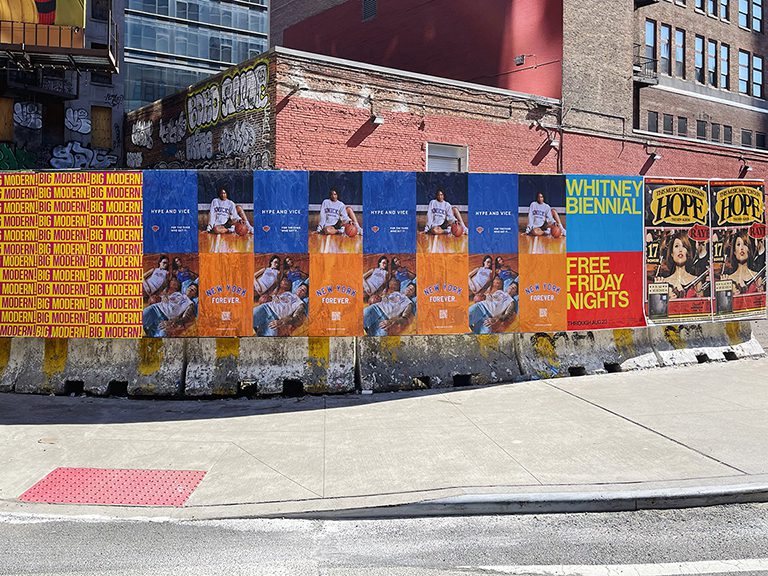
Wheat posting is the practice of adhering large-format printed posters to urban surfaces using paste adhesive. It puts your brand on real walls in real neighborhoods where real people see it every single day.
Wheat posting goes by several names. You might see it called wheatpasting, paste-up postering, or simply street poster advertising depending on who you ask. The term “wheat posting” comes from the wheat flour that was the original base ingredient of the adhesive paste used to affix posters to walls. Modern campaigns use commercial adhesive compounds rather than flour-and-water paste, but the name has stuck. The practice is the same regardless of what you call it: large-format printed posters bonded to urban surfaces to create street-level brand presence.
This format has been used to communicate with urban audiences for hundreds of years. Long before advertising agencies existed, merchants, theatrical producers, and political movements used paste-applied posters to reach people in city environments. The format persists because it solves a communication problem that no digital format has fully replaced. It reaches people in physical space, in specific locations, with a visual message that does not require a device, a data connection, or a platform subscription to receive.
At American Guerrilla Marketing, wheat posting is one of our signature services. We run these campaigns in New York City, Los Angeles, Chicago, Miami, Austin, and other major markets. Every campaign we build is custom-designed from the brief up, with location selection, design review, print production, installation, and documentation handled as an integrated process. This guide explains how wheat posting works as a marketing channel and why it remains one of the most effective tools in the street-level marketing toolkit.
Wheat Posting vs. Wheatpasting: Is There a Difference?
In practice, wheat posting and wheatpasting refer to the same thing. Both terms describe the practice of adhering paper posters to surfaces using a paste adhesive. The variation in terminology comes from regional usage, industry preference, and the fact that this format has never had a single canonical name. Some cities’ marketing communities use one term predominantly; others use the other.
We use both terms interchangeably and recognize that when a client asks about wheat posting, they are asking about the same service as a client who asks about wheatpasting. The paste method, the format options, the location types, and the campaign design principles are identical regardless of which term you start with.
The Wheat Posting Process: From Brief to Wall
Understanding how a wheat posting campaign gets built helps you work more effectively with a campaign partner and helps you set realistic expectations for timelines, costs, and results. Here is the full sequence of a professionally executed wheat posting campaign.
Step 1: Campaign Brief and Audience Definition
Every campaign starts with a brief. We need to understand your audience before we can tell you where to put your posters. Who are they? Where in the city do they live, work, shop, and socialize? What is the message you are trying to communicate, and what do you want someone who sees your poster to do next? What is the geographic scope of the campaign, and what is the timeline?
The answers to these questions drive every subsequent decision. A campaign targeting 18-to-25 music fans in Brooklyn requires a completely different location plan than a campaign targeting 30-to-45 creative professionals in Los Angeles. We do not apply a template. We build the strategy from the specific brief.
Step 2: Location Scouting
Our crews scout locations in the field. We photograph proposed wall surfaces, assess foot traffic patterns at different times of day, evaluate the visual competition from existing poster density on each surface, and confirm that surface conditions are suitable for quality paste adhesion.
We share the location proposal with clients before any print is ordered. Clients can approve, decline, or request alternatives for any proposed location. This step prevents the kind of campaign failure where posters end up on walls that do not deliver the expected audience because nobody verified ground conditions before committing to production.
Step 3: Design Review
We review every design submission against a set of street-level performance criteria before approving it for print. High contrast, legibility at distance, hierarchy clarity, and message simplicity are the core standards. A design that passes these standards on paper or screen will perform in the field. A design that fails any of these standards will underperform regardless of how strong the location plan is.
We give specific, actionable feedback when a design needs adjustment. We are not design critics. We are field practitioners who understand what works on city walls and what does not. Our feedback is always aimed at making the campaign more effective, not at expressing aesthetic preferences.
Step 4: Print Production
Once design is approved, we coordinate print production. We use outdoor-grade uncoated bond paper stock for most campaigns. Uncoated paper bonds better with paste adhesive than coated stocks. For premium placements or campaigns where design fidelity is particularly important, we use heavier-weight stocks that hold their visual quality longer and are more resistant to surface textures telegraphing through the paper.
Step 5: Installation
Installation crews work from the approved location list. They bring paste, brushes, rollers, and the printed poster inventory. Each wall is prepped, pasted, postered, and sealed with a top coat. Crew supervisors check placement quality as work progresses and flag any surfaces that require additional attention before finalizing the placement.
Step 6: Photo Documentation
Every placement is photographed after installation. Clients receive a complete photo report with one image per placement showing the poster in its installed context. This documentation confirms campaign completion, provides a visual record for internal reporting, and gives clients evidence of campaign delivery to use in their own team communications. Some campaigns also include geo-tagged placement maps showing the complete geographic footprint of the installation.
Where Wheat Posting Works Best: Location Intelligence
The value of a wheat posting campaign is entirely dependent on the quality of its location selection. Here is how we think about location quality across the markets where we work.
Foot Traffic Density
High foot traffic is the primary driver of brand contact volume. The more people who walk past a placement, the more people see it per day. In urban environments, certain blocks consistently generate orders of magnitude more pedestrian traffic than nearby blocks. Knowing which specific blocks those are, and having access to wall surfaces on those blocks, is the core location intelligence advantage that experienced wheat posting crews have over newcomers to the format.
Audience Match
High foot traffic is not useful if the foot traffic does not include your target audience. A wall with 10,000 daily pedestrians who are entirely outside your target demographic reaches far fewer of the right people than a wall with 1,000 daily pedestrians who are core members of your audience. Audience match is how we evaluate whether a high-traffic location is actually a high-quality location for a specific campaign. We never recommend a location just because it is busy. We recommend it because it is busy with the right people.
Visual Context and Wall Quality
The visual context around a poster affects how it is perceived. A poster on a clean, well-maintained wall surface in a neighborhood with high visual standards reads differently than the same poster on a deteriorating wall surface in a visually disorganized environment. We select walls that provide appropriate visual context for the brand standards of each client’s campaign.
AGM Field Note: The location-design compound effect. Strong location plus strong design creates a compounding effect. The location provides the audience. The design converts that audience’s attention into brand awareness. Neither works at full potential without the other. Campaigns that cut corners on either dimension underperform relative to campaigns that invest in both.
Wheat Posting Formats: Size Options and Use Cases
Format
Size
Ideal Use Case
Viewing Range
Small
11×17 in
Dense cluster placements, tight corridors
2-5 feet
Standard
24×36 in
Neighborhood campaigns, event promotion
5-20 feet
Large
36×48 in
High-competition zones, anchor placements
10-30 feet
Extra Large
48×72 in
Major corridor placements, premium walls
15-50 feet
Multi-Sheet
Custom
Full-wall takeovers, maximum visual impact
20-100 feet
For most campaigns targeting pedestrian corridors in major urban markets, we recommend starting at 24×36 as the baseline format and going larger in locations where the wall surface and viewing distance support it. Smaller formats work best in clusters where multiple posters create a combined visual mass rather than relying on a single placement to carry the campaign in a given location.
Campaign Longevity: How Long Does a Wheat Posting Placement Last?
Placement longevity varies significantly by market, surface condition, and season. Understanding typical lifespans in your target market helps you plan campaign timelines and budget for refresh placements if needed.
In Los Angeles, the city’s dry climate is a significant advantage. Properly installed posters in LA regularly last four to six weeks without weather-related degradation. The absence of heavy seasonal rain means placements hold up through the campaign’s entire intended active period in most cases. In protected locations such as covered walkways or recessed wall sections, placements can remain readable for eight to ten weeks.
In New York City, conditions are more variable. Summer and fall campaigns in New York typically see three to four week lifespans in good surface conditions. Winter and spring campaigns are more vulnerable to rain and moisture, which can reduce lifespan to two weeks in poor surface conditions. We build campaign timelines to account for these seasonal variables and can schedule refresh placements when a campaign needs to maintain visibility through a longer active window.
In Chicago, the winter months present the most challenging conditions. Cold temperatures slow paste drying and can affect adhesion quality on very cold surfaces. We advise against wheat posting in Chicago between late November and early March unless campaign requirements specifically demand it. The spring through fall season in Chicago produces excellent placement longevity, with three to five week active periods typical in good surface conditions.
In Miami, the summer rainy season is the primary longevity challenge. Campaigns run between May and September in Miami should account for more frequent refresh placements. The dry season from November through April produces the strongest placement longevity in the Miami market, with properly installed posters lasting four to six weeks in most conditions.
Who Uses Wheat Posting Campaigns
The range of organizations and brands that run wheat posting campaigns is broader than most people expect. Here is a cross-section of the industries and use cases we see most commonly.
Music and Entertainment
Music labels, artists, tour promoters, streaming services, and film distributors use wheat posting consistently and historically. The connection between street poster culture and music promotion is deep and authentic. A new album release, a tour announcement, or a concert series promotion communicates differently through city walls than through digital advertising. The physical presence on the street creates an energy around the release that digital cannot replicate. We have worked with independent artists running campaigns in a single neighborhood and major labels running simultaneous campaigns across six cities.
Fashion and Lifestyle Brands
Fashion brands at every price point from streetwear to luxury use wheat posting to establish presence in the neighborhoods where their customers live. The cultural specificity of the format works particularly well for fashion, where neighborhood context is itself a brand signal. A poster in Bushwick says something different about a brand than a poster in SoHo, and both placements are making intentional cultural statements. For seasonal launches, collaboration announcements, and new market entries, wheat posting creates the street-level credibility that fashion brands need to be taken seriously by their core audiences.
Consumer Goods Launches
Food and beverage brands, personal care products, and consumer technology companies use wheat posting for new product launches. The physical presence on street walls creates the sense of cultural momentum around a new product in a way that digital advertising alone cannot achieve. It makes a launch feel like an event rather than just a marketing push. For products that are trying to earn credibility with a specific urban demographic, the physical proof of street-level presence carries a weight that digital advertising simply cannot manufacture.
Event and Experience Marketing
Art shows, pop-up events, gallery openings, film screenings, food festivals, and community events all use wheat posting to drive awareness within specific geographic targets. For events where the audience is local and the timeline is specific, wheat posting provides better geographic targeting than any digital format and creates the physical buzz that makes an event feel anticipated rather than discovered at the last minute.
Measuring the Success of a Wheat Posting Campaign
One of the most common questions we hear is how to measure results from a wheat posting campaign. The format does not produce click-through rates or conversion pixels. But it does produce measurable outcomes when you approach measurement with the right methods.
Geofenced Digital Lift
Geofenced digital advertising targeted at the specific neighborhoods where your wheat posting is running gives you a clean comparison point. Run a digital campaign in the same zones with the same creative, and measure the click-through rate and engagement rate among people in those zones. Compare it to baseline digital performance in those same zones before the wheat posting started. The lift attributable to physical exposure is measurable and typically significant.
Unique Promo Codes and Tracking URLs
If your wheat posting campaign includes a specific call to action, a promo code printed on the poster or a short URL, you can track direct response from street exposure. This approach is particularly effective for event promotion, retail launches, and e-commerce brands where the conversion action is clear and the tracking infrastructure is simple to set up.
Social Media Monitoring
Well-designed wheat posting campaigns in culturally active neighborhoods frequently generate organic social media photography. People photograph interesting posters. They share those photographs on Instagram, TikTok, and other visual platforms. Monitoring for tagged posts, geo-tagged content, and brand mentions in the target neighborhoods during and after the campaign provides an organic engagement metric that reflects genuine cultural attention to the campaign.
Direct Audience Surveys
For campaigns with sufficient budget, direct surveys of target neighborhood residents before and after campaign exposure provide clean brand awareness lift data. This approach is more expensive but produces the cleanest measurement of physical advertising impact on brand recall in specific geographic areas.
Wheat Posting Best Practices for Maximum Campaign Impact
After running dozens of wheat posting campaigns in major markets, we have learned which practices consistently produce better outcomes. These are the standards we apply to every campaign we build.
Scout before you print. Never commit to a print run before verifying that the walls you plan to use are actually suitable for high-quality placement. Surface conditions, competing poster density, and visual context all affect campaign performance and cannot be assessed from a map or a database.
Design for the worst-case visual context. Your poster will not always appear on a clean white wall. It may appear next to other posters, on textured surfaces, in complex visual environments. Design against the hardest possible context. If your design holds up in a visually noisy environment, it will excel in cleaner ones.
Concentrate before you spread. Fifty posters on a single busy block will outperform fifty posters scattered across five different neighborhoods. Start with geographic concentration. Build from there once you have running a strong presence in your primary zone.
Time installation to the campaign window. If your campaign has a specific active period, like an event date or a product launch window, install posters two to three weeks before that window opens. Campaigns installed too early lose visual freshness before the active period begins. Campaigns installed too late miss the build-up period that drives the most conversion intent.
Document everything. The photo report and placement maps are more than accountability tools. They are learning resources that improve future campaigns by showing you exactly what was installed, where, and in what condition. Review them carefully after every campaign.
Frequently Asked Questions About Wheat Posting
Build Your Wheat Posting Campaign With AGM
At American Guerrilla Marketing, we have been running wheat posting campaigns long enough to know exactly what works and what does not. We have placed posters on thousands of walls across dozens of neighborhoods in the cities where this format matters most. We know the specific blocks, the specific walls, and the specific design principles that turn a poster campaign into a genuine brand moment.
We work with brands of all sizes, from independent artists and local businesses to national consumer brands and major entertainment companies. The fundamentals are the same regardless of campaign size: strong location, strong design, strong execution, and thorough documentation. We apply those fundamentals to every campaign we take on. When the work is done, you receive a complete photo report and placement maps documenting exactly what went up, where it is, and what it looks like in context.
If you are ready to put your brand on the walls that matter, contact us. We will build a proposal that fits your budget, your timeline, and your goals. Call us at (646) 776-2770 or email [email protected].
Written by the team at American Guerrilla Marketing. AGM runs wheat posting and street poster campaigns in New York City, Los Angeles, and major markets nationwide.
Frequently Asked Questions
Is wheat posting the same as wheatpasting?
Yes. Wheat posting and wheatpasting both describe the same practice: adhering paper posters to urban surfaces using a paste adhesive. The terms are used interchangeably in different markets and by different practitioners. The mechanics, format options, and campaign considerations are identical regardless of which term you use.
How many wheat posting placements do we need to run an effective campaign?
A minimum of 50 to 100 placements in a focused geographic area creates the critical mass needed for meaningful visual presence. Fewer placements than that typically feel like individual posters rather than a campaign. For city-wide brand awareness, 500 to 2,000 placements across target neighborhoods creates the saturation level that builds genuine audience recall.
How quickly can a wheat posting campaign be launched?
From design approval to installed posters is typically five to seven business days in markets where we have running crew capacity. Rush timelines of two to three business days are possible in high-priority situations. Longer lead times allow for more thorough scouting and better location options, especially in markets where we are building a new location database.
What cities do you run wheat posting campaigns in?
We run campaigns in New York City, Los Angeles, Chicago, Miami, Austin, San Francisco, Portland, Seattle, Philadelphia, Atlanta, and other major markets. Our strongest market depth is in NYC and LA where we have the most running crew networks and location databases. We can coordinate campaigns in any major US metro and work through trusted local partners in markets where we do not have permanent crew presence.
What makes a wheat posting design effective for the street?
High contrast, simple message hierarchy, legible typography at viewing distance, and a primary visual element that communicates the brand in under two seconds. The designs that work best on city walls are the ones that make one clear visual statement with maximum confidence. Complexity, subtlety, and fine detail do not work at street scale. Boldness, clarity, and visual authority do.
How do you document that the campaign was executed correctly?
Every placement is photographed immediately after installation. We deliver a complete photo report showing every poster in its installed location. The report includes location address or intersection data for each placement. Some campaigns include geo-tagged placement maps showing the complete geographic footprint of the installation. This documentation is a standard deliverable on every campaign we run.
Can we run wheat posting and digital advertising at the same time?
Yes, and we strongly recommend it. Geofenced digital advertising targeting the same geographic zones where physical wheat posting is running creates a compounding brand exposure effect that outperforms either format alone. Physical exposure builds subconscious brand recognition. Digital follow-up in the same area converts that recognition into engagement and action. We design integrated campaigns that take advantage of this compounding dynamic.
The best surfaces are smooth, painted concrete, stable brick, and smooth metal or wood with intact paint or finish. Rough, deteriorating, wet, or oily surfaces produce poor adhesion and short placement lifespans. Our crews assess every surface before placement and skip locations that will not support quality installation rather than placing posters in substandard conditions.