Esports is no longer an emerging category. Major tournaments fill arenas with tens of thousands of attendees. Championship events draw viewership that rivals traditional sports broadcasts. And the physical events, the tournaments, the gaming conventions, the fan gatherings around major esports moments, concentrate a specific and highly valuable young adult consumer demographic in ways that brand marketers increasingly recognize as worth serious investment. See also: Sports Marketing.
At American Guerrilla Marketing, we bring the same street-level activation expertise we deploy at music festivals, sporting events, and cultural moments to the esports and gaming event space. The physical dimensions of esports event marketing, the streets surrounding the arena, the neighborhoods where attendees gather before and after, the approach corridors on event days, are opportunities that gaming-focused digital agencies typically ignore and that traditional sports marketing agencies do not fully understand. Our team understands how to activate in those spaces for an audience that has specific expectations about what authentic brand engagement looks like.
This guide covers how esports event marketing works at the physical level, which events generate the strongest opportunities for brand activation, and how to build a campaign that reaches the gaming audience in ways that respect their culture and generate genuine return. See also: Experiential Marketing.
Understanding the Physical Esports Event Audience
Physical esports event attendees are different from the much larger audience that watches esports online. They made a deliberate choice to attend in person, which typically requires purchasing tickets, arranging travel, and spending a day or weekend in a specific city for an event. This self-selection produces an audience that is deeply passionate about gaming culture and more brand-receptive than casual online viewers, because they are in an active, social, experience-seeking mode rather than sitting at home on a screen.
The demographic profile is primarily 18 to 30, with a strong core in the 18 to 24 segment and a growing 25 to 35 contingent as gaming culture’s original fans age into full consumer adulthood. The audience was predominantly male historically but has diversified significantly, particularly at game-agnostic events like PAX and DreamHack. Income levels vary but skew toward early-career adults with meaningful disposable income concentrated on gaming, tech, entertainment, and food.
Critically, the esports audience is brand-aware in ways that make them simultaneously the most valuable and most challenging audience for experiential marketing. They know what authentic looks like and they know what pandering looks like. A brand that shows up with genuine understanding of gaming culture, not just a game controller in their logo, earns real attention. A brand that shows up with awkward forced gaming references earns ridicule.
Why Physical Activation Matters in Esports Marketing
The esports marketing conversation is dominated by digital: streaming sponsorships, in-game placements, influencer partnerships, and branded content. All of these have their place. But the most underutilized opportunity in esports marketing is the physical event, because physical events are where the most passionate segment of the gaming audience concentrates, and where brands can create the kind of memory-generating, tangible experiences that digital channels cannot replicate.
A brand ambassador who puts something interesting in a gaming fan’s hand at the entrance to an esports arena creates a different kind of impression than a logo on a broadcast overlay. A creative activation in the blocks around the venue creates word-of-mouth among people who spent their day immersed in a community event and are actively talking to each other about what they experienced. The street-level campaign creates presence in an environment where very few brands are competing for attention, because most of them are spending their budgets on the digital side.
This is the opening that our team exploits at esports events: the exterior, the surrounding streets, the approach corridors, and the neighborhood gathering spots where the gaming crowd moves before and after the main event. Guerrilla marketing in these spaces reaches the audience without requiring expensive arena-level placements.
Major Esports Events Worth Activating Around
The physical esports event calendar includes several categories of events, each with distinct audience profiles and marketing characteristics.
Championship and tournament finals: The League of Legends World Championship, Call of Duty League Championship Weekend, and similar year-end tournament events fill major arenas in host cities. These events generate significant local and national media coverage and draw fans from across the country who travel specifically for the event. The surrounding streets on championship weekend carry a concentrated, passionate audience that is highly accessible through perimeter campaigns.
Gaming conventions: PAX events in Seattle, Boston, and Philadelphia; DreamHack in Atlanta and other markets; and GDC in San Francisco draw gaming audiences ranging from tens of thousands to over 100,000 attendees across multi-day events. Convention audiences are in a longer discovery mode than tournament attendees, which makes them particularly receptive to brand sampling and ambassador interactions.
League home matches and recurring events: The Overwatch League and other franchised esports leagues hold regular home matches in dedicated arenas or shared venue arrangements throughout the season. These recurring events create consistent marketing windows for brands that want to build frequency with the gaming audience in a specific market over a full season.
LAN events and regional tournaments: Below the national championship level, LAN events and regional tournaments in major cities create additional activation windows that are often less expensive and less competitive for brand presence than marquee national events.
Street Teams at Esports Events: What Works
Our brand ambassador street teams at esports events are selected and briefed specifically for the gaming audience. The ambassadors need to understand gaming culture enough to have real conversations, not just to recite a script. They need to be able to talk about the game being played at the tournament, the culture surrounding it, and how the brand connects to that world in an honest way.
We station ambassador teams at the points of highest concentration in the esports event perimeter: the entrance queues, the rideshare and transit zones around the venue, and the food and bar areas in the surrounding blocks where gaming fans gather before doors open and after events end. Evening post-event windows are particularly productive because attendees are in a heightened social mode after spending hours in a shared competitive experience.
The most effective ambassador interactions at esports events are brief, specific, and experience-forward. The gaming audience does not respond well to a long brand pitch. They respond well to something to try, something to see, or something genuinely interesting about the brand’s connection to gaming or their own experience that day. Short interaction, real substance, something to take away: this formula works consistently.
Sports Experiential Marketing in the Esports Context
The principles of sports experiential marketing apply to esports events with modifications for the specific culture. In traditional sports, the tailgate before the game and the bar after it are natural brand activation zones. In esports, the analogous spaces are the gaming lounges, bar arcades, and gathering spots that the gaming community uses before and after events. Our team identifies these spaces in advance of every esports event we activate around and builds the ambassador and sampling programs to cover them.
Physical brand activations at esports events that work well include: product sampling stations with gaming-relevant products (energy drinks, snacks, gaming peripherals); interactive elements that let attendees do something rather than just see something; and photo moments that generate content people genuinely want to share. The photo moment is particularly important for the gaming audience, which is among the most active content-creating demographics of any event category.
Interactive elements need to be genuinely engaging, not just a branded version of a generic carnival game. The gaming audience is sophisticated about what counts as a real interactive experience and what is just marketing wearing one. We help brands design activations that actually work for this audience rather than ones that look good in a pitch deck but fall flat in the event environment.
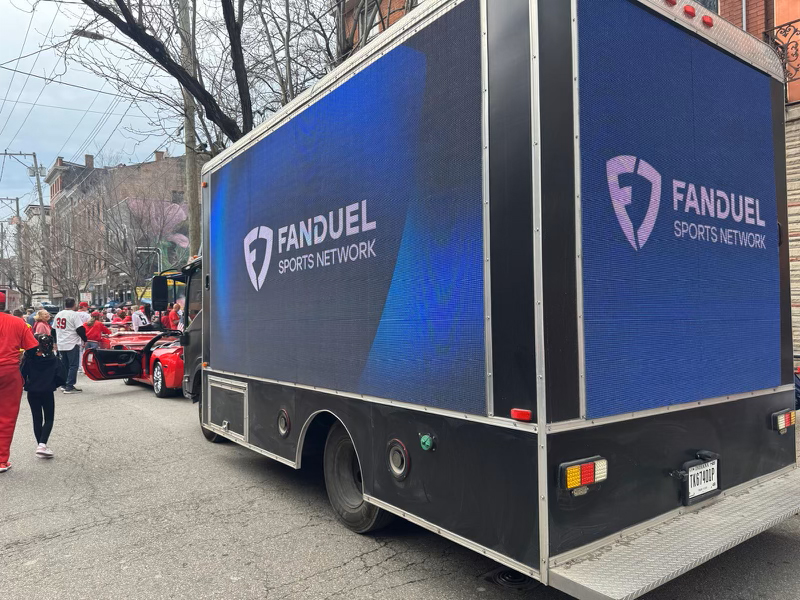
LED Billboard Trucks at Esports Arenas
Our LED billboard trucks run the approach corridors around esports event venues during peak arrival and departure windows. At a major championship event in a major arena, thousands of people arrive in a compressed window and depart at an even more compressed time. The departure moment, when 10,000 to 20,000 people pour out of an arena simultaneously, is one of the highest-density marketing windows available in any event type.
A truck positioned on the primary street leading away from the arena during the departure window generates a very high number of impressions in a short time. Creative that speaks directly to what just happened inside the arena, celebrating the event or the game rather than ignoring it, lands better in this window than generic brand creative that could run anywhere.
We build esports event truck routes with the specific venue geography in mind. Urban arenas have different routing considerations than suburban ones. Transit-heavy markets require different approach tactics than car-heavy markets. The route plan for every esports event deployment is built from on-the-ground knowledge of how the audience actually moves, not from a desk estimate.
Wheatpaste and Street-Level Campaigns Around Gaming Events
In the neighborhoods around major esports event venues, wheatpaste poster campaigns in the days before the event create the pre-event awareness that makes day-of encounters feel like recognition rather than cold introductions. For gaming-adjacent brands that want to build credibility with the esports audience, the poster campaign is a way to put creative in the environment the audience occupies before the event, in the bars, gaming cafes, and streets of the neighborhoods they frequent.
Sidewalk stencils on the approach routes to the event venue add ground-level visibility at the specific moment when attendees are walking in, at their highest energy point, and most tuned in to their physical surroundings. A stencil on the sidewalk outside an esports arena is seen by everyone who walks in on foot, which at most urban esports events is a significant percentage of the total attendance.
Non-Gaming Brands at Esports Events
The esports audience is a young adult consumer demographic that buys across all categories. Some of the most successful brand activations we have seen at gaming events have been from brands with no specific gaming product to sell, who simply recognized that the audience demographic matched their target customer profile.
Food and beverage brands find the esports crowd genuinely receptive, particularly for energy drink, snack, and quick-service food categories that align with gaming culture organically. Fashion brands in streetwear and athletic casual clothing find an audience that cares deeply about how they look and what they wear, and who associate certain brands with the cultural identity of gaming in the same way music fans associate brands with their scene. Financial services brands targeting first-time investors and young professionals are finding the gaming audience to be one of their most productive channels for conversion.
The key for non-gaming brands is approaching the audience with respect. Do not pretend to be a gaming brand if you are not. Do be honest about why you are there and what you are offering. The gaming audience appreciates directness and authenticity, and will respond to a brand that says “we know you are here for the tournament and we just want to give you something worth having” more warmly than one that manufactures a fake gaming connection.
Building an Esports Event Marketing Program
Effective esports event marketing is built on a clear understanding of which events to prioritize, what tactics work for the specific event format and venue, and how to brief ambassadors and creative for the gaming audience.
We recommend brands new to esports event marketing start with a single major event in their target market, execute one well-planned campaign, measure results, and use those results to build a broader program. The gaming audience is one of the most data-rich in consumer marketing, and the results of a physical activation at an esports event are measurable through a combination of ambassador tracking, QR code redemptions, and post-event brand awareness surveys.
Brands with existing digital esports marketing programs, streaming sponsorships or creator partnerships, can add significant value by layering physical activation on top of those programs. The attendees at a major esports event are the same people who watch the streams. A brand that reaches them online and then reaches them again in person at the event creates a frequency and multi-channel impression that digital alone cannot achieve.
Frequently Asked Questions
What does an esports marketing agency do?
An esports marketing agency plans and executes brand campaigns targeting the gaming audience , including sponsorship activation at esports events, physical brand activations at gaming venues, street-level campaigns in the surrounding areas of esports events, brand ambassador programs, and OOH advertising. AGM specializes in the physical and street-level dimensions of esports event marketing.
Which esports events are best for brand marketing?
The League of Legends World Championship, Call of Duty League events, Overwatch League finals, ESL One, and DreamHack are among the highest-attended physical esports events. PAX and GDC, while not purely competitive gaming, draw gaming audiences in large numbers that are highly brand-receptive.
How does physical esports event marketing work?
Physical esports event marketing operates in and around the venues where esports tournaments and gaming events take place. This includes exterior campaigns in the blocks surrounding the venue, mobile billboard routes on approach corridors, brand ambassador teams in adjacent gathering spaces, and any approved interior activations within the event footprint.
What is the esports event audience demographic?
Physical esports event attendees skew 18-30, predominantly male but with a growing female and non-binary segment. They are tech-savvy, early adopters, and highly brand-aware within categories relevant to gaming culture: energy drinks, tech hardware, food delivery, fashion streetwear, and financial services.
Can non-gaming brands market at esports events?
Yes. The esports audience is a young adult consumer demographic that purchases across all categories, not just gaming products. Brands in food, beverage, automotive, fashion, and financial services have all found the esports audience receptive, provided the activation approach is authentic and not condescending about gaming culture.
What makes esports experiential marketing different from other sports marketing?
The esports audience is particularly attuned to authenticity and will reject brand work that feels fake or forced. Unlike traditional sports fans, who are accustomed to heavy sponsor presence, esports fans often have a more skeptical relationship with branded content. The most effective physical activations in esports spaces are experience-first: they offer something genuinely worth doing rather than just a brand logo to stand next to.
How far in advance should we plan esports event marketing?
Eight to twelve weeks before the event is the recommended planning window. Physical esports events often announce dates and venues with limited advance notice compared to traditional sports seasons, so brands that want to execute well should build a flexible planning process that can mobilize quickly when dates are confirmed.