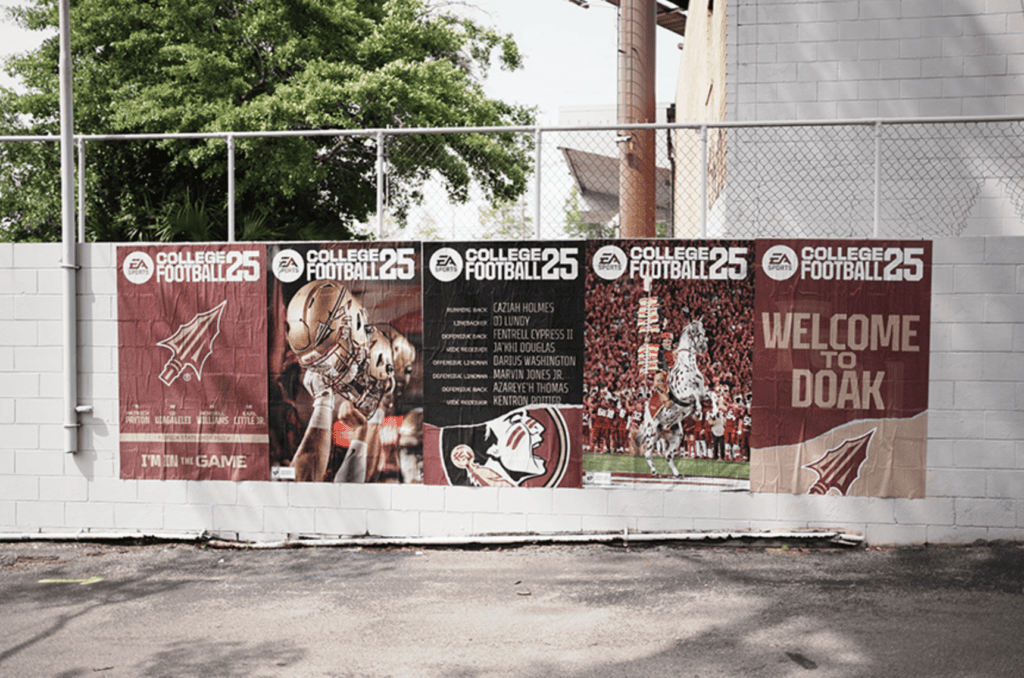
When EA Sports relaunched the College Football franchise with EA Sports College Football 25, they needed to reach the exact audience that had been waiting for that game for over a decade: college football fans on actual college campuses. We deployed 2,500 posters across 15 campuses in the weeks before launch. This is how we planned it, what we learned, and what made it work.
This piece is a first-person account of a real field campaign — not a cleaned-up case study that removes the constraints. Real campaigns have deadlines, production limits, campus-specific rules, variable wall quality, and field teams that have to solve problems on the fly. What made this program successful was the planning that happened before any crew member drove to a campus, and the documentation discipline that gave the client a verifiable record of every placement.
If you’re evaluating a campus poster program for a game launch, entertainment release, or consumer product targeting the college audience, the operating details here are the ones most recaps leave out.
Why Campus Poster Campaigns Work for Game Launches
The core audience for EA Sports College Football 25 — college football fans aged 18-24 — is one of the most geographically concentrated audiences in consumer marketing. During the academic year, millions of them live within a few square miles of their respective campuses. They walk the same corridors every day, eat at the same dining halls, and hang out in the same neighborhoods. That concentration is an activation advantage.
Digital advertising can reach this audience at scale, but it competes with everything else on their screens. A poster on a wall they walk past three times a day generates repeated impressions with no competing content. Better still, those impressions happen in the physical environment where the social context is college football — the conversations, the gaming sessions, the tailgates. The medium and the moment align in a way that scroll-based advertising cannot match.
The challenge is execution at scale. Reaching 15 campuses simultaneously requires logistics, coordination, and documentation systems that most street marketing shops are not equipped to run. That is what we built for this program.
How We Selected the 15 Campuses
Campus selection was the first and most important decision. Not all campuses are equal for this type of program. The variables that mattered:
Conference and Program Prestige
We prioritized campuses with major football programs — SEC, Big Ten, ACC, and Big 12 schools where college football culture is highest intensity. These schools have the largest concentrations of fans who were specifically waiting for the EA Sports College Football return, who remembered the previous franchise, and who would recognize and respond to pre-launch awareness.
Market Accessibility
Campuses in markets where we had established field crews or could recruit qualified crews quickly were prioritized over remote markets that would require new crew development under deadline. Field talent quality affects the outcome more than geography when you’re running a coordinated multi-market rollout.
Wall Inventory Quality
We scouted posting inventory before finalizing each campus. Some campuses have excellent adjacent commercial real estate with high permitted posting density. Others have limited options and require more creative location selection to achieve placement density. Markets with strong inventory got higher poster allocations. Markets with constraints got adjusted targets based on realistic placement potential.
Production and Logistics: What Had to Lock Before Print
The production sequence for a 15-campus simultaneous deployment has to be planned backward from the installation window. Everything — creative, print, shipping, crew scheduling — has to be locked in order before the first item moves.
Creative and Print
Poster creative for campus campaigns has to work at street scale. High contrast, minimal text, strong visual hierarchy. We reviewed the EA Sports supplied creative for street legibility before finalizing print specs — size, paper weight, coating — that would hold up through the installation process and maintain quality on the wall for the targeted visibility window.
Central Production, Distributed Delivery
We produced all materials centrally and shipped to field supervisors in each market on a coordinated timeline. Each market supervisor received their allocation, confirmed receipt, and staged materials for crew distribution. This centralized production approach eliminates the quality variance that comes from local printing in 15 different markets and gives the client consistent visual results across the entire campaign.
Crew Coordination
Each market had a designated field lead. All 15 market leads attended a coordinated briefing — location selection criteria, posting technique requirements, photo documentation protocol, and the check-in and reporting schedule. The briefing eliminated variability in execution standards before crews hit the field.
Installation: What Route Logic and Surface Choice Actually Determined
On installation day, the decisions that separated high-impact placements from wasted posters were location and surface selection. The brief said “15 campuses.” The execution question was which walls on each campus would generate the most impressions over the visibility window.
Priority Locations
We prioritized exterior walls on the pedestrian corridors between residence halls and academic buildings, the surfaces adjacent to dining facilities where students queue and congregate, and the off-campus commercial blocks immediately adjacent to campus where street posting regulations are more permissive than on-campus rules. These locations generated the highest repeat impression rates because the audience passed them multiple times per day as part of their existing movement patterns.
What We Avoided
Interior bulletin board placements, isolated walls with low foot traffic, and locations that required special permissions we hadn’t secured in advance. The field leads had clear authority to substitute planned locations for better alternatives encountered on the day — what mattered was placement quality, not mechanical adherence to a pre-scouted list that might have changed since scouting.
Documentation: How We Proved the Work Was Done
A 2,500-poster campaign is only as credible as its documentation. Every placement was photographed by the installing crew member at time of installation, with GPS metadata embedded. Field leads compiled daily photo reports by campus. We aggregated these into a final placement map and photo library for the client — a verifiable record of where every poster went and what it looked like at time of installation.
Documentation at this level serves two purposes. It gives the client proof of performance they can use internally. It also creates accountability within the field program — crew members who know documentation is required perform more carefully than crews who think they’re unsupervised.
What We Measured Beyond Placement Count
Placement count is the baseline metric, but it tells you what was deployed, not how it performed. We tracked several additional indicators across the campaign window:
Persistence Rate
We ran check passes on a sample of placements in each market at day 3, day 7, and day 14 post-installation. This told us which campuses and which location types held longer and where refresh runs were warranted to maintain saturation through the launch window.
Location Quality Score
Each market lead assessed every placement on a simple quality scale: prime location (direct pedestrian corridor, high daily repeat traffic), standard location (consistent traffic, lower frequency), marginal location (meets minimum threshold but lower impact). The aggregate quality distribution across the campaign helped us optimize targeting for future campus deployments.
Field Observations
Market leads noted observations from the field: ambient buzz, students photographing the posters, competing brand activity, and anything unusual that affected the operating picture. These observations were included in the field reports and proved useful for planning purposes on subsequent campaigns in the same markets.
Lessons That Apply to Any Campus Poster Campaign
The specific brand context of EA Sports College Football 25 — a beloved franchise returning after years away — created a uniquely receptive audience. But the operational lessons apply to any campus program:
- Market leads outperform centrally managed crews. A designated point of contact in each market who owns the deployment result produces better work than remotely managed anonymous crews. The ownership changes behavior.
- Wall quality has a bigger impact than total placement count. 150 well-placed posters on a campus outperform 300 placed on marginal surfaces. Density in the right locations beats coverage of the wrong ones.
- Documentation is not optional. The client value is not just impressions — it’s verifiable impressions. GPS-tagged photo documentation is the difference between a credible field report and an approximation.
- The installation window is the constraint that controls everything else. Campus traffic, seasonal timing, and launch-relative timing all feed into the installation window. Plan backward from that window to determine production, shipping, and crew scheduling requirements.
Applying This Model to Other Entertainment Launches
The campus poster program format works for any consumer product with a concentrated college audience: video game releases, music album launches, streaming show premieres, film releases, athletic gear, and consumer tech. The model is the same — identify where the audience concentrates, select the highest-impact location types, build the logistics chain backward from installation, document everything.
AGM’s poster and wheatpasting programs operate across 50+ markets. Our street team programs complement poster work with human activation when the campaign calls for more than passive visibility. For campus campaigns specifically, we’ve run programs for gaming, streaming, music, and consumer brand clients across SEC, Big Ten, ACC, Pac-12, and Big 12 markets.
FAQ
How did AGM execute 2,500 poster placements across 15 campuses simultaneously?
We deployed coordinated field crews in each market simultaneously, briefed on identical protocols: location selection criteria, posting technique, photo documentation requirements, and daily check-in schedules. Central coordination managed timing across markets so installations happened in a compressed window rather than staggered over weeks.
What made campus poster campaigns effective for the EA Sports College Football 25 launch?
The game’s core audience — college football fans aged 18-24 — is physically concentrated on campuses. Reach them where they live, sleep, eat, and walk to class and you build awareness in the exact context where they’re most likely to talk about a game launch with the people they know.
What posting locations performed best on college campuses?
High-traffic pedestrian corridors between residence halls and academic buildings, areas adjacent to dining facilities, and the streets and walls immediately surrounding campus in off-campus zones consistently outperformed interior bulletin board placements.
How did production logistics work for a 15-campus simultaneous rollout?
Materials were produced centrally and shipped to field supervisors in each market on a coordinated timeline. Each market had a designated field lead who received, inventoried, and distributed materials to crew members. Centralized production with decentralized execution is the standard AGM model for multi-market rollouts.
What documentation did the EA Sports campaign produce?
Every placement was photographed with GPS metadata at time of installation. Daily field reports from each market supervisor consolidated placement counts, location descriptions, and observations. The final client report included a complete photo library and placement map across all 15 markets.
Can this type of campaign be replicated for other game launches or entertainment releases?
Yes. The campus poster campaign model works for any entertainment product with a college audience — games, music, streaming releases, film premieres, athletic gear. The key variables are market selection, timing relative to launch date, and placement density within each campus.
What is the typical cost range for a multi-campus poster campaign?
A 10-15 campus campaign in the range of 2,000-3,000 placements typically runs $30,000-$70,000 depending on production, market selection, crew size, and documentation requirements. Contact AGM for a scoped quote based on your specific markets and volume.
Frequently Asked Questions
What is ea sports football 25 first person?
American Guerrilla Marketing provides ea sports football 25 first person services across 50+ U.S. markets. Every campaign is planned, scouted, executed, and GPS-documented by our field teams. We work with regional brands and Fortune 500 companies on campaigns that require real street-level execution and documented proof of performance.
How does AGM approach first person?
Our process starts with a market consultation to understand your goals, target audience, and budget. We then scout locations, handle any required permissions or permits, coordinate production and installation with our local crews, and provide a full GPS-tagged photo report after the campaign runs.
What markets does American Guerrilla Marketing cover for first person?
We operate in 50+ U.S. markets including New York, Los Angeles, Chicago, Miami, Houston, Atlanta, Seattle, Denver, Boston, and dozens of secondary markets. Contact us to confirm availability and pricing for your specific market.
How much does a first person campaign cost?
Campaign pricing depends on market, format, quantity, and duration. We work with budgets ranging from targeted single-market runs to national rollouts across multiple cities. Use our RFP Builder or contact us directly for a custom quote based on your specific campaign requirements.
How do I get started with first person through AGM?
The fastest way to get started is to submit your campaign details through our RFP Builder at americanguerrillamarketing.com, or contact us directly at [email protected] or (646) 776-2770. Our team typically responds within one business day with availability and initial pricing.