Out-of-home advertising has a measurement problem that has persisted for most of its history. A billboard in a city generates impressions from passing cars and pedestrians, but for most of the industry’s existence, those impressions have been estimated from traffic counts rather than measured from actual audience data. This gap between real impact and measurable proof has kept OOH at the edges of performance-driven media budgets, classified as a brand awareness vehicle with limited accountability.
That is changing, and the OOH market research analyst is the role at the center of that change. As mobile location data, programmatic DOOH (digital out-of-home), and advanced attribution modeling bring OOH into the same measurement frameworks as digital channels, the demand for analysts who can gather, interpret, and translate OOH audience data into strategic campaign decisions has grown significantly. This guide covers what OOH market research analysts actually do, what skills and tools define the role, how the measurement landscape is evolving, and why this data capability matters for brands running physical advertising campaigns.
What Is an OOH Market Research Analyst?
An OOH market research analyst is a data and strategy professional who supports out-of-home advertising planning and evaluation through audience research, location analysis, campaign measurement, and competitive intelligence. The role exists at media owners (billboard and transit operators), at OOH agencies and media planning firms, at research companies serving the industry, and increasingly at brands managing OOH in-house.
The core function is bridging the gap between the physical reality of an OOH placement, a billboard on a specific street, a transit card in a specific subway car, a digital screen at a specific intersection, and the audience measurement data that quantifies who is actually seeing it, when, and in what numbers.
The Shift From Traffic Counts to Audience Intelligence
Traditional OOH measurement relied on traffic counts: the number of vehicles or pedestrians passing a given location per day. This is accurate as a proxy for impressions but tells an advertiser very little about who those impressions reached. Mobile location data has fundamentally changed this. By analyzing the anonymized movement patterns of smartphones, OOH research can now provide advertisers with demographic composition data, audience interest profiles, and behavioral data about the people passing a specific location. This is the transformation that has made OOH research a genuine strategic capability rather than a counting exercise.
Core Responsibilities of an OOH Market Research Analyst
The day-to-day work of an OOH market research analyst spans several interconnected functions, all oriented around improving the quality of OOH advertising decisions with better data.
Audience Measurement and Site Evaluation
The primary technical function is measuring or estimating the audience delivered by specific OOH placements. This involves working with Geopath data, the industry standard for US OOH audience measurement, as well as proprietary data from mobile measurement companies and location intelligence platforms. Site evaluation compares placements across reach, frequency, demographic composition, and cost per thousand impressions (CPM) to guide inventory selection for client campaigns.
Market Analysis and Competitive Intelligence
OOH market research analysts evaluate competitive OOH activity in specific markets, identifying where competitors are advertising, which inventory categories they are using, and what messaging approaches they are taking. This competitive intelligence informs strategy for brands trying to achieve share of voice objectives or identify underserved positioning in specific markets.
Campaign Performance Reporting
Post-campaign measurement is increasingly central to the OOH analyst role. Using mobile location data, foot traffic attribution, brand lift studies, and sales lift modeling, analysts evaluate whether OOH campaigns delivered on their objectives beyond raw impression counts. This performance reporting is what enables OOH to compete for budget in performance-driven marketing organizations that demand accountability from every channel.
Custom Research and Audience Profiling
For major campaigns or market entry decisions, OOH research analysts conduct custom audience profiling studies that go beyond standard Geopath metrics. This might include analyzing the concentration of a specific target demographic in different neighborhoods, identifying commuter patterns that define the best dayparts and locations for specific inventory, or mapping the geographic overlap between a brand’s existing customer base and available OOH inventory.
Key Tools and Platforms in OOH Market Research
The OOH research technology stack has expanded significantly in recent years. Analysts working in this space use a combination of industry-standard platforms and proprietary data sources.
Geopath
Geopath is the nonprofit audience measurement organization for the US out-of-home advertising industry. It provides standardized impression, reach, frequency, and demographic data for OOH placements across major markets. Geopath certification is the OOH equivalent of Nielsen ratings: the common currency that allows buyers and sellers to transact on a shared measurement basis. OOH analysts at agencies and brands use Geopath data as the baseline for all planning and reporting work.
Mobile Location Intelligence Platforms
Platforms like Placer.ai, Foursquare, SafeGraph, and others provide mobile location data that measures the audience composition passing specific locations, the frequency of visits to specific venues, and behavioral attribution data that tracks what exposed audiences do after passing a placement. These tools have become essential for OOH research analysts who need to provide more granular audience intelligence than Geopath’s standardized metrics can deliver.
GIS and Mapping Tools
Geographic information systems (GIS) tools are essential for OOH research because the work is inherently geographic. ArcGIS, QGIS, and mapping platforms like Esri allow analysts to visualize inventory, overlay audience data, map competitor activity, and present complex geographic analysis in formats that non-technical audiences can act on. Strong GIS skills are increasingly a core requirement for OOH analyst roles at agencies and media owners.
Data Visualization and Reporting Tools
Tableau, Power BI, and similar data visualization platforms are used to create the campaign reports and market analysis presentations that OOH analysts produce for clients and internal planning teams. The ability to turn complex datasets into clear, visually compelling insights is as important as the ability to generate the analysis in the first place.
How OOH Research Drives Smarter Campaign Decisions
The value of OOH market research is not in the data itself but in the campaign decisions it improves. Data-informed OOH planning consistently outperforms intuition-based placement for brands that invest in the research infrastructure to do it right.
Location Selection Based on Audience Data Rather Than Gut Feel
Without audience data, OOH placement decisions default to approximations: busy intersection is probably good, neighborhood near the target demographic is probably right. With audience data, placement decisions are grounded in actual measurement of who passes each location and when. This typically produces placements that deliver significantly higher impressions to the target demographic for the same media investment.
Identifying Underserved Markets and Opportunities
OOH research can identify markets where a target demographic is concentrated but competitive OOH presence is low, representing an opportunity to establish strong share of voice without competing for premium inventory against heavy spenders. This market gap analysis is particularly valuable for challenger brands and new market entrants who cannot out-spend established competitors but can out-position them with smarter location strategy.
OOH Research and Guerrilla Marketing
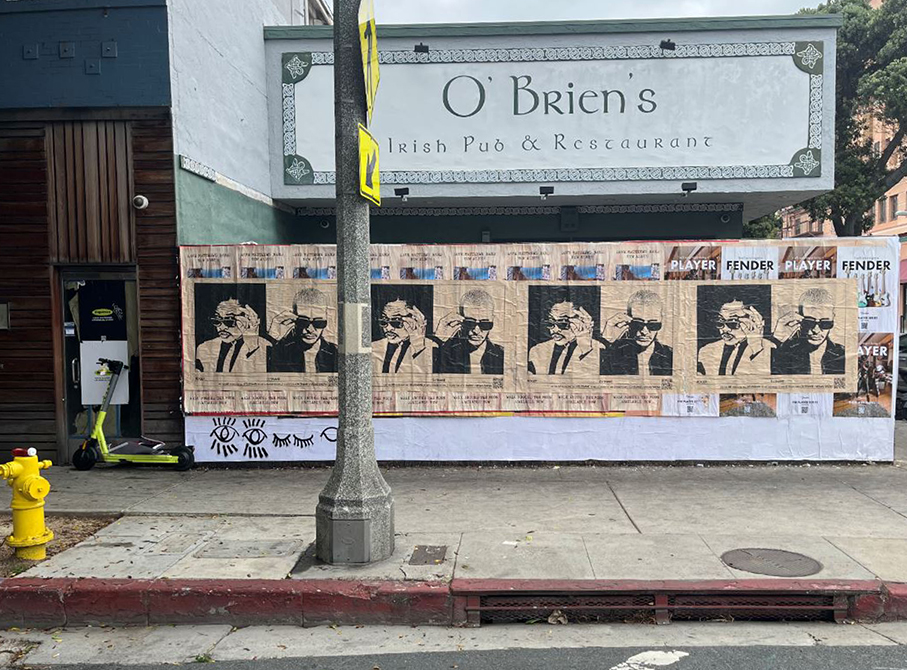
The location intelligence that OOH research analysts use to evaluate billboard placement is equally applicable to guerrilla marketing campaign planning. Our team applies the same data-driven location analysis to wheatpaste poster campaign placement, sidewalk stencil program routing, and street-level activation location selection that OOH analysts apply to traditional inventory planning.
Understanding where the target demographic concentrates, which pedestrian corridors carry the highest relevant foot traffic, and what times of day optimize exposure for a specific audience segment improves guerrilla campaign placement from art to science. Every guerrilla deployment we execute is GPS-documented, and the audience data from mobile location platforms can attribute post-exposure behaviors to specific placement locations, giving brands the attribution data they need to evaluate guerrilla campaign impact alongside traditional OOH.
The OOH Analyst Role in Cross-Channel Media Planning
As OOH measurement becomes more sophisticated, the role of OOH analysts in broader cross-channel media planning is expanding. Brands that previously treated OOH as an isolated awareness channel are increasingly integrating OOH exposure data into unified measurement frameworks that track consumer journeys across physical and digital touchpoints.
OOH researchers who understand how to connect exposure data from outdoor placements to downstream digital behavior data, website visits, search queries, and purchase transactions that follow geographic OOH campaigns, are providing brands with insights that justify OOH investment in performance-driven budget processes. This is the frontier of OOH market research, and it is where the most sophisticated work in the category is being done in 2026.
Frequently Asked Questions About the OOH Market Research Analyst Role
What does an OOH market research analyst do?
An OOH market research analyst collects, analyzes, and interprets data to support out-of-home advertising planning and campaign evaluation. Core responsibilities include audience measurement, site evaluation, competitive analysis of OOH inventory, campaign performance reporting, and strategic insights to guide media planning decisions.
What skills are required for an OOH market research analyst role?
Key skills include data analysis and statistical modeling, GIS and mapping tools, proficiency with audience measurement platforms like Geopath and Nielsen, Excel and data visualization tools, understanding of media planning and OOH inventory types, and the ability to translate data findings into actionable strategic recommendations.
What is Geopath and how is it used in OOH research?
Geopath is the nonprofit audience measurement organization for the US out-of-home advertising industry. It provides standardized audience metrics for OOH placements including impressions, reach, frequency, and demographic composition. OOH analysts use Geopath data to evaluate inventory, compare placements, and provide clients with audience reach estimates for proposed campaigns.
How is mobile location data used in OOH market research?
Mobile location data measures the audiences passing OOH placements, their demographic characteristics, and their subsequent behaviors after exposure. This data enables OOH research analysts to provide more granular audience intelligence than traditional traffic count methods and to measure campaign effectiveness through foot traffic attribution.
What is the difference between OOH research at a media owner vs. agency vs. brand?
At a media owner, OOH research focuses on proving the value of their own inventory. At an agency, research focuses on finding the best inventory across multiple vendors for client campaign objectives. At a brand, OOH research evaluates whether OOH investment is delivering on business objectives and how it integrates with broader media mix modeling.
How is OOH measurement evolving in 2026?
OOH measurement in 2026 is increasingly driven by mobile location data, programmatic transaction data, and AI-driven attribution modeling. The ability to measure foot traffic lift, website visit attribution, and sales lift from OOH campaigns is improving rapidly, making it easier to integrate OOH into cross-channel performance measurement frameworks.
How does OOH market research support guerrilla and experiential marketing campaigns?
OOH market research supports guerrilla and experiential campaigns by identifying the highest-traffic locations for activations, analyzing the demographic composition of target neighborhoods, evaluating competitive presence in specific geographies, and measuring the foot traffic and brand impact generated by physical activations. This data-driven approach improves placement quality and accountability for non-traditional OOH campaigns.
Frequently Asked Questions
What is demystifying the ooh market research analyst role?
American Guerrilla Marketing provides demystifying the ooh market research analyst role services across 50+ U.S. markets. Every campaign is planned, scouted, executed, and GPS-documented by our field teams. We work with regional brands and Fortune 500 companies on campaigns that require real street-level execution and documented proof of performance.
How does AGM approach analyst role?
Our process starts with a market consultation to understand your goals, target audience, and budget. We then scout locations, handle any required permissions or permits, coordinate production and installation with our local crews, and provide a full GPS-tagged photo report after the campaign runs.
What markets does American Guerrilla Marketing cover for analyst role?
We operate in 50+ U.S. markets including New York, Los Angeles, Chicago, Miami, Houston, Atlanta, Seattle, Denver, Boston, and dozens of secondary markets. Contact us to confirm availability and pricing for your specific market.
How much does a analyst role campaign cost?
Campaign pricing depends on market, format, quantity, and duration. We work with budgets ranging from targeted single-market runs to national rollouts across multiple cities. Use our RFP Builder or contact us directly for a custom quote based on your specific campaign requirements.
How do I get started with analyst role through AGM?
The fastest way to get started is to submit your campaign details through our RFP Builder at americanguerrillamarketing.com, or contact us directly at [email protected] or (646) 776-2770. Our team typically responds within one business day with availability and initial pricing.