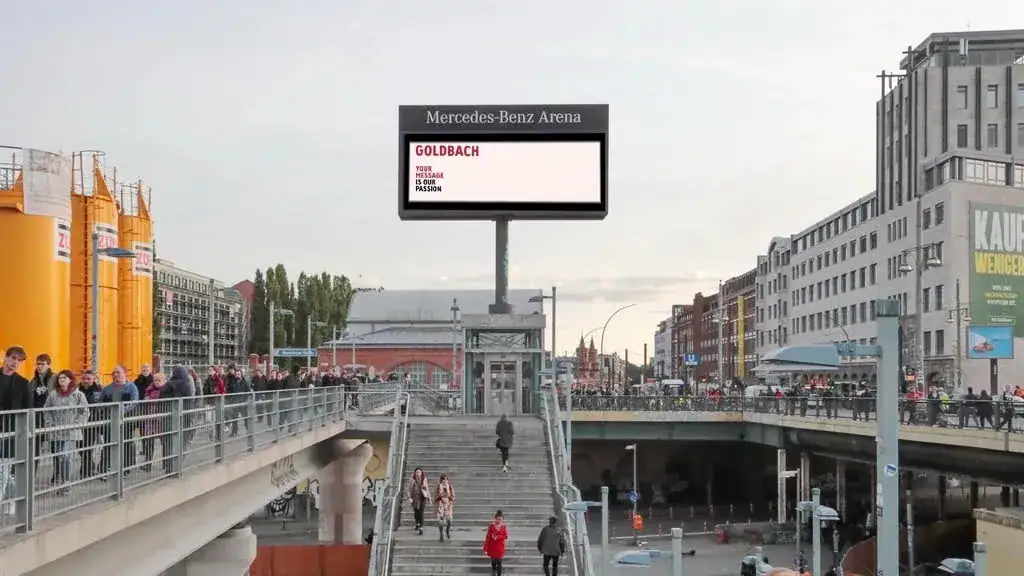
Global advertising has never been more accessible or more complex. Digital channels have flattened geographic barriers, making it technically possible for any brand to serve ads in Tokyo, London, and São Paulo from a single dashboard. But the paradox of digital ubiquity is that it has made physical, street-level advertising in global cities more valuable, not less. When every brand’s digital message is served to every screen simultaneously, the campaigns that break through are the ones that show up in the real world — on walls, sidewalks, and building facades in the cities where the target audience actually lives and moves.
This guide covers the strategic logic of global advertising, the role of guerrilla and out-of-home tactics in international campaigns, the key differences between major global markets, and how brands coordinate street-level presence across multiple countries and cities without losing the local authenticity that makes these campaigns work.
Our team operates across North American markets with an international partner network that extends campaign execution standards to major cities worldwide. We build global advertising strategies from the street up — starting with the physical campaign that generates real-world impressions and earned media, then amplifying through digital channels that extend reach into the audiences the physical campaign does not directly touch.
Why Global Advertising Requires Local Intelligence
The most common failure mode in global advertising is the campaign that treats every market identically. A billboard creative that performs brilliantly in Chicago generates neutral or negative response in London because the cultural reference does not translate. A guerrilla activation that earns headlines in New York violates public space regulations in Munich because the permit research was not done for the specific local market.
Effective global advertising starts with local market intelligence: who is the audience in this specific city, what visual culture do they respond to, what regulatory environment governs outdoor advertising, and what physical infrastructure is available for street-level campaigns. The strategic framework is global; the execution is local.
For brands operating across multiple markets simultaneously, this means building a network of local execution partners who understand on-the-ground conditions in each city, reporting structures that aggregate results across markets in a consistent format, and campaign calendars that sequence market activations to build cumulative global momentum rather than launching everything simultaneously and fragmenting attention.
The Multiplier Effect: When Street Campaigns Go Global
The defining advantage of guerrilla advertising in global strategies is the multiplier effect. A well-executed street-level campaign in a single global city that generates strong earned media and social amplification does not just reach the local audience — it reaches global audiences through press coverage and social sharing that extends the campaign’s geographic footprint to every market where the brand has awareness.
Examples of this multiplier at work are found throughout advertising history. Campaign activations in Times Square or on the South Bank in London earn international press coverage that generates brand impressions in markets where the campaign never physically deployed. A guerrilla activation that gets photographed and shared on Instagram during a major cultural event in a global city reaches the social networks of attendees who are themselves from 50+ countries — giving the campaign a global earned media footprint from a single local execution.
This multiplier effect is the primary reason guerrilla and out-of-home advertising continues to grow as a global brand strategy even as digital advertising becomes more sophisticated. Physical campaigns create social-sharing moments that digital campaigns, on their own, rarely generate.
New York City: The Global Advertising Benchmark
New York City remains the global benchmark for street-level advertising. Times Square, SoHo’s Spring Street corridor, the Meatpacking District, and the Brooklyn neighborhoods of Williamsburg and Bushwick are the world’s most densely documented outdoor advertising environments — campaigns executed here generate global press attention and social sharing that no other single market can match.
Our North American campaigns in New York City use the full tactical range — wheat paste in Williamsburg and Bushwick, sidewalk stencils in SoHo and the Meatpacking District, mobile billboard trucks in Midtown, and street team activations at Grand Central Terminal, Penn Station, and Union Square. New York campaigns are the foundation of most multi-city global strategies because the earned media value of a successful NYC activation funds justification for international market expansion.
London: The European Street Campaign Capital
London’s Shoreditch and Brick Lane districts in East London are the premier guerrilla advertising markets in Europe — comparable to New York’s Williamsburg in street art density, pedestrian traffic, and social media amplification potential. The Shoreditch High Street corridor and Brick Lane itself are iconic street art zones where campaigns integrated into the visual environment earn engagement from the creative and media professionals who dominate the neighborhood’s demographic.
London’s regulatory environment for outdoor advertising is stricter than New York’s in some respects — UK advertising standards apply to commercial messages in public spaces, and London Borough councils each have specific rules governing temporary poster campaigns. Campaigns in Shoreditch (London Borough of Tower Hamlets) and Hackney require advance research on approved surfaces and installation timing. Our London partner network manages this compliance as a standard component of UK campaign execution.
Berlin: High Reach at Lower Cost
Berlin is the most cost-efficient major city for guerrilla advertising in Europe. The city’s post-reunification outdoor advertising culture — historically tolerant of wheat paste, street art, and unsanctioned visual interventions across the former East Berlin neighborhoods — creates an environment where brands can achieve mass visual presence at a fraction of London or Paris costs.
Kreuzberg, Neukölln, and Friedrichshain are Berlin’s strongest guerrilla advertising neighborhoods — dense, walkable, and populated by the creative and young professional demographic that is most receptive to street-level brand communications. Construction hoarding coverage in Berlin’s extensive ongoing development zones provides legal surface for wheat paste campaigns across multiple neighborhoods simultaneously.
Toronto: North America’s Second-Largest English-Language Market
Toronto’s Kensington Market, Queen Street West, and the Annex neighborhoods are the strongest guerrilla advertising zones in Canada — comparable to New York’s Brooklyn neighborhoods in street art tolerance and demographic profile. Toronto’s status as Canada’s financial and cultural capital makes it the primary North American market outside the US for brands seeking Canadian market presence.
Toronto campaigns require attention to Canada’s bilingual context in Quebec-adjacent messaging, though Ontario itself is a primarily English-language market. The concentration of media, finance, and tech professionals in downtown Toronto creates a high-value B2B guerrilla marketing opportunity comparable to DC’s professional market, but with a different industry mix — financial services, media and entertainment, and tech dominante the downtown Toronto professional demographic.
São Paulo: The Emerging Market Opportunity
São Paulo is the largest city in South America and one of the world’s most dynamic guerrilla advertising markets. The city’s Vila Madalena and Pinheiros neighborhoods are Brazil’s answer to New York’s SoHo — dense with galleries, restaurants, and bars serving the Brazilian creative class. Street art is deeply embedded in São Paulo’s visual culture, making it the most receptive major city in Latin America for guerrilla advertising campaigns.
São Paulo offers exceptional reach at lower cost than North American or European markets, making it an attractive component of global advertising strategies for brands seeking emerging market presence. The city’s 12 million metropolitan residents and the concentration of Brazil’s media and advertising industry in the Itaim Bibi and Pinheiros commercial zones make São Paulo campaigns visible to the professional decision-makers who shape Brazilian consumer culture.
Building a Global Advertising Campaign: The Framework
Effective global advertising campaigns are built on a consistent strategic framework applied with local execution intelligence. The framework we use for multi-market campaigns has five components: brand strategy (global and consistent), creative brief (global guidelines, local adaptation allowed), market selection (prioritized by audience concentration and media efficiency), execution partner network (local partners with proven execution standards), and consolidated reporting (unified metrics that enable cross-market comparison).
Campaign sequencing matters as much as geographic selection. Launching simultaneously in 10 markets with thin budgets in each generates weaker results than launching in 3 markets with full execution budgets and then expanding as earned media momentum builds. We recommend a phased approach: anchor market (typically New York or the client’s home market), expansion markets (2–3 additional cities with high audience concentration), and global extension (international markets that amplify earned media from the anchor and expansion market activations).
Technology’s Role in Coordinating Global Advertising Campaigns
Coordinating guerrilla marketing campaigns across multiple global markets requires a technology infrastructure that was simply not available to brands ten years ago. Today’s global campaign platforms enable centralized creative asset management, multi-market campaign calendar visibility, real-time photo documentation from field teams in any timezone, and consolidated reporting dashboards that aggregate impression data from London, Sydney, and São Paulo alongside New York and Chicago in a single view.
Our international campaign coordination uses a cloud-based project management and asset delivery system that gives clients visibility into campaign status across all markets simultaneously. When a wheat paste campaign in Berlin is installed at 11pm local time, the GPS-stamped installation photos are available in the client’s reporting dashboard by midnight Berlin time — 6pm New York, 3pm Los Angeles. This real-time visibility eliminates the multi-day reporting delays that previously made global campaign management opaque and reactive.
Social media monitoring tools that aggregate brand mentions across languages — using machine translation to surface relevant content from French, German, Japanese, and Portuguese-language social networks — extend global campaign monitoring beyond the English-language social media bubble that most brands track. A brand campaign in Tokyo that earns strong documentation on Japanese Instagram is invisible to standard English-language social monitoring but highly visible to the Japanese consumer market. Our international campaign reports include multilingual social monitoring for all non-English markets as standard.
Cultural Adaptation in Global Guerrilla Advertising
The most common mistake in global guerrilla advertising is treating cultural adaptation as a translation problem — simply converting English-language creative into the local language and assuming the message will land. Cultural adaptation goes far deeper than language: it requires understanding the specific visual culture, humor conventions, political sensitivities, and social values of each market and adjusting the campaign’s creative approach accordingly.
A guerrilla campaign in Japan requires understanding that public space is treated as a shared resource where intrusive commercial activity generates negative social response — campaigns that are legible as respectful of public space consistently outperform campaigns that replicate the aggressive visual intervention style that works in New York or São Paulo. A campaign in Berlin requires understanding the city’s historically rich relationship with protest art and political visual culture, where campaigns that engage authentically with this context earn the artistic credibility that generic brand advertising cannot purchase.
Our global campaign team includes cultural consultants in all major international markets who review campaign creative and activation plans before deployment to identify cultural blind spots that the brand’s domestic team may not recognize. This review process has prevented multiple potential cultural missteps that would have damaged brand perception in international markets and added significant earned negative media to campaigns intended to generate positive brand associations.
Choosing the Right Global Advertising Partner
The most critical decision in a global advertising campaign is partner selection in each international market. A global advertising partner network is only as strong as its weakest local market partner — the brand’s global campaign integrity depends on every local partner executing to the same documentation, regulatory compliance, and creative quality standards that the anchor market (typically New York or the client’s home market) establishes as the campaign benchmark.
Evaluating international guerrilla marketing partners requires assessing three specific capabilities in each market: local regulatory knowledge (do they know the specific rules for the neighborhoods where the campaign will execute?), location intelligence (do they have specific placement knowledge or just generic “we know the city” generality?), and documentation standards (can they produce GPS-stamped photo documentation and impression estimates that meet the same reporting standards as US-market campaigns?). Partners that meet all three criteria in their local market are the ones that extend your global campaign’s quality standards internationally rather than creating documentation and quality gaps that undermine the value of the overall campaign investment. Our Industry City Brooklyn NY headquarters coordinates international campaigns through a vetted partner network that meets these standards across all major international markets. Contact us at (646) 776-2770.
Measuring Global Guerrilla Campaign Effectiveness
Measuring guerrilla marketing campaign effectiveness across multiple international markets requires a consolidated reporting framework that captures consistent metrics in each market while accommodating the differences in data availability between global cities. New York and London offer sophisticated pedestrian traffic count data, social listening tools with comprehensive coverage, and digital analytics integrations that enable precise campaign attribution. São Paulo and Istanbul offer less standardized data infrastructure, requiring methodology adaptations that maintain comparability while working within each market’s information environment.
The universal metrics that our global campaign reports capture in every market are: physical impression estimates (based on verified foot and vehicle traffic data or conservative modeled estimates where count data is unavailable), organic social documentation volume (posts and stories documenting campaign elements, tracked in the local language using market-specific hashtags and location tags), earned media monitoring (press coverage and blog mentions in local media outlets), and direct response metrics where the campaign includes trackable CTAs.
The most meaningful global campaign metric is not any single-market number but the cumulative total — the aggregated impression count, social documentation volume, and earned media reach across all markets combined. A campaign that generates 500,000 impressions in New York, 350,000 in London, and 280,000 in Berlin delivers 1.13 million combined impressions from a coordinated investment that would be impossible to achieve through any single-market concentration of the same budget. The global reach multiplier is the primary economic argument for multi-market guerrilla campaigns over single-market concentration.
The Future of Global Guerrilla Advertising: Technology and Physical Integration
The most significant shift in global guerrilla advertising over the next five years will be the deepening integration between physical street-level campaigns and augmented reality experiences that layer digital content onto physical installations. AR-enabled wheat paste posters — physical installations that trigger immersive digital experiences when viewed through a smartphone camera — bridge the gap between the physical impact of street art and the measurability of digital advertising in ways that traditional physical campaigns cannot.
Early AR guerrilla campaigns in Tokyo and London have demonstrated that AR-enhanced physical installations generate 3–5x higher organic social documentation than equivalent non-AR physical campaigns in the same locations — the interactive digital layer creates a strong motivation to document and share that purely visual installations do not match. As smartphone camera AR capabilities become universal and the technical production costs of AR-enhanced campaign materials decrease, we expect AR integration to become a standard component of premium global guerrilla campaign packages rather than a novelty reserved for well-funded brand launches.
Our global campaign design team is developing AR integration capabilities across our major market partner network, with the goal of offering clients the ability to deploy AR-enhanced physical campaigns that generate both traditional physical impressions and measurable digital engagement metrics from the same installation. This convergence of physical and digital measurement in a single campaign element is the future of guerrilla marketing in global cities where smartphone camera AR capabilities and high mobile data penetration make the technology accessible to the full target audience rather than just early adopters.
Starting Your Global Advertising Campaign: Practical First Steps
The practical starting point for a global guerrilla advertising strategy is not a 10-market launch plan but a 2-market pilot that tests the brand’s creative concept and execution infrastructure in high-value, well-understood markets before committing the resources required for broader geographic expansion. New York and London are the standard pilot market pair for English-language brands — both markets have sophisticated local execution ecosystems, strong press and social amplification potential, and clear data infrastructure for measuring campaign impact. A successful NY-London pilot generates the documented ROI evidence that justifies the investment in Paris, Berlin, Toronto, and beyond.
The pilot market approach also generates critical creative learnings. What resonates visually in New York’s SoHo may require adaptation for London’s Shoreditch. What tones of voice land well with a Brooklyn creative audience may need adjustment for a Berlin Kreuzberg audience with different cultural reference points and different expectations of brand communication. These learnings are cheapest and most valuable when captured in the pilot markets before the campaign is scaled to 10 or 20 cities where creative mismatches become expensive to correct.
Global advertising is an iterative build, not a one-time launch. The brands that achieve genuine global presence through guerrilla marketing are the ones that commit to long-term market investment, continuous creative adaptation, and rigorous performance measurement that drives genuine improvement across successive campaign cycles. Contact our team at Industry City, Brooklyn NY — (646) 776-2770 — to begin planning your global advertising strategy.
Frequently Asked Questions
What is global advertising?
Global advertising refers to coordinated marketing campaigns deployed across multiple international markets — creating a unified brand presence across different countries, cultures, and regulatory environments. Global advertising spans digital, traditional, and guerrilla tactics adapted to local market requirements while maintaining consistent brand identity.
How does guerrilla marketing work in a global advertising strategy?
Guerrilla marketing plays a critical role in global advertising because it generates earned media and social amplification that extends brand reach far beyond the physical footprint of the campaign. A well-executed street-level activation in London, New York, or Tokyo that goes viral creates global brand impressions from a local investment.
What are the key differences between advertising in US cities versus international markets?
US advertising regulation is primarily municipal. European markets have stronger national regulation and cultural sensitivities. Asian markets vary dramatically by country. Language adaptation, cultural context, and legal compliance are the primary differences brands must navigate in global advertising.
Which global cities are best for guerrilla advertising campaigns?
The strongest global guerrilla advertising markets are New York City, London, Tokyo, Paris, Berlin, Melbourne, Sydney, Toronto, and São Paulo. New York and London generate the strongest earned media; Berlin and São Paulo offer exceptional reach at lower cost.
How do brands coordinate global advertising campaigns across multiple markets?
Effective global campaigns establish a central brand strategy and creative framework, then adapt execution to local market requirements. Coordination requires local market partners, centralized reporting that aggregates results across markets, and a campaign calendar that sequences activations for maximum cumulative impact.
What is the ROI of global guerrilla advertising versus traditional global media?
Global guerrilla advertising consistently generates higher earned media value per dollar invested because physical campaigns that are surprising or provocative earn organic social sharing that multiplies reach beyond the paid media footprint. A viral guerrilla campaign in a single global city can generate press coverage worth multiples of the campaign’s total cost.
Does American Guerrilla Marketing execute campaigns outside the United States?
Yes. Our team coordinates campaigns in international markets through our partner network. We manage campaign strategy, creative adaptation, and execution standards from our Industry City, Brooklyn NY headquarters while deploying through vetted local market partners. Contact us at (646) 776-2770.