Los Angeles is one of the most complex advertising markets in the world. The geography is sprawling, the population is dense in pockets, and the audience is simultaneously hyper-local, national, and international depending on which neighborhood and which demographic you are trying to reach. Static billboards are locked to a location. Digital platforms reach the screen but not the street. Mobile billboards solve the fundamental LA advertising problem by going where the audience is rather than waiting for the audience to come to them.
A mobile billboard in Los Angeles puts your brand on Sunset Boulevard during evening drive, outside Crypto.com Arena during a Lakers game, parked on Abbot Kinney during the weekend market, or circling the Staples district during a major event. The truck goes where you need it to go, when you need it there, with a message sized for maximum visual impact and documentation that proves every impression delivered.
This guide covers how mobile billboard campaigns work in the Los Angeles market, which formats perform best, how to plan routing for maximum target audience exposure, what effective campaigns cost, and how to integrate mobile billboards with broader out-of-home and guerrilla marketing campaigns for amplified impact across the city.
Why Mobile Billboards Are Uniquely Suited to the Los Angeles Market
Los Angeles is a city built around the car. The vast majority of residents spend significant daily time in their vehicles, on freeways and surface streets, in traffic that creates unusually long dwell times in specific corridors. That driving culture, combined with the geographic fragmentation of the LA metro into distinct neighborhoods with distinct characters and audiences, creates conditions where mobile billboards are more effective than in almost any other American city.
Unlike New York, where pedestrian density means OOH is effective in concentrated areas, LA’s audience moves. A brand that needs to reach entertainment industry decision-makers on one day and young consumers in Venice Beach on another day cannot serve both purposes with a single static board. A mobile billboard fleet can. The routing flexibility is what makes the format so valuable in a market as geographically and demographically varied as greater Los Angeles.
The Attention Economics of LA Traffic
LA traffic, famously among the worst in the nation, creates extended dwell times in specific freeway and arterial corridors where a mobile billboard or parked LED truck can generate thousands of impressions per hour from drivers who have nothing to do but look around. The 405, the 101, the 10, and surface street corridors through Beverly Hills, West Hollywood, and Century City all represent high-value impression environments that static boards on fixed structures cannot reach because the structures are not there, or the angles are suboptimal.
Mobile Billboard Formats in Los Angeles
Mobile billboard campaigns in LA run in two primary formats, each with distinct advantages depending on creative objectives and budget.
Static Truck Billboards
Traditional truck-mounted billboards use printed vinyl or paper signage on one or both sides of a standard truck. They are the lower-cost format and work well for high-contrast designs with simple, bold messages that can be read quickly from a moving vehicle. Static formats are effective for campaigns focused on brand name recognition, URL promotion, or simple event announcements where production cost needs to be managed.
LED Billboard Trucks
LED billboard trucks display full-motion digital video content on high-brightness screens mounted on the truck. They are visible in full sunlight, animated, and capable of showing multiple creative variants sequentially. LED trucks command significantly more attention than static formats because motion is a natural visual attention trigger. For product launches, entertainment campaigns, brand activations, and any campaign where visual impact is the priority, LED billboard trucks are the format of choice in the Los Angeles market in 2026.
High-Impact Routes and Neighborhoods for LA Mobile Billboard Campaigns
Routing strategy is the difference between a mobile billboard campaign that generates meaningful impressions and one that drives through low-traffic corridors and produces minimal results. Effective routing in Los Angeles requires local knowledge of traffic patterns, event schedules, neighborhood demographics, and the specific locations where your target audience concentrates.
Entertainment Industry and Award Season Audiences
The Sunset Strip, Beverly Hills, Century City, Bel Air, and the Brentwood corridors reach entertainment industry professionals, agents, executives, and high-income consumers. During award season (January through March), routing near hotel districts used for industry events, including the areas around the Beverly Hilton, Chateau Marmont, and the venues hosting the Oscars and Golden Globes, delivers very high-value impressions for brands targeting the entertainment industry.
Tech and Creative Industry Audiences
Silicon Beach, the tech corridor along Santa Monica, Culver City, and Playa Vista, hosts major offices for Google, Amazon, Snap, and hundreds of technology companies. Routing through these corridors during morning and evening commute reaches tech industry professionals who are often primary targets for B2B software, fintech, and professional services brands. Venice Beach, Abbott Kinney, and Silver Lake reach creative and startup audiences with younger demographics and higher cultural influence.
Consumer Audience Mass Reach
For consumer brands seeking maximum impression volume in the LA market, the San Fernando Valley corridors along Ventura Boulevard, the Westside Pavilion area, and the Miracle Mile reach dense, diverse consumer audiences across wide demographic spreads. The Grove and Farmers Market area in mid-city generates high foot traffic around a major retail destination. Hollywood Boulevard and the Walk of Fame area reach both local Angelenos and the substantial tourist audience that visits year-round.
Event-Driven Routing
Los Angeles hosts more major events than virtually any other American city. Lakers and Clippers games at Crypto.com Arena, Rams and Chargers games at SoFi Stadium, concerts at the Kia Forum and the Hollywood Bowl, film premieres at the TCL Chinese Theatre and the El Capitan, music festivals at Coachella (two weekends annually in nearby Indio), and major trade shows at the Convention Center all represent high-concentration audience moments. Our team routes LED trucks to the highest-visibility positions outside these venues during arrival and departure windows for maximum event-adjacent impressions.
Planning a Mobile Billboard Campaign in Los Angeles
Effective mobile billboard campaigns in LA require planning beyond simply booking a truck. Route design, timing, creative specification, and documentation logistics all require local expertise and coordination.
Route Planning and Timing
Routes should be designed around the target audience’s daily movement patterns, not just geographic concentration. A brand targeting entertainment industry professionals needs different routes at 8am (arriving at production offices in Burbank, Studio City, and Century City) than at 8pm (arriving at dinner reservations in West Hollywood and Beverly Hills). This temporal routing intelligence is what separates campaigns that reach the right people from campaigns that drive through the right zip codes at the wrong time.
Creative Requirements for Mobile Billboards
Mobile billboard creative must communicate in 3-5 seconds to a viewer passing at speed. This requires: a single dominant visual or headline, brand identification that reads instantly, and a simple call to action. Multi-message creative is one of the most common mistakes in mobile billboard advertising. The format demands simplicity. LED trucks have the advantage of motion, which can communicate slightly more complex narratives, but the fundamental constraint remains: if it does not land in 3 seconds, it has not landed.
GPS Documentation and Campaign Reporting
Every mobile billboard campaign we execute is GPS-tracked throughout the deployment. Clients receive route logs confirming that agreed routes were executed as planned, along with photography and video documentation of the truck in the target neighborhoods. This documentation is the proof of performance that separates professional campaigns from operators who cannot demonstrate where and how the budget was deployed.
Integrating Mobile Billboards With a Broader LA Campaign
Mobile billboards in Los Angeles perform at their highest when integrated with complementary street-level and digital tactics that reinforce the brand message across multiple touchpoints.
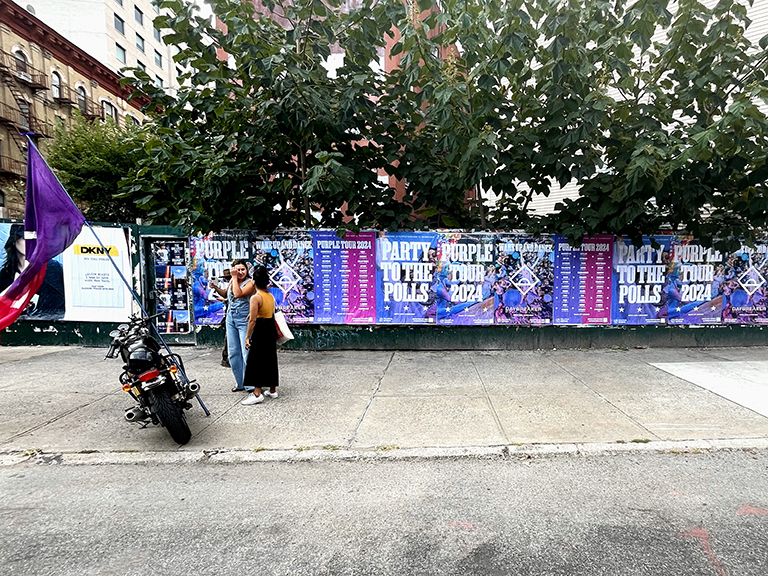
Our team pairs LED billboard trucks with wheatpaste poster campaigns in the same neighborhoods, creating visual saturation that makes the brand feel omnipresent rather than one-off. Sidewalk stencil programs near event venues and high-foot-traffic corridors extend the campaign to ground level. Brand ambassador teams stationed near the truck routes create human interaction moments that convert impressions into conversations and conversions. The combination of mobile billboard, static street-level, and human activation creates a level of brand saturation in specific LA markets that no single format can achieve independently.
What to Expect From a Professional LA Mobile Billboard Campaign
When you work with our team on a Los Angeles mobile billboard campaign, you receive a comprehensive service from route planning through final documentation. We brief each driver on route specifics, timing windows, and parking instructions for maximum legal dwell-time positions near target venues. Photography is taken at multiple locations throughout each deployment day. GPS logs are archived and available for client review. The campaign is executed as designed, and the documentation proves it.
We deploy mobile billboard campaigns across 50+ U.S. markets, with deep expertise in the Los Angeles geography, events calendar, and neighborhood dynamics that determine where mobile billboard investment delivers the most value for each client’s specific objectives.
Frequently Asked Questions About Los Angeles Mobile Billboards
What is a mobile billboard and how does it work in Los Angeles?
A mobile billboard is a large-format advertising display mounted on a truck that drives or parks in specific locations. In Los Angeles, mobile billboards and LED billboard trucks are routed through high-traffic neighborhoods, entertainment districts, and event venues to maximize impressions with the flexibility of choosing exactly where and when your brand appears.
What is the difference between a static mobile billboard and an LED billboard truck in LA?
Static mobile billboards use printed vinyl signage. LED billboard trucks display full-motion digital video content on high-brightness screens visible in daylight and at night. LED trucks command significantly more attention and can show richer creative, making them the preferred format for most LA brand campaigns in 2026.
How much does a mobile billboard campaign in Los Angeles cost?
Costs range from approximately $800-$2,000 per day for static truck formats and $1,500-$4,000 per day for LED billboard trucks. Full campaign packages including route planning, GPS documentation, and photography start at $5,000-$15,000 for most brand campaign objectives.
What neighborhoods in Los Angeles are most effective for mobile billboard campaigns?
The best routes depend on the target audience. West Hollywood and Beverly Hills reach entertainment and affluent consumer audiences. Santa Monica and Venice reach beach culture and tech demographics. Downtown LA reaches business and commuter audiences. Hollywood and the Walk of Fame maximize entertainment and tourist exposure.
Can mobile billboards in LA be used for event promotion?
Absolutely. LED billboard trucks are among the most effective event promotion tools in LA. Trucks can be routed through venue neighborhoods before and during events, parked on high-visibility adjacent streets, and timed to appear when event attendees are arriving or departing for maximum impressions.
Are mobile billboard campaigns in Los Angeles GPS-tracked?
Yes. Professional mobile billboard campaigns should include GPS tracking and photographic documentation. GPS logs confirm routes were executed as planned, and photography provides visual proof of the campaign in target neighborhoods. Every AGM mobile billboard deployment is fully GPS-tracked and documented.
How far in advance should I book a mobile billboard campaign in Los Angeles?
For standard campaigns, 1-2 weeks advance booking is typically sufficient. For campaigns tied to major events or award season, 3-6 weeks advance booking is recommended as truck availability in Los Angeles is limited during high-demand periods. Award season (January-March) is the most competitive period for LA mobile billboard inventory.
Frequently Asked Questions
What is the power of los angeles mobile billboards reaching your target?
American Guerrilla Marketing provides the power of los angeles mobile billboards reaching your target services across 50+ U.S. markets. Every campaign is planned, scouted, executed, and GPS-documented by our field teams. We work with regional brands and Fortune 500 companies on campaigns that require real street-level execution and documented proof of performance.
How does AGM approach your target?
Our process starts with a market consultation to understand your goals, target audience, and budget. We then scout locations, handle any required permissions or permits, coordinate production and installation with our local crews, and provide a full GPS-tagged photo report after the campaign runs.
What markets does American Guerrilla Marketing cover for your target?
We operate in 50+ U.S. markets including New York, Los Angeles, Chicago, Miami, Houston, Atlanta, Seattle, Denver, Boston, and dozens of secondary markets. Contact us to confirm availability and pricing for your specific market.
How much does a your target campaign cost?
Campaign pricing depends on market, format, quantity, and duration. We work with budgets ranging from targeted single-market runs to national rollouts across multiple cities. Use our RFP Builder or contact us directly for a custom quote based on your specific campaign requirements.
How do I get started with your target through AGM?
The fastest way to get started is to submit your campaign details through our RFP Builder at americanguerrillamarketing.com, or contact us directly at [email protected] or (646) 776-2770. Our team typically responds within one business day with availability and initial pricing.