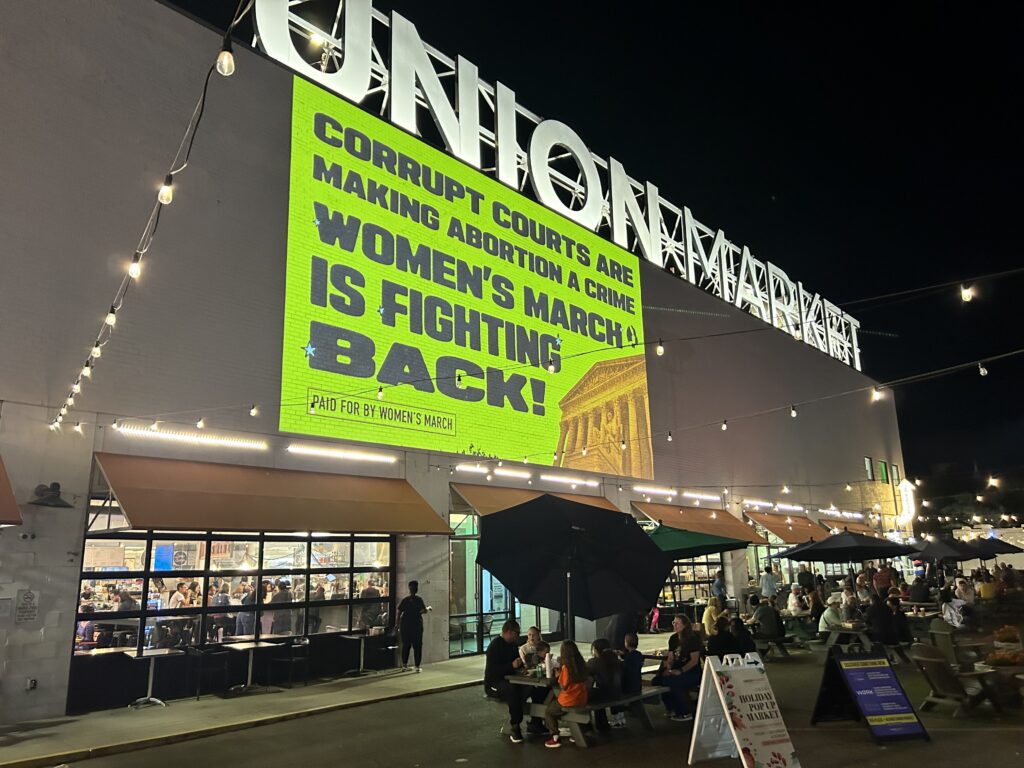
Small businesses that invest in street-level advertising consistently build stronger neighborhood brand recognition than competitors relying exclusively on digital channels, and they often do it at lower cost per qualified impression. The key is understanding which formats deliver the highest impression quality for a modest budget, how to plan campaigns around audience movement patterns rather than just surface availability, and how to document results so you can repeat what works. We’ve executed guerrilla campaigns for small businesses across New York, Miami, Los Angeles, Chicago, and dozens of other markets. This is the framework that actually works at limited budgets.
Why Small Businesses Win with Guerrilla Marketing
Guerrilla marketing advantages small businesses for a structural reason: the tactics that work best at the street level require creativity and local knowledge more than they require budget. A local restaurant that executes 50 well-placed sidewalk stencils in the three-block radius around its location, combined with a 100-location street poster campaign in the surrounding neighborhood, will generate stronger local brand recognition than a chain competitor spending ten times more on national digital advertising that reaches the same neighborhood with a fraction of the geographic relevance.
The competitive advantage of local physical presence is specificity. Digital advertising serves your neighborhood and the next twenty neighborhoods identically. A sidewalk stencil on the exact corner where your target customer walks to work every morning is a fundamentally different kind of impression, more contextually relevant, more repeated (they walk past it five days a week), and more memorable.
The Highest-ROI Guerrilla Formats for Small Business Budgets
Sidewalk Stencils and Chalk Campaigns
Sidewalk stencil campaigns are among the most cost-effective awareness formats available to small businesses. A 50-placement AGM stencil campaign is $6,982 and includes stencil production, materials, crew coordination, and photo documentation. Each stencil generates thousands of impressions over its lifespan from repetitive foot traffic on the same routes.
The most effective stencil placement strategy: map your five busiest pedestrian corridors within a one-mile radius of your business, identify the 10 highest-volume intersections on each corridor, and concentrate placements at those 50 points. This creates a brand saturation effect in the specific geography your customers already move through, rather than scattered impressions across a broad area.
Street poster advertising and Poster Campaigns
Street poster advertising, large-format posters applied to approved surfaces in a target neighborhood, delivers sustained visual presence over 2–6 weeks per campaign. A 50-location street poster advertising run in a dense urban neighborhood (apartment buildings, commercial corridors, construction hoardings) generates repeated impressions from the same foot traffic that passes those locations daily. For a local business, that repetition is exactly the brand-building mechanism that creates the “I keep seeing this place everywhere” effect that drives trial.
We’ve run street poster campaigns for small restaurants, local gyms, boutique retailers, and service businesses in neighborhoods including the East Village and Williamsburg in NYC, Wicker Park and Logan Square in Chicago, Silver Lake and Echo Park in LA, and Wynwood and Little Havana in Miami. Campaigns in these dense urban neighborhoods consistently generate 15,000–40,000 weekly impressions from a 50–100 location run. Pricing depends on poster size, quantity, route, and market, so AGM quotes those campaigns directly.
Door Hanger Distribution
For businesses with specific service areas, restaurants offering delivery, home service providers, local healthcare and wellness businesses, targeted door hanger distribution reaches exactly the households in the right geographic footprint with a message they can reference when they’re ready to purchase. A 2,500-piece distribution in a targeted neighborhood runs $350–$700 for printing plus $400–$900 for professional GPS-tracked distribution. Total cost of $750–$1,600 reaching 2,500 households is often the most cost-efficient direct response channel available to a local business.
Brand Ambassador Programs
Hiring 2–4 brand ambassadors to work high-foot-traffic hours in your target area, distributing samples, engaging people in conversation, handing out promotional offers, creates human-to-human brand interactions that no passive advertising format can replicate. For food and beverage businesses, health and wellness brands, and services where trial is the primary conversion mechanism, street-level sampling by well-trained ambassadors delivers conversion rates that justify the cost for most campaigns.
Brand ambassador pricing at AGM is $389.99 for a standard 6-hour shift, $489.99 for a professional 6-hour shift, and $589.99 for a premium 6-hour shift. Street teams are $389.99 for a standard 6-hour shift per team member or $589.99 for a premium 6-hour shift per team member.
LED Billboard Truck for Launch Windows
A single day with a mobile LED billboard truck targeting your specific neighborhood, event, or commercial corridor creates outsized visual presence for a specific moment, a grand opening, a limited-time offer, a new location launch. AGM LED trucks run $250 to $300 per hour with an 8-hour minimum. For a single-day activation driving your target area’s busiest intersections, the reach is comparable to a month of static advertising with much greater geographic precision.
Planning the Campaign Around Audience Movement
The single largest variable separating high-ROI from low-ROI small business guerrilla campaigns is placement strategy. The question isn’t “where can we put this?”, it’s “where do our specific customers walk, wait, and commute?”
Map your audience’s daily movement pattern: where do they live (residential neighborhood), where do they work (office district), where do they shop (grocery, retail corridors), where do they recreate (parks, gyms, coffee shops). The intersections between those routes, the places where your target customer passes multiple times per week, are your highest-value placement zones. Concentrate your campaign budget on those 10–20 locations before spreading to secondary zones.
Measuring Results from Street-Level Campaigns
Small businesses often assume guerrilla campaigns can’t be measured. That’s not accurate. Practical measurement approaches that don’t require enterprise analytics:
- Unique offer codes: Include a promo code specific to the guerrilla campaign on all materials. Track redemption to directly attribute sales to the campaign.
- QR codes on posters and stencils: Track scan volume from campaign-specific QR codes that land on a dedicated page
- Ask customers how they heard about you: Simple intake question at point-of-sale or initial contact, “How did you find us?”, attributes awareness sources over time
- Before/after foot traffic tracking: Google Business Profile shows foot traffic data for brick-and-mortar locations; compare weeks during campaign to weeks before
- Social mention monitoring: Guerrilla campaigns in dense urban areas often generate organic social posts and photos, track using brand name search and location tags
AGM Services for Small Business Guerrilla Campaigns
American Guerrilla Marketing works with small and mid-size businesses on focused, budget-appropriate campaigns. We don’t require minimum campaign budgets that only national brands can meet, we structure campaigns to deliver meaningful reach within realistic small business budgets.
Common small business campaign packages we execute:
- Neighborhood launch packages: sidewalk stencils + street team + 1-day LED truck (contact AGM for pricing)
- Sustained awareness campaigns: monthly street poster advertising runs + quarterly stencil refresh (contact AGM for pricing)
- Event-specific activations: product launch, grand opening, or seasonal promotion campaigns (contact AGM for pricing)
Contact us at americanguerrillamarketing.com/contact for a proposal specific to your location, budget, and campaign objectives.
Budget Tiers: What Different Spend Levels Can Actually Buy
Small businesses need honest budget planning, not inspirational examples from national brands. AGM’s published street-level entry points on this page start at $2,855 for 5 sidewalk stencils, $389.99 for a standard 6-hour street-team shift per team member, and $250 to $300 per hour for an LED truck with an 8-hour minimum. Broader poster, stencil, or multi-format neighborhood rollouts should be scoped directly.
| Budget |
What It Can Realistically Support |
| $2,855 |
5 sidewalk stencil placements |
| $389.99 per 6-hour shift |
1 standard street-team or brand-ambassador shift |
| $250 to $300/hour, 8-hour minimum |
LED billboard truck route |
| $8,000–$15,000 |
Multi-neighborhood rollout with repeated touches and creative refresh |
How Small Businesses Should Choose Between Reach and Repetition
The instinct is usually to reach as many people as possible. For local campaigns, repetition usually matters more than reach. A coffee shop in East Nashville gains more from being seen ten times by 8,000 nearby residents than once by 40,000 people across the wider city who will never visit. We almost always recommend dense local repetition first, then broader reach once the message and creative are proven.
Extended FAQ
What is the best promotional tactic for a new local service business?
Usually a combination of door hangers and visible street-level branding in the immediate service zone. That gives both direct response and ambient awareness.
How long should a small business promotional campaign run?
For meaningful awareness, 3–6 weeks is a practical minimum. One-day or one-weekend campaigns can work for events or openings, but they are usually not enough for sustained local brand lift on their own.
Can AGM build a plan around a very small radius?
Yes. Many of our highest-ROI small business campaigns are hyper-local, a few blocks, one zip code, or one retail corridor rather than a full city.
Promotional Timing: When Campaigns Pull Hardest
Small-business promotions perform differently by timing. Restaurants and nightlife offers tend to pull best Thursday through Sunday. Home-service offers perform well when delivered early in the week because the homeowner has time to call and book. Retail promotions tied to payday cycles often perform better around the 1st and 15th. The right timing can raise response without increasing spend, which is why we plan around local behavior rather than just whichever week is convenient internally.
Mixing Offline and Digital Response
The smartest low-budget campaigns almost always connect offline awareness to a digital follow-up. A stencil makes someone curious. A poster gives the URL or code. A retargeting ad reminds them later that night. The pieces do not have to be expensive, but they should help each other. Many small businesses fail because they expect one offline touch to carry the entire conversion burden alone.
Operational Mistakes Small Businesses Make
The big mistakes are picking too broad a geography, running offers with weak urgency, and failing to track which route or neighborhood generated the lead. If one zip code produced six leads and another produced zero, that is strategic gold for the next campaign. Without route-level learning, every promotion starts from scratch.
Extended FAQ Continued
What if my business only serves one side of town?
That is an advantage. Narrow service areas make targeting easier and usually improve efficiency because the campaign only needs to dominate the relevant zone.
Can a small business use LED trucks profitably?
Yes, especially for openings, launches, or a short promotional window where timing matters more than long-term repetition.
Should I run one larger campaign or several smaller ones?
Usually several smaller, trackable waves. That lets you learn, refine the offer, and put more money behind the neighborhoods and messages that actually convert.
Frequently Asked Questions
Cost-Effective Promotional Campaigns That Drive Engagement: Proven Guerrilla Strategies for Small Businesses generates better results when placement, timing, creative, and local execution all work together in New York. These questions cover the details brands usually need before launch, during rollout, and while evaluating performance.
For bus in New York, the strongest campaigns usually come from tight geographic targeting, message discipline, and enough repetition to be remembered. Market conditions, neighborhood flow, event calendars, commuter behavior, and production logistics all change how the tactic performs, so the planning details matter as much as the idea.
What guerrilla marketing tactics work best for restaurants?
For restaurants, the highest-performing street-level tactics are sidewalk stencils within a 3–5 block radius, door hanger distribution in surrounding residential blocks targeting delivery area households, and brand ambassador sampling at nearby office buildings or transit hubs during lunch hours. LED truck campaigns on grand opening day or for limited-time offers create event-level buzz.
How small a budget can an effective guerrilla campaign work with?
For official AGM pricing, the lowest published entry point on this page is $2,855 for 5 sidewalk stencils. Street teams start at $389.99 per 6-hour shift per team member, and LED trucks run $250 to $300 per hour with an 8-hour minimum. For broader neighborhood rollouts, contact AGM for pricing.
Does guerrilla marketing work for service businesses (not just retail)?
Absolutely. Service businesses, HVAC, plumbing, landscaping, legal, healthcare, fitness, generate significant leads from targeted door hanger and street poster campaigns in their service area. The key is targeting the right neighborhoods (matching service tier to household demographics) and using a strong direct-response offer with a trackable response mechanism.
How do I know which neighborhoods to target?
Start with your current customer base. Map where your existing customers live or work. The highest concentrations of existing customers reveal your highest-affinity neighborhoods, those are the best places to expand awareness because you already know the audience there converts. Expand outward from those clusters into adjacent areas as campaigns prove out. Cost-Effective Promotional Campaigns That Drive Engagement: Proven Guerrilla Strategies for Small Businesses becomes much stronger when the article moves past surface level advice and into route logic, timing, crew decisions, and what buyers should expect before launch. That is where most campaigns win or lose. Good ideas are common. Clean execution in the right place at the right time is not. In practice, the first move is narrowing the audience into a physical map. That means identifying the streets, retail corridors, campus edges, transit entrances, event approaches, or nightlife clusters where attention piles up. Once that map is clear, the next step is deciding which format fits the movement pattern. Posters work best where people have a second to read. Snipes work when repetition matters. Stencils and decals are strongest where pedestrians slow down, wait, or make a decision about where to go next. Teams that skip that planning step usually spend money on visibility without building enough repetition to create recall. Teams that plan carefully can get more from the same budget because they are buying concentration, not just volume. That is the real difference between activity and impact. Every market has its own map of useful surfaces and high value foot traffic. In downtown cores, the best routes are usually the blocks between transit stops and the place people are actually trying to reach. Around campuses, it is the edge streets, dorm approaches, coffee runs, late night food corridors, and the walk between parking and class. Around events, it is the window from arrival through line formation, then the exit path where people are still talking about what they just saw. That is why local detail matters so much. A good plan names corners, not just cities. It names venue approaches, not just districts. It defines morning traffic, lunch traffic, post game traffic, and late night traffic as separate moments because they behave differently. When brands treat all movement as one audience, the campaign gets blunt. When they map those flows correctly, the same media spend starts to feel much larger. AGM usually builds this out with a route first, then layers creative on top of it. That order protects the campaign from a common mistake: falling in love with the visual before making sure the audience can actually encounter it often enough to remember it. When a page like this feels light, the missing pieces are almost always the same. Add named locations, examples of which formats fit those locations, the quantity needed to make the campaign visible, and the operational limits that buyers should know before launch. Add a realistic budget section. Add a stronger FAQ that answers the practical objections a client will raise on the phone. Those additions do not pad the page. They make it useful. That is also where trust is built. Readers can tell when a page only gestures at a topic. They can also tell when the writer understands the field side of the job. Specifics about route density, production timing, weather risk, crew count, proof photos, QR tracking, and refresh windows make the content stronger because they come from real execution questions. If a brand is using this topic to compare partners, those specifics matter even more. They make it easier to judge whether a vendor is selling a real plan or just a good sounding idea. Pricing depends on format, timing, print specs, route length, and how many placements a campaign needs to make a real impression. For street level media, brands usually do better when they fund enough placements to own a specific route instead of buying a thin layer across too much ground. A small run can look busy in a deck and still disappear on the street. AGM publishes fixed pricing for several core services. 24×36 wheatpaste posters are $4,500 for 100 and $5,500 for 200. 48×72 wheatpaste posters are $10,500 for 100 and $13,500 for 200. 9×12 snipes are $4,500 for 400 and $5,500 for 800. 11×14 jumbo snipes are $6,500 for 400 and $7,500 for 800. Sidewalk stencils are $2,855 for 5, $3,231 for 10, $3,989 for 20, $6,982 for 50, and $11,999 for 100. Sidewalk decals are $2,904 for 5, $3,404 for 10, $4,998 for 20, $8,709 for 50, and $14,466 for 100. LED billboard trucks are $250 to $300 per hour with an 8-hour minimum. For any other quantity, market, or setup, contact AGM for pricing. If the project needs a custom mix, AGM usually points brands to the RFP Builder so scope, city count, and production details line up before pricing is locked. That matters because the wrong quantity is often more expensive than the right format. A cheap campaign that is too small to be seen is not efficient. It is just forgettable.
How do I know if this topic is worth turning into a real campaign?
Start with audience location, not creative ideas. If you can name the blocks, venues, campus gates, stations, or event windows where attention is concentrated, the campaign can usually be built into something measurable. If the audience is vague, the spend drifts and results get fuzzy fast.
What usually makes a street campaign feel too small?
The most common issue is spread. Brands buy a handful of placements across too many neighborhoods instead of owning one route. A tighter footprint with stronger repetition beats a scattered footprint almost every time, especially for event promotion, launches, and local service awareness.
Should the message focus on awareness or action?
That depends on the traffic environment. Fast moving traffic calls for a short awareness message with one visual anchor. Slow pedestrian traffic can support a QR code, a stronger offer, and more direct response copy. The format should match the pace of the audience, not the other way around.
How long should a campaign stay up?
For event driven pushes, the best window is often the 7 to 14 days before the date. For evergreen brand building, two to four weeks works better because repetition does the heavy lifting. Weather, removals, and local conditions still matter, so timing should always be part of the plan.
What should be tracked besides impressions?
Use QR scans, coupon redemptions, landing page traffic, geofenced audience lift, survey responses, and direct field photos. Street work is easier to defend when the campaign is built with proof from day one instead of trying to backfill measurement after the fact.
Does creative matter more than placement?
Both matter, but placement usually wins the argument. A decent design in the right corridor will outperform a beautiful design placed where the right people never see it. Street media is a placement game first and a design game second.
Related Pages and Articles