
November 25, 2026
Wheatpasting & Poster Campaigns in Dallas, Texas
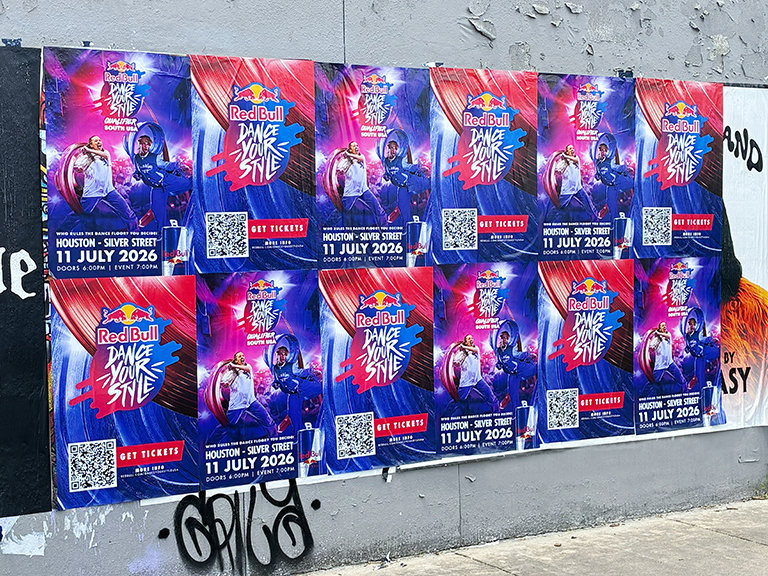
The thing that decides whether a Dallas poster campaign works is not the creative and it is not the paper. It is which district you are standing in when you ask for permission.
Dallas is a city of named districts rather than one downtown. The city’s own visitor guide lists Deep Ellum, Downtown, Uptown, Bishop Arts District, Trinity Groves in La Bajada, Lower Greenville Avenue, Oak Lawn, the Design District, the Harwood District, Fair Park, the Dallas Arts District, Knox/Henderson, Cedars/Southside, East Dallas and West Village among its principal neighbourhoods. That is not a long list of interchangeable areas. Those districts have genuinely different ownership structures, and the ownership structure is what determines whether a poster campaign is a conversation with a venue owner or a submission to a property manager.
Get that wrong and the campaign fails in a specific Dallas way. Material goes up in an institutionally managed district, gets noticed and removed inside a day, and the client has paid for a night that produced nothing. Meanwhile the districts where the same material would have been welcomed and would have held for weeks got skipped because they were not on the map someone drew in a meeting.
This page is about how Wheatpasting & Poster Campaigns actually runs in Dallas: which districts take paper and why, what North Texas weather does to a pasted sheet across the year, how permission culture changes block to block, the crew reality of a car-dependent city with far-apart districts, and what I talk Dallas clients out of.
Dallas districts sort into three permission cultures, and that is the plan
Everything operational in Dallas follows from this. The districts are not variations on a theme, they are three different environments.
The first is the tolerant creative fabric, and Deep Ellum is its centre. Deep Ellum carries the energy, the live music, the murals and the late-night movement, with Elm Street as the densest pedestrian block and alleyway bars behind it. It has the deepest mural and live-music heritage in the city and the most visible street-art identity. That heritage produces something practical: a comparatively tolerant instinct on cooperating private walls and venue frontages, and property owners who are generally used to being asked. The operative permission in Deep Ellum is the building owner’s or the venue’s, and asking is a normal conversation rather than an unusual one. For paste, Deep Ellum is the best district in Dallas and it is not close.
The second is the small-business neighbourhood, where the shopkeeper decides and the relationship is personal. Bishop Arts District runs on craft cocktails and an independent crowd in a compact grid. Lower Greenville Avenue is a linear strip and is where locals drink rather than visitors. In both, there is a specific person behind a specific door who either says yes or does not, and that person will remember how the campaign behaved. The reputational cost of a bad removal in a tight district like Bishop Arts is larger than any procedural cost, and I mean that literally: it closes doors for years.
The third is the institutionally managed environment. Uptown, the Dallas Arts District and the Harwood District are corporate-landlord territory. Uptown’s McKinney Avenue is the densest bar and restaurant corridor in the city and skews polished and patio-driven, which makes it tempting on an audience map. But unapproved placement in these districts is noticed and removed quickly, and anything at all requires written consent through a property manager. That is not a reason to avoid them. It is a reason to treat them as a lead-time problem rather than a night-of problem.
Knox/Henderson is more dinner and cocktail oriented. The Design District and the Dallas Arts District carry the design and institutional art audience. Fair Park carries event volume.
A realistic Dallas poster build starts in Deep Ellum, adds Bishop Arts and Lower Greenville with proper relationship work, and only touches Uptown or Harwood if the lead time exists to get written consent through management.
What North Texas weather does to a pasted sheet
Dallas has a humid subtropical climate, built along the Trinity River on the southern plains, with moderate winters and very hot, rather humid summers. That sentence hides four distinct problems for paper, and they do not all happen at once.
Midsummer is the hostile season and August is the peak. Very hot with excessive humidity layered on top. The thing clients do not picture is what happens to the substrate rather than the air. Masonry and metal in full North Texas afternoon sun run far above air temperature. Paste applied to a wall that has been baking all day behaves differently than paste applied to a wall at ambient, and adhesive tack goes unpredictable. That is not a theoretical concern, it is why a summer install in Dallas gets scheduled into the deepest part of the night, after the fabric has had hours to shed heat, rather than at the start of the shift.
UV load through the long North Texas summer is the main cause of colour shift on unprotected poster stock. Not rain, not wind, sun. If a Dallas campaign’s creative depends on colour fidelity, surface orientation becomes a selection criterion rather than a preference, and material specification matters more than the client expects.
Spring is the violence. North Texas sits in a severe-weather belt with thunderstorm, hail and tornado risk concentrated in spring. For a poster campaign that is a scheduling and a damage risk rather than a cure-time one. Hail will destroy pasted paper outright in minutes, and it does so to the whole campaign at once rather than one sheet at a time. A spring Dallas build needs either flex in the schedule or an accepted understanding that a storm cell can write off a deployment.
Winter brings occasional ice events, and these do two things. They lift fresh work, because ice forming in and under a sheet that has not fully cured will break the bond. And they remove vehicle access for a day, which in a car-dependent city means the crew does not work at all. Dallas ice events are not frequent enough to dominate a winter plan, but they are frequent enough that a winter campaign with a hard deadline should carry a spare night.
The two reliable quality windows are October into November, and the mild part of spring between storm systems. October is widely rated the best month in Dallas, with highs around 79°F and lower humidity, and September has already cooled to around 78°F average. Those are the conditions where paste cures properly, the crew can work a full shift, and the sheet has a fair chance of holding.
October is the best month and the most contested one
Here is a Dallas scheduling tension that does not exist in most cities, and planning around it is worth more than any other single piece of local advice I can give.
The State Fair of Texas at Fair Park is the dominant autumn event, running roughly late September into mid-October. The 2026 edition is listed as 25 September to 18 October. It reshapes traffic and attention across the eastern side of the city for weeks, not days.
At the same time, October is the best weather month of the Dallas year. Lower humidity, highs around 79°F, reliable working conditions.
So October is simultaneously the best window to install and the busiest window for attention, which makes it the highest-competition period in the city. Every brand with a Dallas plan wants the same weeks. Surfaces are more spoken for, owners are being asked more often, and the visual environment is noisier.
What I do with that depends on the client. If the campaign is tied to Fair Park audiences or to autumn retail, October is worth the competition and we start permission conversations well ahead rather than in September. If the campaign is not date-tied, I often argue for November instead, which keeps most of the weather advantage and loses most of the competition, or for the mild gaps in spring between storm systems.
The other calendar anchors worth naming. Deep Ellum Arts Festival is the district’s own spring anchor, and for a Deep Ellum-weighted campaign it is the moment the district’s audience is at its most receptive and most culturally engaged. Dallas Blooms adds to the spring calendar.
Summer is the attention trough at street level because daytime pedestrian dwell collapses in the heat. That is the same inversion Texas gives you generally: the hot months are the weak months for anything that needs people on foot.
Dallas is also a major convention and business-travel market, which means downtown and Uptown footfall swings with the convention calendar independently of leisure seasonality. If a campaign is weighted toward those districts, the convention schedule matters more than the season does.
Permission block by block, and the grey area
This is a grey area. It varies by municipality, it depends on surface ownership and local ordinance, and enforcement is inconsistent. I will not tell you anything is legal or illegal, and I will not cite a statute I have not verified. Nothing here is legal advice.
What I can describe is the practical permission character of Dallas, which is genuinely distinctive and is the most useful thing a buyer can understand about this market.
Enforcement in Dallas is best characterised as property-owner and complaint-led rather than systematic. That is a meaningful difference from cities that run dedicated municipal programmes aimed at unauthorised posting. It means the entity most likely to act on your material is the person who owns or manages the wall, not a city crew working a list. Which in turn means the single highest-value thing you can do in Dallas is get that person on side in writing, because they are both the risk and the solution.
The practice that follows is specific by district. In Deep Ellum, the operative consent is the building owner’s or the venue’s, and owners there are generally used to being asked. In Bishop Arts and Lower Greenville, the shopkeeper decides and the relationship is personal, so the ask happens in person, in daylight, before the night of the install. In Uptown, the Dallas Arts District and the Harwood District, it is written consent through a property manager with real lead time, or it is nothing.
Third-party surfaces are the trap, and Dallas has more of them than most cities because of continuous development. Utility poles, construction hoarding and scaffolding are all in third-party control. The pole is usually a utility asset. The hoarding belongs to the contractor. The scaffolding belongs to whoever erected it. Dallas’s development pace means hoarding is abundant and visually tempting, which is exactly why I insist on a named contractor contact and a written, dated consent with an agreed removal date. Hoarding looks ownerless and never is.
Removal is the part I treat as non-negotiable here, and the reason is reputational rather than procedural. In a tight district like Bishop Arts, where the same thirty business owners talk to each other, material left up past its window does more damage to future access than any fine would. We document at install and at removal, photographically, and we take material down on the agreed date.
Specific ordinance provisions, permit requirements and penalty details are things I have not verified for Dallas, and I will not invent them. Those get confirmed with the city before scoping.
Crew reality: six to eight stops, not a circuit
Dallas is emphatically car-dependent and the districts are far apart. The planning model that works is six to eight separate park-and-walk stops, not a circuit.
Each district is walkable once you are in it. Deep Ellum has its Elm Street spine. Bishop Arts has a compact grid. Lower Greenville is a linear strip. Uptown’s McKinney Avenue is a defined run. Those are all genuine walking patches and a crew works them properly on foot with material.
The drives between them are the cost. Traffic on the inner highway loops is heavy through extended peak periods, which means the transit time between districts is not a fixed number you can plan once. A route that works at 1 a.m. does not work at 7 p.m.
Downtown is described as fairly empty at night outside event times, which makes it an easy night-window environment. Clean access, little interference, straightforward working conditions.
Deep Ellum is the opposite and needs the opposite treatment. It runs late and busy, which is why its audience is worth having and also why you cannot work it at 11 p.m. with a bucket. Deep Ellum is a pre-dawn district. The trough after the late crowd has gone and before the city wakes up is the working window there.
Uptown’s McKinney Avenue has dense patio activity and valet traffic that complicates kerbside access on weekend evenings. For a crew with material and a vehicle, valet traffic is a real obstacle, not an inconvenience. McKinney Avenue work goes mid-week or very late.
Fair Park is a hard exclusion during the State Fair for anything needing vehicle access. With the 2026 fair listed as 25 September to 18 October, that is a three-week block on the eastern side of the city where a crew should not be trying to park and unload.
Heat sets shift length in summer. In July and August overnight temperatures stay high, so night work is cooler than day but it is not cool. Output per crew hour drops and shifts get shorter. That is a throughput fact and it goes into the plan honestly rather than being discovered on the night.
What goes wrong, and what I talk Dallas clients out of
Uptown on short notice. This is the most common Dallas misstep. A client sees that McKinney Avenue is the densest bar and restaurant corridor in the city, puts it at the top of the target list, and wants it next week. Uptown is institutionally managed. Unapproved placement is noticed and removed quickly. Without written consent through a property manager, and the lead time that takes, the money is spent on material that will be gone before most people see it. I either get the lead time or I move the scope to Deep Ellum.
Construction hoarding without a named contact. Dallas’s development pace makes hoarding abundant and tempting, and it is in third-party control every time. I will not put material on hoarding without a named contractor contact and a written, dated consent with an agreed removal date.
August launches. Hostile substrate temperatures, unpredictable adhesive tack, the heaviest UV of the year and collapsed daytime pedestrian dwell. If the date moves, I move it. If it does not, I schedule into the deepest part of the night and I tell the client what they are buying.
Fixed spring dates with no flex. North Texas sits in a severe-weather belt with thunderstorm, hail and tornado risk concentrated in spring. Hail takes out a whole deployment at once. A spring campaign either carries flex or accepts the risk explicitly.
All fifteen districts. Dallas’s district list is long and clients sometimes treat it as a checklist. Six to eight separate park-and-walk stops is already a demanding night, and the drives are real. Three or four districts held properly beats a thin presence across the city.
Fair Park area work during the State Fair. For anything needing vehicle access, that area is off the plan for the duration.
Skipping the daylight ask in Bishop Arts and Lower Greenville. These are personal-relationship neighbourhoods. A crew turning up at 3 a.m. without having spoken to anyone is not saving time, it is burning future access in a district where thirty business owners know each other.
Treating removal as optional. In complaint-led, owner-led Dallas, the people who let you up are the people who decide whether you come back.
Where paper stops in Dallas
Posters do one thing better than any other format: they make a brand look like it belongs to a neighbourhood. In Deep Ellum, with its mural heritage and its Elm Street pedestrian spine, a well-placed poster campaign reads as part of the district rather than as advertising placed into it. That is worth a great deal and nothing else replicates it.
But Dallas is emphatically car-dependent, the districts are far apart, and traffic on the inner highway loops is heavy through extended peak periods. The people sitting in that traffic are not reachable by paper. Neither is the event volume moving to and from Fair Park across the three weeks of the State Fair, nor the convention and business-travel audience moving between downtown hotels and venues by vehicle.
So the pairing I recommend for Dallas builds with real spread is a poster campaign holding Deep Ellum, Bishop Arts and Lower Greenville, where the format earns its cultural credibility, plus LED Trucks & Mobile Billboards covering the drive-time and event audience that paste structurally cannot touch. The two work on different people at different moments, and in a city this spread out, choosing only one means accepting a known blind spot.
If the budget only supports one, and the brand’s positioning depends on looking native to Dallas culture, I would put it all in Deep Ellum and do it properly.
Frequently asked questions
Which Dallas districts are best for poster campaigns?
Deep Ellum first, by a clear margin. It has the deepest mural and live-music heritage in the city, the densest pedestrian block on Elm Street, and property owners who are used to being asked. Bishop Arts and Lower Greenville work well with personal relationship building. Uptown, the Arts District and Harwood are institutionally managed and need written consent with lead time.
What time of year should a Dallas poster campaign run?
October into November and the mild gaps in spring are the reliable quality windows. October is the best weather month with highs around 79°F and lower humidity, but it overlaps the State Fair of Texas and is therefore the highest-competition period. November keeps most of the weather advantage with less competition. Summer is the attention trough.
How does Dallas weather damage posted material?
Three ways at different times. Summer UV through the long North Texas season is the main cause of colour shift, and hot masonry makes adhesive tack unpredictable. Spring brings thunderstorm, hail and tornado risk that can write off a deployment at once. Winter ice events lift fresh work before it cures and remove vehicle access for a day.
Can you post on construction hoarding in Dallas?
Only with a named contractor contact and written, dated consent including an agreed removal date. Dallas’s continuous development makes hoarding abundant and visually tempting, but hoarding is always in third-party control, as are utility poles and scaffolding. This is a grey area that depends entirely on who controls the surface, so we document it properly.
How is posting enforced in Dallas?
Enforcement here is best characterised as property-owner and complaint-led rather than systematic, which differs from cities running dedicated municipal programmes. The practical consequence is that the owner or manager of the surface is both the main risk and the solution. This remains a grey area, so we work from written, dated owner consent and contracted removal.
What determines the size of a Dallas poster campaign?
Surface count, how many districts you want held, the lead time needed for institutionally managed districts, crew size and night count, and the drive time between districts since Dallas works as six to eight separate park-and-walk stops rather than a circuit. Summer heat reduces crew output, and the removal commitment is part of every scope.
Request a campaign quote
Tell me which Dallas districts matter to your brand, what window you are working toward, and how much lead time you have for permission. I will tell you which parts of that plan will hold and which I would spend somewhere else.
Request a campaign quote and we will scope it around real districts, documented owner consent and a weather window that gives the paper a chance.

Ready to Run Your Campaign?
Call us or email us. We’ll tell you exactly what we can do in your market and what it costs.
Related Service
Explore similar advertising solutions offered by American Guerrilla Marketing.
American Guerrilla Marketing — Los Angeles
Street-level campaigns in Los Angeles and nationwide. Wheatpasting, LED trucks, street teams, and more.
(646) 776-2770
Related Articles
-
Wheatpasting & Poster Campaigns in Salt Lake City
November 25, 2026
-
How Big Is a Standard Poster Explained for Brand Marketers
November 25, 2026
-
Wheatpasting & Poster Campaigns in Fort Worth, Texas
November 25, 2026
-
Wheatpasting & Poster Campaigns in Savannah, Georgia
November 24, 2026
-
Wheatpasting & Poster Campaigns in Kansas City, Missouri
November 24, 2026