
November 25, 2026
Wheatpasting & Poster Campaigns in Salt Lake City
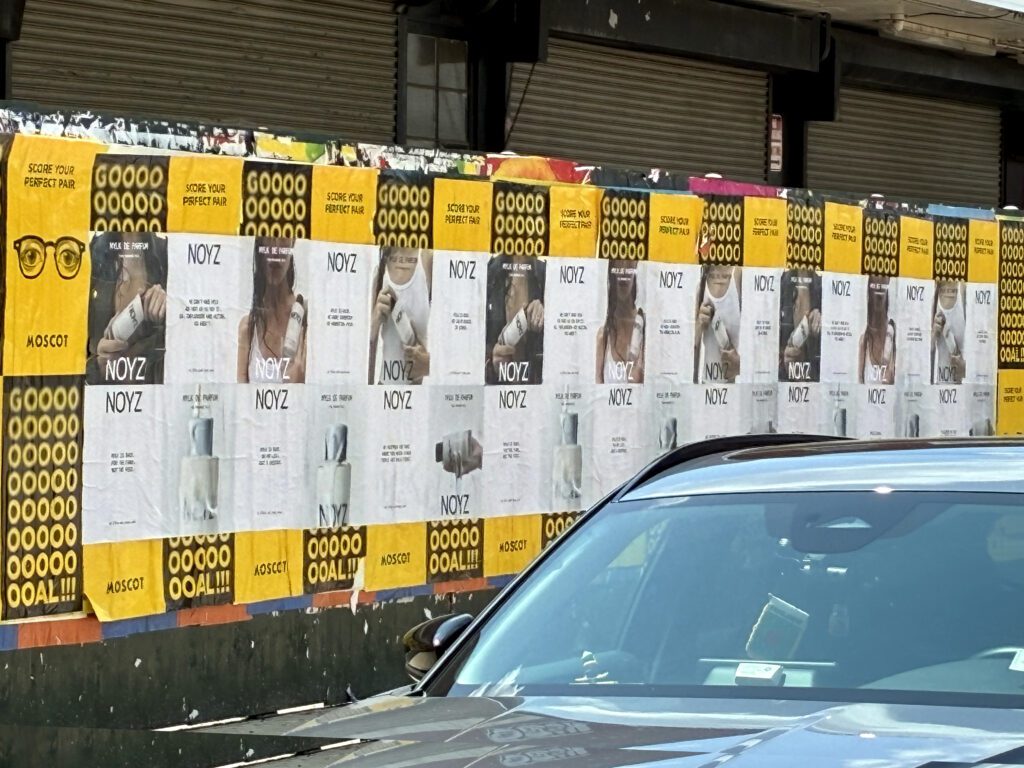
Most buyers who call us about Salt Lake City carry a map in their head that does not match the city.
They picture a dense downtown core with a continuous wall of posted surface running block after block, the way it works in older East Coast markets. Then they get here and find a grid built at a scale never designed for someone carrying a bucket, a downtown tightly managed by the institutions around it, and the actual receptive surface sitting southwest in a warehouse district most visitors never see.
That mismatch is the single most common reason a Salt Lake poster campaign underperforms. The creative is fine. The paper is fine. The buyer simply bought the wrong part of the city.
So this page is organised around one question, and it is not where the foot traffic is. It is who owns the wall.
In Salt Lake City that question has four different answers depending on which district you are standing in, and each answer produces a completely different campaign. Get the ownership tier right and posters here hold beautifully, because the dry valley air is genuinely kind to paste. Get it wrong and you are buying paper that comes down before the weekend.
I have built this page the way I would brief a crew lead flying in. Districts first, surfaces second, weather third, then the things I argue with clients about.
The Granary District is the campaign, and everything else is support
If you only take one thing from this page, take this: in Salt Lake City the Granary District is where a poster campaign actually lives.
The Granary is the former industrial and commercial warehouse pocket southwest of the downtown core, now occupied by artists, makers, craft breweries, restaurants and live music venues. The physical asset is the thing that matters to us. Large, blank, privately owned brick. Not fifty small panels split between forty owners, but big continuous elevations on buildings with a single identifiable owner.
Two things follow from that, and they are both operationally enormous.
First, the district publicly promotes large-scale mural work on those warehouse walls. Local tourism coverage describes the brick as an outdoor gallery. That tells you something you cannot learn from a permit search: the ownership culture here is already accustomed to negotiating surface use. Someone has already knocked on that door and had a productive conversation about what goes on the side of the building. We are not the first ask.
Second, those owners are reachable. Industrial and light-commercial property in a district like this tends to have a findable owner or a property manager who answers an email. Compare that to a downtown block where the surface belongs to an institution with a facilities department and a maintenance crew that walks the perimeter every morning.
So the Granary is where we put campaign weight. Secured private brick, documented permission, large format, long dwell. The rest of the city plays a supporting role.
9th and 9th is the compact independent-retail and cafe district built around the intersection that gives it its name. It is small, genuinely walkable, and it reaches a local audience rather than a visiting one. For music, culture and lifestyle campaigns this district punches above its physical size, because the people who live around it are the people those campaigns want. But it is a handful of blocks. Treat it as a precision placement, not a volume buy. A crew can cover the whole district on foot from one parking spot in a single pass.
Sugar House is a walkable neighbourhood centre reshaped by heavy construction. Residents will tell you it has eroded the small arts-enclave character the district used to have and made it less walkable than it was. For us the construction is not a problem, it is an opportunity with a different owner attached. Active sites mean hoarding and scaffolding. Hoarding is flat, clean, replaceable and temporary, and it belongs to the contractor or developer holding the site, not to the city and not to the building behind it.
Downtown is the institutional audience. The Eccles Theater pulls touring Broadway and concert crowds onto the street in a concentrated burst on show nights. The Clark Planetarium brings families. The managed retail core brings national-brand shoppers. Downtown delivers real volume, and it is also the most scrutinised and actively maintained environment in the city. It is permission-first ground, which in practice means venue windows, theatre lobbies and retail-tenant glass rather than street-level surfaces.
That is the ownership map. Granary brick for weight, 9th and 9th for cultural precision, Sugar House hoarding for opportunistic volume, downtown for sanctioned placements only.
What 4,226 feet does to a printed sheet
Salt Lake City sits at roughly 4,226 feet in a semi-arid valley ringed by the Wasatch, Oquirrh and Traverse ranges, with the Great Salt Lake alongside. That elevation changes the materials conversation more than buyers expect.
The city records over 3,000 hours of sunshine a year. Put high elevation on top of that and you have thinned the atmospheric filter sitting between your artwork and the sun. Ultraviolet load here is exceptional, and it is the dominant year-round degradation factor for anything we hang.
What that looks like in practice: ink fade on south and west elevations runs visibly faster than the same stock would fade in a low-altitude market. A deep red goes chalky. A black flattens to grey. The paper is still perfectly attached and the campaign still looks dead.
So in Salt Lake City we treat UV-stable inks and laminated or vinyl stock as the default for anything with a dwell longer than a few weeks. Not an upgrade, not a premium option, the baseline. On a north-facing Granary elevation you can get away with more. On a west-facing wall catching the full afternoon through a dry, clear sky, you cannot.
The dry air cuts the other way, and this is the part I genuinely like about working here.
Annual precipitation is low, around 15 inches, and summer is the driest season. Low humidity means paste sets fast and cures hard. Paper does not stay soft and wick at the edges the way it does in a Gulf or Atlantic market where the sheet sits damp for hours and the corners go to lace. A summer install in this valley cures quickly and cleanly, and the bond you get is genuinely better than what the same crew would achieve at sea level in August.
The trade-off is the working window. Dry air that cures your paste fast also skins over your bucket fast. We mix and apply in smaller batches here than we would elsewhere, and a crew that has come from a humid market will waste material in the first hour before they adjust.
Freeze-thaw, inversion, and why winter changes the whole format
Winter in this valley is where paste campaigns go wrong, and the failure is mechanical rather than aesthetic.
Snowfall averages roughly 55 inches a year. Winter temperatures drop below freezing and the valley cycles repeatedly across that freezing point rather than sitting consistently below it. That cycling is the problem. Water gets behind a poster edge, freezes, expands, and lifts the paper away from the substrate. Then it thaws, more water gets in, and the next cycle lifts it further. You can watch a campaign peel from the corners inward over about ten days.
Paste applied to cold masonry does not help, because it will not key properly into a surface that is near or below freezing. You get a bond that looks fine when the crew walks away and fails on the first real cycle.
There is a scheduling conflict buried in that. Anything paste-based in a Salt Lake winter needs a genuine warm window, which means mid-day. Low-observation install work wants the opposite, pre-dawn or late night. Those requirements point in opposite directions, and I would rather tell a client that up front than fight it on site.
Our answer is to stop fighting it. Winter campaigns here get built around mechanically secured substrates rather than paste alone, or around private indoor-facing placements where the surface temperature is controlled. If a client insists on paste on exterior brick in January, that is a conversation I will have honestly and probably lose on purpose.
Then there is inversion, which is the local condition that surprises crews from outside Utah.
Winter inversion is a defined valley phenomenon here. Warmer air settles over the valley and traps colder air beneath it, and the surrounding ranges form a basin that holds that cold air in place and shields it from the winds that would otherwise clear it. Snow-covered ground cools the surface air further and reinforces the whole thing. State environmental quality resources and the Utah Climate Center both document it, and the Climate Center publishes an inversion forecast. A surface inversion probability at or above 35 percent is described as indicating a statistically significant likelihood of an extended event.
For poster work, inversion means extended periods of stagnant, particulate-laden air sitting at street level. Airborne grime settles onto poster faces and dulls them faster than you would ever expect in a climate this dry. A sheet that should read clean for a month starts looking tired in two weeks because it has acquired a film.
Residents report the same haze problem in a different season when summer wildfire smoke from the west settles into the valley.
Neither kills a campaign. Both shorten the honest dwell estimate, and I would rather quote a shorter dwell and be right.
Permission here is a grey area with an unusually sharp split
I will not tell you what is permitted and what is not in Salt Lake City, because that is not a question I can answer for you and because the answer varies by surface, by owner and by municipality. What I can give you is the operating character of this market, which is the thing that actually changes how a campaign is built.
Salt Lake City has a sharper split than most cities between institutional ground and industrial ground.
On the industrial side, the Granary District is the most defensible environment in the market. A district that openly promotes large mural work on its warehouse walls has an owner culture that is comparatively open to negotiated surface use. Direct, documented permission from the building owner is the approach that works here, and it produces placements that stay up for their full run instead of disappearing on night three.
On the institutional side, downtown surrounds major civic, retail and religious institutions plus a managed retail centre. Expect high scrutiny and active maintenance. Anything placed there without an explicit arrangement has a short life.
Sugar House sits in its own category because of the construction. Hoarding and scaffolding belong to the contractor or developer holding the site. The site superintendent is the decision-maker, the permission needs to be explicit and in writing, and the arrangement needs to survive the site handing over to a different crew mid-campaign. That last point catches people. A verbal yes from a superintendent who rotates off the job in three weeks is worth nothing to the person who replaces him.
Poles, signal cabinets and public furniture are the genuinely ambiguous category in this city, and we describe them exactly that way. Enforcement attention is inconsistent and varies by district. Tolerance in the Granary tells you nothing useful about tolerance on a downtown block four streets away.
The way AGM reduces risk here is unglamorous and it works. We put campaign weight on secured private surfaces. We get permission from the identified property owner in writing before a crew is dispatched. We photograph every placement at install with location detail. We commit to removal and we actually come back and do it, because an operator who leaves paper on a Granary wall after a run has ended has burned that wall for everyone, including the next client. We also tell clients to confirm current city sign and right-of-way requirements directly with the municipality before each campaign, because those requirements change and we are not the right source for them.
Running crews on a grid this wide
Salt Lake City’s blocks are famously oversized, and that single geometric fact breaks more campaign plans here than weather does.
A block in this city is long. Distances that look like a two minute walk on a map are not, and crews consistently underestimate them. If you plan a Salt Lake night the way you would plan a night in a market with small blocks, you will finish about sixty percent of your sheet count and you will not understand why.
So we plan district by district, with the vehicle as a moving base rather than a parking problem to be solved once.
The Granary is the best staging environment in the city. Wide streets, low pedestrian volume, easy vehicle access and real kerbside space. It is the easiest place in Salt Lake to run ladder or lift work without obstructing anyone, which matters because the Granary is also where the large-format walls are. Big surfaces need height access, and height access needs room.
9th and 9th is the cleanest unit of work in the city. Tight, centred on one intersection, coverable on foot from a single park. A small crew clears it quickly.
Sugar House is workable on foot but currently complicated by the construction, which brings lane closures and access disruption that change week to week. Scout it close to the install date rather than relying on a plan drawn a month out.
Downtown has the most traffic friction, the most structured parking and the highest observation. Treat it as a pre-dawn job.
The sequence I would build for a standard Salt Lake run: a late-evening Granary pass while the district’s bars and venues are active and the brick is accessible, then downtown and 9th and 9th in the quiet pre-dawn hours. Night windows are good in this market, and the dry air makes them better, because paste sets fast once it is on the wall and the crew is not standing around waiting for a sheet to take.
One last thing nobody warns visiting crews about. At over 4,000 feet, ladder and lift work is more tiring than people arriving from sea level expect. Crews slow down in hour three and blame the job. It is the altitude. Hydration in dry summer air is a genuine operational issue here, and we staff accordingly.
The Salt Lake calendar, including the one that just disappeared
The biggest calendar fact about this market is a subtraction.
The Sundance Film Festival was founded in Salt Lake City in 1978, moved to Park City in 1981, and took place in Utah every January through 2026, with much of the 2026 festival shifted down from Park City into Salt Lake City itself. From 2027 it relocates to Boulder, Colorado, with the 2027 festival running January 21 to 31 outside Utah.
If your January plan for Salt Lake City is built on festival spillover, that plan is obsolete. It still catches people, because January in Utah carried a reliable surge of out-of-market attention for decades. Confirm what, if anything, replaces it locally before committing to a January run.
Everything else in the Salt Lake year is driven by snow and sun.
Winter brings heavy snowfall and ski-season visitor traffic moving through the valley toward the Wasatch resorts, plus the inversion episodes described above. Spring is the wettest season and the transition into the outdoor programming year. Summer is dry, hot and the best install weather in the market by a wide margin, with the caveat of possible wildfire smoke haze.
UNVERIFIED: this page does not confirm specific University of Utah academic term dates, convention-week schedules at the downtown convention centre, or current local festival dates beyond the Sundance relocation. The Granary and downtown venue calendars drive genuine nightlife peaks, but confirm those dates directly before building a timed campaign around them. I would rather flag that than guess and have a crew arrive the week after the crowd left.
What we talk Salt Lake City clients out of
Downtown saturation. This is the big one. Buyers want the blocks around the theatre and the retail core because that is where they can see people. It is the most managed ground in the city and the least likely to hold unsanctioned paper. I would rather put that weight into secured Granary brick with a long dwell and send a street team downtown on show nights.
January campaigns built on the old festival assumption. Covered above. It has left Utah.
Exterior paste in deep winter. The freeze-thaw cycle in this valley will lift your corners and the warm-window requirement conflicts with the night-window preference. We move those campaigns to mechanically secured surfaces or to a different format entirely.
Uncoated stock on west-facing walls. At this elevation with this much sunshine, uncoated paper on a west elevation is a short campaign dressed as a long one.
Thin coverage spread across all four districts. The grid is too wide for that to produce frequency. A viewer in Sugar House will not see your Granary placement. Pick two districts and own them.
Projection during an inversion episode. If a client is pairing posters with projection, which is a natural combination in this market, the haze that sits in this valley during an inversion scatters light close to the source and destroys contrast. Projection Advertising works well here in clear, dry conditions, and the Utah Climate Center forecast is the tool to schedule around. That is the upsell I actually recommend alongside a Granary poster run, because projected content on a large blank warehouse wall at night in clean air is one of the better things this city offers.
Frequently asked questions
How long do posters actually last in Salt Lake City?
On secured private brick in dry summer conditions, paste cures fast and hard here and a well-installed sheet holds well. The limiting factors are ultraviolet fade at this elevation and grime settling during inversion or wildfire smoke episodes. We quote dwell by season and elevation of the wall rather than giving one number, and laminated stock extends it meaningfully.
Why does AGM push the Granary District so hard?
Because the surfaces are large, blank, privately owned brick with identifiable owners, and because the district has an established culture of negotiated mural work. That combination means we can get documented permission and the placement stays up for the full run. It is the most defensible ground in the city for this format.
Can you run poster campaigns here in winter?
We can, but not with paste on cold exterior masonry. The valley cycles across freezing repeatedly, water gets behind the edge and lifts the sheet. Winter work in Salt Lake gets built around mechanically secured substrates or private indoor-facing placements instead. We will tell you that before you book rather than after it fails.
Does the Sundance move change Salt Lake City campaign planning?
Yes, for January. The festival ran in Utah through 2026 and relocates to Boulder, Colorado from 2027. Any January plan assuming festival spillover attention needs rebuilding. Confirm what local programming replaces it before committing to that month, because the rest of the Salt Lake winter calendar is driven by ski traffic rather than film.
Is posting permitted in Salt Lake City?
That is a grey area and it varies by surface ownership, by district and by municipal requirement. Enforcement attention here is inconsistent, and tolerance in one district tells you nothing about another. We work from documented property-owner permission on private surfaces, photograph every placement, and commit to removal. Confirm current city sign and right-of-way requirements directly with the municipality.
How many nights does a Salt Lake City campaign take?
It depends on surface count and how spread out the districts are, and this grid is wide enough that spread matters more here than in most markets. A concentrated Granary run with large-format walls moves fast. A campaign stretched across the Granary, 9th and 9th, Sugar House and downtown needs more nights purely for drive time between them.
Request a campaign quote
If you are planning a poster campaign in Salt Lake City, tell us which districts matter to you, what the run length is, and when it needs to be live. We will come back with a surface plan built on the ownership map above, an honest dwell estimate for the season, and a removal commitment.
If your dates fall in winter, say so early. That changes the format conversation, and it is better had before artwork is printed.
Request a campaign quote and we will scope the Salt Lake build with you.

Ready to Run Your Campaign?
Call us or email us. We’ll tell you exactly what we can do in your market and what it costs.
Related Service
Explore similar advertising solutions offered by American Guerrilla Marketing.
American Guerrilla Marketing — Los Angeles
Street-level campaigns in Los Angeles and nationwide. Wheatpasting, LED trucks, street teams, and more.
(646) 776-2770
Related Articles
-
Wheatpasting & Poster Campaigns in Dallas, Texas
November 25, 2026
-
How Big Is a Standard Poster Explained for Brand Marketers
November 25, 2026
-
Wheatpasting & Poster Campaigns in Fort Worth, Texas
November 25, 2026
-
Wheatpasting & Poster Campaigns in Savannah, Georgia
November 24, 2026
-
Wheatpasting & Poster Campaigns in Kansas City, Missouri
November 24, 2026