Atlanta runs one of the highest volumes of major conventions and trade shows of any U.S. city. The Georgia World Congress Center is one of the largest convention facilities in the country, and its position in downtown Atlanta, adjacent to Centennial Olympic Park and within walking distance of the major convention hotel cluster, creates a defined geographic zone where convention audiences are accessible in predictable patterns across the event days. That accessibility is what makes Atlanta a high-value market for convention field marketing, and what makes the specific knowledge of GWCC’s surrounding geography worth understanding before building a campaign plan.
Our team has executed convention marketing campaigns in Atlanta across multiple industries. The tech and gaming conventions that fill GWCC in spring, the healthcare and medical trade shows in fall, the entertainment and media industry events that draw national audiences across the year. Each convention audience is different, but the geographic framework for reaching them shares consistent elements: the hotel corridors, the MARTA station approaches, the Midtown evening zones, and the pedestrian connections between GWCC and the broader downtown commercial area.
This guide covers the Atlanta convention marketing landscape in operational detail: where convention audiences move, which positions produce the strongest engagement results, which formats work in the Atlanta market, and what a properly executed Atlanta convention campaign looks like from briefing to wrap report.
The Georgia World Congress Center: Building-by-Building Geography
GWCC is actually a campus of multiple connected buildings spanning a large footprint in downtown Atlanta, bounded roughly by Northside Drive, Nelson Street, Centennial Olympic Park Drive, and Marietta Street. Understanding which buildings host the specific convention you are targeting determines where the audience enters and exits, which hotels they are concentrated in, and which pedestrian routes they use across the event days.
Building A, B, and C Approach Routes
GWCC’s three primary exhibit buildings each have distinct entrances and pedestrian flows. Building A, facing Centennial Olympic Park, draws attendees from the Omni Hotel at CNN Center and the Hyatt Regency via the park walk. Building B is the central hub with connections to the GWCC courtyard and the primary registration areas for most large conventions. Building C, the newest and largest section, draws significant traffic from the overflow hotel properties farther west along Ivan Allen Jr. Boulevard.
Street team positioning for a GWCC convention campaign is determined by which building hosts the primary convention activity. Crews positioned at the wrong building entrance on a large convention day may miss the majority of the target audience even while standing in the right general neighborhood.
Hotel Corridors and the Convention Geographic Envelope
The convention audience’s geographic footprint extends beyond GWCC itself to the hotel corridor that houses them during the event. The primary convention hotels in downtown Atlanta, the Omni at CNN Center, the Westin Peachtree Plaza, the Marriott Marquis, the Hyatt Regency, and the Hilton Atlanta in the Peachtree Center complex, create a defined zone stretching roughly from GWCC east to Peachtree Street along Marietta Street and the Courtland/Peachtree corridor.
The Morning Hotel Corridor Window
The most reliable convention marketing window in Atlanta is the morning hotel corridor departure. Convention attendees leaving their hotels between 7:30 and 9:00 AM to reach GWCC for the morning session represent a concentrated, predictable pedestrian flow that passes specific choke points between the hotel and the convention center. Street teams positioned at these choke points engage the audience in the moments between their hotel and the convention hall, when they are awake, receptive, and not yet absorbed in convention programming.
The Lunch and Evening Social Windows
Convention attendees in Atlanta have two additional predictable external windows. The lunch break, typically from noon to 1:30 PM, generates attendee traffic into the surrounding restaurants and the food court at CNN Center. The evening social window, after convention sessions end around 5:30 to 6:00 PM, drives significant attendee movement toward the Midtown bar and restaurant corridor and toward the hotel lobby bar circuit.
MARTA Approaches: Five Points and Peachtree Center
MARTA serves the downtown convention district via the Five Points station, the system’s central hub, and the Peachtree Center station one block north. Convention attendees arriving by MARTA from the airport or from Midtown hotels use these stations as their primary transit connection. The exits from Five Points onto Marietta Street and Peachtree Street and from Peachtree Center onto Peachtree Street create pedestrian streams that flow through defined corridors toward GWCC and the convention hotel cluster.
Street teams positioned at the MARTA exits during the morning arrival window capture convention attendees at the moment of their approach to the convention zone. The crews engage a largely professional, business-oriented audience in a transitional moment between transit and event. This is one of the most receptive windows in the convention marketing day.
Midtown: The Evening Convention Zone
Midtown Atlanta, particularly the Peachtree Street corridor from 10th Street to 14th Street and the side streets including Juniper and Piedmont, hosts a concentration of bars and restaurants that draw significant convention traffic in the evening hours. The 10th Street and Piedmont corridor in particular has a restaurant density that makes it a natural gathering zone for convention groups moving toward dinner and after-event socializing.
Evening convention marketing activations in Midtown operate differently than the morning GWCC approach campaigns. The audience is in a social, off-duty state. Engagement needs to be casual and relevant to the evening context rather than professionally pitched at business objectives. Street teams in the Midtown evening zone are more effective with give-away items that have social value than with promotional materials that feel like a convention floor interaction extended into the evening.
LED Billboard Trucks in the Atlanta Convention District
LED billboard trucks operating in the downtown Atlanta convention zone during major events reach both the vehicle-borne and pedestrian audience moving through the GWCC perimeter. The Northside Drive and Ivan Allen Jr. Boulevard corridors that define the western approach to GWCC carry significant vehicle traffic from the Convention Center MARTA station and from the parking facilities west of Northside Drive. An LED billboard truck working these corridors during the morning arrival and evening departure windows generates high-visibility impressions from the combined vehicle and pedestrian audience in a tight geographic zone.
Wheatpasting and Poster Campaigns in Atlanta’s Convention Zone
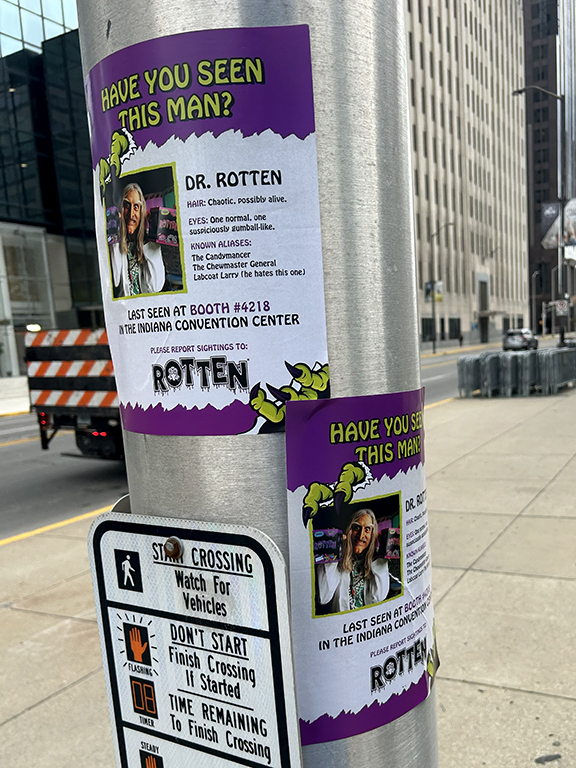
Advance wheatpasting and poster campaigns in the convention zone and surrounding areas create physical brand presence that builds across the days before a major event opens. The Marietta Street corridor between GWCC and downtown, the Peachtree Center Avenue restaurant and hotel cluster, and the Midtown commercial zone along Peachtree Street are the primary poster placement zones for Atlanta convention campaigns.
Poster campaigns placed in Atlanta typically go up three to five days before the convention opens, targeting the local business and hospitality audience that will be adjacent to the event even before the convention attendee population arrives in force. The advance presence means that the brand is established in the visual environment before the convention audience fills the zone.
Sidewalk Stencils on Atlanta Convention Approach Routes
Sidewalk stencils applied to the primary pedestrian approach routes from the major convention hotels to GWCC create brand presence at ground level that reaches every attendee who walks those routes. The Marietta Street sidewalk from Peachtree Center to the GWCC Building B entrance, the Centennial Olympic Park walkway from the Omni Hotel, and the pedestrian bridge connection from the MARTA Vine City station to GWCC are all high-value stencil positions for Atlanta convention campaigns. Our sidewalk stencil programs in Atlanta produce stencils that remain visible through the full convention schedule.
Multi-Day Convention Campaign Structure
Atlanta conventions that run multiple days require a campaign structure that delivers consistent brand presence across the full event schedule without fatiguing the audience with identical engagement every day. We build multi-day Atlanta convention campaigns with varying formats and positions across the days: morning hotel corridor street teams on day one, Midtown evening activation on day one, MARTA approach positioning on day two, and lunch window coverage in the downtown restaurant zone on day three.
The variation keeps the campaign fresh for the audience that encounters it multiple times across the convention schedule, while the consistent brand presentation across all formats ensures that the repeated exposures build a coherent impression rather than disconnected encounters with the same brand in different contexts.
Atlanta’s Convention Industry: Key Trade Shows and Conference Categories
Understanding which trade shows bring which audiences to Atlanta shapes the campaign planning for convention marketing in this market. Atlanta hosts a significant volume of technology, healthcare, entertainment, food service, and trade conferences that each bring distinct professional audiences with different industry identities, brand relationships, and engagement patterns.
Technology and Startup Conferences
Atlanta’s growing technology sector has supported a cluster of tech conferences and startup events that draw audiences from across the Southeast tech community and increasingly from national and international markets. These conventions bring a younger, more digital-native professional audience that is familiar with brand marketing tactics and appropriately skeptical of generic trade show promotional approaches. Tech conference audiences respond best to activations that demonstrate a genuine product or service relevance, not just promotional materials. The activation that shows up with something genuinely useful for a tech professional is more effective than the one that shows up with branded stress balls and lanyards.
Healthcare and Medical Conventions
Healthcare and medical trade shows at GWCC bring large professional audiences of physicians, healthcare administrators, medical device and pharmaceutical professionals, and healthcare systems buyers. This audience has specific regulatory restrictions on promotional engagement that shape how brands can interact with them, particularly for healthcare-adjacent products. Healthcare convention marketing at GWCC requires campaign approaches that respect professional context and regulatory environment while still generating meaningful brand impressions in the surrounding convention geography.
Entertainment and Gaming Events
Atlanta hosts significant entertainment and gaming industry events that bring creative professionals, content creators, and entertainment industry attendees to GWCC. This audience has a different engagement profile than healthcare or technology: more receptive to entertainment-based brand activations, more visually oriented, and more likely to document and share activation experiences on social platforms. Entertainment convention campaigns benefit from elements that are worth photographing and sharing because the audience’s content creation habits amplify the physical activation’s reach into their social networks.
Working the Convention Schedule: Day-by-Day Tactical Planning
Major conventions at GWCC follow a predictable schedule structure: a registration and opening day with heavy arrival traffic, full programming days with morning keynotes and afternoon sessions, and a closing day with reduced attendance as early-departure attendees leave before the final sessions. Building the campaign plan around this schedule ensures that the highest-intensity campaign activity matches the highest-density attendee windows, and that the campaign does not waste resources on late-convention days when the audience has significantly thinned.
The highest-value activation days for Atlanta convention marketing are the opening arrival day, when the full attendee population is moving through the convention geography for the first time and establishing their spatial orientation, and the evening social days, when attendees are exploring the broader Atlanta geography and most receptive to engagements that connect them to the city’s commercial life outside the convention center. The closing day is typically the lowest-value activation day because early departures reduce the available audience significantly by early afternoon.
Combining Convention Marketing with Atlanta’s Cultural Calendar
Atlanta’s convention marketing campaigns that coincide with major Atlanta cultural events, sports games at nearby State Farm Arena or Truist Park, or the city’s festival programming, have an opportunity to reach convention attendees during their off-convention social activity. Convention attendees who attend an Atlanta Hawks game or an Atlanta Braves game during their convention visit are outside the direct convention geography and accessible through the sports event field marketing formats that work alongside the convention campaign. Coordinating convention marketing timing with Atlanta’s event calendar allows brands to maintain attendee engagement across the full duration of their visit, not just during convention programming hours.
Atlanta Hotel Market and Convention Accommodation Geography
The Atlanta convention hotel market has expanded significantly with the addition of major properties in the downtown and Midtown corridors. The concentration of convention hotels in the downtown cluster around GWCC and Peachtree Center means that the pedestrian corridors connecting these properties to the convention center carry virtually the entire convention attendee population during the morning and evening transitions. Understanding the specific hotel footprint for each major convention, which properties are headquarters hotels versus overflow properties, shapes the most efficient street team positioning for the morning departure window.
For conventions that use Midtown hotels as overflow properties, the convention attendee geography extends beyond the immediate downtown cluster to the Peachtree Street hotel corridor from 14th Street south to the convention district. This extended hotel corridor creates a longer pedestrian approach route that generates engagement opportunities at multiple points along the walk, rather than just at the immediate GWCC entrances. Street teams positioned at the Midtown-to-downtown transition points along Peachtree Street reach convention attendees who are further from their destination and therefore in a less hurried state than the attendees already in the immediate convention precinct.
MARTA as a Strategic Campaign Asset in Atlanta
MARTA’s coverage of the Atlanta convention market creates both a challenge and an opportunity for convention marketers. The challenge is that MARTA’s limited downtown coverage means that many convention attendees, particularly those staying in hotels farther from MARTA lines, arrive by rideshare or vehicle rather than transit. The opportunity is that the MARTA connections that do serve the convention district, particularly the Five Points and Peachtree Center stations, concentrate the transit-using convention audience in specific, accessible locations that can be activated effectively with street teams positioned at the station exits.
For conventions that draw significant attendee populations from outside the Atlanta metro area, the MARTA connection from Hartsfield-Jackson Atlanta International Airport to the downtown convention district is a high-value arrival corridor. Convention attendees who take MARTA from the airport, one of the few cities where the airport-to-downtown rail connection is widely used by convention travelers, arrive at Five Points Station and transition to their hotels through a specific pedestrian geography that our team knows well from prior activations in the Atlanta market.
Post-Convention Evening Programming Zones
Atlanta’s convention programming typically ends between 5:00 and 6:00 PM, after which the convention audience disperses toward evening social programming that may be organized by the convention or self-directed by individual attendees exploring the city. The organized convention evening events, typically held at Centennial Olympic Park, the Georgia Aquarium, or the World of Coca-Cola, create known destination gatherings that can be targeted with street team and give-away activations in the approach geography. Self-directed attendee evening activity concentrates in the Midtown restaurant and bar district and in the Buckhead commercial zone for conventions with attendee hotel clusters in that area.
Frequently Asked Questions
What is convention marketing in Atlanta?
Convention marketing in Atlanta involves running brand activation campaigns targeting attendees of conferences and trade shows at the Georgia World Congress Center and other major Atlanta venues. This includes street teams, LED billboard trucks, wheatpasting campaigns, and field crew deployments in the hotel corridors and pedestrian zones that convention attendees move through.
What is the main convention venue in Atlanta?
The Georgia World Congress Center is Atlanta’s primary convention facility, one of the largest in the country with over 1.5 million square feet of exhibit space. Major conventions also use the Marriott Marquis, Hyatt Regency, and Hilton Atlanta in the Peachtree Center complex.
Where do Atlanta convention attendees go outside the convention center?
Atlanta convention attendees at GWCC are concentrated in the downtown area around Centennial Olympic Park and in Midtown along Peachtree Street. Evening traffic moves toward Midtown bars and restaurants along the 10th Street and Juniper Street corridors.
How do you run a street team campaign at an Atlanta convention?
Atlanta convention street teams are positioned at the key pedestrian corridors between the convention center and surrounding hotels, the MARTA station exits, and the restaurant and bar corridors where convention attendees gather in the evening. Morning deployment targets breakfast exits from major convention hotels.
What makes Atlanta a strong convention marketing market?
Atlanta hosts a high volume of major trade shows and conventions across technology, healthcare, entertainment, and business sectors. The concentrated hotel geography around GWCC keeps convention audiences in a defined zone that is accessible for field-level marketing.
What does Atlanta convention marketing cost?
Atlanta convention marketing campaigns typically range from $3,000 to $12,000 depending on crew size, campaign duration, and formats included. Single-day street team activations start at $2,000.