Apps do not grow in a vacuum. The most successful digital product launches combine paid digital advertising with real-world presence that creates a sense of scale, legitimacy, and urgency that no banner ad can replicate. When someone sees your app promoted on their phone, it is one of dozens of ads they will see that hour. When they walk past a densely-deployed street-level campaign on their morning commute — then see it again at lunch — the impression is different in kind, not just in degree.
At American Guerrilla Marketing, we have executed street-level campaigns for mobile apps, SaaS platforms, consumer tech products, and digital services. Our team works out of Industry City, Brooklyn, NY, and deploys across 50+ U.S. markets. This guide covers the formats that drive app awareness and downloads, how to target the right neighborhoods and corridors, and what a well-run app launch guerrilla campaign actually looks like from brief to final report.
If you are planning an app launch and want to build real-world presence without burning your entire budget on paid search, this guide is the right starting point.
Why Street-Level Marketing Works for App Launches
Digital advertising for apps is expensive and crowded. Cost-per-install on major platforms has climbed steadily for years. At the same time, app store discovery has become harder as the number of competing apps increases. Brands that treat digital advertising as their only acquisition channel face a structural disadvantage: they are fighting on the most contested ground with the most competition.
Real-World Presence Creates Perceived Scale
When an app brand appears in the physical environment — on sidewalks, on transit corridors, on building exteriors, on the streets where the target audience commutes and spends leisure time — it signals investment and scale. Consumers apply a legitimacy heuristic to brands they see in the physical world: if a company is willing to spend on real-world marketing, it must be the real thing. This is especially valuable for new apps that have no established brand equity.
Street-Level Campaigns Reach Audiences Outside the Ad Stack
Ad-blocker usage has grown consistently for a decade. Many of the most valuable consumers — particularly younger, urban, tech-savvy audiences — are also the most aggressive about blocking digital ads. A sidewalk stencil on the block they walk every morning cannot be blocked. A street poster at the coffee shop they visit daily is not filtered. Street-level campaigns reach audiences in contexts where the ad stack does not operate, which is an increasingly valuable distribution advantage.
Physical Campaigns Drive Social Amplification
A street-level campaign that is visually distinctive or conceptually clever gets photographed. Those photos get shared. That earned media extends the reach of a physical campaign into the digital channels where the app is ultimately discovered and downloaded. We design campaigns for shareability so that the earned media component is part of the planned reach, not a lucky bonus.
The Formats That Perform for App Launches
Not every guerrilla format works equally well for a digital product launch. Here are the formats our team deploys most frequently for app campaigns and why each one performs.
Sidewalk Stencils Near Target Audience Concentrations
Sidewalk stencils are cost-effective, high-density, and ideal for campaigns targeting a specific urban demographic. For a consumer app targeting 25-to-35-year-olds in a major metro, stenciling the sidewalks outside popular bars, coffee shops, gyms, and transit stations in the right neighborhoods creates concentrated awareness in the exact population the app needs to reach first. Our sidewalk stencil campaigns include location scouting, production, and installation.
Street Poster Campaigns with QR Codes
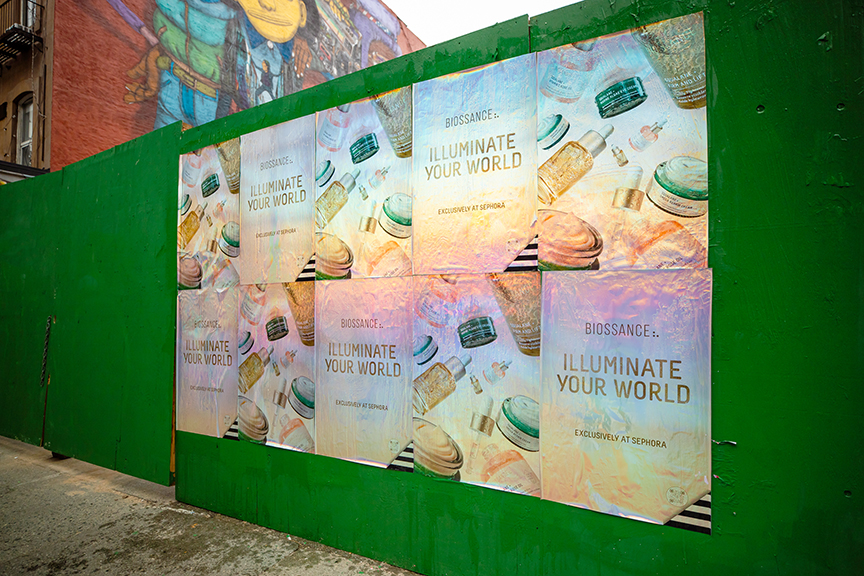
Street posters with integrated QR codes create a direct path from physical impression to app store download. When posters are placed in environments where the audience has time to pull out their phone — transit waiting areas, coffee shop corridors, campus bulletin boards — scan rates are meaningfully higher than in pure pedestrian-flow locations. Our poster campaign team handles permitting, production, and installation across all major markets.
LED Billboard Trucks for Launch-Day Impact
An LED billboard truck parked outside a major venue or moving through a dense urban corridor on launch day creates immediate, unavoidable visibility. For app launches tied to a specific date or event, LED trucks provide the kind of high-impact, time-specific presence that static placements cannot deliver. Our LED billboard truck fleet is available in all major markets.
Street Team Activations with QR Distribution
Street teams deployed in target neighborhoods can hand-deliver a download incentive, demonstrate the app, and engage directly with potential users. When the street team is positioned in the right locations — outside transit hubs, at community events, near campus gathering points — conversion rates from activation to download are measurably higher than from passive ambient placements alone. Our street team marketing program is staffed with trained field teams in every major U.S. market.
Experiential Activations for Product Demonstration
For apps with a complex value proposition or a feature set that is difficult to convey in a single image, an experiential activation gives potential users a chance to try the product in context. A demo station or interactive installation in a high-traffic public space converts curiosity into comprehension in a way that a poster or stencil cannot. Our experiential marketing team designs and executes these activations at every budget level.
Targeting Strategy: Finding the Right Neighborhoods and Corridors
Geography is the most critical variable in street-level marketing. Deploying in the right neighborhoods at the right density is what separates a campaign that drives downloads from one that generates impressions without results.
Demographic Mapping
We start every app launch campaign by building a detailed demographic profile of the target user and then mapping where that demographic concentrates in each target market. Age, income, lifestyle behavior, and commute patterns all inform location selection. A fintech app for young professionals targets different corridors than a social app for college students, even in the same city.
Venue-Specific Targeting
Beyond neighborhoods, we identify the specific venues and anchors that generate the highest concentration of target users: transit stations, coffee shops, gyms, co-working spaces, university campuses, and entertainment districts. Campaigns that target specific venues outperform campaigns that simply target a broad neighborhood because they concentrate impressions on the highest-probability users.
Multi-Market Sequencing
For apps launching nationally, we sequence market deployments strategically rather than launching everywhere simultaneously. Leading with the two or three markets where the target demographic density is highest lets the campaign build early traction before expanding. It also allows for rapid iteration on creative and format selection based on early market performance.
Measurement and Attribution
Connecting street-level activity to app store outcomes requires a measurement stack that bridges the physical and digital. Here is how we approach it.
Trackable QR Codes and Custom URLs
Every campaign element that can carry a QR code or URL gets one. We use unique codes by format, location cluster, and market so that download attribution can be traced back to specific placements. This gives our clients a direct mechanism for comparing the effectiveness of different formats and locations within the same campaign.
Geofenced Retargeting Windows
We layer geofenced digital retargeting around the zones where street-level campaigns are concentrated. Users who pass through a campaign zone and have not downloaded the app can be served a targeted digital ad within a defined window. This closes the loop between physical impression and digital conversion and materially improves the overall campaign conversion rate.
Download Spike Analysis
Campaign windows typically produce measurable download spikes that can be isolated in app store analytics. We document campaign timing and market-by-market activation dates precisely so that clients can correlate campaign activity with app store data. This is not a perfect attribution mechanism, but it is a reliable signal for campaign impact when combined with the direct tracking methods above.
Budget Ranges for App Launch Guerrilla Campaigns
Our team structures budgets around market count, format mix, and campaign duration. Here is a practical framework for planning.
Single-Market Entry Campaigns
A single-market sidewalk stencil or poster campaign — the right entry point for teams testing street-level tactics for the first time — runs $8,000 to $20,000 including design, production, installation, and reporting. This is a meaningful reach investment in a concentrated neighborhood or corridor without requiring a major budget commitment.
Multi-Format City Campaigns
Combining two or three formats in a single market — stencils plus posters plus a street team day — typically runs $25,000 to $60,000. Multi-format campaigns create the layered impression frequency that drives meaningful download volume rather than incremental awareness.
National Launch Campaigns
Multi-city launch campaigns across 5 to 10 markets with a full format stack budget $100,000 to $300,000 or more. These campaigns establish nationwide physical presence at launch and create the impression of a brand that is already everywhere — which is one of the most powerful signals an app can send in its first weeks. Contact our team through the contact page or request a capabilities deck for a detailed proposal.
Frequently Asked Questions
Why does a digital product need street-level marketing?
Digital advertising for apps competes in an extremely crowded, high-cost environment. Street-level campaigns reach the same audience in a context where they are not bombarded with competing messages, and where physical presence creates a sense of scale and legitimacy that digital-only campaigns cannot replicate. Apps that invest in real-world visibility at launch tend to outperform apps that rely exclusively on paid digital channels.
What guerrilla marketing formats work best for an app launch?
Sidewalk stencils, street poster campaigns, LED billboard trucks, street team activations with QR codes, and ambient installations near target audience gathering points all perform well for app launches. The best format depends on the target audience, the geographic market, and the campaign budget. Multi-format campaigns outperform single-format executions.
How do you target the right neighborhoods for an app launch campaign?
We map the demographic and behavioral profile of the target audience and then identify the specific neighborhoods, corridors, and venues in each market where that audience concentrates. For consumer apps, this often means college campuses, transit corridors, co-working districts, and residential neighborhoods with a high density of the target demographic.
How do you measure downloads from a street-level campaign?
We use trackable QR codes, custom app store landing page URLs, and geofenced retargeting windows tied to campaign zones. Download spikes during and immediately after campaign windows are also a standard measurement signal. Our reporting package includes all of these data points along with photo documentation and impression estimates.
What is a realistic budget for app launch guerrilla marketing?
Effective app launch guerrilla campaigns can be executed starting at $8,000 to $15,000 for a single-market sidewalk stencil or street poster push. Mid-tier campaigns with LED trucks and street teams typically run $20,000 to $50,000 per market. Multi-market launches with full format stacks budget $75,000 to $200,000+.
How quickly can American Guerrilla Marketing deploy an app launch campaign?
Standard lead time is 2 to 4 weeks from brief to first installation, depending on format complexity and market. Rush executions are available in most major markets for single-format campaigns. We operate in 50+ U.S. markets from our headquarters at Industry City, Brooklyn, NY.