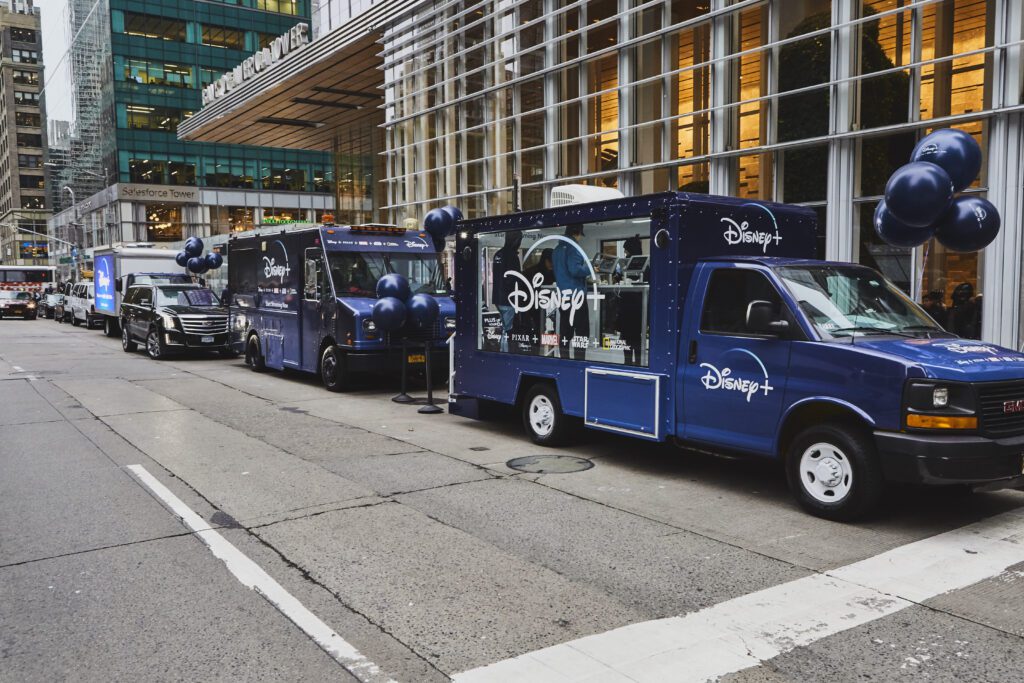
Ambient advertising is one of the most effective formats in the out-of-home toolkit — not because it is the loudest, but because it meets audiences exactly where they are. Instead of buying space on a predetermined surface, ambient campaigns are designed around the physical environment itself. The placement, the surface, and the context all become part of the creative execution. When it works, the ad does not interrupt — it fits, and that is precisely why it gets noticed.
At American Guerrilla Marketing, we have planned and executed ambient advertising campaigns across every major U.S. market. Our team operates out of Industry City in Brooklyn, NY, and we bring that street-level sensibility to campaigns from Los Angeles to Atlanta to Chicago. This guide covers the formats, the strategy, the costs, and the mechanics of running ambient campaigns that actually move the needle.
Whether you are new to ambient formats or looking to refine an existing OOH strategy, this is the reference guide our team uses to brief clients and plan executions. No filler, no preamble — just the operational detail that makes campaigns perform.
What Ambient Advertising Actually Means
The term “ambient advertising” gets used loosely, so let us define it clearly. Ambient advertising refers to any campaign that uses non-traditional surfaces or placements within a specific physical environment to deliver a brand message. The key word is context. A billboard on a highway is OOH advertising. A branded floor decal inside a busy subway station is ambient. The surface is unusual; the placement is deliberate; the environment amplifies the message.
The Three Elements That Define Ambient Work
Every strong ambient campaign shares three defining characteristics. First, the placement is context-driven — chosen because of what happens at that location, not just because foot traffic passes by. Second, the format is non-standard — it uses surfaces, dimensions, or interactions that traditional OOH does not accommodate. Third, the creative is environment-specific — it works because of where it lives, not despite it.
Why Ambient Outperforms Standard Formats in Specific Scenarios
Standard OOH formats — billboards, bus shelters, transit posters — are high-reach vehicles. They deliver impressions at scale. Ambient advertising trades raw reach for relevance and memorability. When your target audience lives, works, or gathers in a specific environment, placing a message inside that environment beats placing it on a highway they happen to drive through. For urban brands, campus campaigns, and geographically-targeted activations, ambient formats regularly outperform standard OOH on engagement and recall metrics.
Core Ambient Advertising Formats
Our team works across every major ambient format. Here is how each one operates and where each one performs best.
Sidewalk Stencils
Sidewalk stencils use water-based, pressure-wash-removable paint applied through a stencil or screen to create branded messages on public pavement. They are low-cost, high-visibility, and effective in pedestrian-dense environments. A well-placed sidewalk stencil in a high-traffic block can generate thousands of impressions per day at a fraction of the cost of a transit shelter ad. Our sidewalk stencil campaigns are designed for impact in the highest-footfall locations in each market.
Street Poster Campaigns
Street poster campaigns use large-format printed posters applied to permitted surfaces — construction hoarding, bulletin boards, and other approved locations. When properly sited and densely deployed, a poster campaign creates an unavoidable presence in a neighborhood or corridor. Our team scouts every location before booking to ensure maximum visibility and proper permitting. Learn more about our poster campaign services.
Projection Advertising
Projection advertising deploys high-lumen projectors to display brand imagery on building facades, sidewalks, or other large surfaces at night. The format is particularly effective for event-tied activations, product launches, and high-visibility stunts in dense urban environments. Our projection advertising team handles permitting, location scouting, and execution in markets across the country.
LED Billboard Trucks
Mobile LED billboard trucks carry large-format digital displays through high-traffic areas, following a GPS-tracked route designed to maximize target audience exposure. They are ideal for event-surrounding campaigns, competitor conquesting, and markets where static placements are difficult to secure. Our LED billboard truck fleet operates in all major U.S. markets.
Experiential Installations
Experiential installations are the most immersive form of ambient advertising. They create branded environments that audiences physically enter, interact with, and remember. From pop-up galleries to branded street furniture to interactive installations, experiential work drives social amplification in addition to direct impression delivery. Our experiential marketing team designs and builds activations at every scale and budget level.
Planning an Ambient Advertising Campaign
Good ambient campaigns do not happen by accident. They require disciplined location scouting, production management, and logistics coordination. Here is how our team approaches the planning process.
Audience-First Location Selection
We start every ambient campaign by mapping the target audience’s physical behavior patterns. Where do they commute? Where do they spend leisure time? Where do they shop, eat, or socialize? The answers determine where we deploy. A campaign targeting college-aged consumers in a major metro looks nothing like a campaign targeting commuting professionals in the same city.
Permitting and Compliance
Every format has its own permitting landscape, and every market has its own rules. Sidewalk stencils require different approvals in New York than in Chicago. Projections have nighttime noise ordinances to navigate. Our team handles all permitting research and compliance documentation as part of every campaign. Clients should never have to manage this — it is our operational responsibility.
Production and Installation
Production quality determines whether an ambient campaign looks intentional or sloppy. We control print quality, material selection, installation technique, and placement precision. For multi-market campaigns, we maintain field teams and vetted installation crews in every major metro to ensure consistent execution nationwide.
Cost Benchmarks for Ambient Advertising
Clients consistently want specific numbers, so here are the cost ranges our team works within across common ambient formats. All figures are approximate and vary by market, scope, and production complexity.
Entry-Level Ambient Formats
Sidewalk stencil campaigns in a single market typically run $3,000 to $8,000 including design, stencil production, and installation. Street poster campaigns in one market start at $5,000 to $12,000 depending on quantity and location quality. These are strong options for brands testing ambient tactics with a limited budget.
Mid-Tier Ambient Formats
LED billboard truck campaigns typically start at $2,500 to $5,000 per market per day. Projection advertising campaigns run $8,000 to $25,000 depending on projection surface, lumen requirements, and hours of operation. Multi-market deployments at this tier allow brands to establish ambient presence across several cities simultaneously.
High-Impact Experiential Formats
Custom experiential installations range from $15,000 for a simple branded pop-up to $150,000 or more for a full-scale multi-element activation in a major market. These campaigns generate earned media and social amplification that extends their effective reach far beyond the live event footprint. Our guerrilla marketing services page provides a full overview of what we offer at each tier.
Measurement and Reporting
Ambient advertising is measurable. Our standard reporting package covers every campaign we execute.
Documentation Standards
We document every installation with GPS-stamped photography taken at the moment of installation. Field teams capture multiple angles, environmental context, and proximity to traffic generators. Clients receive a complete photo report within 48 hours of installation completion.
Impression Estimation
Foot traffic data from third-party sources allows us to build market-specific impression estimates for each placement location. These estimates are conservative and methodology-transparent — we show the math, not just the number. For mobile formats like LED trucks, GPS tracking logs provide route-by-route impression data.
Digital Integration and Attribution
For campaigns that integrate ambient placements with digital channels, we incorporate trackable QR codes, custom URL slugs, and social listening into the reporting framework. When a campaign goes viral, we capture that amplification. When it drives traffic to a landing page, we track it. Ambient advertising does not have to be a black box.
Integrating Ambient Advertising with Digital Campaigns
The most powerful campaigns treat ambient advertising as a digital amplifier, not a standalone channel. When a street-level placement generates a photo that gets shared on social media, the effective reach multiplies. Our team designs ambient campaigns with social amplification in mind.
Design for Shareability
Ambient placements that are visually arresting, location-specific, or conceptually clever tend to get photographed and shared. We work with clients to ensure that every ambient execution has a “worth photographing” quality that encourages organic amplification without requiring an incentive structure.
QR Codes and Direct Response
QR codes integrated into ambient placements create a direct measurement mechanism and a conversion pathway from physical to digital. When properly designed — size appropriate, high-contrast, placed at natural eye level — QR codes on ambient placements achieve measurable scan rates. Our team handles QR placement as part of every applicable campaign design.
Retargeting and Geofencing
We layer geofenced retargeting around high-concentration ambient placements so that audience members who pass through a deployment zone can be reached again with digital ads. This closes the loop between physical impression and digital conversion and allows brands to measure the downstream value of ambient exposures.
Brand Ambassador Programs as an Ambient Complement
Static ambient placements perform best when paired with human interaction. Our brand ambassador agency deploys trained field teams to occupy the same environments as our ambient placements, creating a layered campaign presence that drives engagement and conversation. A sidewalk stencil plus an ambassador team in the same corridor doubles the impact of either format alone. Our street team marketing program is designed to integrate seamlessly with any ambient deployment.
Sampling Programs as an Ambient Extension
Product sampling is one of the most direct forms of ambient marketing. When our team places a sample of your product into someone’s hands in the exact environment where they would use or purchase it, the ambient context reinforces the brand message at the moment of trial. Our product demonstrations are coordinated through the same field teams that execute our other ambient formats, so campaigns can run multiple tactics simultaneously under unified management.
Frequently Asked Questions
What is ambient advertising?
Ambient advertising places brand messages inside the physical environments where a target audience already spends time — transit hubs, retail corridors, parks, gyms, or college campuses — rather than interrupting them on a screen. The placement is the strategy: when the environment reinforces the message, recall and engagement both increase.
How is ambient advertising different from traditional out-of-home advertising?
Traditional OOH (billboards, bus shelters) is bought through media vendors and placed in fixed, predetermined locations. Ambient advertising is more flexible and creative — it can occupy non-standard surfaces, operate at street level, and be designed to blend into or contrast with the immediate environment in ways that standard formats cannot.
What formats fall under ambient advertising?
Ambient advertising includes sidewalk stencils, street poster campaigns, projection mapping, vehicle wraps, transit takeovers, experiential installations, sampling activations, and branded environmental elements like park benches, steps, or building facades. The defining characteristic is context: the placement is intentional and environment-specific.
How much does an ambient advertising campaign cost?
Costs vary widely by format and market. Sidewalk stencil campaigns can run $3,000 to $10,000 for a single market. Street poster campaigns typically start at $5,000 to $15,000. Experiential installations range from $15,000 to $100,000 or more depending on scale and complexity. LED billboard truck campaigns start around $2,500 per day per market.
How long does it take to plan and launch an ambient campaign?
Most ambient advertising campaigns require 2 to 6 weeks of lead time from brief to execution, depending on format complexity, permitting requirements, and production timelines. Rush executions are possible in some markets and formats, but generally result in higher costs.
Can ambient advertising be tracked and measured?
Yes. Our team documents every campaign with GPS-stamped installation photos, geo-tagged field reports, and market-specific impression estimates based on foot traffic data. For digital-physical integration, we include trackable QR codes, custom landing page URLs, and social listening to capture organic amplification.
Which markets does American Guerrilla Marketing cover for ambient campaigns?
We plan and execute ambient advertising campaigns across 50+ U.S. markets. Our core operations are based in Industry City, Brooklyn, NY, but we maintain field teams and vetted vendor networks in every major metro and dozens of secondary markets nationwide.