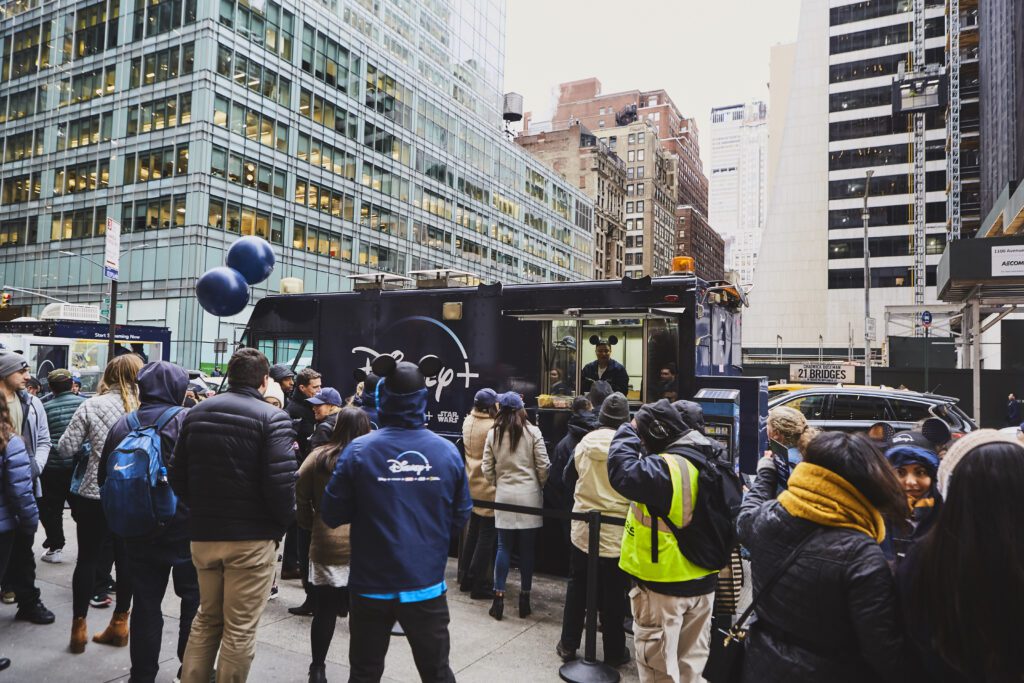
Most advertising asks for attention. Ambient experiential marketing earns it. Instead of interrupting someone on a screen, an ambient experiential campaign meets them in the real world — on the sidewalk, inside a transit station, in the lobby of a building they pass through every day — and gives them something worth pausing for. The best of these campaigns get photographed, shared, and remembered long after the installation comes down.
At American Guerrilla Marketing, we design and execute ambient experiential campaigns for brands that want physical presence in the markets that matter. Our team is based in Industry City, Brooklyn, NY, and we deploy across 50+ U.S. markets. We handle everything from location scouting and permitting through installation, staffing, and post-campaign reporting. This guide covers how ambient experiential marketing works, what formats perform best, and what it takes to run a campaign that creates genuine brand impact at street level.
If you are planning an activation and want it to feel like it belongs in the city — rather than dropped into it — this is where to start.
What Makes a Campaign Ambient and Experiential
Ambient and experiential are two distinct traditions in out-of-home marketing that, when combined, produce something more powerful than either alone. Understanding how they intersect clarifies what makes this format so effective — and what separates the campaigns that land from the ones that get ignored.
The Ambient Principle: Context Is the Message
Ambient marketing is defined by its relationship to environment. A campaign is ambient when the placement itself is part of the creative logic — when removing it from that specific location would make it meaningless. A branded floor graphic in a gym locker room is ambient. A poster on a bus shelter is not. The environment amplifies the message. That is the core principle.
The Experiential Principle: Participation Over Observation
Experiential marketing creates encounters that require the audience to do something — touch, taste, try, photograph, or simply stop and engage. It is the difference between seeing a brand and experiencing it. Experiential campaigns generate disproportionate recall because they involve active participation, which deepens memory encoding compared to passive exposure.
Where They Meet
Ambient experiential marketing is the combination: a campaign designed for a specific environment that also invites audience interaction. A photo moment built into a transit station mural. A product sampling activation set inside a farmer’s market. A projection display that responds to pedestrian movement. These are ambient because they belong to their environment and experiential because they require engagement. That combination is where the most memorable brand moments happen.
Formats That Work for Ambient Experiential Campaigns
Our team works across a wide range of ambient experiential formats. Here is how each one operates and where each one performs best.
Environmental Installations
Environmental installations are custom-built branded structures or zones placed in public spaces. They range from simple branded furniture and signage clusters to multi-element immersive environments. The best installations are designed to be photographed — they have a clear hero visual and a natural framing that makes social sharing intuitive. Our experiential marketing team designs and produces these from concept through teardown.
Pop-Up Experiences
Branded pop-up experiences are temporary environments — a store, a lounge, a demo space, a gallery — placed in high-traffic public or semi-public locations. They create a conversion environment where audiences can engage with a product or brand narrative at depth. Pop-ups work especially well for product launches, brand extensions, and occasions where the audience needs more than a 3-second exposure to understand the value proposition. Learn more about our pop-up event services.
Transit Environment Takeovers
Transit stations offer high foot traffic and extended dwell time — both ideal conditions for ambient experiential work. Full-station takeovers, branded platform experiences, and interactive installations inside transit environments allow brands to create immersive presence at scale. Our team navigates transit authority permitting and vendor relationships in every major U.S. transit market.
Projection-Based Activations
Projection advertising deployed as an experiential element — a brand narrative projected on a building facade, an interactive projection that responds to pedestrian movement, a countdown projection building anticipation for a product launch — merges the visual scale of outdoor advertising with the engagement dynamics of experiential work. Our projection advertising team handles all technical and permitting requirements.
Sampling Events with Environmental Staging
Product sampling is one of the oldest forms of experiential marketing, and it remains one of the most effective. When we deploy a sampling event with purpose-built environmental staging — custom structures, branded environments, trained ambassador staff — the experience becomes something more than a free taste or product trial. It becomes a brand encounter that the consumer actively chose to participate in. Our product demonstrations are designed to drive trial, conversation, and social amplification simultaneously.
Planning and Strategy for Ambient Experiential Campaigns
Effective ambient experiential campaigns require more planning than most other formats because they are environment-dependent. Location scouting, permitting, production logistics, and staffing all have to align before the first installation goes up. Here is how our team structures the planning process.
Audience Mapping and Location Selection
We begin every campaign by mapping where the target audience spends time. Not just which neighborhoods they live in, but which transit corridors they use, which parks they frequent, which retail blocks they shop, and which public spaces they pass through on a regular basis. That mapping drives location selection. The goal is to find the locations where an ambient experiential placement will feel natural — as if it belongs — rather than intrusive.
Creative Development Around the Environment
Ambient experiential creative is developed in reverse: we start with the location and build the concept to match it. A campaign that is designed for a generic location and then placed somewhere specific almost always feels off. When the concept is built from the environment outward, it fits in a way that makes audiences stop and engage rather than walk past.
Permitting and Regulatory Compliance
Every public space has its own permitting requirements, and every city has its own regulatory landscape for temporary installations, projections, and branded events. Our team handles all permitting research, application submission, and compliance documentation. Clients should not have to navigate this — it is an operational function we own entirely.
Brand Ambassadors as the Human Layer
Static ambient experiential elements work better when paired with trained human staff. Our brand ambassador agency provides the field teams that turn a great installation into a genuine conversation. Ambassadors direct foot traffic, explain the experience, facilitate interactions, capture social content, and handle the moment-to-moment engagement that a static installation cannot. Our street team marketing program integrates seamlessly with any ambient experiential deployment.
Measurement and Reporting
We report on every campaign with the same rigor we bring to execution. Standard deliverables include GPS-stamped installation photography, engagement count logs, dwell time observations, social amplification monitoring, QR and URL conversion data (where applicable), and a written summary with impressions methodology. Clients receive the first report within 48 hours of campaign launch and a final report within 5 business days of campaign close.
Social Amplification Tracking
Ambient experiential campaigns frequently generate organic social content from audience members who photograph and share their encounter. We monitor relevant hashtags, location tags, and brand mentions throughout campaign duration. When organic amplification occurs, we document it and include it in the overall campaign reach calculation.
Connecting Ambient Experiential to Broader Campaign Strategy
Ambient experiential marketing performs best when it is not a standalone tactic. It is a physical anchor for a campaign that also runs in digital, social, and other OOH channels. When someone encounters an ambient experiential activation and then sees a related social ad two hours later, the connection reinforces both touchpoints. Our team works with clients to integrate ambient experiential placements into a broader guerrilla marketing strategy that coordinates street-level and digital channels toward the same audience.
Geofenced Digital Retargeting
We layer geofenced retargeting around the footprint of major ambient experiential activations so that audience members who pass through the experience zone can be reached again with digital advertising. This creates a measurable connection between physical encounter and digital conversion and provides a mechanism for attributing downstream outcomes to the ambient campaign.
Frequently Asked Questions
What is ambient experiential marketing?
Ambient experiential marketing places branded experiences inside the everyday environments where a target audience already lives, works, or gathers. Unlike scheduled event activations, ambient experiential campaigns are woven into the physical landscape so that the audience encounters them organically rather than by invitation.
What is the difference between ambient marketing and experiential marketing?
Ambient marketing focuses on placing brand messages in unexpected environments using non-traditional surfaces and formats. Experiential marketing focuses on creating interactive brand encounters. Ambient experiential marketing merges both: it uses environmental placements that invite or require audience interaction, creating a hybrid of impression delivery and engagement.
What formats does ambient experiential marketing include?
Common formats include interactive street installations, branded pop-up experiences in high-traffic public spaces, environmental takeovers of transit stations or retail corridors, projection-based activations, sampling events with theatrical staging, and street-level branded zones that audiences walk through or interact with.
How much does an ambient experiential campaign cost?
Budgets range from $15,000 for a targeted single-market street activation to $200,000 or more for a multi-city experiential campaign with custom-built environments. Most mid-market brands execute effective ambient experiential campaigns in the $25,000 to $75,000 range per market.
How is ambient experiential marketing measured?
Measurement covers live engagement counts, dwell time, photo documentation, social amplification tracking, QR or URL conversion data, and earned media monitoring. For sampling-integrated activations, trial units distributed provide a direct output metric. Our team delivers a full reporting package within 48 to 72 hours of campaign completion.
Which cities does American Guerrilla Marketing operate in for experiential campaigns?
Our team operates in 50+ U.S. markets. Headquarters are in Industry City, Brooklyn, NY, and we deploy field teams, installation crews, and brand ambassador staff in every major metro area nationwide.