
November 11, 2026
Album Rollout Poster Strategy: How It Works
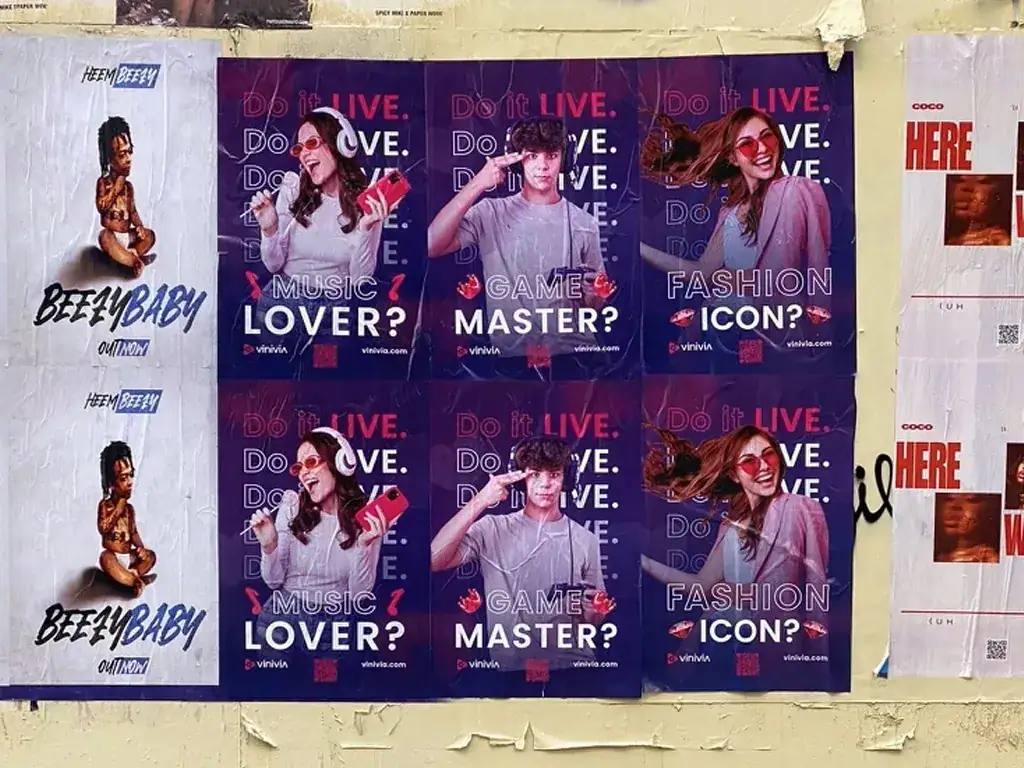
An album rollout is a schedule problem disguised as a creative problem.
The artwork is usually settled months before anyone calls us. What is not settled is the sequence: when the first visual lands on a street, what it says before the title is public, how the corridor changes on release day, and what is still up two weeks later when the second single arrives.
Most labels and managers I talk to are thinking about street posters as a single drop. One artwork, one city list, one night. That is a launch, not a rollout. A rollout is a run of phases on the same corridors, where each phase builds on the walls the last one established.
This post is the operational version of that. How our crews actually sequence an album rollout, what the phases look like on the ground, what breaks, and what we routinely talk artists and labels out of.
The rollout shape that works
Almost every album campaign we run breaks into four phases on the street.
Phase one: tease. Before anything is announced, a visual with no title and no date. Artwork fragment, a symbol, a crop of the album cover, a line of lyric. Goes up on a focused set of corridors in the markets that matter most to the artist. The job here is to make the corridor familiar. People who walk the same block every day should register a change without being able to name what it is.
Phase two: announce. Title, date, and the full artwork. This phase goes up overnight so the corridor flips between one evening and the next morning. The visual continuity with phase one is the whole point: the people who clocked the tease now get the payoff on the same walls.
Phase three: release week. Heaviest volume. Full artwork, the strongest density on the strongest corridors, timed so the maximum number of faces are up and clean on street date and the few days after.
Phase four: sustain. Lighter maintenance presence tied to singles, video drops, chart moments or tour routing. This is where most campaigns stop too early.
The reason this shape works is that it uses the same walls four times. A corridor you have paid attention to across six weeks reads very differently from a corridor you hit once. Repetition on a known block is worth more than scattering sheets across a wider map.
Choosing markets, then choosing corridors
The market list usually arrives from the label already made: the artist's top streaming cities, the tour routing, or the cities where press lives.
That part is not our call. The corridor selection inside each market is.
Markets we work most for music campaigns include New York, Los Angeles, Chicago, Atlanta, Austin, Nashville, Philadelphia, Seattle, Miami and the Bay Area. Each one has a different poster geography.
In New York, music poster runs cluster around the Lower East Side and Bowery hoardings, parts of Williamsburg and Bushwick, and the corridors near venues in both. The sightlines are short and pedestrian, which argues for smaller panels placed densely.
In Los Angeles the geography is the opposite. The useful walls are along stretches where people are driving, plus the hoarding around redevelopment sites and the areas near venues on the east side. Fewer placements, bigger panels, longer viewing distances.
Chicago gives you real pedestrian density on the north side and around the venue corridors, with hard weather seasonality that affects when you can install.
Austin concentrates around the downtown and east side venue clusters, and the whole calendar bends around festival season, when every usable surface in the centre is contested weeks in advance.
Atlanta spreads out. The corridors that work are commercial stretches and the areas around specific venues rather than a single walkable core.
Nashville has a dense entertainment core and a music industry audience that is genuinely reachable on a few specific streets, which is unusual and useful.
The corridor plan matters more than the market count. I would rather hold six corridors across three cities for six weeks than scatter single nights across twelve cities.
Timing, and the deadline nobody protects
The street date is fixed. Everything upstream of it is not, and that is where rollouts break.
A workable backward schedule covers artwork lock for each phase, pre-press and a physical proof on the real uncoated stock, the print run and drying time, freight into each market, route scouting, and then the install nights themselves. Weather buffer sits on top of all of it.
The step that slips is approvals. Not the press, not the crew. Label sign-off, management sign-off, artist sign-off, clearance on imagery, occasionally a last change to a date or a featured credit. We have had campaigns where every operational element was ready and the only thing threatening the street date was one approval chain.
The practical defence is to lock the tease artwork early, because it carries no title or date and therefore has almost nothing to approve. Teases can be printed weeks ahead. Announce artwork is the risky one because it carries the date, and the date is the thing most likely to move.
If a date is genuinely unstable, we would rather run the tease phase and hold the announce print until the date is final than print a wall of posters carrying a date that changes.
What a music install night actually looks like
Crews run in pairs. One person pastes the surface, the other places the sheet and brushes it out from the centre to the edges to push air and excess paste out. Two people is fast, quiet and self-sufficient for a corridor.
Larger routes run multiple pairs with a vehicle moving between them carrying paper and paste.
Work starts late. Typically after the foot traffic thins out, and runs through to early morning. The reasoning is practical: fewer pedestrians to work around, fewer delivery vehicles parked against the wall you need, easier parking, and clean documentation photos without people walking through the frame.
Release week installs sometimes go later still, because the point is for the corridor to be fresh at morning commute on a specific day.
A pair working a familiar corridor covers ground steadily. The limiting factor is almost never pasting speed. It is walking distance between usable surfaces, where the vehicle can sit, and how much of the planned route turns out to be unavailable because a hoarding came down or somebody else's campaign got there first.
Every placement gets photographed the same night, in enough context to identify the location. For a music campaign that photo set does double duty: it is the delivery record for the label and it is also the asset the artist's own channels end up using.
Stock, artwork and what survives three weeks outdoors
Music artwork has a specific weakness outdoors: it tends to be dark, moody and photographic. That is exactly the kind of image the street treats worst.
Three things to know.
Uncoated stock only. Paste has to soak through the sheet from the back to bond. Gloss or satin coating blocks it and the poster peels. Lighter uncoated paper conforms to brick and plywood texture and dries tight. Heavy card fights the wall and lifts at the corners.
Heavy ink coverage is a liability. Full-bleed black and dense dark fields stiffen the paper and slow paste absorption, which is why those panels bubble first. Album covers are frequently exactly this. We ask for the dark field broken up or screened back where the design allows, and where it does not we plan earlier replacement on those panels.
Fine detail disappears. Small credit type, tracklists, tiny logos and subtle tonal work are invisible from across a street and gone entirely after rain streaks and dust. A poster has about two seconds and roughly three elements: the image, the name, the date.
On colour: magenta tends to go first under sun, so a visual that depends on hot pink or bright red drifts over a few weeks on a sun-facing wall. If a campaign has colour-critical artwork we try to weight it toward walls that do not face the afternoon sun.
How long does a sheet hold? On clean construction plywood with decent weather, weeks. On a contested corridor during a busy season, it can be covered by another crew in days. At shoulder height on a pedestrian street, hand damage is usually the bigger factor than weather. This is why maintenance passes exist, and why a rollout that needs to be visible on street date is scoped with a pass right before it.
Weather windows across a rollout
An album rollout usually spans six to ten weeks, which means it spans weather.
Paste needs a dry window to cure. Rain in the first couple of hours after placement washes the paste out before the bond sets and the sheet is gone. Dew on an already-tacky poster is fine.
Cold slows the cure and stretches the vulnerable window. In genuine freeze conditions we move the night rather than install something that will be on the ground by morning. Chicago, New York and Seattle rollouts in deep winter need real schedule slack for this.
Heat does the opposite. Paste skins over quickly, so the crew has less working time per sheet and has to move faster. Summer installs in Atlanta, Austin and Miami are planned for the coolest hours of the night for that reason as much as for foot traffic.
Wind is the one that cancels nights outright, especially on larger panels. Wet paper has no strength and a big sheet in a gust is unmanageable.
When a street date is immovable, we build the release week install with a spare night in the plan. Losing a night to weather on a tease phase is an inconvenience. Losing it the night before street date is a failure.
What goes wrong, and where we push back
Running one night and calling it a rollout. This is the most common mistake. A single drop produces a photo set and very little else. The value of street posters is accumulation on specific corridors over weeks.
Announcing a date on a poster before the date is locked. We have been asked to paste dates that were still under negotiation. Posters are not editable. If the date moves, the corridor is now actively wrong, and a wrong date on a wall is worse than no poster.
Treating the tease as optional to save a phase. The tease is the cheapest phase in effort and it is what makes the announce land. Cutting it is cutting the setup and keeping the punchline.
QR codes as the main response. They work on a pedestrian wall at eye level where someone can stop. They do not work twelve feet up on a hoarding across four lanes. We ask where the viewer is physically standing before we let a code carry the campaign.
Tracklists and credits on a street poster. Nobody reads them. They make the sheet busier and the name smaller.
Chasing market count over corridor depth. Twelve cities with one night each produces nothing anyone remembers. Three cities held for six weeks produces a corridor that feels like the artist owns it.
Pasting surfaces somebody clearly cares for. Fresh paint on an independent storefront, a mural, a community board. Our crews skip those regardless of what the route sheet says. It is the right call and it protects the artist from a story they do not want.
Laminated or synthetic stock. Does not take paste, does not conform, does not break down if it comes loose. Paper is the correct material.
Permission, ordinance and the grey area
I get asked this on nearly every music campaign, usually by a manager who wants a yes or no. The honest answer is that it is a grey area.
Rules on outdoor posting vary by municipality, and enforcement varies even more than the rules, including between neighbourhoods in one city. What matters in practice is who owns the surface, what the local ordinance says about that type of surface, and whether permission was obtained from whoever has authority over it.
So that is where the work goes. We build routes around permissioned private surfaces wherever the campaign allows, because a permissioned hoarding is a wall where the campaign can run its full length, be maintained across phases and come down cleanly. For a rollout specifically, this matters more than for a one-off drop. You cannot build four phases on a wall you might lose in week two.
We also commit to removal. Paper posters are temporary by design, and leaving a corridor worse than we found it is bad for the artist, bad for the street and bad for the next campaign that wants to run there.
We will not hand you a yes or no verdict on any particular placement. We are not in a position to give legal advice, and anyone handing you a confident blanket answer on something this jurisdictionally variable is guessing. What we will do is describe how a specific market tends to behave, where risk sits, and how permission, surface selection, documentation and removal reduce it.
Artists and labels with low risk tolerance get an entirely permissioned route. It is smaller and takes more effort to assemble. For a major label release it is usually the right call.
Measuring a rollout without inventing numbers
I will not give you impression figures, because nobody in this format can produce honest ones.
What a rollout can actually deliver:
A dated photographic record of every placement, by corridor and by phase. This is the primary deliverable and it is verifiable.
Survival reporting from maintenance passes: which corridors held, which got covered, which surfaces failed and why. Over a six-week rollout this becomes genuinely useful intelligence for the next campaign.
Owned social content. Fan photos of posters in the wild are a consistent by-product of music campaigns, and the artist's channels usually get more use out of them than out of the official shots.
Correlation, not attribution. You can line up phase dates against streaming and search activity in those metros and look at shape. That is directional. Anyone who tells you a poster run produced a specific number of streams is selling you something.
Where posters sit next to the rest of the street plan
Posters are the base layer of a rollout because they hold a corridor across weeks.
The format that pairs best for music is Projection Advertising, used as a single-night spike rather than a sustained layer. On announce night or release night, a projection on a large surface near a venue or a dense corridor gives the campaign something that photographs well and travels on social, while the posters do the long work of staying up.
The two reinforce each other. The projection creates the moment, and the posters are still there in the morning when people come back to look for it. We scope projection nights against the same corridor map as the poster route so the two land in the same visual territory.
Frequently asked questions
How long before release should an album poster campaign start?
Plan the street work backwards from street date across four phases: tease, announce, release week and sustain. A typical rollout occupies several weeks on the same corridors. Lock tease artwork early, since it carries no title or date and almost nothing to approve, and hold announce printing until the release date is genuinely final.
How many cities should an album rollout cover?
Fewer than most labels want. Corridor depth beats market count. Holding a handful of corridors in two or three priority markets across the full rollout produces a street presence people notice and return to. Single nights spread across a dozen metros produce a photo set and very little accumulated effect.
What should be on an album rollout poster?
Three things at most: the image, the artist name and the date. Street posters are read from across a road, at an angle, in about two seconds. Tracklists, credits, small logos and fine type are invisible at that distance and gone entirely after a few rain streaks and some dust.
What happens if the release date moves after posters are printed?
Printed posters cannot be edited, and a wrong date on a wall is worse than no poster. This is why we push to keep the tease phase dateless and hold the announce print run until the date is locked. If a date is unstable, we run the tease and wait rather than commit a dated run to the street.
Is putting up album posters on the street allowed?
It is a grey area. It varies by municipality and by surface, and enforcement is inconsistent even within a single city. The outcome depends on surface ownership, local ordinance and whether permission was given. We cannot give legal advice. We reduce risk by building routes on permissioned private surfaces, documenting placements and committing to removal.
How do you report results on a poster rollout?
With a dated photographic record of every placement by corridor and phase, plus survival reporting from maintenance passes showing what held and what did not. You can compare phase dates against metro-level streaming and search activity for direction. Anyone quoting precise impression or stream numbers from a poster run is inventing them.
Ready to plan the rollout
Send us the release date, the market list and the artwork status, even if the artwork is only the cover. We will come back with a phase plan by corridor, the install nights each phase needs, the printing spec for outdoor stock, and an honest read on the permission picture in each market.
If you are early enough that the tease art is not designed yet, that is the best moment to talk. Decisions about contrast, ink coverage and how the tease visually connects to the announce are quick at the design stage and impossible after printing.
Request a campaign quote and tell us when the record comes out.

Ready to Run Your Campaign?
Call us or email us. We’ll tell you exactly what we can do in your market and what it costs.
Related Service
Explore similar advertising solutions offered by American Guerrilla Marketing.
American Guerrilla Marketing — Los Angeles
Street-level campaigns in Los Angeles and nationwide. Wheatpasting, LED trucks, street teams, and more.
(646) 776-2770
Related Articles
-
Wheatpasting & Poster Campaigns in Brooklyn, New York
November 12, 2026
-
Poster Campaign Proof of Posting: Common Mistakes
November 12, 2026
-
Poster Campaign Scope by Market Size vs Alternatives
November 12, 2026
-
Wheatpasting & Poster Campaigns in Houston, Texas
November 12, 2026
-
Wheatpasting & Poster Campaigns in Virginia Beach
November 12, 2026