
November 11, 2026
Examples of Guerrilla Advertising: A Field Guide From the
Most writing about examples of guerrilla advertising is written from a desk. This one is written from the van.
I am going to take you through what the work looks like from the crew side. The order of a night, the way a city behaves at different hours, what a wall tells you before you touch it, and the small signals that tell a lead whether a corridor is worth using again. If you are a buyer trying to work out whether this is the right channel for you, the crew view is more useful than the gallery view, because the crew view is where your campaign either holds or falls off.
There are no numbers on this page. Not because I am hiding anything, but because scope is driven by surfaces, crew, nights and permission, and I would rather explain those levers than invent a figure.
A warning before we start. The best known examples of this trade are the ones that look effortless. They are never the effortless ones. The effortless looking ones are the ones where somebody spent six weeks getting a property owner to say yes and then had a dry Tuesday.
The night, hour by hour
Every format has its own shape, but a poster night is the template, so let me walk one.
Afternoon the day before. Paste gets mixed and left to cool and thicken. Mixed hot and used hot, it runs off the wall. Left to sit, it grips. Posters are counted, sorted by site and bundled per route, so nobody is sorting paper in the dark. Buckets, brushes, rollers, gloves, a scraper, water, bin bags, a torch and printed route sheets go into the vehicle. Printed, because phone batteries die in the cold and a dead phone in a strange neighbourhood at 3am is a real problem.
Midnight to 1am. The lead checks the forecast one final time. Rain inside the first few hours after an install takes the sheets before the bond cures, so this is the last honest moment to move the night. I have cancelled at this point more than once and I have never regretted it.
1am to 2am. Crew leaves. Two to four people in a vehicle. The window matters: thin foot traffic, workable parking, and nobody trying to get past us on a narrow pavement.
2am to 5am. The route. One person pastes the wall, one holds and aligns the sheet, one watches the street and handles access, the lead runs the sequence and shoots documentation at each site. On a tight corridor we split into pairs and leapfrog.
5am. The walk back. The lead walks the corridor in reverse and checks edges, because edges are where failure starts and a two minute fix now saves a dead poster tomorrow.
Before 6am. Off the street, before the first commuter wave. A photo set, a site by site log, and a note of everything that failed or got skipped and why.
Reading a wall before you touch it
New crew learn this in a week and then never forget it. This is the whole craft compressed.
Run a hand across it. If your palm comes away powdery, the paste is going to bond to dust and not to the wall, and the sheet will release in one piece inside a day. Wipe it hard or walk away.
Look at the paint. Fresh or flaking paint means the poster will hold and then take the top layer with it at removal. That is how you lose a property owner permanently. We skip those surfaces even when the client specifically asked for them.
Look at the texture. Rough brick makes the paper bridge the mortar lines instead of settling into them, so you get a bubbled face and lifting edges. Smooth and sealed is always better: clean plywood hoarding, painted metal, sealed concrete.
Look up. Overhangs and ledges change everything. A sheltered wall holds through weather that strips an exposed one.
Look at what is already there. If a surface is clearly cleared regularly, anything you put there is a one night piece. Sometimes that is fine. You just need to know it before, not after.
Feel the temperature. Below freezing, paste behaves badly, because the water in it does what water does. We move the night or switch format.
City by city, how the ground changes
The same format is a different job in different cities, and this is the part buyers most often miss.
New York. Dense, vertical, and the surface inventory changes constantly because construction hoarding appears and disappears. SoHo and the Lower East Side give you walls with real foot traffic past them. Downtown Brooklyn turns over fast. Parking is the hardest operational problem in the city and it shapes the route more than the artwork does. Street Teams work well around Union Square and along the Bedford Avenue stretch in Williamsburg, where people walk slowly enough to be stopped.
Los Angeles. There is no single pedestrian spine, so coverage has to be deliberate. Melrose, Abbot Kinney in Venice, the Arts District and the Hollywood Boulevard tourist corridor each behave like separate towns with their own hours and their own crowd. Foot traffic is thinner but more intentional, which means fewer passes per person and a stronger case for concentrating hard rather than spreading.
Chicago. Milwaukee Avenue through Wicker Park gives you genuine density. Winter is the defining constraint. Wind and grit are brutal on surfaces, and a February street team shift is a different job from a June one in every way that matters, from shift length to how long anyone will stand still to listen.
Austin. Congress Avenue and East Sixth carry the weight. Event weeks change the city so completely that a plan written in a quiet month is worthless during one. Everything is contested, surfaces and crews alike. Either book those windows far out or deliberately run the shoulder weeks, when your work is not competing with everything else in town.
If a plan reads identically for all four of those cities, it was not really planned.
The seasons, honestly
Spring and autumn are the best working windows almost everywhere. Moderate temperatures, usable paste, concrete that takes decals, nights that get dark early enough for projection without running to midnight.
Summer. Long evenings push projection windows very late, which hurts. Heat shortens street team shifts, because standing on hot pavement for four hours degrades the quality of every conversation after hour two. Surfaces are generally fine.
Winter. The hard season. Freezing temperatures break paste. Cold concrete refuses decals. Crews work slower in gloves and nobody on the street wants to stop and talk. Winter work is possible, but it needs shorter shifts, sheltered surfaces and realistic expectations about what the weather will do to a run.
Rain. Not a footnote in any season. Rain within the first hours after a poster install takes the sheet. Rain during decal application makes the job impossible. Rain on a projection night ruins the image and threatens the gear. And rain during a street team shift changes human posture entirely: people walk faster, look down, and will not free a hand to take anything.
Examples by what the client actually needed
Here is the more useful way to catalogue this work. Not by format, by job.
The client who needed a corridor to feel occupied. Poster campaign along one walking route, concentrated, repeated over several weeks with maintenance passes. The mechanism is repetition on the same commuter. This is the most reliable thing we do.
The client who needed volume of placements quickly. Snipe Advertising. Smaller pieces, higher counts, a two person crew moving fast along street level surfaces. The feel of saturation rather than one hero image.
The client who needed people routed from a station to a door. Sidewalk decals and stencils. The format earns its keep when it has a direction to give. Most of that shift is surface prep: sweeping, sometimes washing, and waiting for concrete to be completely dry.
The client who needed a content moment on a specific night. Projection. Site visit at the real hour, two or three crew, a short run and a strong capture. Projection is an event, not a campaign, and clients who understand that get good results from it.
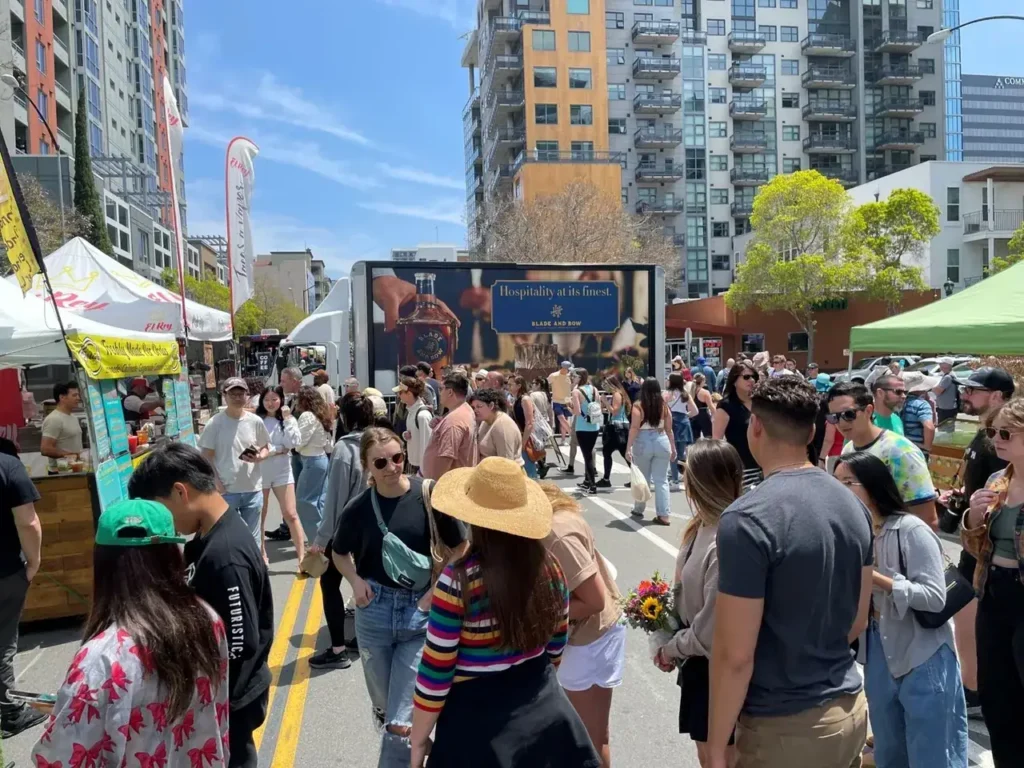
The client whose audience drives rather than walks. LED Trucks & Mobile Billboards. A planned loop through traffic during the evening peak, or around a stadium district before a game, where people are stuck and looking out of the window. Six words on the panel, no QR code.
The client who needed a human to explain something. Street teams. Pods of two to six per corridor, three to four hour shifts, a supervisor who can read the street and pull the team if conditions change.
Most real campaigns are two or three of those at once in the same footprint. Surfaces hold the corridor every day. Bodies show up on selected days. The surfaces make the team look official and the team gives the surfaces a voice.
What the crew notices that the report does not
Small things that change whether we recommend a corridor again.
How quickly the first poster gets interference. Some corridors are respectful for weeks. Some get tagged over within a night. That is not predictable from a map and it is why we test before we scale.
Whether anyone asks what we are doing. A corridor where a security contact stops us politely is a corridor where a conversation with the property owner probably turns into real permission. A corridor where somebody is hostile is a corridor we quietly drop.
What the morning looks like. We go back. A poster that looks perfect at 3am and awful at 9am usually has a lighting reason, and sometimes the right answer is the same artwork on the opposite side of the street.
How long the walk between sites is. Routes that look tight on a map can be ten minutes apart on foot with buckets. That is the difference between finishing a route and abandoning the last four sites.
The grey area, plainly
Permission is the part of this trade people want a clean answer about, and there is not one.
Rules for pavements, plazas, poles and walls vary by municipality and often by district inside the same city. Enforcement is inconsistent. A block nobody pays attention to for a year becomes an actively managed block the month a business improvement district takes an interest. Whether a given placement is acceptable depends on who owns the surface, what the local ordinance says and whether you have permission. I will not tell you a format is legal or illegal, and I am not qualified to give you legal advice.
How we lower risk, concretely.
Private surfaces first. Construction hoarding, private walls, venue frontage, approved boards, with the owner's agreement in writing. Names recorded, approvals kept.
Documentation on the crew. The lead carries contacts and approvals, so a challenge gets a phone number rather than a shrug.
A no argument rule. If a crew is challenged, they move. We log it and reassess. Two pushbacks and the corridor leaves our list.
Removal planned from day one, not bolted on. Every surface we use, we return to, and we photograph the condition we leave behind. That is why owners say yes to us again next quarter.
What we push back on
The reference deck recreation. A famous installation usually involved a closed street, a long approvals process and production resources that paid for everything in the frame. We can build something strong in your corridor. We cannot reproduce another city's permitting outcome.
One night, one neighbourhood, measurable lift expected. Street work compounds. If the schedule only allows one night, the honest deliverable is photography, and we should plan it as a shoot.
Even coverage of an entire metro. Thin spread is invisible everywhere.
Paragraphs on posters. Two seconds of attention from a walking person. Six words.
QR codes as the only response path, and especially on a moving truck panel.
Landmark walls by name. Usually owned by someone who will not agree, or cleared within days.
Projection in a bright commercial strip in midsummer, which gives you a late window and a washed out image.
Decals on cold winter concrete, which simply do not bond.
Saying yes to all of those would be easier. It would also produce campaigns I would not want photographs of.
What drives scope
Surface count or shift count, the biggest lever by far. Number of cities, since each one means its own crew, local knowledge and permission conversations. Run length, because a single install night is a project while a multi week programme with maintenance passes is an operation. Crew size per shift. Time of night and day of week. Permission complexity, which quietly eats more calendar than production ever does. Materials and production, from poster stock and size to decal lamination and projection content. Removal scope. Documentation standard, where a site by site photo log is normal and full video capture is a separate production job. And lead time, because compression damages permission and production before it damages anything visible.
The maintenance pass, which nobody asks about
Buyers ask about the install. Almost nobody asks about the second visit, and the second visit is what separates a campaign from a night out with a bucket.
A run of posters does not fail evenly. On any given corridor some sheets hold perfectly for weeks and a handful go early, usually the ones on the most exposed or dustiest surfaces. If nobody goes back, your corridor degrades into a patchy mix of strong placements and torn remnants, and torn remnants read worse than nothing at all.
So we schedule return passes. A smaller crew, often two people, walks the route in daylight, photographs each site, notes what is intact, repastes lifting edges and replaces what has gone. Daylight matters here because you are inspecting, not installing, and you need to see the surface properly.
The frequency depends on weather and on how contested the corridor is. A sheltered run in a quiet neighbourhood might only need checking every couple of weeks. An exposed corridor during a wet stretch needs attention much sooner.
Removal is the last pass and it is the one I will not let a client skip. We take the material down, clear the residue and photograph the surface as we leave it. That pass is the reason property owners take our call next quarter, and it is the single clearest difference between crews who intend to work a city for years and crews who intend to work it once.
Frequently asked questions
What does a typical install night look like?
Paste is mixed the afternoon before and left to thicken. The crew leaves between 1am and 2am with sorted bundles and printed route sheets. Two to four people work the corridor, one pasting, one aligning, one watching the street, the lead documenting. At around 5am the lead walks it back checking edges, then the crew is off the street before commuters.
How do you decide whether a wall is usable?
Touch it. Powder on your palm means the paste will bond to dust and the sheet will release within a day. Flaking paint means removal will strip the wall. Rough brick bubbles because paper bridges mortar lines. Sheltered surfaces outlast exposed ones. Below freezing, we move the night rather than fight the paste.
Do campaigns run differently in different cities?
Completely. New York is dense and vertical with constantly changing hoarding and brutal parking. Los Angeles has no pedestrian spine, so coverage concentrates in separate corridors. Chicago is defined by winter wind and grit. Austin is reshaped by event weeks. A plan that reads identically for all four was not really planned.
Is guerrilla advertising allowed on public streets?
It is a grey area. Ordinances vary by municipality and sometimes by district, enforcement is inconsistent, and the answer depends on surface ownership and permission. We reduce risk by using private surfaces with written owner agreement, carrying documentation, briefing crews to move rather than argue, and planning removal from day one. We do not give legal advice.
What season is best for street level campaigns?
Spring and autumn. Moderate temperatures keep paste workable, concrete takes decals, and darkness arrives early enough for projection without running past midnight. Summer pushes projection windows late and shortens useful street team shifts. Winter breaks paste below freezing and cold concrete refuses decals, so work moves to sheltered surfaces and shorter shifts.
Should I run one format or several?
Several, in the same footprint. Posters hold the corridor every day for weeks. Street teams show up on selected days within that same area. Decals route people toward a specific door. A truck loop adds reach if your audience drives. Single format campaigns consistently underperform combinations run across the same ground.
Request a campaign quote
Tell us the cities, the window and what the work has to achieve. We will tell you which corridors are worth using, what the surfaces in them will actually do to your artwork, how long permission realistically takes, and which part of your plan we would argue with.
If you want the format that carries the most weight for the least complexity, start with Wheatpasting & Poster Campaigns and build the rest of the campaign around that corridor.
Request a campaign quote and we will scope it from the street up.

Ready to Run Your Campaign?
Call us or email us. We’ll tell you exactly what we can do in your market and what it costs.
Related Services
Explore similar advertising solutions offered by American Guerrilla Marketing.
American Guerrilla Marketing — Los Angeles
Street-level campaigns in Los Angeles and nationwide. Wheatpasting, LED trucks, street teams, and more.
(646) 776-2770
Related Articles
-
Projection Advertising in the South Nashville Metro
November 12, 2026
-
Projection Advertising in Miami: How It Actually Works
November 12, 2026
-
What to Expect From an Experiential Marketing Agency in New
November 12, 2026
-
The OOH Media Buying Process: What to Expect
November 12, 2026
-
Brand Ambassador Staffing Agency: A Field Guide From the
November 12, 2026