American Guerrilla Marketing
Nationwide Service
Media planning, media buying, billboard advertising, & guerrilla marketing
The Live Music Capital runs on discovery — fly posting campaigns that put your brand where Austin’s tastemakers look.
Austin occupies a singular position in American cultural geography — a city that has managed, against considerable odds, to remain simultaneously one of the fastest-growing major metros in the country and one of its most influential incubators of independent culture. The city’s population has more than doubled since 2000, with Austin consistently ranking among the top three fastest-growing large cities in the United States across every year of the 2010s and into the 2020s. Tech industry giants — Dell, Apple, Tesla, Google, Oracle, Samsung, Meta — have established major Austin presences, importing 170,000 or more tech sector workers and the spending power that comes with them. And yet Austin remains the city that coined “Keep Austin Weird” as a civic motto, the city where the Continental Club has been booking live music since 1957, and the city whose South by Southwest festival set the global agenda for music, film, and tech culture for more than three decades. Flying a poster on the right Austin wall is not merely an advertising act — it’s a participation in a cultural conversation that reaches far beyond the city’s city limits.
The numbers that define Austin’s market scale are staggering even before accounting for its cultural amplification. South by Southwest brings more than 300,000 attendees to the city each March — including music industry professionals, tech investors, international press, brand marketing executives, and tastemakers whose influence on national and global culture is disproportionate to their headcount. Austin City Limits Music Festival at Zilker Park draws 450,000 attendees across two weekends each October, making it one of the largest music festivals in the United States by total attendance. UT Austin’s enrollment of more than 51,000 students makes it one of the largest universities in the country, and its campus feeds directly into the Red River Cultural District and East 6th Street entertainment corridors that anchor Austin’s live music and nightlife scene. Beyond these headline figures, Austin hosts 15 million annual visitors who come to experience a city that has become one of the most culturally discussed destinations in America — people who arrive already curious about what’s new, what’s happening, and what’s worth their attention.
Austin’s tech economy has added a consumer dimension to its cultural identity that makes fly posting even more strategically valuable than it was a decade ago. The 170,000-plus tech workers employed in Austin by companies ranging from Dell’s Round Rock campus to Apple’s new campus in north Austin to the Tesla Gigafactory in nearby Pflugerville represent a demographic with high disposable income, a strong bias toward authenticity over corporate polish in brand selection, and a documented preference for discovering brands through organic and peer-influenced channels rather than traditional advertising. These tech workers socialize heavily in the Rainey Street and East 6th corridor, live in the Mueller and South Congress neighborhoods, and frequent the farmers markets and live music venues of the Red River District. A fly posting campaign that reaches them in these spaces encounters them at their most receptive — off work, in a discovery mindset, and in a social context where brand impressions are shared and discussed with peers whose opinions they trust.
The “Keep Austin Weird” ethos is not marketing mythology — it represents a genuine cultural value system that Austin’s residents actively enforce through their consumer choices and community advocacy. The campaign was launched by Austin bookstore owner Red Wassenich in 2000 as a call to support local independent businesses against the encroachment of national chains, and it has since become a civic organizing principle that shapes everything from the city’s independent restaurant scene to its resistance to national retail formats to its enthusiastic embrace of locally produced art and music. In this cultural context, fly posting — a medium that is inherently local, physical, and independent in its aesthetic character — reads as an authentically Austinite form of communication. When your campaign appears on an East 6th Street wall alongside hand-drawn show flyers and independently produced concert posters, it is participating in Austin’s visual culture in the way that culture actually functions, not intruding on it from outside.
From Red River's live music walls to East 6th Street's indie corridor to South Congress's iconic boulevard — AGM puts your campaign on the surfaces that Austin's tastemakers, music fans, tech workers, and festival crowds walk past every day. Get your free Austin campaign quote today.
Select a city to explore Fly Posting Advertising opportunities.
Most cities tolerate fly posting; Austin invented the visual tradition that fly posting embodies. The city’s identity as the Live Music Capital of the World was not decreed by a marketing committee — it emerged organically from a half-century of independent music promotion conducted almost entirely through the physical medium of printed posters on walls. In the 1970s and 1980s, when Austin’s Sixth Street scene was establishing itself as one of the most important live music corridors in America, the announcement mechanism was the poster. A touring band’s arrival was announced by its advance team with hand-printed or Xeroxed flyers plastered on the walls of venues, phone booths, and storefronts along Red River Street and the emerging East Sixth corridor. The Antone’s Blues Club, Stubb’s Waller Creek Amphitheater, the Paramount Theatre — these venues built their audiences through exactly the medium that AGM now executes at professional scale for national brands.
Understanding this heritage is the key to understanding why fly posting performs so differently in Austin than in most American cities. In Dallas, fly posting is a countercultural statement in a corporate city. In Houston, it’s a cross-cultural reach mechanism in a diverse metropolis. In Austin, fly posting is not countercultural — it is the culture. The Red River Cultural District’s walls have hosted band posters for four decades. East 6th Street’s commercial facades wear layers of independent music promotion as naturally as they wear their vintage signage. South Congress’s independent storefronts treat poster culture as part of their visual identity. When a brand’s campaign appears in this context — not as a foreign commercial intrusion but as a natural addition to a visual tradition the neighborhood has cultivated for generations — it earns a quality of reception that is simply unavailable through any other medium in this market.
The SXSW dimension of Austin fly posting adds a layer of strategic value that is unique in American media markets. When 300,000 attendees arrive for South by Southwest each March — many of them the music industry executives, tech investors, global media figures, and cultural tastemakers who collectively determine which brands, artists, and ideas will be discussed nationally for the next twelve months — the physical walls of Austin become the most valuable brand real estate in the country for that ten-day window. A fly posting campaign on Red River Street during SXSW is not seen by 300,000 generic consumers; it’s seen by 300,000 people who are in Austin specifically because they care about being at the center of cultural conversation. The amplification potential — in social sharing, in editorial coverage, in word-of-mouth reach through the networks of Austin’s most influential week-long visitors — makes SXSW-timed Austin fly posting one of the highest-leverage brand awareness investments available anywhere in American guerrilla marketing.
AGM’s Austin fly posting packages include location scouting across the city’s most valuable entertainment and cultural corridors, professional overnight installation, and complete timestamped photo documentation delivered within 48 hours. Festival season packages for SXSW and Austin City Limits are available with advance booking.
Austin campaigns can be paired with Houston, Dallas, and San Antonio for statewide Texas coverage. Contact AGM for custom SXSW and ACL festival packages and for multi-city Texas proposals.
Award Winning Personalized Service
You will get thoughtful, devoted, and individualized attention from our experienced, qualified, and professional personnel. Being one of the most illustrious agencies in Brooklyn, New York, American Guerrilla Marketing has been awarded the Best of Brooklyn title.
Nationwide
Industry City, Brooklyn, New York 11232
American Guerrilla Marketing
Hours
Mon - Fri: 9 AM - 5 PM
Sat & Sun: Closed
Automate your campaign with AGM’s Request for Proposal Builder. Simply answer a few quick questions about your campaign goals, markets, and timeline, and the system will generate a tailored presentation with recommended strategies, quantities, and pricing. Click the RFP Builder to instantly receive your customized proposal.
Austin campaign strategy begins with the calendar. More than any other city in the AGM network, Austin’s effectiveness as a fly posting market is shaped by when you choose to campaign as much as where you choose to place. The SXSW window in March and the ACL Festival window in October are Austin’s two peak campaign moments — periods when the city’s streets are saturated with a higher concentration of culturally influential visitors than at any other time. Planning your Austin fly posting campaign to align with one or both of these windows is the single most important strategic decision a client can make for this market, and it should drive the entire campaign timeline from brief to installation to monitoring.
For SXSW-timed campaigns, AGM recommends a two-phase deployment strategy. The first phase drops posters across the Red River Cultural District, East 6th Street, and South Congress three to five days before SXSW’s opening day — establishing campaign presence before the event crowd arrives and ensuring that posters are fresh and fully adhered when the first wave of 300,000 attendees begins walking Austin’s streets. The second phase involves mid-festival monitoring and refresh, replacing any damaged or compromised posters at the campaign’s midpoint to maintain full visibility through the festival’s final day. This two-phase approach ensures that your campaign is visible not just to the early-week arrivals but to the full ten-day SXSW audience, including the final weekend when many of the event’s highest-profile industry attendees are most actively exploring the city beyond the official festival programming.
For Austin City Limits Festival campaigns in October, the strategic approach is slightly different because ACL draws a more geographically concentrated audience — 75,000 per day at Zilker Park in South Austin — that moves between the festival grounds and the South Congress, Bouldin Creek, and South Lamar corridors on festival days. AGM positions ACL-timed campaigns with a South Austin emphasis, placing posters along South Congress and South Lamar in the days before the festival opens and ensuring strong coverage of the streets between downtown and Zilker Park that festival pedestrians walk regularly. The ACL crowd skews slightly older than the SXSW audience — more in the 25–45 range versus SXSW’s younger heavy representation — which makes ACL timing particularly valuable for consumer brands targeting the millennial and older Gen Z demographic with established income and strong lifestyle brand affinity.
Austin’s tech industry workforce has created a year-round fly posting opportunity that operates independently of the festival calendar. The 170,000-plus tech workers concentrated in Austin — particularly those at the Apple campus in north Austin, the Oracle lakefront campus, the Google offices Downtown, and the growing concentration of startups and scale-ups in the East Austin innovation corridor — socialize heavily in Rainey Street, East 6th, and the bars and restaurants along South Congress. These workers have high disposable income, strong peer influence networks, and a documented preference for discovering brands through authentic cultural channels rather than conventional advertising. Campaigns targeting Austin’s tech workforce position posters in Rainey Street, East 6th, and the bar corridors between downtown and the Domain in north Austin, creating coverage across both the central city social scene and the north Austin tech campus community.
East 6th Street has emerged as Austin’s most important new campaign territory in the past five years. While the western segment of 6th Street — “Dirty 6th,” the well-known tourist bar corridor from Congress Avenue to Red River Street — has been Austin’s nightlife center for decades, the eastern segment of 6th Street from Red River eastward to Chicon Street has developed into something genuinely different: a corridor of vintage shops, taco stands, natural wine bars, record stores, and underground music venues that serves as Austin’s hippest, most locally authentic neighborhood. The east 6th community skews younger and more culturally forward than the tourist-oriented western end, and its resistance to commercialization makes authentic, well-crafted fly posting more effective here than almost any other commercial medium. Brands that can credibly participate in East Austin’s visual conversation — through compelling creative that understands the neighborhood’s sensibilities — find east 6th one of the most valuable single-block-increment campaign zones in the entire Austin market.
The Red River Cultural District is Austin’s live music heart and the highest-value fly posting zone in the city for entertainment brands. The District runs along Red River Street from 6th Street northward to approximately 11th Street, with Stubb’s Waller Creek Amphitheater at the south end (capacity 2,750 for the indoor Waller Creek Amphitheater and 3,000 for the outdoor amphitheater) and Mohawk, Parish, Emo’s, and Antone’s further north along the corridor. The venues collectively book hundreds of shows per year spanning every musical genre, and their combined weekly audience creates one of the most music-engaged pedestrian environments in America. The district’s brick and concrete venue exteriors provide excellent posting surfaces with exceptional daily impression counts. SXSW programming is concentrated in and around the Red River District, making it the single most competitive and highest-value posting zone in Austin during the festival’s run.
East 6th Street from Red River Street eastward to approximately Chicon Street — distinct from the tourist-oriented western segment — is Austin’s most culturally vital emerging corridor. The neighborhood’s character is defined by independently owned businesses operating out of converted residential houses and small commercial buildings: vintage clothing shops, artisan taco stands, underground bars, small record shops, and DIY creative spaces. The Violet Crown Social Club, Nickel City, Canje, and dozens of other independent venues anchor the corridor’s nightlife scene. East 6th’s posting surfaces tend toward smaller commercial facades and utility infrastructure rather than the large warehouse walls of Deep Ellum or EaDo, rewarding saturation placement strategies that build cumulative presence across the corridor rather than relying on a small number of dominant placements. For brands with strong independent, arts-forward, or music-adjacent positioning, East 6th offers the closest thing Austin has to a guaranteed cultural endorsement through physical presence.
South Congress Avenue is Austin’s most recognizable non-festival commercial corridor — the iconic stretch from Barton Springs Road southward past the Alamo Drafthouse, Uncommon Objects, Güero’s Taco Bar, and the landmark Continental Club that has anchored Austin’s live music heritage since 1957. SoCo draws both visitors and longtime Austin residents in roughly equal measure, creating a demographic mix that is broader and more tourist-inclusive than East 6th but more locally engaged than Sixth Street’s western end. Weekend foot traffic along SoCo is strong from mid-morning through midnight, with First Thursday monthly events adding an art walk dimension. The corridor’s independent storefronts and the blanks walls of the South Lamar Theater and Alamo Drafthouse provide excellent posting surfaces, and the 24″×36″ standard format performs particularly well here due to the corridor’s intimate commercial scale.
Rainey Street is a single block of bungalow houses converted to bars, food trailers, and cocktail lounges running south from Cesar Chavez Street to Driskill Street, just southeast of downtown Austin. What it lacks in scale it makes up in demographic precision: Rainey Street draws Austin’s tech industry crowd with almost no other segment represented in significant numbers. On Thursday, Friday, and Saturday evenings, the street and its immediately adjacent blocks fill with software engineers, product managers, startup founders, and tech marketing executives from Austin’s major tech employers and startup community. This demographic has high disposable income, strong peer influence networks, and a documented preference for brands with genuine quality signals over mass-market positioning. Fly posting on Rainey and its immediate approaches — Driskill and River Street — delivers exceptional precision for brands targeting Austin’s tech professional community.
South Lamar Boulevard from Barton Springs southward into the Bouldin Creek neighborhood is Austin’s most consistently local commercial corridor — the zone that established Austin residents most strongly claim as their own against the tourist traffic that dominates SoCo and the tech crowd that dominates Rainey. The Alamo Drafthouse South Lamar, the Violet Crown Cinema, the Lamar Union development, and the concentration of independent restaurants and coffee shops along the corridor serve a 28–45 demographic that is strongly engaged with local culture and strongly resistant to corporate marketing. Fly posting on South Lamar performs best for brands that can communicate genuine local engagement and independent cultural values — the same qualities that the neighborhood’s permanent resident population prizes in the businesses they choose to patronize.
The West Campus neighborhood immediately west of UT Austin’s 431-acre campus — bounded roughly by Guadalupe Street (the Drag) to the east and Lamar Boulevard to the west — is home to the majority of UT Austin’s 51,000-plus students who live off campus. Guadalupe Street itself, known as “the Drag” by Austin residents, runs along the western edge of the main campus and provides the primary commercial infrastructure for the student population. Fly posting in West Campus and along Guadalupe reaches Austin’s largest concentrated young adult demographic at a time in their lives when brand loyalties are forming and entertainment and lifestyle purchasing decisions are being made with both social and personal significance. For music labels, streaming platforms, apparel brands, tech products, and entertainment brands targeting the 18–24 demographic, West Campus is Austin’s highest-density single-zone opportunity.
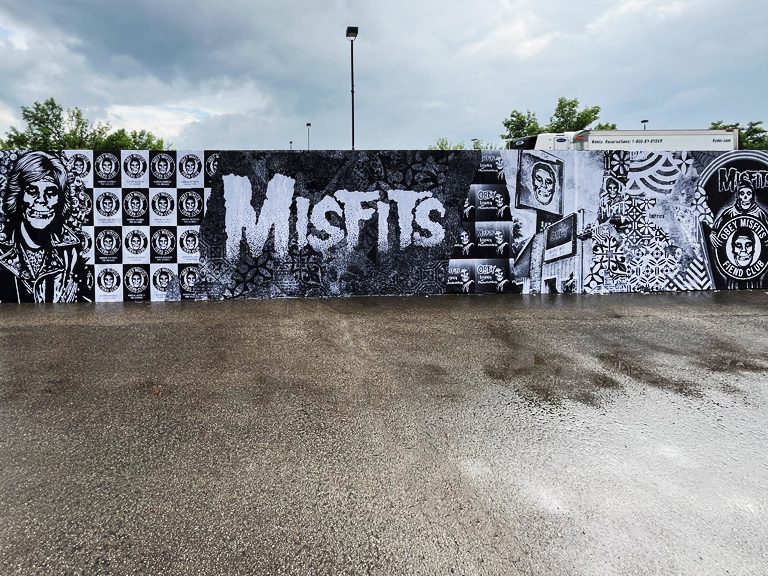
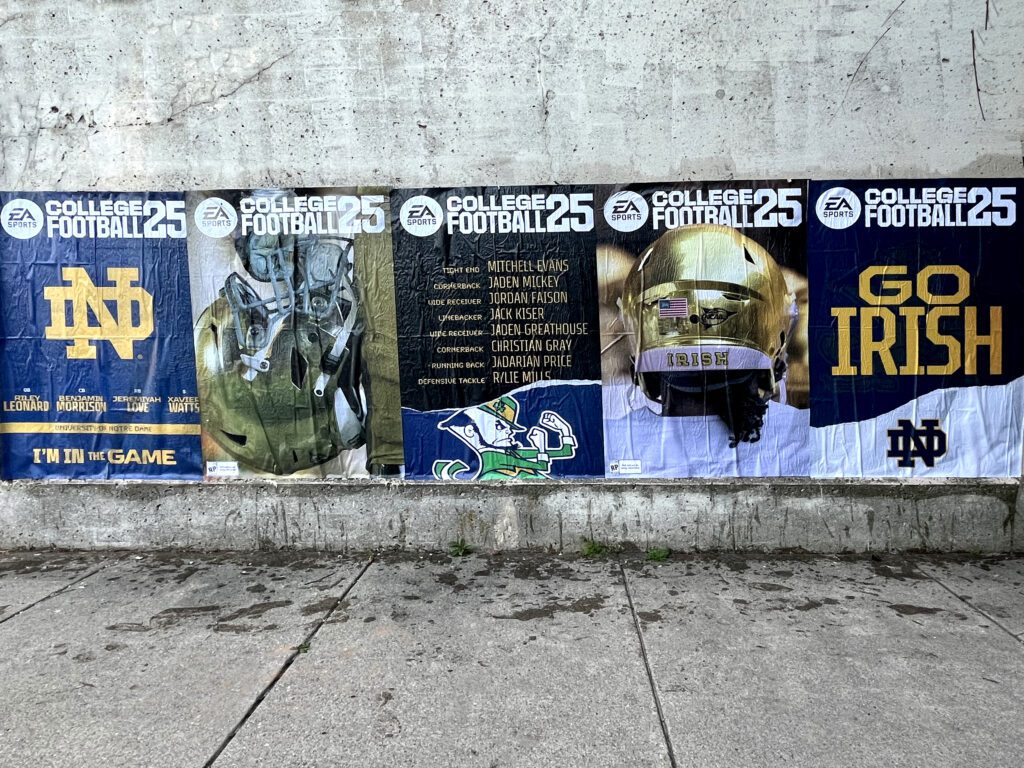
American Guerrilla Marketing has executed Austin campaigns for clients including Netflix, whose streaming platform launches required precisely timed drops in Austin’s most influential corridors before and during major cultural events. We’ve run campaigns for The Onion, EA Sports, Biossance, and Shepard Fairey — the latter a collaborator whose entire career has been built on the legitimacy of physical poster art on urban walls. Our Austin crew understands the city’s visual culture not as an outsider looking for placement opportunities but as a participant in the tradition that makes Austin’s walls the most culturally significant posting surfaces in Texas.
The operational demands of SXSW are a case in point for AGM’s Austin capabilities. During festival week, Austin’s streets are more congested, more photographed, and more competitive for visual attention than at any other time of year — while simultaneously representing the highest-value campaign window available in this market. AGM’s SXSW execution protocol accounts for the unique challenges of festival week: increased vehicle and pedestrian traffic during installation windows, higher surface competition from other campaign materials, and the need for midweek monitoring and refresh to maintain campaign integrity through the full ten-day run. Clients who have executed Austin campaigns with less-prepared vendors during SXSW and then switched to AGM consistently report better placement quality, better surface retention, and better photo documentation through the complete festival window.
Our Austin surface relationships cover the Red River Cultural District, East 6th Street, South Congress, Rainey Street, South Lamar, and the West Campus corridor — the full range of Austin’s meaningful entertainment and cultural zones. These established relationships provide access to the best surfaces in each corridor rather than the leftover walls that become available through cold outreach. Every AGM Austin campaign begins with a location map for client review before installation and concludes with complete timestamped, geo-tagged documentation within 48 hours of campaign completion. Remote clients — the majority of our Austin campaign clients are based in New York, Los Angeles, or Nashville — get the same documentation quality and placement accountability as if they were on the ground in Austin for every installation.
SXSW is the single most valuable campaign window in the Austin market, and fly posting is arguably the highest-ROI medium available during the festival because of the extraordinary concentration of culturally influential attendees on Austin’s walkable entertainment streets. AGM’s SXSW integration strategy begins with a pre-festival drop three to five days before the event opens — establishing campaign presence before the first wave of 300,000 attendees arrives and ensuring posters are fully set and visually pristine for the opening weekend rush. The campaign then enters a monitoring and refresh phase that runs through the festival’s final day, maintaining poster integrity through the full ten-day window. This continuous coverage ensures that latecoming attendees — often some of the festival’s highest-profile industry figures who arrive for the second week — encounter the campaign at the same quality as opening-weekend visitors. For clients who want to amplify SXSW fly posting with social activation, AGM can recommend placement locations that are particularly likely to appear in the background of street photography that SXSW attendees post extensively throughout the festival.
The Red River Cultural District’s most valuable posting surfaces cluster in three zones along the Red River Street corridor. The southern zone, around the intersection of Red River and 6th Street adjacent to Stubb’s outdoor amphitheater, receives the highest foot traffic volume because it sits at the convergence point between Sixth Street’s westbound nightlife traffic and the Red River District’s northbound live music corridor — a natural pedestrian pinch point where thousands of people pass on weekend evenings. The central zone between 7th and 9th Streets on Red River includes the walls of Mohawk, Parish, and several adjacent venues that together create a dense entertainment nucleus where concertgoers congregate before and after shows. The northern zone near Emo’s at the 10th Street end of the district catches the overflow from Stubb’s major amphitheater shows — when Stubb’s hosts a 3,000-person sold-out show, the audience spills north along Red River before and after the performance, dramatically increasing foot traffic in front of the northern zone’s posting surfaces. AGM recommends coverage across all three zones for entertainment campaigns and can prioritize southern zone saturation for clients with a single-zone budget constraint.
Yes — Austin City Limits timing is AGM’s second most requested Austin campaign window after SXSW. ACL runs across two consecutive weekends in October at Zilker Park in South Austin, drawing 75,000 attendees per day across six days of programming over the two weekends. The festival’s south Austin location means that the pedestrian approach corridors from downtown to Zilker Park — South Congress, Barton Springs Road, and South Lamar — receive dramatically elevated foot traffic from festival-goers walking between their downtown hotels and accommodations and the festival grounds. AGM positions ACL-timed campaigns with a strong South Austin emphasis, placing posters along South Congress and South Lamar in the days before the first ACL weekend and refreshing for the second weekend if needed. The ACL audience demographic — slightly older and more music-industry-adjacent than the mainstream SXSW crowd, with stronger representation in the 28–45 range — makes October timing particularly effective for brands targeting the established music fan and premium consumer segments of Austin’s market.
Austin’s 170,000-plus tech workers are not homogeneously distributed across the city — they cluster in specific residential and social geographies that fly posting can target with precision. The Rainey Street corridor is the single most tech-concentrated social space in Austin, drawing tech workers from Google Downtown, Oracle’s lakefront campus, and the cluster of startups and scale-ups in the East Austin innovation corridor on Thursday, Friday, and Saturday evenings. East 6th Street attracts a younger tech worker demographic — the 22–30 segment of Austin’s tech industry, primarily early-career engineers and junior product roles — who are drawn to East 6th’s independent character precisely because it offers a contrasting aesthetic to their corporate office environments. The Domain in north Austin, where Apple and other major tech employers have campuses, has developed its own surrounding commercial district with restaurants and bars that serve the north Austin tech worker community — an increasingly important posting zone for brands that want to reach the Apple, NXP Semiconductors, and other north Austin tech employer populations without requiring them to commute downtown for exposure.
East 6th Street and South Congress serve overlapping but meaningfully different Austin demographics that respond to different campaign aesthetics and messaging approaches. East 6th is local-first — its primary audience is Austin residents, particularly the 21–35 creative and culturally engaged community that has made the corridor their neighborhood hangout rather than a destination they visit. The creative ethos on East 6th is deliberately anti-corporate and indie-maximalist, which means campaigns that feel authentic, handcrafted, or culturally specific perform dramatically better than polished commercial aesthetics. South Congress, by contrast, draws a broader audience that includes a significant tourist component alongside long-term Austin residents — people visiting Austin specifically because SoCo is on the cultural tourism checklist. This broader audience is more receptive to a wider range of brand aesthetics but delivers lower concentration of the deeply locally-embedded tastemakers who make East 6th particularly valuable for brands that want to establish indie cultural credibility. For most campaigns, covering both corridors is the optimal strategy — East 6th for cultural depth, South Congress for broader reach.
Austin’s “Keep Austin Weird” ethos is a genuine cultural value system, not just a marketing slogan, and it has concrete implications for fly posting campaign design in this market. The city’s community actively distinguishes between campaigns that feel like authentic participants in Austin’s independent visual culture and campaigns that feel like national brands trying to borrow that culture’s credibility without earning it. Campaigns that land on the right side of this distinction — through genuinely compelling creative, locally specific references, or an aesthetic that aligns with Austin’s independent music and arts tradition — earn organic social amplification and word-of-mouth reach that multiplies their physical impression counts. Campaigns that land on the wrong side — polished corporate aesthetics on Austin’s most authentic walls — can generate backlash that is uniquely damaging in a city where community opinion travels fast through strong social networks. AGM advises Austin clients on the creative and tonal calibration required to position their campaigns as culturally appropriate additions to Austin’s visual landscape rather than unwelcome commercial intrusions, and our knowledge of what works on specific walls in specific neighborhoods is built from years of direct Austin campaign experience.
UT Austin’s main campus is managed by the University of Texas System and has its own posting regulations that preclude standard fly posting approaches on university-controlled surfaces. However, the West Campus neighborhood immediately adjacent to the campus — particularly the Guadalupe Street corridor known as the Drag, which runs along the campus’s western boundary and is lined with privately owned retail and commercial buildings — is fully accessible for fly posting campaigns and offers exceptional reach into the student population. The Drag’s mix of bookstores, food options, and student-service businesses generates extremely high daily pedestrian traffic from UT students crossing between campus and their West Campus residences. Additional West Campus surfaces in the residential blocks between Guadalupe and Lamar provide secondary coverage depth that captures the student population within their neighborhood rather than just in transit along the main commercial corridor. For brands targeting the 18–24 student demographic specifically, the West Campus posting zone is AGM’s top recommendation in Austin.
Austin’s fly posting market produces the strongest responses for brands that align with three core Austin cultural values: independence, authenticity, and creative quality. Music labels and touring artists consistently achieve the highest engagement rates of any category — Austin’s population is more intensely music-engaged per capita than virtually any other American city, and concert promotion posters are received with genuine interest and positive community reception across all of the city’s major corridors. Technology brands with genuinely interesting products — particularly those with a creative or independent positioning rather than an enterprise focus — perform well in East 6th and Rainey Street placements where the tech and creative industries overlap. Apparel and lifestyle brands with credible independent or streetwear positioning find the Red River and East 6th corridors particularly receptive. Film and streaming platforms launching culturally relevant content find Austin’s tastemaker-heavy audience to be a powerful word-of-mouth amplifier when fly posting campaigns create the street-level visibility that triggers social sharing and media coverage. Brands that perform poorly in Austin are those whose creative feels corporate, generic, or disconnected from the city’s specific cultural sensibilities.
Festival season bookings for Austin — SXSW in March and Austin City Limits in October — require the longest advance planning of any campaign window in the Texas market. AGM strongly recommends booking SXSW campaigns a minimum of eight weeks before the festival’s opening day, and ten to twelve weeks is preferable for campaigns targeting the highest-value Red River Cultural District surfaces. The combination of high campaign competition from national brands all targeting the same SXSW window, the logistical complexity of operating in a city with dramatically elevated vehicle and pedestrian traffic during the festival, and the need to coordinate print production and crew positioning well in advance of the event all contribute to this extended lead time. ACL Festival campaigns should be booked a minimum of six weeks before the festival’s first weekend to ensure surface availability in the South Austin corridors that are most valuable for ACL-timed placements. For non-festival Austin campaigns — targeting the year-round student and tech industry audience — AGM’s standard two-to-three-week booking lead time is typically sufficient.
Yes — AGM has spent years developing and maintaining relationships with property owners, building managers, and venue operators throughout Austin’s key posting corridors who provide legitimate surface access for our campaigns. These established relationships are particularly important in Austin because the city’s community of long-term property owners and venue operators in the Red River District, East 6th, and South Congress are protective of their spaces and their neighborhood’s visual character — they don’t grant posting access to vendors they don’t know and trust. AGM’s surface relationships in Austin give our clients access to the highest-visibility, most strategically positioned walls in each corridor rather than the marginal surfaces that become available through cold-approach posting. These relationships also ensure that our placements are treated as legitimate and supported by the property owners whose surfaces they occupy, which translates to better placement longevity and less likelihood of premature removal than campaigns placed without owner consent. For clients who want the best Austin posting surfaces — not just available surfaces — AGM’s established network is a material competitive advantage.