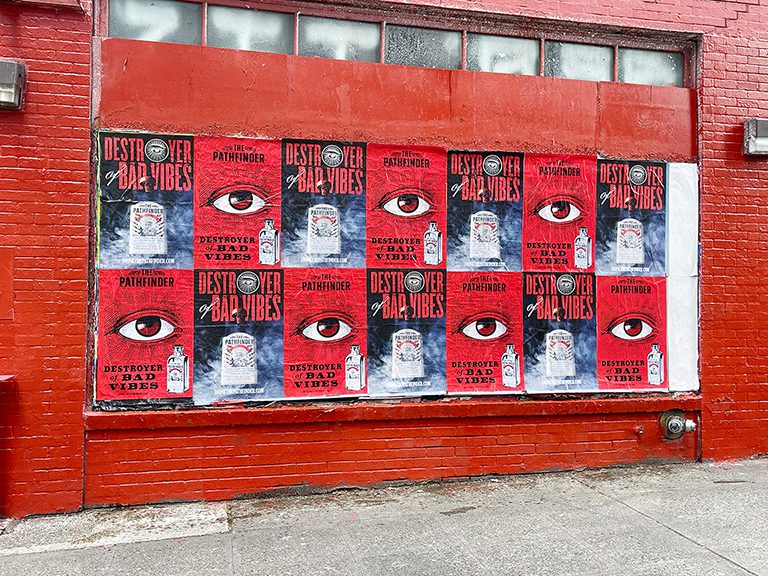
Normal posters range from 11×17 to 24×36 inches, with 24×36 being the most common for street campaigns. Here’s the full breakdown of what “normal” actually means in practice.
When someone asks us what size normal posters are, the answer depends on what they’re using the poster for. “Normal” means something different in a college dorm room versus on a street corner in Brooklyn versus inside a movie theater lobby. Context matters.
That said, there is a clear answer for advertising and promotional work: the 24×36 inch poster is the most common standard size for professional street-level campaigns in the United States. Our crews place these across New York City, from Williamsburg to Harlem. They go up on buildings in the Mission in San Francisco, along Crenshaw in LA, down Milwaukee Avenue in Chicago.
But there’s more to the story. Let’s walk through what “normal” means across different poster categories and use cases.
Here’s the full range of what most people consider standard or normal poster sizes:
Size
Dimensions
What It’s Called
Most Common Use
Small
11 x 17 in
Tabloid
Flyers, bulletin boards, corridors
Medium-Small
12 x 18 in
Small Poster
Window displays, small events
Medium
18 x 24 in
Standard Poster
Retail windows, indoor events
Large
24 x 36 in
One-Sheet / Large Poster
Street campaigns, storefronts
Entertainment
27 x 40 in
Movie One-Sheet
Cinema, entertainment marketing
Extra Large
36 x 48 in
Large Format
Transit, large retail, outdoor
The sizes 18×24 and 24×36 are the two most frequently referenced as “normal” posters for advertising and promotional use. The 24×36 is what most professional campaigns use for street-level work. The 18×24 is common for indoor displays and window placements.
What Is the Normal Poster Size for Advertising?
In our line of work, 24×36 is the normal size for street-level poster campaigns. It’s 2 feet wide and 3 feet tall. It holds up well in outdoor conditions. It’s visible from 30 to 40 feet away with a clean design. Print shops stock it as a standard size, which keeps cost and turnaround time reasonable.
We use 24×36 in heavy rotation. A typical street-level campaign in a major city might involve 200 to 500 of these, placed across a defined geographic area. If a client is promoting a concert, a brand activation, a product launch, or a retail opening, 24×36 is usually our starting point for street work.
The 18×24 takes over in indoor settings. This size works in window displays, inside venue common areas, along corridors, and in storefront display cases. It’s visible from 15 to 25 feet under most conditions. For clients who need presence inside a specific venue or retail environment, 18×24 is often the right call.
Field standard: Our crews work primarily with 24×36 for outdoor placements and 18×24 for indoor or window placements. These two sizes cover the vast majority of what professional poster campaigns require. When in doubt, start here.
Normal Poster Sizes for Specific Use Cases
Music and Concert Posters
Concert and music event posters historically landed on the 18×24 format. Independent venues, clubs, and record stores all used this size. You still see it everywhere in New York. Flyers for shows at Brooklyn Steel, the Bowery Ballroom, or Elsewhere in Bushwick are often 18×24.
Major touring acts often step up to 24×36 for building-level placements and outdoor locations. Festival posters sometimes go even bigger. But for club shows and local events, 18×24 is the normal size.
Movie Posters
The standard US movie poster is 27×40 inches. This is the “one-sheet” format that’s been used by the Hollywood studios since the 1980s. Before that, the dominant format was 41×81 (three-sheet) and 22×28 (half-sheet). Today’s multiplex lobby frames are built for 27×40.
The international version of the one-sheet is 27×41 inches, one inch taller. The difference is minimal and the formats are functionally identical in practice.
Political and Campaign Posters
Political campaign posters vary widely. Yard signs are typically 18×24 or 24×36. Larger building-level banners can be custom-sized. For traditional printed posters placed in windows and storefronts, the 18×24 and 24×36 are normal sizes. Small campaign flyers often run at 11×17 or 8.5×11.
Retail and Business Promotion
Retail poster sizes depend heavily on the display infrastructure. A 11×17 or 18×24 fits standard snap frames and poster holders. A 24×36 requires a larger frame but is more impactful in a window or on a floor-standing display. Most retail environments use 18×24 or 24×36 as the normal range.
Why 24×36 Became the Normal Street Poster Size
The 24×36 poster size didn’t emerge from any official standard. It grew organically from practical considerations in the poster printing industry. Large-format roll printers output at 24 or 36 inch widths. Cutting a 24-inch wide roll at 36 inches produces a 24×36 sheet with no waste. The math is efficient.
Frame and display hardware manufacturers settled on 24×36 because it was what print shops were producing. Once the hardware matched the print format, the size became self-reinforcing. Printers used it because hardware supported it. Hardware manufacturers built for it because print shops supplied it.
That’s how industry standards usually work. Not from a central authority, but from practical convergence around what’s efficient to produce and display. The 24×36 is simply the size that emerged as normal from decades of poster advertising practice.
Print tip: When ordering 24×36 posters, specify the orientation. Portrait (24 wide, 36 tall) is the default. environment (36 wide, 24 tall) is less common but sometimes right for the location. Make sure you and your printer are aligned on this before committing to a print run.
How Normal Poster Sizes Vary by Country
The “normal” poster size is different in Europe. European countries use the ISO 216 standard, which produces A-series sizes. The A1 (23.4 x 33.1 inches) is roughly equivalent to a US 24×36 but not an exact match. The A2 (16.5 x 23.4 inches) is close to an 18×24.
In Japan, the B2 (19.7 x 27.8 inches) is the standard entertainment poster size. Japanese movie posters are typically B2, which is slightly larger than an 18×24 but smaller than a 24×36.
In Australia, ISO sizes are standard. Australian print shops operate on A0, A1, A2, and A3, which align with European formats rather than US ones.
If you’re running campaigns across markets, be clear about which size system you’re using. Don’t assume that a design set up for US sizes will print correctly at European ISO sizes without adjustment. The proportions don’t match exactly.
What Makes a Poster Size “Normal”?
A size is “normal” when it meets three criteria. First, it’s widely stocked by print suppliers. Second, display hardware is built around it. Third, enough campaigns have used it that it feels familiar and expected in its context.
By that definition, the normal US poster sizes are:
11×17 for small indoor formats
18×24 for standard indoor and window use
24×36 for street-level and large indoor use
27×40 for entertainment and cinema contexts
Other sizes exist and are used regularly. But these four are the ones that get called “normal” most often. If you’re planning a campaign and don’t have a specific reason to choose a different size, start with one of these four.
For more on how we approach poster sizes and campaign planning, see our poster advertising services. We run campaigns across every major US market and know which sizes work in which locations.
How to Choose Between Normal Poster Sizes
When you’re planning a poster campaign and trying to decide which normal size to use, the decision comes down to five practical questions.
Where is it going? Outdoor placements need 24×36 minimum to read from street distance. Indoor placements at close range can use 18×24 effectively.
How far will viewers be from the poster? If the average viewer is more than 20 feet away, use 24×36. If they’re within 10 to 15 feet, 18×24 works. If they’re within 5 feet, 11×17 is fine.
What’s the viewing duration? A poster at a bus stop gets 30 to 60 seconds of attention. A poster on a bulletin board inside a gym might get 10 to 15 seconds from a moving person. At a bus stop, a larger, simpler poster with less copy wins. On a bulletin board, a more detailed 18×24 can carry more information.
What’s the display infrastructure? If you’re placing into existing frames or display fixtures, the size has to match what’s already there. Find out the frame size before you finalize your print spec. Ordering 24×36 for fixtures built for 18×24 wastes money.
What’s your per-unit vs. total coverage priority? A smaller budget produces more units at 18×24 than at 24×36. If coverage and saturation matter more than per-placement impact, go smaller and get more placements. If individual placement impact matters more, go larger with fewer, better-placed units.
Most experienced campaign planners use both sizes. 24×36 for the high-visibility outdoor placements that anchor the campaign visually. 18×24 for the indoor, window, and secondary placements that fill in coverage. The two sizes complement each other. They’re not alternatives, they’re partners in the same campaign.
Outdoor vs. Indoor: How Location Changes the Normal Size
Where the poster goes is the biggest factor in choosing a size. Outdoor and indoor environments have different viewing distances, different lighting conditions, and different physical constraints. What reads as “normal” in one context can look wrong in another.
Outdoor placements get read from a distance. A pedestrian on a sidewalk in Williamsburg might be 20 to 40 feet from a building-mounted poster. At that distance, a 24×36 is comfortably readable if the design is bold and the type is large. An 18×24 starts to disappear at the far end of that range. An 11×17 is essentially invisible at street level except to someone standing directly in front of it.
Indoor placements happen at much closer range. A poster inside a bar, a gym lobby, a college hallway, or a coffee shop gets viewed from 5 to 15 feet. At that distance, an 18×24 makes a strong impression. A 24×36 can feel oversized depending on the wall space. An 11×17 works fine in dense bulletin board environments where multiple posters compete for attention.
The practical upshot: if you’re placing outdoors, size up. If you’re placing indoors, you can size down without losing impact. Splitting a print run between the two sizes , 24×36 for outdoor and 18×24 for indoor , is common practice for campaigns that cover both environments.
Normal Poster Sizes for NYC Street Campaigns
New York City is the most intensive poster advertising market in the United States. Our crews place thousands of posters per month across the five boroughs. Here’s what normal sizes look like in practice in specific New York City neighborhoods.
SoHo and Nolita: The standard outdoor placements here run 24×36. The walls in this neighborhood are premium and heavily contested. A 24×36 holds its own visually against the ambient noise of the neighborhood. For window placements in boutiques and galleries, 18×24 is the norm because most storefront windows have limited vertical space.
Williamsburg and Bushwick: These neighborhoods have more large, flat wall surfaces than Manhattan neighborhoods. You’ll see everything from 24×36 to full-size wheat-paste murals here. For a standard campaign, 24×36 is the workhorse size. The Williamsburg audience is used to seeing poster campaigns and responds to strong design regardless of size. Quality of the creative matters more here than in almost any other neighborhood.
Crown Heights, Bed-Stuy, and East Flatbush: Highly active communities with dense foot traffic and real neighborhood character. 24×36 dominates the outdoor environment. Street poles, construction walls, and building facades all accommodate this size. For bar and venue interior placements, 18×24 is standard. Pre-event campaigns for local events and concerts do very well at this size in these neighborhoods.
Harlem: Both the commercial corridors on 125th Street and the residential blocks have strong poster advertising activity. 24×36 for street placements, 18×24 for venue and community center interiors. The foot traffic on 125th is dense enough that even 18×24 placements register if the location is right.
The Bronx and Queens: Commercial corridors in the Bronx (Fordham Road, Tremont, East Tremont) and Queens (Jamaica, Flushing, Astoria) are active poster markets. Standard size is 24×36 for street-level placements. The audience in both boroughs represents some of the highest-density foot traffic in the city. A well-placed 24×36 in Flushing or Jamaica sees more daily exposures than the same placement in most Manhattan neighborhoods.
One practical note about NYC poster campaigns: paper quality matters more here than in lower-humidity markets. New York weather is hard on paper posters. A 24×36 on standard matte paper can fail within a week in winter rain or summer humidity. For campaigns running more than 5 to 7 days outdoors, weatherproof stock or vinyl is worth the premium.
Bleed, Safe Zones, and Setting Up Normal Poster Files
When you’re ordering posters at any normal size, you’ll need to set up your files correctly for print. The two main things to get right are bleed and safe zones.
Bleed is the extra margin of artwork that extends beyond the poster’s final trim size. Standard bleed for most poster printers is 0.125 inches on all sides. So a 24×36 poster with bleed is set up at 24.25 x 36.25 inches. This ensures that if the cut is slightly off, there’s no white border showing at the edge.
Safe zone is the area inside the final trim size where all critical content , text, logos, key images , should live. Standard safe zone is 0.25 inches inside the trim. So on a 24×36 poster, keep important elements at least 0.25 inches from the edge. Anything outside that boundary risks being cut off.
Most professional print shops provide templates for their standard sizes. Download and use them. Setting up files without the template is how artwork gets cropped and campaigns get delayed. One extra hour of file setup saves a lot of pain on the back end.
Paper Types for Normal Poster Sizes
The size of a poster is one decision. The paper it’s printed on is another. And paper choice affects how a poster looks, lasts, and performs in its environment.
Common paper types for standard poster sizes:
Matte paper: No glare. Reads well in bright outdoor light. Good for text-heavy designs. Standard for most street campaign work. Gets wet and deteriorates faster in rain-exposed locations.
Gloss paper: Bright, saturated colors. Photographs well. Shows glare in some lighting conditions. Common for entertainment and retail posters.
Satin/silk paper: A middle ground. Lower glare than gloss, richer color than matte. Good for high-quality promotional work where both image quality and readability matter.
Vinyl: Weatherproof. Used for outdoor placements that need to survive rain, wind, and temperature changes. Standard for long-running outdoor campaigns. Costs more than paper but lasts significantly longer.
Weatherproof paper: A paper-like substrate with moisture resistance. Less expensive than vinyl. Good for campaigns with a run of several weeks in outdoor environments.
For outdoor street campaigns in New York, Chicago, or any city with real weather, paper choice matters as much as size. A 24×36 printed on cheap matte stock might last three days in October rain. The same design on weatherproof stock or vinyl can last three weeks. The cost difference is real but so is the difference in effective campaign duration.
Normal Poster Sizes and Print Run Quantities
The size you choose affects how many you can afford to run. Bigger posters cost more per unit. That’s straightforward. But the relationship between size and quantity matters strategically.
A campaign with 500 units at 18×24 will saturate a neighborhood more completely than the same budget spent on 200 units at 24×36. More placements means more coverage, more repetition, and more chance that any given pedestrian sees the campaign multiple times. Frequency matters in advertising.
On the other hand, 200 large 24×36 posters in highly visible, high-traffic locations can outperform 500 smaller posters placed in lower-visibility spots. Placement quality matters as much as quantity.
The right answer depends on your campaign goals and geography. For saturation of a specific neighborhood , say, a push around Crown Heights or Astoria before a local event , higher quantity at 18×24 can be the right call. For a campaign that needs to register across a large geography with high visual impact at key nodes, 24×36 with fewer but stronger placements may win. Our field teams advise on this tradeoff as part of campaign planning.
FAQ: What Size Are Normal Posters?
Frequently Asked Questions
What size are most normal posters?
For advertising and street campaigns, the most common normal size is 24×36 inches. For indoor and window displays, 18×24 is most common. For personal and decorative use, many people consider 18×24 the normal size for room posters and art prints.
Is 24×36 a normal poster size?
Yes. The 24×36 inch poster is one of the most standard sizes in US poster printing. It’s used for street campaigns, venue promotions, storefront displays, and anywhere that a large, visible format is needed.
What is the normal size for a movie poster?
The normal size for a US movie poster (called a one-sheet) is 27×40 inches. This is the format used in theater lobby display frames. The international version is 27×41 inches, which is one inch taller.
What is considered a normal poster for room decoration?
For room decoration, the most common sizes are 18×24 and 24×36. Some people prefer smaller sizes like 11×17 or 12×16 for tighter wall arrangements. Art prints often come in 16×20 or 20×24, which aren’t standard advertising sizes but are common in home decor contexts.
How does 11×17 compare to a normal poster?
11×17 is on the small end of what most people call a poster. It’s technically a standard tabloid sheet. It works for indoor bulletin board placements and close-range viewing. For street campaigns, it’s too small to make an impact from more than 10 to 15 feet away.
What is the normal size for a concert poster?
The most common size for concert and event posters is 18×24 inches. This format works for venue window placements, inside bars and clubs, and storefront displays near the venue. Major touring shows often step up to 24×36 for higher-visibility placements.
What is the normal poster size at Walmart or Target?
The most common poster sizes available at major retailers for decorative use are 11×17 and 18×24. Some retailers carry 24×36. Poster board (the blank physical material) is usually sold at 22×28 at retail stores.