People ask this question constantly, and for good reason. There is no official body that declares a single “normal” poster size. But there are clear conventions, and knowing them means you do not have to guess every time you start a print project.
We print posters in New York City and ship campaigns across the U.S. We have seen every size, every context, and every use case. Here is what a normal poster looks like, broken down by the environment it lives in.
What Size Is a Normal Poster?
The normal poster size for general use in the United States is 24 x 36 inches. For small event posters, normal is 18 x 24. For academic and conference posters, normal is 36 x 48. The right “normal” depends on what you are using it for.
Normal is contextual. Here are the formats that are considered normal across the most common poster use cases.
Context
Normal Poster Size
Why This Size
Wall decoration / dorm room
24 x 36 in
Fits consumer frames, standard retail size
Concert / music event promotion
18 x 24 in
Fits venue bulletin boards and storefronts
Movie theater advertising
27 x 40 in
Fits theater display hardware (one-sheet)
In-store retail promotion
22 x 28 in
Fits standard retail clip-frame displays
Academic conference presentation
36 x 48 in
Fits standard conference display boards
Trade show booth display
36 x 48 in
Visible from trade show aisle distances
Small event / bar promotion
11 x 17 in
Cheap to print, fits local venue spaces
Street advertising
24 x 36 in
Visible from street level, standard placard size
Why 24 x 36 Is the Normal for General Use
The 24 x 36 inch poster is normal for general use because it hits the right balance across four criteria that drive poster format adoption: print cost, frame availability, visibility at distance, and transportability.
Print Cost
24 x 36 prints efficiently on wide-format inkjet printers that use 24-inch rolls. There is minimal paper waste. The print time is reasonable. And the per-unit cost at most commercial print shops is competitive because the format is so commonly produced. Custom or unusual sizes often cost more due to setup time and material waste.
Frame Availability
Consumer frames in 24 x 36 are available at virtually every retailer in the country. IKEA, Target, Walmart, Hobby Lobby, and art supply stores all carry this size in multiple styles and price ranges. When frame makers standardized on 24 x 36, poster makers followed. The two markets reinforce each other.
Visibility at Distance
A 24 x 36 poster with correctly sized text is readable from 8 to 10 feet away. That covers most indoor display environments: a hallway, a storefront window seen from the sidewalk, a bulletin board across a classroom. At this viewing distance, body text needs to be at least 24 points to be comfortable. Headlines should be 72 points or larger.
Transportability
A 24 x 36 poster rolls into a standard 3-inch diameter mailing tube. It fits through doorways, elevators, and taxis without folding. It can be shipped across the country in a standard poster tube for a few dollars. The format works in the real world, more than the print shop.
What Does a Normal Poster Look Like?
Beyond dimensions, a normal poster has a consistent structure. Here is what you see on a well-designed normal poster.
A Dominant Image or Visual Element
The top portion of the poster is almost always dominated by a large image, illustration, or typographic treatment. This is the first thing the eye goes to. It establishes the mood and draws the viewer in before they commit to reading anything.
A Clear Title or Headline
The primary text element on a poster is short and large. An event name, a film title, a brand name. This is the piece of information that needs to stick even if the viewer only glances at the poster for two seconds.
Secondary Information
Below the headline, smaller text carries the supporting details: date, location, website, artist name, contact information. This information is important but does not need to stop every passerby. It rewards people who are interested enough to step closer and read.
A Clear Background
Normal posters have high contrast between the content and the background. Dark backgrounds with light content, or light backgrounds with dark content. Low-contrast posters get missed in busy environments.
When You Need Something Bigger Than Normal
The 24 x 36 normal is not always right. These situations call for larger formats.
Conference and Research Presentations
Academic conference posters need more space because they carry more content. Abstract, introduction, methods, results, discussion, references, figures, data tables. You cannot fit all of that at readable sizes on a 24 x 36. The 36 x 48 format is normal in this context specifically because of content volume requirements.
High-Visibility Street Advertising
A street-level advertising poster needs to compete with the visual noise of an urban environment. In Manhattan, Brooklyn, Chicago, or Los Angeles, a 24 x 36 poster on a busy commercial block is relatively small. A 24 x 36 blends in. A 36 x 48 or 48 x 72 stands out. For outdoor advertising campaigns, bigger than normal is often the right choice.
Large Venue Displays
Arena lobbies, convention center corridors, and hotel ballroom foyers are physically large spaces. A 24 x 36 poster in a 40-foot-wide lobby looks like a postcard. Normal sizing does not work in outsized spaces. The display environment sets the minimum size.
When in Doubt, Go Up a Size
If you are unsure whether 18 x 24 or 24 x 36 is right for your space, go with the 24 x 36. A poster that is slightly larger than necessary is more impactful. A poster that is slightly too small looks like it was placed by mistake.
When You Need Something Smaller Than Normal
Not every project needs the general-use normal. Smaller formats make sense in specific situations.
Very Small Venues
A bathroom stall. A community bulletin board. A small coffee shop notice board. These spaces cannot accommodate a 24 x 36. An 11 x 17 or 18 x 24 is more appropriate. The goal is to fill the display surface without overwhelming it.
High-Volume Distribution
If you need to print 5,000 posters for a flyering campaign, cost matters. An 11 x 17 costs a fraction of a 24 x 36. If your campaign goal is quantity and reach rather than visual impact at a single location, smaller and cheaper makes sense.
Art Print Sales
Not all poster customers want a full 24 x 36 on their wall. 12 x 18 and 13 x 19 are popular art print sizes for buyers who want something substantial but smaller than a full poster. Artists selling prints at markets and online shops often carry both sizes.
Normal Poster Setup for Print
If you are setting up a normal 24 x 36 poster file for print, here are the baseline specifications to get it right.
Document size: 24 x 36 inches (plus 0.125 inch bleed on each side)
For an 18 x 24 poster, increase the resolution to 200 DPI and reduce minimum body text to 18 pt for close-range viewing. For a 36 x 48, the resolution can drop to 100-150 DPI because the viewing distance is greater.
Normal vs. Oversize vs. Miniature: A Comparison
Here is a quick comparison of how different poster sizes relate to the normal consumer format of 24 x 36.
Size
Relative to 24 x 36
Classification
8.5 x 11
11% of normal area
Flyer / mini
11 x 17
22% of normal area
Small event poster
18 x 24
50% of normal area
Small poster
22 x 28
71% of normal area
Retail standard
24 x 36
100% (baseline)
Normal
27 x 40
125% of normal area
Movie one-sheet
36 x 48
200% of normal area
Large / conference
48 x 72
400% of normal area
Extra-large / outdoor
What size is a normal poster?
24 x 36 inches is the normal size for general-use posters in the United States. The “normal” size changes by context: 18 x 24 for concerts, 36 x 48 for conferences, 27 x 40 for movies.
Is 18 x 24 a normal poster size?
Yes. 18 x 24 is a standard small poster size, especially in the concert and event promotion industry.
What is a normal poster size in cm?
A 24 x 36 inch poster is approximately 61 x 91.4 centimeters. An 18 x 24 is approximately 45.7 x 61 centimeters.
What is a normal movie poster size?
27 x 40 inches (the one-sheet format). This is the standard for theatrical movie posters in North America.
Does a normal poster fit a standard frame?
Yes. 24 x 36 frames are widely available at most consumer retailers. 18 x 24 and 27 x 40 frames are also available at most frame retailers.
What is a normal poster size for a trade show?
36 x 48 inches. This is the standard large-format size used at most trade shows and business exhibitions.
Can I print a normal size poster at FedEx or Staples?
Yes. Both FedEx Office and Staples offer large-format poster printing at 18 x 24, 24 x 36, and other standard sizes. Quality and turnaround vary by location.
What is a normal poster size for a school project?
22 x 28 inches for a flat cardstock poster board. Tri-fold boards for science fair presentations open to 36 x 48 inches.
Should I design in portrait or environment for a normal poster?
Portrait is the default for general-use posters. environment is used when the content or venue requires it. If in doubt, use portrait orientation.
How much does it cost to print a normal 24 x 36 poster?
At most commercial print shops, a single 24 x 36 poster on paper runs $15 to $45 depending on material and finish. Volume orders reduce the per-unit cost significantly.
Why a Normal Poster Still Works in a Digital World
Marketers sometimes ask whether poster advertising is still worth the investment in an era dominated by digital media. The answer, consistently, is yes. Physical posters have properties that digital advertising cannot replicate, and those properties drive real results when posters are used correctly.
The most important property of a physical poster is that it cannot be blocked, skipped, or scrolled past. A poster on a building wall in a neighborhood you walk through every day is a persistent presence. You see it whether you want to or not. This forced impression is something digital ad blockers and scroll behavior have eliminated from much of digital advertising.
The second property is environmental integration. A well-placed poster becomes part of the visual texture of a neighborhood. It is associated with the street, the block, the specific location where you encountered it. That geographic association is powerful for brands trying to build local identity or create a sense of cultural presence in specific communities.
The third property is social amplification. A striking poster in the right location gets photographed and posted to Instagram, TikTok, and Twitter. The physical impression multiplies into digital exposures with no additional media cost. This amplification effect does not happen with bland or poorly designed posters. But when a poster design is genuinely interesting, the social media spread can outperform the physical placement alone.
Printing a Normal Poster: Step by Step
If you are printing your first poster, here is the complete process from design file to finished print.
Confirm the size. Decide on your dimensions (default to 24 x 36 for general use) and confirm the orientation (portrait for most applications).
Set up the design file. Create a new document in your design application at 24 x 36 inches, 150 DPI, CMYK color mode, with 0.125-inch bleed on all sides.
Design the poster. Place your primary image or visual element in the upper portion. Add headline text at minimum 72 points. Add supporting details at minimum 24 points. Keep important content within the safety zone (0.125 inches from the trim edge).
Check the file. View at 100% zoom and confirm text is readable. Check that all images are at sufficient resolution (not pixelated). Confirm fonts are embedded or outlined.
Export as PDF. Use Press Quality or PDF/X-1a export settings. Include crop marks and bleed in the export.
Order the print. Submit the PDF to a commercial print shop or large-format printing service. Confirm the size, paper stock, and finish before the order is placed.
Review the proof (if time allows). Some print shops offer a digital proof or a physical proof print for an additional charge. For large orders or color-critical work, the proof is worth the cost.
Receive and inspect the print. Check for color accuracy, trimming accuracy, and surface quality before signing off on the order.
Normal Poster Sizes for Different Paper Stocks
The normal 24 x 36 poster size is available on a variety of paper stocks, each with different visual qualities and use cases. Here are the most common options.
60-pound bond: The cheapest option. Used for indoor temporary displays and high-volume flyering where cost matters more than quality. Colors appear duller than on coated stock.
80-pound coated matte: The standard for professional poster printing. Colors are vibrant without glare. Readable under any lighting. The right choice for most advertising and event poster applications.
100-pound coated gloss: High-gloss finish with vivid colors. Best for photographic content and consumer decorative posters. Creates glare in direct light, making text-heavy content harder to read.
Satin / semi-gloss: A balance between matte and gloss. Good for posters with both photographic content and significant text. Most versatile option for retail and event applications.
Canvas: For art reproduction and decorative prints. Has a texture that other papers do not. Typically stretched on a frame for wall display or printed flat and mounted.
Normal Poster Size and Guerrilla Marketing Campaigns
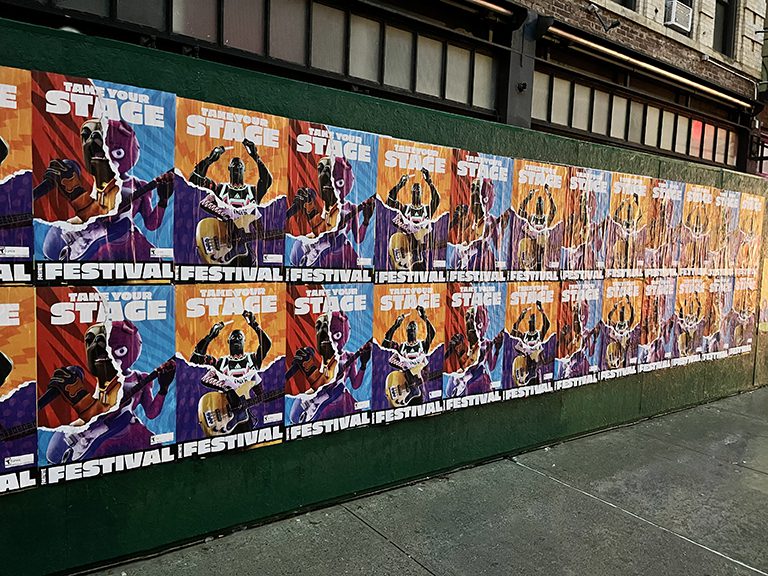
Guerrilla marketing campaigns use the normal poster size as their operational baseline. The 24 x 36 format is practical for street-level placement, affordable enough to print in the quantities that make a campaign feel saturated, and large enough to command attention from pedestrian traffic at typical urban sidewalk distances.
A street-level guerrilla campaign in New York City typically runs 200 to 500 posters across targeted neighborhoods, with each poster placed at a specific location chosen for foot traffic, audience relevance, and visibility. The 24 x 36 poster at this scale creates a sense of presence without requiring the logistics of a large-format outdoor campaign with specialized equipment and installation crews.
The 18 x 24 format is used in guerrilla campaigns for venue seeding: getting posters into the windows and on the bulletin boards of specific cultural venues where the target audience congregates. Record shops, independent bookstores, coffee shops, and neighborhood bars are all prime locations for 18 x 24 posters placed through direct outreach to venue staff.
Normal poster sizes work for guerrilla campaigns precisely because they are normal. A 24 x 36 poster on a street-level display surface does not look suspicious or out of place. It looks like advertising. That familiarity is part of why the format works. People are conditioned to read posters of this size. They engage with the content before they have consciously decided to engage with an advertisement.
Asking Print Shops for Normal Poster Sizes
When you walk into a print shop and ask for a normal poster, here is exactly what to say to get what you need efficiently.
For a general-purpose advertising poster: “I need a 24 x 36 inch poster, portrait orientation, on 80-pound coated matte paper. Please include crop marks and deliver as a print-ready PDF.”
For a concert or event poster: “I need an 18 x 24 inch poster, portrait orientation, on 80-pound coated paper. Satin or matte finish. Single piece, or quantity of [X].”
For a conference poster: “I need a 36 x 48 inch poster, portrait orientation. The conference board is 4 x 6 feet. I need it on matte paper suitable for pushpin mounting.”
Being specific prevents the most common order confusion. Print shops process dozens of orders per day and need clear specifications to execute correctly. A specific, well-stated order gets the right result. A vague request for “a poster” requires clarifying questions that delay the process and increase the chance of a misunderstanding.
A Final Word on Normal Poster Sizing
“Normal” in poster sizing means what most people use most often. That is 24 x 36 inches for general consumer and advertising posters in the United States. It means 18 x 24 for event and concert promotion. It means 36 x 48 for academic and professional contexts. The word “normal” shifts based on who is asking and what they are doing.
The value of knowing what is normal is that it gives you a calibrated default. When a client asks for a poster and provides no further information, you know to ask clarifying questions about the display environment before assuming 24 x 36 is right. When a conference abstract is accepted and you need to prepare a poster, you know to check the organizer’s guidelines before assuming your campus print shop’s default size will work. When a retailer asks you to produce point-of-sale materials, you know to ask about the display frame size before you start designing.
Normal is useful. But it is the floor of what you need to know, not the ceiling. The specifics of each project determine whether the normal is right, and those specifics are always worth investigating before you commit to a print run that cannot be undone.
Frequently Asked Questions
What size is a normal poster?
24 x 36 inches is the normal size for general-use posters in the United States. The “normal” size changes by context: 18 x 24 for concerts, 36 x 48 for conferences, 27 x 40 for movies.
Is 18 x 24 a normal poster size?
Yes. 18 x 24 is a standard small poster size, especially in the concert and event promotion industry.
What is a normal poster size in cm?
A 24 x 36 inch poster is approximately 61 x 91.4 centimeters. An 18 x 24 is approximately 45.7 x 61 centimeters.
What is a normal movie poster size?
27 x 40 inches (the one-sheet format). This is the standard for theatrical movie posters in North America.
Does a normal poster fit a standard frame?
Yes. 24 x 36 frames are widely available at most consumer retailers. 18 x 24 and 27 x 40 frames are also available at most frame retailers.
What is a normal poster size for a trade show?
36 x 48 inches. This is the standard large-format size used at most trade shows and business exhibitions.
Can I print a normal size poster at FedEx or Staples?
Yes. Both FedEx Office and Staples offer large-format poster printing at 18 x 24, 24 x 36, and other standard sizes. Quality and turnaround vary by location.