Usual Size of a Poster: Standard Dimensions for Campaigns
We get asked this question more than almost any other: what is the usual size of a poster? It seems like it should have a simple answer, and in some ways it does. But after years of running print campaigns, paste-up operations, event signage systems, and transit placements, we know that the right answer depends on what the poster is for, where it will be used, and who will be looking at it.
The short answer: the most common poster size in US street and event marketing is 18×24 inches (45.7 x 61.0 cm). But that single answer leaves out the full context of why that size is standard, when you should use something else, and what the measurements mean in terms of design, print production, and field performance.
This is the long answer. We are going to cover every usual poster size, what makes each one standard, and how each one performs in the specific campaign contexts where it lives. By the end, you will know exactly which size your campaign needs and why.
The 18×24 inch (45.7 x 61.0 cm) format is the standard in North American street marketing. It is the size that paste-up crews are optimized to install, the size that print vendors keep in stock as a regular run item, and the size that delivers the right balance of visibility and economy for citywide poster campaigns.
At 18 inches wide and 24 inches tall, this format has a 3:4 aspect ratio. That ratio means the poster is one and a third times as tall as it is wide, which gives a vertical orientation that reads naturally as a “poster” in the way most people visualize one. The dimensions are large enough to be read from across a sidewalk, at typical pedestrian distances of ten to twenty feet, a headline set at 80 to 100 points is clearly legible. And the size is small enough that one person can install a paste-up poster alone, which keeps field operations efficient at scale.
If someone asks us “what is the usual size of a poster?” and they are asking because they want to run a street campaign, our answer is 18×24. Almost every time.
The Standard Poster Sizes: Full Reference Table
The 18×24 is the most common, but it is far from the only usual poster size. Here is the full reference for every format we use regularly, with dimensions in inches and centimeters, aspect ratios, and the campaign contexts where each one is the normal choice.
Poster Size (Inches)
Dimensions (cm)
Aspect Ratio
Common Name
Where It Is Normal
8.5 x 11
21.6 x 27.9 cm
~3:4
Letter / Mini Poster
Community boards, interior bulletin boards
11 x 17
27.9 x 43.2 cm
~2:3
Tabloid / Half-Sheet
Venue promotion, street handouts, bar campaigns
12 x 18
30.5 x 45.7 cm
2:3
Small Street Poster
Light pole banners, smaller venue windows
16 x 20
40.6 x 50.8 cm
4:5
Medium Poster
Gallery, retail, event lobby
18 x 24
45.7 x 61.0 cm
3:4
Standard Street Poster
Street campaigns, paste-up, venue windows, events
20 x 30
50.8 x 76.2 cm
2:3
Small One-Sheet
Retail display, movie promotion, event signage
24 x 36
61.0 x 91.4 cm
2:3
Large Street Poster
High-visibility street placement, construction walls
27 x 40
68.6 x 101.6 cm
~2:3
One-Sheet / Movie Poster
Lobby display, movie house, marquee campaigns
40 x 60
101.6 x 152.4 cm
2:3
Bus Shelter Poster
Transit shelter panels, large event entry displays
Why 18×24 Became the Standard Poster Size
Standards in print do not emerge by accident. The 18×24 inch format became the usual size for street posters because of a convergence of practical factors that made it the most functional format for most contexts. Understanding why helps you decide when to stick with the standard and when the campaign calls for something different.
Press Economics
Offset and digital presses operate most efficiently when the paper size matches the press sheet size. The 18×24 format fits cleanly on a 19×25 press sheet, leaving a standard bleed margin with minimal paper waste. For large-quantity poster runs, 500, 1,000, 5,000 pieces, this efficiency translates directly into lower per-unit cost. Sizes that do not fit cleanly onto standard press sheets generate more waste and require more handling, both of which increase cost.
Installation Ergonomics
A single person can handle an 18×24 paper poster in all weather conditions. It rolls and unrolls easily for transport. It can be pasted onto a wall in under sixty seconds. It does not require two people to align and install. At 24×36, installation gets more manageable with two people; at larger sizes, it begins to require focused crew members per sheet. For campaigns that involve hundreds or thousands of placements across a city, the ergonomics of solo installation matter enormously for field productivity.
Visibility at Standard Pedestrian Distances
The 18×24 format was effectively calibrated for urban pedestrian environments. At the typical sidewalk viewing distance of ten to twenty feet, a poster of this size is large enough to register as a visual presence and read a headline in a glance. It is not so large that it overwhelms surfaces that also carry other visual information. It hits the visibility threshold without demanding a surface that can accommodate something larger.
Compatibility with Common Surfaces
Plywood construction hoarding panels, corrugated metal fence panels, and other common urban paste-up surfaces tend to run between 18 and 48 inches wide. An 18×24 poster fits comfortably within a single fence panel with room for overlap, which means it can be applied without crossing a structural seam. At 24×36, a single poster may overlap two structural elements, which can cause the paper to bridge across a gap and eventually tear or buckle. The 18×24 format’s compatibility with common surface dimensions is a real operational advantage.
When the Usual Poster Size Is Not the Right Size
The 18×24 is the usual size, but campaigns frequently call for a different format. Here is when we reach for something else.
When Visibility Must Reach Farther
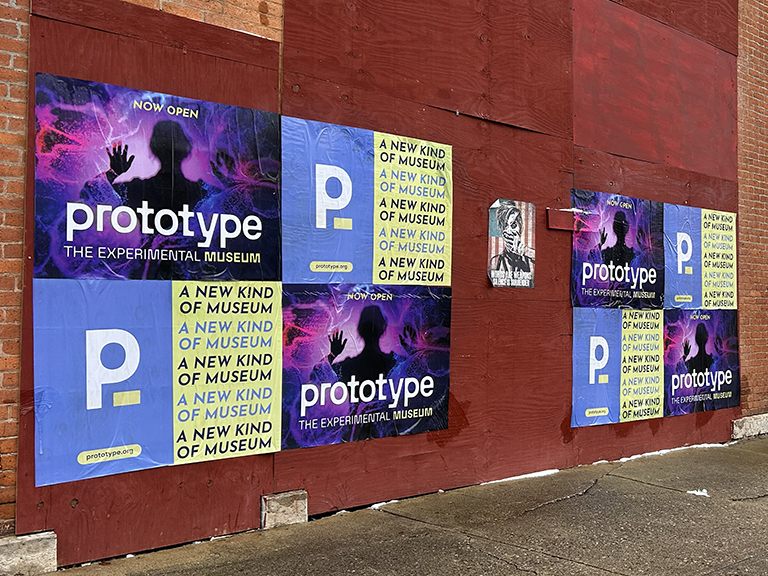
A campaign placement on a construction wall facing a wide boulevard, where the nearest pedestrian lane is thirty feet from the wall, needs a format that reads at thirty feet. The 18×24 shrinks to near-invisibility at that distance for casual viewers. We step up to 24×36 for these placements, and sometimes to 36×48 (a four-panel tile) for major boulevard walls where even the 24×36 is undersized relative to the available surface area and viewing distance.
When Budget Is the Primary Constraint
When a client needs maximum quantity within a fixed budget, we scale down to the 11×17 format. A quantity of 5,000 copies of an 11×17 poster costs significantly less than 5,000 copies of an 18×24 poster. For campaigns where saturation, touching every community board, every laundromat, every cafe, is more important than individual poster impact, the smaller format makes the math work. It is a common choice for grassroots campaigns, community outreach, and local event promotion with limited budgets.
When the Application Is a Specific Standard
Some applications have their own standard sizes that override the street marketing standard. Movie and theater lobbies use the 27×40 one-sheet. Transit shelter advertising uses the 40×60. Retail floor stands use the 22×28. For these applications, the usual size is whatever the fixture or medium requires, and designing to the street standard would produce a piece that does not fit the space it is intended for.
When the Creative Requires More Space
Some concepts are not achievable at 18×24. A campaign built around a large, detailed photographic image that needs scale to communicate properly should move to 24×36. A brand activation backdrop that needs to fill a ten-foot wall space needs to be built from multiple 24×36 or 36×48 sheets tiled together. The creative idea should inform the format choice, not the other way around. We have seen campaigns choose the 18×24 standard and then produce creative that is so dense and detailed that it becomes illegible in the field.
The Usual Poster Sizes by Campaign Type
Here is our practical guide to the usual poster size for each major campaign type we manage.
Concert and Music Venue Promotion
The usual poster size for concert promotion has two formats that coexist: the 11×17 (27.9 x 43.2 cm) for bar and record store distribution, and the 18×24 (45.7 x 61.0 cm) for street and venue window placement. Many music campaigns produce both at the same time. The 11×17 is cost-effective enough to produce in large quantities for local saturation and handout distribution. The 18×24 provides the venue-facing presence that communicates the event’s scale and importance. High-profile national tours often add a 24×36 (61.0 x 91.4 cm) format for key placement locations and collector appeal.
Event posters typically run at 18×24 (45.7 x 61.0 cm) for street placement and 24×36 (61.0 x 91.4 cm) for venue and lobby placement. The street campaign usually begins four to six weeks before the event and uses the 18×24 format for its economy and installation speed. As the event date approaches, the 24×36 format anchors high-traffic corner locations and venue windows where the larger size delivers more visual authority. Outdoor events with focused event staff also use 18×24 corrugated plastic or foam core boards for directional wayfinding on the day of the event.
Product Launch and Brand Campaigns
Product launches in urban markets typically use a two-tier poster system: 18×24 for neighborhood-level saturation across multiple zones, and 24×36 for flagship placement locations in high-traffic corridors. The 24×36 placements often overlap with transit media buys (bus shelter 40×60 panels, bus king sides) to create a multi-format presence in the same geography that delivers sustained frequency to the target audience. The design system typically holds constant across all sizes, same typography, same color, same hero visual, with layout adjustments to fit each format’s aspect ratio.
Retail and Point-of-Sale
For retail applications, the usual poster size shifts to whatever the in-store fixture system accommodates. Most US retail chains use the 22×28 inch (55.9 x 71.1 cm) standard for floor stand and point-of-purchase displays. Window posters for retail typically run 24×36 (61.0 x 91.4 cm) in portrait orientation. Counter cards and near-register materials run from 5×7 to 14×18 depending on the counter space available. The “usual” size in retail is fixture-driven, not campaign-driver, so always confirm the fixture dimensions before designing retail poster materials.
Grassroots and Community Campaigns
Grassroots campaigns prioritize quantity and distribution breadth over individual poster impact. The usual size here is 11×17 (27.9 x 43.2 cm), the tabloid half-sheet that fits on a community board, can be handed out from a table at an event, and costs little enough per piece to allow thousands of touchpoints on a limited budget. For anchor locations where community boards are large enough to accommodate it, a 18×24 (45.7 x 61.0 cm) format piece appears alongside the 11×17 distribution to increase visibility at the most important locations.
Usual Poster Size and Aspect Ratio: Why They Matter Together
The physical dimensions of a poster are defined by its size. The proportional shape of a poster is defined by its aspect ratio. Understanding the relationship between the two is what allows a design to scale cleanly between formats without rebuilding from scratch.
The 18×24 and 24×36 both share a 3:4 and 2:3 aspect ratio family, close enough that a design built at one can be adapted to the other with modest crop and recomposition rather than a full redesign. The 11×17 and 18×24 also share similar proportional logic, which is why many campaigns produce both from a single design concept. The 27×40 one-sheet runs at a ratio just slightly off from 2:3 (it is closer to 27:40 = 0.675, vs 24:36 = 0.667), close enough for practical purposes, but worth noting when scaling between the movie poster format and the standard street poster format.
When a campaign involves multiple poster sizes, we establish the aspect ratios first and sort the formats by ratio family. Formats that share a ratio get adapted from a single master design. Formats with a distinct ratio get a separate treatment. This approach reduces design hours significantly on multi-format campaigns while maintaining a consistent visual system across all sizes.
How to Measure Poster Size for File Setup
Setting up a design file for the correct poster size seems straightforward, but we see errors in this step regularly. Here is the correct workflow.
Set the Document Size to the Final Print Size
Open your design application and set the document dimensions to the exact final print size. For an 18×24 poster: document size is 18 inches by 24 inches. For a 24×36: document is 24 inches by 36 inches. Do not design at a fraction of the final size and scale up at output, this approach requires careful resolution management and is prone to errors. Set the document to the actual size from the start.
Add Bleed
Bleed is the extra area beyond the trim line that ensures background colors and images extend fully to the edge of the final print without leaving a white gap. Standard bleed for poster printing: 0.125 inches (3.2 mm) on each side. Some large-format vendors require 0.25 inches (6.4 mm). Set your bleed guides in the document settings, not manually, so the bleed extends to the document edges consistently.
Set Resolution
For poster sizes under 18×24, work at 300 DPI. For 18×24 and 24×36, work at 150 to 200 DPI. For larger formats, 100 to 150 DPI is sufficient. These numbers apply to the final document resolution as configured in applications like Photoshop. In vector applications like Illustrator or InDesign, resolution is less of a concern for vector elements but applies to any raster images placed in the document, those should be supplied at the appropriate resolution.
Use CMYK Color Mode
Poster printing uses the CMYK color model (Cyan, Magenta, Yellow, Key/Black). Digital screens use RGB. Colors that look vivid on screen in RGB can appear duller in CMYK print if the conversion is not managed properly. Set your document to CMYK from the start, or if you are designing in RGB for any reason, apply a color profile that simulates press output and expect the print vendor to apply a color profile conversion at output.
Poster Size and Paper Stock: What Goes with What
The usual size is only one dimension of a poster specification. The paper stock, the substrate, weight, and finish, determines how the poster performs in its intended environment and how it looks and feels in the hand. Here is the usual stock specification for each campaign context.
Poster Size
Application
Recommended Stock
Finish
11 x 17
Handout / bar / venue
80 lb text
Matte or uncoated
18 x 24
Paste-up / street
80 lb uncoated text
Uncoated (better paste adhesion)
18 x 24
Retail / mounted display
100 lb gloss cover
Gloss or matte
24 x 36
Paste-up / street
80 lb uncoated text
Uncoated
24 x 36
Window / lobby display
100 lb gloss cover
Gloss or matte
27 x 40
Lobby / movie house
100 lb gloss cover or photo paper
Gloss
40 x 60
Transit shelter (backlit)
Backlit film paper
Translucent backlit
International Poster Sizes: What Is Usual in Other Markets
The usual poster size in the US is defined by the inch-based system described above. In most of the rest of the world, the ISO A-series defines the usual poster sizes. The most common international street and event poster sizes are:
A3 (297 x 420 mm / 11.69 x 16.54 inches): The international equivalent of the US 11×17 tabloid. Used for venue promotion, community boards, and event posters in European and Asia-Pacific markets.
A2 (420 x 594 mm / 16.54 x 23.39 inches): Close to the US 18×24, this is the most common street poster size in European markets. Paste-up campaigns in London, Paris, and Berlin typically run at A2.
A1 (594 x 841 mm / 23.39 x 33.11 inches): Roughly equivalent to a US 24×32 or slightly under a 24×36. Standard for concert posters and major event campaigns in European markets.
A0 (841 x 1189 mm / 33.11 x 46.81 inches): The largest standard ISO format, roughly equivalent to a US 33×47. Used for large-format event and retail display in international markets.
For campaigns that run in both US and international markets, we typically design at the US standard size first (18×24 or 24×36), then adapt to the ISO format by cropping or recomposing, since the US and ISO formats do not share the same aspect ratio (3:4 vs. root-2). A separate size adaptation pass is needed rather than a simple scale, but if the design is built with this in mind from the start, the adaptation is straightforward.
What Makes a Poster Size “Right” for a Campaign
The right poster size is never a theoretical question. It is always an operational one. Three questions determine it.
What is the viewing distance? The farther the audience stands from the poster when they first encounter it, the larger the format needs to be. Street pedestrians at ten to twenty feet: 18×24. Drivers on an arterial road at fifty to two hundred feet: 24×36 or a multi-sheet configuration. Lobby visitors at five to fifteen feet: 24×36 or 27×40. Bus shelter commuters at two to four feet: 40×60.
What is the surface? The surface available determines the maximum size you can use and informs the most appropriate size for the context. A standard construction fence panel runs about 18 to 24 inches wide per module, so the 18×24 is the natural fit. A large blank hoarding wall running thirty feet wide calls for a multi-sheet grid using 24×36 as the tile unit. A retail window running 36 inches wide accommodates a 24×36 in portrait or environment. A transit shelter interior frame accepts exactly a 40×60 and nothing else.
What is the print budget? The per-unit cost of poster printing scales with size. An 18×24 run at 1,000 copies costs roughly half to two-thirds the price of a 24×36 run at the same quantity. If the budget requires quantity for reach, the smaller format makes the campaign more achievable. If the budget is sufficient and the campaign needs presence over quantity, the larger format earns its premium.
Frequently Asked Questions
What is the most common poster size?
The most common poster size in North American street and event marketing is 18×24 inches (45.7 x 61.0 cm). This format is used for paste-up street campaigns, venue window display, event promotion, and most other contexts where the phrase “put up posters” is the campaign instruction. The 24×36 (61.0 x 91.4 cm) is the second most common, used for higher-visibility placements and premium presentation
What size is a typical school or classroom poster?
Classroom and school-use posters are most commonly produced at 18×24 inches (45.7 x 61.0 cm) for wall-mounted instructional content, and at 24×36 inches (61.0 x 91.4 cm) for larger bulletin board or hallway displays. Student project posters (tri-fold boards) use a different standard: the standard tri-fold board is 48×36 inches (121.9 x 91.4 cm) folded into three panels of 16×36 each.
What size is a movie poster?
The standard US movie poster, called the one-sheet, is 27×40 inches (68.6 x 101.6 cm). This has been the lobby display standard for theatrical films for over a century. International markets use slightly different standards, the UK uses 27×40, some European markets use A1 (23.39 x 33.11 inches) or B1 (27.8 x 39.4 inches).
What is the usual size of a concert poster?
Concert posters are produced in two standard sizes for most campaigns: 11×17 inches (27.9 x 43.2 cm) for venue handout and bar distribution, and 18×24 inches (45.7 x 61.0 cm) for street placement and venue window display. High-profile tours and major venue campaigns often add a 24×36 (61.0 x 91.4 cm) format for anchor street placements and collector editions. The 11×17 and 18×24 are by far the mos
What size poster fits a standard poster frame?
Standard US retail poster frames are available in three common sizes: 11×17 inches (27.9 x 43.2 cm), 18×24 inches (45.7 x 61.0 cm), and 24×36 inches (61.0 x 91.4 cm). The 18×24 and 24×36 are the most widely available in mid-range retail frame products. The 27×40 one-sheet movie poster format has limited off-the-shelf frame options and often requires a custom or specialty frame.
Is there a universal standard poster size?
There is no single universal standard across all markets and all applications. The closest thing to a universal standard in North American street marketing is 18×24 inches (45.7 x 61.0 cm). In international markets, the A2 size (420 x 594 mm / 16.54 x 23.39 inches) is the closest international equivalent. Transit and outdoor advertising formats have their own separate standards (40×60 for bus shel
What is the standard size for a vertical poster?
Vertical (portrait orientation) is the default orientation for most poster formats. The standard vertical poster sizes are 18×24 inches (45.7 x 61.0 cm), 24×36 inches (61.0 x 91.4 cm), and 27×40 inches (68.6 x 101.6 cm). environment orientation posters are used for specific applications, bus side advertising, some banner formats, and horizontal display formats in retail.