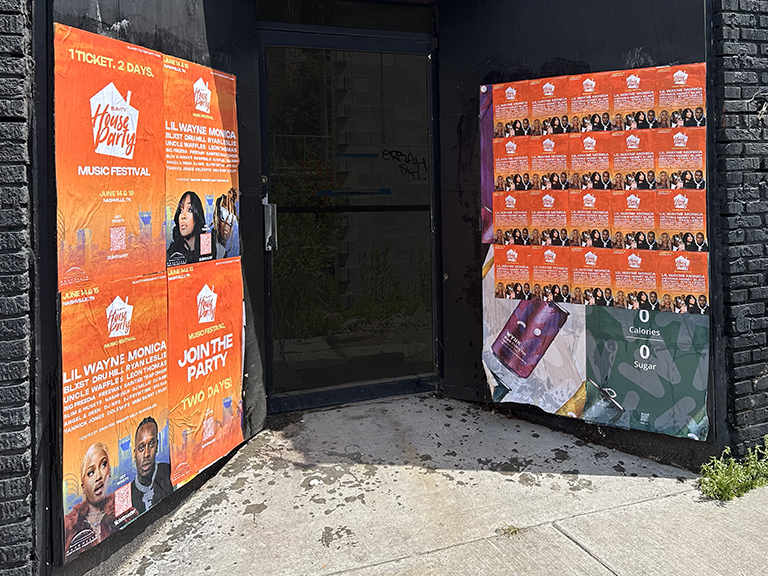
We run poster campaigns in cities across the US. Here’s every standard poster size in inches, what it’s used for, and how to choose the right one.
Poster sizes in inches. That’s the question every client asks before we get started. It sounds simple. It gets complicated fast.
The United States poster industry runs on inches. No centimeters, no millimeters. Inches. And within that system, there are maybe eight or ten sizes that actually matter for real campaigns. The rest are specialty cuts that add cost without adding real value.
We’ve been working with poster campaigns since before most of the current wave of marketing agencies existed. Our crews have posted on construction walls in SoHo, bulletin boards in Logan Square in Chicago, scaffolding in Capitol Hill in Seattle, and every surface in between. We know which sizes perform, which ones printers love, and which ones create headaches on both ends.
Small formats have a specific role. They’re not the headline act. They’re the supporting cast that gets into spaces the bigger sizes can’t reach.
8×10 is barely a poster. It’s a photo print. We use 8×10 for highly targeted placements where the viewer is guaranteed to be close. Think: a coffee shop counter display, a bookstore shelf talker, a backstage badge. Not a format for mass distribution, but useful in the right context.
11×14 is stronger. It fits standard photo frames, which means it can live in retail environments without needing custom mounting hardware. Boutiques on Rodeo Drive in Los Angeles, record shops on the Lower East Side, independent bookstores in the U District in Seattle all use 11×14 for in-store promotional pieces.
11×17 is our small-format workhorse. At 11 inches wide by 17 inches tall, it’s the largest size that most home and office printers can produce. That makes it accessible for clients with in-house print capabilities. For professional campaigns, we print 11×17 on a commercial press in 500 or 1,000-unit runs and send crews out to place them in approved venues and windows throughout a neighborhood.
The 11×17 aspect ratio (approximately 1:1.5) is close enough to a full-size poster that designs can often be scaled down from a 24×36 without major rework. Same proportions, smaller output.
Pro Tip: When running a street campaign with multiple sizes, we design the large format first (usually 24×36) and then scale down to 11×17 for interior placements. Same artwork, same visual identity, different touchpoints along the customer’s path through a neighborhood.
Medium Poster Sizes in Inches: 18×24 and 22×28
The medium range is where a lot of clients get confused. 18×24 and 22×28 look similar on paper. In practice, they’re used differently.
18×24 is the classic medium poster. Two feet tall, one and a half feet wide. It’s a format that’s been used in entertainment marketing, music venues, and street campaigns for decades. On a brick wall in Pilsen in Chicago or on a construction board on Van Ness in San Francisco, an 18×24 makes a solid impression without requiring the same paper budget as a 24×36.
22×28 is sometimes called the half-sheet format. It’s wider relative to its height than most posters. The 22×28 fits retail display stands, pharmacy bulletin boards, and standard display frames found in grocery stores. It’s an interior format, not a street format. The wider shape accommodates product shots and horizontal layouts better than the narrower 18×24.
If you’re running an event in a specific venue, 18×24 goes on the exterior walls and doors. 22×28 goes on the interior board near the entrance or the bar. Both serve the same campaign, at different positions in the customer experience.
Large Poster Sizes in Inches: 24×36 and Above
That’s where street campaigns live. Large poster sizes in inches start at 24×36 and go up from there.
24×36 is the standard outdoor poster size in the United States. At two feet wide by three feet tall, it’s visible from across a standard city street. The format has a 2:3 aspect ratio, which is universally understood by designers. When a client tells us they want “a big poster,” 24×36 is what we order.
We print 24×36 on several different paper stocks depending on the campaign. Uncoated 80 lb text stock for a raw, grainy look in markets like Brooklyn or Portland. Satin 100 lb stock for music campaigns where image quality matters. Gloss for retail and product launches where color vibrancy is the priority.
27×40 is the movie one-sheet. It’s taller relative to its width than a 24×36. The narrow, vertical format is designed for the display cases in theater lobbies, which are sized to fit a 27×40 piece exactly. For entertainment campaigns outside theater lobbies, 27×40 works anywhere a tall, vertical surface is available.
27×39 is the international one-sheet. Same basic concept, slightly shorter. Used for international film releases where European display cases have different standard dimensions.
40×60 moves into transit advertising territory. Bus shelter faces, kiosk panels, and some construction wall installations use this size. At 40 inches wide by 60 inches tall, a 40×60 poster commands serious real estate. These are typically produced on heavy stock or vinyl and require vehicle transport to the placement site.
Budget Perspective: A single 24×36 poster in a 1,000-unit run costs roughly $1.50 to $4.00 per sheet depending on paper stock and printing method. A 40×60 at the same quantity can cost $8 to $20 per sheet. Budget your size decision accordingly, especially if you’re covering multiple neighborhoods.
Specialty and Non-Standard Poster Sizes in Inches
Beyond the standard list, there are specialty sizes that clients request for specific reasons.
Square posters, 24×24 or 20×20, work well for campaigns built around Instagram-native content. If your brand lives on social media with a square grid aesthetic, translating that to a square poster keeps the visual language consistent. Square isn’t a native print format so printers charge slightly more for the odd cut.
Panoramic formats like 48×16 or 60×20 work for horizontal applications. Think display ledges, wide banner hangers, or window applications where width is more available than height. We’ve used these for campaign windows on Bleecker Street in the West Village and along 3rd Street Promenade in Santa Monica.
Tabloid format, 11×17, is technically a “standard” paper size in the US but the smallest size most people consider a poster. We’ve already covered this in the small format section.
Super A3 or B+ paper, 13×19 inches, is common in fine art printing and photo prints. Some clients use 13×19 for limited-edition campaign art that’s meant to be kept. It’s not a typical street format, but we’ve produced it for record labels releasing limited-run prints alongside album artwork campaigns.
How Printer Roll Width Affects Available Poster Sizes in Inches
Here’s something most clients don’t think about: the poster sizes in inches that printers prefer are driven by roll width.
Most large-format inkjet printers use roll paper. The standard roll widths are 17 inches, 24 inches, 36 inches, 44 inches, and 60 inches. Every standard poster size in inches lines up with at least one of these roll widths.
An 11×17 poster uses a 17-inch roll with zero waste, cutting down the length. A 24×36 uses a 24-inch roll, cutting at 36-inch intervals. A 36×48 uses a 36-inch roll. A 40×60 requires a 44-inch or 60-inch roll, with some waste.
When you ask for a non-standard width, the printer has to choose between a larger roll (waste) or a smaller roll (can’t fit). Either way, you pay more. If your design calls for a 25-inch width, they’ll run you on a 36-inch roll and cut the excess. You’re paying for 11 extra inches of paper per sheet.
Stick to standard widths: 11, 17, 18, 24, 27, 36, 40, 44, 60. Those align with roll stock and keep your costs down.
How to Choose the Right Poster Size in Inches for Your Project
We walk clients through a short decision process before every campaign order. Here’s how we approach it.
First, identify the placement environment. Is this going outdoors on a construction wall? Then 24×36 minimum. Is this going in bar bathrooms and coffee shop windows? Then 11×17 works. Is this for a theater or venue lobby with display cases? Find out the case dimensions first, then choose accordingly.
Second, think about viewing distance. If people will read the poster from 6 feet away or less, 11×17 or 18×24 is fine with properly sized type. If they’ll read it from 15 to 20 feet, you need 24×36 minimum with headline type at 150+ points.
Third, check your print budget against quantity. More square inches times more quantity equals higher print cost. If you’re spreading a campaign across 50 neighborhoods, you may need to accept a smaller size to cover all your intended locations within budget.
Fourth, confirm printer availability. Before you finalize a size, call your print vendor. If they’re backordered on 27×40 stock and your campaign launches in three days, you need to know that now, not after you’ve already built all the artwork.
Poster Sizes in Inches: City-by-City Field Notes
The same poster size performs differently depending on the city and the built environment. Here is what our crews have observed working in the major markets.
New York City
NYC’s dense urban grid means viewers are often within 10 to 20 feet of building surfaces. In neighborhoods like the Lower East Side, Bushwick, and Crown Heights, the 24×36 inch format is the default. Buildings are tall, walls are plentiful, and the 24×36 fills the visual field at close viewing distance without looking oversized. For the broader midtown zones, where foot traffic crosses wider sidewalks, the 36×48 starts to outperform the 24×36 at key intersections like 34th and 8th or 42nd and Eighth Avenue.
Los Angeles
LA’s street widths are generally wider than NYC’s, which means viewing distances are greater. On Melrose Avenue, the Sunset Strip, and Fairfax Avenue in West Hollywood, the 36×48 inch format outperforms the 24×36 because viewers are often approaching from 30 to 50 feet away. On tighter residential commercial streets like Abbott Kinney in Venice or Montana Avenue in Santa Monica, the 24×36 inch format works well.
Chicago
Chicago’s grid streets create consistent viewing corridors. On Milwaukee Avenue in Wicker Park, the 24×36 inch format is the standard because pedestrian viewing distances are predictable. On wider commercial streets like Western Avenue or Cermak Road, the 36×48 format has stronger performance. Construction hoarding throughout the Loop and Fulton Market creates focused flat surfaces that accommodate 24×36 and larger in repeating patterns.
Miami
Miami’s tropical climate affects material durability more than size selection. Standard paper stock struggles in high humidity and frequent rain. The size choice stays consistent with other markets (24×36 for outdoor, 18×24 for indoor) but material selection shifts to coated or weatherproof stocks that hold up in Miami’s climate. In Wynwood, where large-format murals set the visual context, the 36×48 inch format or larger performs better competitively because the surrounding art is at a scale that makes smaller posters feel modest by comparison.
Atlanta
Atlanta’s commercial districts are more car-dependent than the dense coastal cities. In areas like Little Five Points and Midtown near 10th Street, foot traffic is strong enough for 24×36 to work at street level. Near major corridors like Ponce de Leon Avenue and Peachtree Street, larger format placements or multiple 24×36 pieces in a cluster work better because viewing often happens from a car rather than on foot.
Resolution Requirements for Each Poster Size in Inches
File setup mistakes waste money. A design that looks sharp on screen can print blurry if the resolution is wrong for the output size. Here’s how to set up files correctly for every major poster size.
The 300 DPI Rule and When It Doesn’t Apply
300 DPI at final print size is the standard for fine art and close-viewing print work. For street poster campaigns viewed from 5 to 20 feet away, you can often get away with 150 DPI at final size without visible quality loss. The critical factor is viewing distance. A poster on a construction wall in SoHo viewed from 8 feet can print at 150 DPI and look sharp. A poster on a coffee shop wall viewed from 3 feet needs 300 DPI or the image grain becomes visible.
File Setup by Size
11×17 inches: 300 DPI at size. File dimensions: 3,300 x 5,100 pixels at 300 DPI. Keep it at 300. These are read up close.
18×24 inches: 200 to 300 DPI at size. 3,600 x 4,800 pixels at 200 DPI. Full 300 is better for print quality on close-view placements.
24×36 inches: 150 to 200 DPI at size. 3,600 x 5,400 pixels at 150 DPI. Street viewing distance allows lower resolution without visible degradation.
27×40 inches: 150 DPI at size. 4,050 x 6,000 pixels. Theater lobby viewing is typically from 6 to 15 feet, so 150 holds well.
40×60 inches: 100 to 150 DPI at size. Transit advertising viewed from 10 to 30 feet. 100 DPI is acceptable for these distances.
Color Mode and Bleed
Always set files to CMYK color mode for print. RGB files can print with color shifts, especially in reds and oranges. Add 0.125-inch bleed on all sides for any poster that prints to the edge. Without bleed, a slight miscut on the press leaves a white border that looks amateurish. Your print vendor will confirm their bleed requirements when you submit the order, but 0.125 inch covers nearly all vendors.
Frequently Asked Questions
What is the standard poster size in inches?
The most common standard poster size in inches is 24×36. This is what most people mean when they say “full size poster” in the context of street campaigns, music promotion, and general advertising.
What size poster is 11×17?
11×17 inches is often called a tabloid poster or a small poster. It’s the largest size most office printers handle, and it’s widely used for interior placements, event flyers, and small-run promotional pieces.
What poster sizes in inches are available from most print shops?
Most print shops stock paper for 11×17, 18×24, 24×36, and 27×40. Some also carry 22×28 and 40×60. Outside these sizes, expect custom order lead times and higher pricing.
What is the difference between 18×24 and 24×36 posters?
18×24 is a medium poster, 1.5 feet wide by 2 feet tall. 24×36 is a large poster, 2 feet wide by 3 feet tall. The 24×36 has twice the surface area. Both share the same 2:3 aspect ratio, so artwork scales directly between the two.
What is the biggest standard poster size in inches?
Among commonly stocked print formats, 40×60 is the largest standard size. Above that, you’re into custom large-format printing, typically ordered as vinyl banners or foam board mounts rather than paper posters.
What poster size in inches should I use for a music show?
For music show promotion, we typically use 18×24 or 24×36 for outdoor and venue walls, and 11×17 for interior placements and record shop windows. Some clients do a tiered run with all three sizes hitting different locations at the same time.
No. The US uses inch-based custom dimensions. Europe uses the ISO A-series (A1, A2, A3, etc.) measured in millimeters. A1 (23.4×33.1 inches) is the closest European equivalent to the US 24×36.