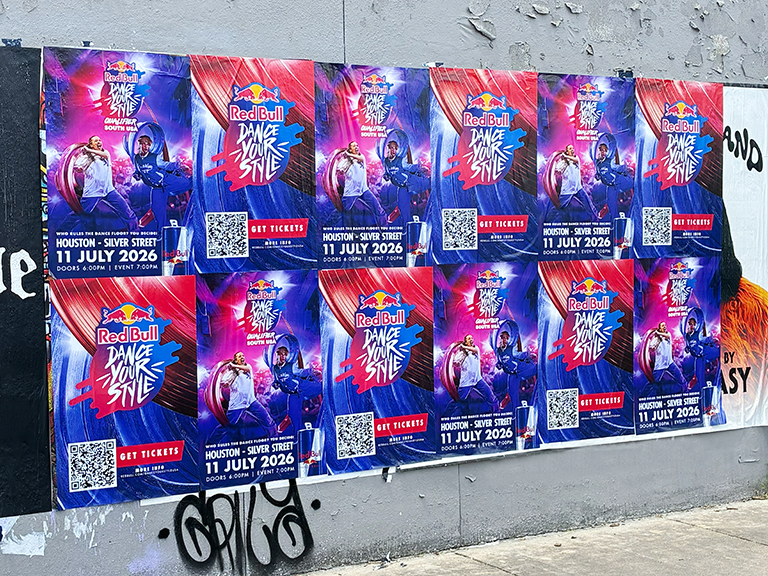
Poster Dimensions: The Complete Field Guide to Every Size
If you have ever ordered posters for a campaign and watched them land completely wrong, too small to read from the curb, too large to fit the surface, trimmed awkwardly by the printer, you already understand why poster dimensions matter more than most people admit. Our team has pasted, stapled, and wheatpasted millions of posters across New York City and dozens of other markets, and the single most common mistake clients make is treating dimension as an afterthought. They finalize artwork, then ask us what size to print. We want to flip that script for you completely.
This guide covers every meaningful poster dimension you will encounter, from the little 11 x 17 inch snipe that saturates a neighborhood block to the oversized 40 x 60 inch transit format that owns a bus shelter. We include exact measurements in both inches and centimeters, aspect ratios, print-ready resolution requirements, and direct advice from our field crews on what performs best in specific contexts. By the end, you will know exactly which poster dimensions to choose before your designer opens a single file.
A poster is more than a print product. It is a communication unit with a specific job to do at a specific distance. Every dimension decision affects how far away someone can read the headline, how much real estate the brand takes up in the viewer’s field of vision, and whether the format fits the surface inventory you plan to use. Our crews work with surface constraints every day, a column might accept 24 x 36 inches but not 27 x 40, a utility box panel measures exactly 18 x 24 inches, a construction hoarding row expects 24 x 36 with a half-inch overlap.
Getting dimensions right from the start saves money on reprints, avoids awkward crops, and makes installation faster. When we brief clients on poster dimensions, we always tie the measurement back to the goal: distance of readability, volume of paste, and density of the neighborhood’s visual noise. A 12 x 18 inch snipe in a quiet residential block hits harder than a 24 x 36 in Times Square. Context is everything, and dimensions are the vehicle for that context.
Standard Poster Dimensions: The Industry Reference Chart
Below is our master reference table for every poster dimension you will realistically encounter. All measurements are width x height unless otherwise noted.
Poster Name
Inches (W x H)
Centimeters (W x H)
Aspect Ratio
Primary Use
Mini / Snipe
8.5 x 11 in
21.6 x 27.9 cm
22:28 (≈11:14)
Guerrilla snipes, door hangers, micro-postering
Small Street Poster
11 x 17 in
27.9 x 43.2 cm
11:17
Street-level saturation, record promos, concert flyers
Medium Street Poster
12 x 18 in
30.5 x 45.7 cm
2:3
Snipes, column wraps, café bulletin boards
Half Sheet
14 x 22 in
35.6 x 55.9 cm
7:11
Vintage movie format, specialty retail
Standard B Poster
18 x 24 in
45.7 x 61.0 cm
3:4
Most common street campaign format, retail, venues
Our crew’s workhorse, wheatpaste, construction hoarding
One-Sheet (Movie Poster)
27 x 40 in
68.6 x 101.6 cm
27:40
Theater lobbies, poster frames, entertainment campaigns
Large Format Street
27 x 41 in
68.6 x 104.1 cm
27:41
Modern one-sheet variant, frame-friendly
Large Format environment
36 x 24 in
91.4 x 61.0 cm
3:2
Horizontal applications, construction fencing runs
Jumbo Poster
36 x 48 in
91.4 x 121.9 cm
3:4
Storefront windows, temporary wall takeovers
Two-Sheet
40 x 60 in
101.6 x 152.4 cm
2:3
Bus shelters, transit platforms, double-face frames
Three-Sheet
41 x 81 in
104.1 x 205.7 cm
1:2
Doorway column displays, tall narrow walls
Six-Sheet
81 x 81 in
205.7 x 205.7 cm
1:1
Large format outdoor, multi-panel transit panels
Door Panel
20 x 60 in
50.8 x 152.4 cm
1:3
Entrance doors, elevator panels, narrow verticals
ISO / International Poster Dimensions (A-Series)
If you are running a campaign that crosses into European markets, or if you are working with a printer that defaults to ISO paper sizes, you need to know the A-series dimensions. These are based on a consistent aspect ratio of 1:√2 (approximately 1:1.414), which means each size folds exactly in half to become the next size down.
ISO Size
Inches (W x H)
Centimeters (W x H)
Millimeters (W x H)
Nearest US Equivalent
A0
33.1 x 46.8 in
84.1 x 118.9 cm
841 x 1189 mm
Close to 33 x 47, oversized
A1
23.4 x 33.1 in
59.4 x 84.1 cm
594 x 841 mm
Closest to 24 x 36
A2
16.5 x 23.4 in
42.0 x 59.4 cm
420 x 594 mm
Between 18 x 24 and 16 x 24
A3
11.7 x 16.5 in
29.7 x 42.0 cm
297 x 420 mm
Close to 12 x 16
A4
8.3 x 11.7 in
21.0 x 29.7 cm
210 x 297 mm
Close to 8.5 x 11 (letter)
B1
27.8 x 39.4 in
70.7 x 100.0 cm
707 x 1000 mm
Close to 28 x 40
B2
19.7 x 27.8 in
50.0 x 70.7 cm
500 x 707 mm
Close to 20 x 28
Small Poster Dimensions (8.5 x 11 and 11 x 17 Inches)
8.5 x 11 Inches (21.6 x 27.9 cm), The Snipe Format
In street campaign terms, the 8.5 x 11 is the snipe. It is the smallest format our crews regularly deploy. At this size, you can print hundreds, sometimes thousands, of units for a modest budget, and you can cover a neighborhood in a matter of hours. The aspect ratio sits at approximately 22:28, or practically 11:14. This is a US Letter-size sheet, which means any office printer can produce it, but professional offset printing gives you far better ink density and weather resistance.
On the street, 8.5 x 11 works best for density over distance. You are not trying to be read from across the street, you want someone walking past to glance down or sideways and catch the message from about three feet away. That means big type, one hero image, and almost no body copy. Our crews treat this as a brand frequency tool rather than a storytelling format. Hit 200 poles in a 10-block radius and the brand becomes impossible to ignore.
11 x 17 Inches (27.9 x 43.2 cm), The Concert Poster Classic
The 11 x 17 is the original concert poster dimension. For decades, every music venue, record label, and touring act lived in this format. The aspect ratio is 11:17, which is a little narrower than a standard 2:3, giving it a slightly tall, elongated feel that works beautifully for typographic layouts with stacked text and event information. At 72 DPI it looks fine on screen; for print you need a minimum of 300 DPI, meaning your file should be at least 3,300 x 5,100 pixels.
At street level, an 11 x 17 reads cleanly from about 8 to 12 feet. This is the ideal “around the block” format, close enough for detail, big enough to stop foot traffic. Our teams often use 11 x 17 for local neighborhood saturation campaigns where cost-per-impression matters as much as visual impact. You can print 500 sheets for the price of 50 sheets at 24 x 36.
Medium Poster Dimensions (18 x 24 and 12 x 18 Inches)
18 x 24 Inches (45.7 x 61.0 cm), The Street Standard
If we had to crown one format as the true standard poster dimension for street campaigns, it would be 18 x 24 inches. The aspect ratio of 3:4 is clean and familiar, the format is big enough to command attention from about 20 feet, and the size is manageable for a two-person crew doing fast installations. Our teams can carry a tube of 50 rolled 18 x 24 posters comfortably, which matters when you are covering ground on foot in Manhattan or another dense urban market.
Printers stock this size by the thousands, which keeps costs per unit low. At 300 DPI your file needs to be 5,400 x 7,200 pixels. We typically request a 0.125 inch bleed on all sides when going to offset, bringing the actual print file to 18.25 x 24.25 inches. For most wheatpaste applications, the bleed is absorbed into the wet paste overlap and does not affect the finished look.
12 x 18 Inches (30.5 x 45.7 cm), The 2:3 Sweet Spot
Twelve by eighteen is a cleaner 2:3 ratio version of the small format family. It slots between the 11 x 17 concert poster and the full 18 x 24. Our crews use this size often for snipe campaigns where we want something slightly bigger than an 11 x 17 but do not need the full presence of an 18 x 24. It is also cost-effective for large print runs and fits many standard poster frames sold at retail, making it a good choice for campaigns that have both an indoor and an outdoor component.
Large Poster Dimensions (24 x 36 Inches)
24 x 36 Inches (61.0 x 91.4 cm), The Campaign Workhorse
In our world, 24 x 36 is the workhorse. This is the dimension that dominates street campaigns, construction hoarding installations, building-side paste work, and utility surface coverage. The 2:3 aspect ratio is visually balanced and gives designers enough vertical real estate to build a compelling hierarchy, headline, subhead, image, logo, call to action, without feeling cluttered.
At 300 DPI, a 24 x 36 file is 7,200 x 10,800 pixels. That is a large file, and many clients are surprised by the size. For paste-up work where the poster goes to 200 or 300 DPI effective resolution on the wall, 150 DPI at actual size is often sufficient and keeps file sizes manageable, roughly 3,600 x 5,400 pixels. We advise shooting for 200 DPI minimum at actual size to preserve sharp text and logo details under close inspection.
The 24 x 36 is readable from approximately 40 to 50 feet in clear conditions with a bold headline at 200 points or larger. In crowded urban environments with competing visual noise, bump that up to 300 points for the primary message if you want true stop-and-read performance. Our crews can install 24 x 36 sheets solo in a pinch, but two-person teams work faster and produce cleaner overlaps on longer runs.
The Movie Poster Dimension: 27 x 40 Inches
27 x 40 Inches (68.6 x 101.6 cm), The One-Sheet
The 27 x 40 one-sheet is one of the most recognized poster dimensions in American culture. Every movie that has played in a theater since the 1980s has had a one-sheet printed to these exact dimensions. The aspect ratio works out to 27:40, slightly more narrow than a 2:3 ratio, giving it a tall, vertical presence that commands theater lobbies and poster frames alike.
When entertainment clients come to us for street campaigns around film releases or album drops, we often recommend building artwork to 27 x 40 first, then adapting to 18 x 24 and 24 x 36 for the street inventory. The one-sheet proportions train the eye to recognize entertainment content, the format carries cultural signal before a viewer even reads the copy. For standard lobbies and poster frame installations, 27 x 40 remains the industry standard. Its modern variant, 27 x 41 inches, accounts for frame tolerances in some display systems.
Oversized Poster Dimensions (36 x 48, 40 x 60 and Beyond)
36 x 48 Inches (91.4 x 121.9 cm), Jumbo Street Format
At 36 x 48 you are entering what our crews call the “wall presence” tier. A single 36 x 48 poster on a flat wall surface stops foot traffic from half a block away. The 3:4 aspect ratio is familiar and clean. This format works well for large window installations, temporary retail takeovers, and situations where a client wants maximum impact from a single sheet rather than a tiled multi-sheet display. Print costs jump here, expect to pay significantly more per unit than 24 x 36, so 36 x 48 tends to be a targeted statement format rather than a high-volume saturation tool.
40 x 60 Inches (101.6 x 152.4 cm), The Two-Sheet
The 40 x 60 two-sheet is the standard dimension for transit bus shelter panels and some subway station frame installations. At this scale, a single poster becomes an immersive visual element, particularly in a backlighted frame. The 2:3 ratio at this size means the headline can comfortably be read from across a street intersection, making it one of the most effective transit formats available. Our clients running urban transit campaigns often combine 40 x 60 bus shelter buys with a complementary street-level 24 x 36 program to create both long-range and close-range touchpoints in the same market.
41 x 81 Inches (104.1 x 205.7 cm), Three-Sheet
The three-sheet dates back to the golden age of American entertainment advertising and originally referred to three stacked 27 x 40 sheets. In modern practice, it is printed as a single 41 x 81 sheet for doorway columns, narrow vertical walls, and transit gateway installations. The near 1:2 aspect ratio makes it ideal for tall, narrow surfaces, subway column wraps, building entry columns, stairwell walls. This is a specialist format that our team encounters primarily in entertainment marketing and high-visibility urban corridors.
Poster Dimensions by Campaign Type
Wheatpaste Campaigns
For wheatpaste, our crews default to 24 x 36 inches as the primary format, supplemented by 18 x 24 for secondary saturation in adjacent blocks. We sometimes run a small percentage of 36 x 48 as hero placements at high-visibility corners. All wheatpaste posters should be printed on 60 lb or heavier uncoated stock, coated paper bubbles and peels faster under paste. File preparation: 150-200 DPI at actual print size, no coating, press-ready PDF.
Street Snipe Campaigns
For snipe campaigns, 11 x 17 and 8.5 x 11 are our standard formats. On particularly high-volume runs we will add 12 x 18 as a larger tier. Snipes go on 60 lb or 80 lb uncoated text weight paper, printed in large batches to minimize cost per unit. The goal is frequency, not individual impression quality. When you cover 500 poles and lamp posts with 11 x 17 posters in a 10-block grid, the cumulative effect outperforms a single 24 x 36 on every surface in the area.
Transit and OOH Frame Campaigns
Transit frame formats are dictated by the physical dimensions of the frame, which vary by vendor and market. Common bus shelter formats include 40 x 60 inches (two-sheet), 47.5 x 69 inches for some markets, and 22 x 56 inches for interior transit cards. Always confirm exact dimensions with the vendor before artwork production. A 0.25 inch production bleed is standard for most backlighted transit formats.
Construction Hoarding Campaigns
Construction hoarding (the wooden fencing surrounding active build sites) is one of the best canvas formats in urban markets. Panel widths vary but typically fall in 8-foot sections. Our crews tile 24 x 36 posters across these panels, usually three or four across per section, or work with 36 x 48 for fewer seams and bigger impact. The poster dimension matters here because a gap between sheets breaks the visual illusion and reduces readability. We cut posters to fit exactly, with a half-inch overlap at every seam for a clean finish.
Resolution Requirements by Poster Dimension
Many clients deliver print files at screen resolution, which produces blurry output. Here are the minimum and recommended resolutions for common poster dimensions:
Poster Size
Minimum (150 DPI)
Recommended (300 DPI)
Ideal for Large Format
8.5 x 11 in
1,275 x 1,650 px
2,550 x 3,300 px
300 DPI always
11 x 17 in
1,650 x 2,550 px
3,300 x 5,100 px
300 DPI always
12 x 18 in
1,800 x 2,700 px
3,600 x 5,400 px
300 DPI always
18 x 24 in
2,700 x 3,600 px
5,400 x 7,200 px
200-300 DPI
24 x 36 in
3,600 x 5,400 px
7,200 x 10,800 px
150-200 DPI acceptable
27 x 40 in
4,050 x 6,000 px
8,100 x 12,000 px
150-200 DPI acceptable
36 x 48 in
5,400 x 7,200 px
10,800 x 14,400 px
100-150 DPI can work
40 x 60 in
6,000 x 9,000 px
12,000 x 18,000 px
100-150 DPI common
How We Choose Poster Dimensions in the Field
When a client comes to us with a campaign brief, our team runs through a short decision tree to arrive at the right poster dimension for that specific activation. The process starts with three questions: (1) What surfaces are we targeting? (2) What viewing distance do we expect? (3) What is the unit economics, how many posters does the budget support?
Surfaces dictate size in a hard physical way. A standard utility pole face is about 12 inches wide and accepts 11 x 17 or, with overhang, 12 x 18. A plywood construction fence panel is 8 feet wide and accepts multiple 24 x 36 tiles. A blank brick wall might take a full 36 x 48 or even a tiled mosaic of smaller sheets. Our crews survey routes before we print, counting surfaces and measuring where necessary, so the dimension decision is based on real field data.
Viewing distance drives minimum headline size more than any other factor. At 10 feet, a 36-point headline is readable. At 30 feet, you need 100+ points. At 50 feet, 200 points minimum. The poster dimension sets the physical canvas; the viewing distance sets how bold the type must be. If the two are mismatched, say, a small 11 x 17 in a location that will only be seen from 40 feet, the format fails regardless of how good the artwork is.
Budget shapes the volume of the campaign, and volume affects saturation. A 24 x 36 might cost four to five times more per unit than an 11 x 17 at the same quantity. If the campaign goal is neighborhood omnipresence, making the brand feel unavoidable, volume wins over size, and we go to a smaller format at higher count. If the goal is a few iconic hero placements at major intersections, we go large and spend the budget on fewer, bigger statements.
Poster Dimensions for Specific Industries
Music and Entertainment
Concert and album campaigns almost always start with a 24 x 36 as the primary street format, a 27 x 40 one-sheet for venue lobbies and framed installations, and an 11 x 17 for high-volume flyer distribution in target neighborhoods. Some artists supplement with a 40 x 60 transit format for market-wide reach. The 24 x 36 is the centerpiece because it is big enough to stop foot traffic and cheap enough to run in the hundreds of units across multiple markets.
Retail and Consumer Brand Launches
Retail campaigns benefit from 18 x 24 as a high-volume saturation format, with 24 x 36 for hero corners and anchor locations. Retail street campaigns tend to run tighter geographically, a few blocks around the store, so per-unit cost matters less and the 24 x 36 is often the right call throughout. For grand opening events where the goal is to own the immediate neighborhood visually, we will bring in 36 x 48 for a handful of premium placements within one block of the entrance.
Political and Advocacy Campaigns
Political and advocacy work leans heavily on 11 x 17 for cost efficiency, campaigns often need to cover dozens of neighborhoods at the same time and per-unit cost is the limiting constraint. We supplement with 18 x 24 for key corridors and precincts. The message on political posters is typically short and high-contrast, which means even small formats are effective at communicating the core ask from moderate viewing distances.
Real Estate and Development
Real estate campaigns use the construction hoarding context almost by default. When a developer breaks ground on a new building, the hoarding fence becomes a high-visibility advertising surface in a dense pedestrian corridor for months or years. Our standard approach is 24 x 36 tiled installations or, for premium budgets, full-bleed vinyl wraps that cover the entire hoarding run. The 24 x 36 tiled format uses standard poster dimensions, keeping print costs in a manageable range while still producing impressive visual impact.
File Setup and Bleed Specifications by Poster Dimension
Every poster file going to a professional printer should include a bleed, an extension of the background artwork beyond the trim edge that gives the printer room to cut without leaving a white border. Standard bleed for most poster dimensions is 0.125 inches (3.175 mm) on all four sides. For large format digital print, 0.25 inches is often required. Here are the correct document setups with bleed for the most common poster dimensions:
Final Trim Size
Document Size with 0.125″ Bleed
Document Size with 0.25″ Bleed
11 x 17 in
11.25 x 17.25 in
11.5 x 17.5 in
12 x 18 in
12.25 x 18.25 in
12.5 x 18.5 in
18 x 24 in
18.25 x 24.25 in
18.5 x 24.5 in
24 x 36 in
24.25 x 36.25 in
24.5 x 36.5 in
27 x 40 in
27.25 x 40.25 in
27.5 x 40.5 in
36 x 48 in
36.25 x 48.25 in
36.5 x 48.5 in
40 x 60 in
40.25 x 60.25 in
40.5 x 60.5 in
Poster Dimensions and Paper Stock Selection
The dimension of a poster affects the paper stock choice in ways that are not always obvious. Larger posters are heavier and stiffer, which changes how they curl in humid conditions and how they respond to paste. Small formats like 11 x 17 can be printed on 60 lb text and survive a paste-up installation without tearing. A 24 x 36 on 60 lb text can be difficult to handle because the sheet flexes and folds during installation. Our crews prefer 70 lb or 80 lb uncoated text for 24 x 36 street posters, stiff enough to handle cleanly, light enough to roll 50 sheets in a tube without a logistics problem.
For 36 x 48 and above, we move to 100 lb uncoated text or light cover stock. Coated stocks are not recommended for exterior paste-up under any circumstances, the coating prevents paste absorption and causes premature delamination. For indoor applications (lobby displays, retail windows, frame installations), coated or satin stocks produce a more polished finish and are appropriate since weather resistance is not a factor.
Frequently Asked Questions
What is the most common poster dimension for street campaigns?
In our experience across hundreds of campaigns, 24 x 36 inches (61 x 91.4 cm) is the single most common poster dimension for urban street campaigns. It balances visual presence, cost per unit, and ease of installation better than any other format. The 18 x 24 inch format is a close second for high-volume saturation work where cost per impression is the primary constraint.
What is the standard poster dimension for movie posters?
The standard American movie poster is 27 x 40 inches (68.6 x 101.6 cm), known as the one-sheet. This dimension has been the industry standard for theater lobby one-sheets since the 1980s. The modern variant is 27 x 41 inches, which accommodates certain frame tolerances. International markets use slightly different dimensions, the UK quad is 30 x 40 inches (76.2 x 101.6 cm), for example.
What poster dimensions work best for transit bus shelters?
The standard bus shelter poster dimension is 40 x 60 inches (101.6 x 152.4 cm), known as the two-sheet. Some markets use 47.5 x 69 inches for certain frame configurations. Always verify dimensions with the specific transit vendor before producing artwork, as dimensions vary by city and vendor.
Are there standard ISO poster dimensions?
Yes. The ISO A-series is the international standard: A0 is 33.1 x 46.8 inches (84.1 x 118.9 cm), A1 is 23.4 x 33.1 inches (59.4 x 84.1 cm), A2 is 16.5 x 23.4 inches (42.0 x 59.4 cm), A3 is 11.7 x 16.5 inches (29.7 x 42.0 cm), and A4 is 8.3 x 11.7 inches (21.0 x 29.7 cm). These are widely used in Europe and international markets. The US has no direct ISO equivalent, but A1 is closest to the US 24 x
What resolution should I use when setting up files for large poster dimensions?
For small formats (11 x 17 and below), use 300 DPI at the final printed size. For medium formats (18 x 24 to 24 x 36), 200-300 DPI at actual size is recommended. For large format (36 x 48 and above), 100-150 DPI at actual size is standard for wide-format digital printing. Trying to produce a 36 x 48 at 300 DPI creates an unnecessarily large file and offers no practical quality improvement over 150
What is the aspect ratio of the most common poster dimensions?
The 2:3 ratio (width to height) is the most common aspect ratio in American poster design, it applies to 12 x 18, 24 x 36, and 20 x 30. The 3:4 ratio applies to 18 x 24, 36 x 48, and the ISO A-series. The 27 x 40 one-sheet has a unique 27:40 ratio that does not reduce to a clean fraction.
Can I use non-standard poster dimensions for a campaign?
Absolutely. Many clients run entirely custom poster dimensions based on the surfaces available in their target market. If you are targeting a specific wall, a building-side banner, or a set of custom frames, we can work with whatever dimensions fit. The trade-off is that custom dimensions often cost more to print (no stock paper sizes, custom cutting) and may require custom frames or installation