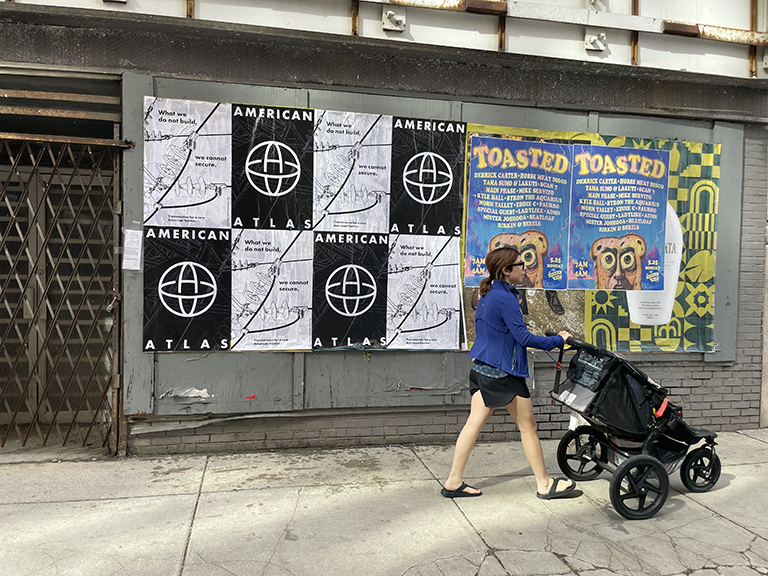
Poster Area: Size, Surface, and Coverage Explained
Poster area is something our teams calculate every day. Whether you’re covering a wall in Bushwick or planning a campaign across 20 locations, here’s how to think about it.
Poster area sounds like a math problem. And it is, but it’s also a strategic problem. The total surface area your posters cover affects how a campaign looks, how many pieces you need to print, how long installation takes, and how your message registers from a distance.
We run poster campaigns in New York, Los Angeles, Chicago, Miami, and across the country. Every campaign starts with a surface area calculation. How big is the wall? How many pieces cover it? What size maximizes visual impact within our print budget?
This guide covers poster area from the ground up. We’ll look at the square inch and square foot coverage of every standard poster size, how to calculate wall coverage, and how to plan a campaign around the space you have.
Area is the number that drives print quantity, installation time, and cost. Let’s walk through a real example.
Say we have a construction wall on West 14th Street in the Meatpacking District. The wall is 20 feet wide and 10 feet tall. That’s 200 square feet, or 28,800 square inches of surface area.
If we’re using 24×36 posters (864 square inches each), we need 28,800 / 864 = about 33 pieces to cover the wall edge to edge. If we’re tiling 18×24 posters (432 square inches each), we need about 67 pieces for the same wall.
The 18×24 option requires twice as many prints for the same coverage. Twice the paper, twice the ink, twice the paste time. At scale, choosing a size without calculating coverage can double your campaign cost.
In practice, we don’t always cover every square inch of a wall. We sometimes choose a tighter, more curated configuration: three or four large posters in a deliberate arrangement, with breathing room between them. That arrangement can be more visually arresting than wall-to-wall coverage.
Coverage Formula: To calculate how many posters cover a wall, divide the total wall area in square inches by the area of one poster in square inches. Round up to the nearest whole number. Add 10 to 15 percent for overlapping edges and any damaged pieces during installation.
Understanding Poster Area in Real Campaign Scenarios
We’ve run campaigns in a lot of different urban environments. Here’s how poster area plays out in practice across different site types.
Construction Walls and Plywood Hoarding
Construction hoarding, the temporary plywood fencing around building sites, is a prime poster location in urban areas. A typical construction hoarding panel is 4 feet wide by 8 feet tall, which is 32 square feet per panel.
A 24×36 poster covers 6 square feet. That means roughly five to six posters tile a single 4×8 panel if you allow for slight overlaps at the edges. A construction site with 20 panels of hoarding gives you about 100 to 120 poster slots if you tile 24×36 pieces in two columns per panel.
We’ve covered complete construction blocks in SoHo, the Flatiron District, and River North in Chicago this way. When the campaign is coherent and the artwork is strong, a construction wall becomes a gallery.
Venue and Bar Walls
Interior venue walls, the kind you see inside concert halls and bars along Sunset Strip or Wicker Park, typically have tighter surface dimensions and competing visual noise. Other posters, art prints, sponsor logos, and signs all compete for space.
In these environments, smaller poster areas actually perform better. An 18×24 at direct eye level in a bar bathroom commands the entire viewer’s attention for the 45 to 90 seconds they stand there. The concentrated area, at 3 square feet, becomes an advantage rather than a limitation.
Street Utility Poles and Lamp Posts
Utility pole campaigning uses 11×17 posters almost exclusively. The pole face is narrow, typically 4 to 8 inches wide. You’re not trying to cover surface area; you’re placing a poster at eye level where a pedestrian’s gaze naturally lands.
On a 6-inch utility pole, an 11×17 poster wraps the pole and its own edges become the boundary. The 1.3 square feet of paper is exactly right for this surface. Larger formats don’t work on poles. The area math doesn’t fit.
Poster Area and Paste Budget
Every extra square inch of poster area requires paste to mount it. On outdoor campaigns using wheat paste, the paste volume scales directly with poster area.
For a 24×36 poster (6 square feet), we use roughly a quarter cup of paste for a proper bond on a smooth surface. On a rougher surface (brick, textured stucco), we might use half a cup per poster to ensure the paste saturates the paper and bonds to the irregular surface.
For a campaign of 500 posters at 24×36, that’s 500 x 0.25 cups = 125 cups of paste, or about 8 gallons. At 1,000 posters, 16 gallons. This math affects supply budgets for large campaigns.
At 18×24 (3 square feet), paste use per sheet drops to about an eighth of a cup. Same 500-sheet campaign requires only 63 cups, or about 4 gallons. Smaller area, smaller paste requirement, lower supply cost.
Material Planning: When budgeting a poster campaign, always account for paste, rollers, and installation labor in addition to print costs. Larger poster areas mean more material consumption per location and longer installation time per site.
How Poster Area Affects Visibility and Readability
More area doesn’t automatically mean better visibility. But there are thresholds below which a poster becomes illegible from a typical viewing distance.
On a busy city sidewalk, a pedestrian approaching a wall from 20 feet away needs a poster with a headline of at least 150 to 200 points of type to read it comfortably. On a 24×36 poster (6 square feet), that type size is achievable and still leaves room for supporting content. On an 11×17 poster (1.3 square feet), 200-point type would fill half the page and leave no room for anything else.
The relationship between area and readability determines which poster size is appropriate for each viewing distance:
Viewing at 3 to 5 feet: 11×14 or 11×17 is sufficient
Viewing at 5 to 10 feet: 18×24 starts to work well
Viewing at 10 to 20 feet: 24×36 is the practical minimum
Viewing at 20 to 50 feet: 27×40 or larger
Viewing at 50+ feet: Large-format formats of 36×48 or bigger
A poster placed where viewers can only get within 5 feet is wasting the area of a 24×36. An 11×17 does the same communication job at a fraction of the print cost. Matching area to viewing distance is how we keep campaigns efficient.
Total Campaign Coverage Area
When clients ask about campaign reach, we often think in terms of total poster area deployed across all locations.
A campaign with 200 posters at 24×36 covers 1,200 square feet of wall space (200 x 6 sq ft). Spread across 40 locations, that’s 30 square feet per location, roughly five poster panels each. That’s a meaningful visual presence at each spot.
The same budget spent on 400 posters at 11×17 covers only 520 square feet total. More pieces, less area per piece, less impact at any single location. But the 400 pieces can reach twice as many locations, 80 instead of 40, increasing geographic reach.
There’s a real tension between concentration and distribution. We see it in every campaign we plan. High-area formats (24×36 and above) create strong exposures at fewer locations. Low-area formats (11×17) spread farther but with less per-location impact. The right balance depends on campaign goals.
Frequently Asked Questions
What is the area of a standard 24×36 poster?
A 24×36 poster has an area of 864 square inches, or exactly 6 square feet. This is the most common outdoor campaign poster size in the US.
How many 24×36 posters cover a 10-foot wall?
A 10-foot wide by 10-foot tall wall is 1,440 square inches wide and 120 inches tall. You can fit 5 posters wide (5 x 24 = 120 inches) and 3 posters tall (3 x 36 = 108 inches), for 15 total posters to cover most of the wall with some margin at the top.
What is the area of an 11×17 poster?
An 11×17 poster has an area of 187 square inches, or 1.30 square feet. It’s roughly one-fifth the area of a standard 24×36 campaign poster.
Does a bigger poster always mean better campaign results?
No. Bigger area works better at longer viewing distances and on large open surfaces. In tight interior spaces where the viewer is close, a smaller poster at eye level outperforms a large poster in the wrong position. Area should match the location and the viewing context.
How do I calculate how many posters I need to cover a wall?
Multiply wall width by wall height (both in inches) to get total wall area in square inches. Divide by the area of one poster in square inches. Round up to the nearest whole number and add 10 to 15 percent extra for overlaps and damage during installation.
What is the largest standard poster area?
Among commonly stocked standard poster formats, 40×60 inches (2,400 square inches / 16.67 square feet) is the largest. Above that, campaigns typically move to custom large-format printing on vinyl or fabric rather than paper posters.
How much area does an 18×24 poster cover compared to 24×36?
An 18×24 poster covers 432 square inches (3 square feet). A 24×36 covers 864 square inches (6 square feet). The 24×36 is exactly twice the area of an 18×24. For the same wall coverage, you need twice as many 18×24 pieces as 24×36 pieces.