Poster Dimension Guide | American Guerrilla Marketing
We’ve printed and posted tens of thousands of pieces across New York, Los Angeles, Chicago, and everywhere in between. Here’s what we know about poster dimensions.
We’ve printed and posted tens of thousands of pieces across New York, Los Angeles, Chicago, and everywhere in between. Here’s what we know about poster dimensions.
Poster dimension is not a single answer. It’s a spectrum. We work with everything from a tight 11×17 in a bar bathroom in Williamsburg to a full 24×36 on a construction site wall on Canal Street. Every campaign starts with the same question: what size actually works here?
We’ve been doing this for over a decade. Our crews know the neighborhoods, the surfaces, the foot traffic patterns. And we can tell you: the wrong poster dimension wastes money. The right one drives people to stop, look, and act.
This guide covers every major poster dimension. We’ll break down standard sizes, outdoor formats, specialty cuts, and what each one is good for in a real campaign.
Poster dimension refers to the physical measurements of a printed poster. Width by height. Simple. But that simplicity hides a lot of nuance.
In the United States, poster dimensions are measured in inches. The print industry has settled on a set of standard sizes over the decades. These standards exist because they match common paper roll widths, printing press beds, and display frame systems.
When a printer quotes you a “standard” size, they mean the cut falls on a clean line that minimizes paper waste. When we order a campaign run of 2,000 posters, being one inch off a standard dimension can add real cost. Print houses charge for cuts, and non-standard cuts mean more setup time.
Outside the United States, poster dimensions follow the ISO 216 system. That system uses A-series paper sizes. A1, A2, A3, and so on. Each size is exactly half the area of the one above it. The math is clean, and the system is used across Europe, most of Asia, and Latin America.
Our campaigns in New York and other major US cities use American standard dimensions. But if you’re printing for international distribution or working with a European design shop, knowing both systems matters.
Standard US Poster Dimensions
Here’s the breakdown we use every day. These are the sizes we order, the sizes our vendors stock, and the sizes that work across the most common posting surfaces.
Theater lobbies, large-format entertainment promos
Two Sheet
41 x 54
Outdoor transit displays, bus shelter faces
The 24×36 Dimension: Our Most-Used Size
If we had to pick one poster dimension to run a campaign with, it’s 24 inches wide by 36 inches tall. That’s our workhorse.
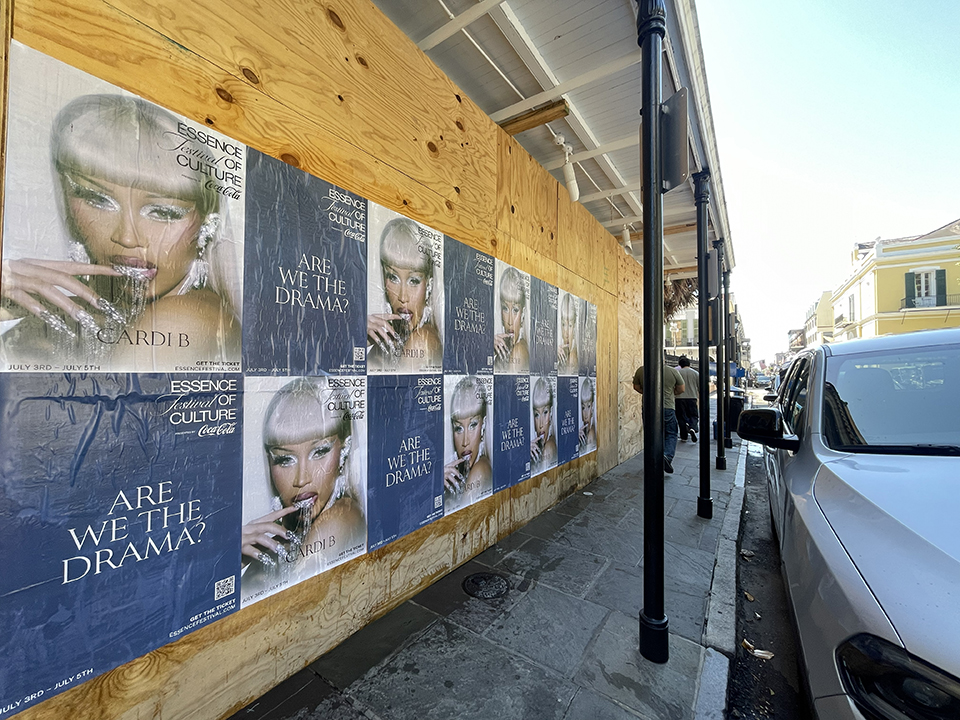
At 24×36, a poster is big enough to stop someone walking at a normal pace. You can read it from 15 feet away if the type is sized right. It fits on a standard wood panel on a construction wall along Broadway in SoHo, or on a plywood hoarding in the West Loop in Chicago.
24×36 also prints efficiently. Most large-format printers run on 24-inch or 36-inch roll stock. A portrait 24×36 wastes almost no paper. That keeps unit costs down when you’re printing 500, 1,000, or 5,000 pieces.
The aspect ratio, 2:3, is visually balanced. Design teams know it. Most template files are built around it. When a client sends us artwork, 24×36 is what we ask for first if they haven’t specified.
Field Note: When clients ask us what poster dimension to use for a street campaign, we almost always say 24×36 for the main run. We might supplement with 11×17 for window placements and interior spots, but 24×36 does the heavy lifting outdoors.
Small Poster Dimensions: 11×17 and Under
Small doesn’t mean weak. It means targeted.
11×17 is the go-to for dense urban interiors. We use it in coffee shops on Bedford Avenue in Williamsburg, in record stores on Haight Street in San Francisco, in bars along Milwaukee Avenue in Chicago. These spaces have windows, bulletin boards, bathroom walls, and visible countertops.
The dimension works because it’s manageable. A single crew member can carry hundreds of 11×17 pieces in a bag. They go up fast. They’re approved by most venues in advance with minimal friction. And in a compact space, an 11×17 at eye level performs better than a big sheet in the wrong spot.
11×14 is slightly smaller. Think photo print territory. We use it for in-store placements and framed displays in boutiques. It’s not a street format. It’s an interior format for targeted retail environments.
8×10 exists but is really too small for most campaign use. At 8×10, you’re competing with every business card and sticker on a crowded board. It works for very specific applications, like a small run of personalized pieces or a tight interior placement where the proximity is guaranteed.
Large Poster Dimensions for Outdoor Campaigns
When we talk about large poster dimensions, we’re usually talking about anything at or above 24×36. These are the formats that own a wall.
27×40 is the classic movie one-sheet. Hollywood settled on this dimension because it fits the standard theater display case. The near-vertical proportions make it ideal for showing a face or a figure against a dramatic background. We use this format for entertainment clients, music releases, and any campaign where the imagery needs room to breathe vertically.
40×60 inches falls into the “two sheet” territory. It’s what you see on the sides of some bus shelters. It’s a format for campaigns where raw size is the message. When our crew goes out on Broadway at night and puts up a row of 40×60 pieces, people notice.
Going even larger, you hit specialty outdoor formats. The 4×8 sheet is four feet by eight feet. It’s cut from a standard plywood panel. Some campaigns use tiled configurations of multiple prints to build a larger image. If you want to cover a 16-foot stretch of wall in Bushwick, you use eight 24×36 pieces tiled side by side or four 4×6 panels printed and mounted in sequence.
Size Reality Check: Bigger is not always better. A 27×40 in the wrong spot gets ignored. An 11×17 at the exact right eye level in a bar can drive more conversions. Match the dimension to the location. That’s how we think about every job.
ISO and Metric Poster Dimensions
The ISO 216 standard runs on a different logic than American sizing. Instead of picking convenient inch measurements, ISO starts with a single sheet, the A0, which has an area of exactly one square meter. Every smaller size is half of the one above it.
Here’s how the common ISO poster dimensions convert to inches:
ISO Size
Millimeters
Inches (approx)
A0
841 x 1189
33.1 x 46.8
A1
594 x 841
23.4 x 33.1
A2
420 x 594
16.5 x 23.4
A3
297 x 420
11.7 x 16.5
A4
210 x 297
8.3 x 11.7
A1 is the closest ISO equivalent to a US 24×36. It’s slightly narrower and slightly taller. If you’re working with a print shop in Europe or designing for an international campaign, A1 is the format to design toward.
A2 sits between an 18×24 and a 24×36 in US terms. It’s used heavily in UK street poster campaigns. Transit systems in London, Berlin, and Amsterdam have A2-compatible display frames at stations.
For US campaigns, we stick to inch-based dimensions. Our printers work in inches, our vendors stock paper in inch widths, and our clients brief in inches. But when a client comes to us having already produced artwork in A1, we can work with it. A1 prints fine on a 24-inch roll with a small white border.
Choosing the Right Poster Dimension for Your Campaign
The right dimension depends on four things: location, viewing distance, content, and budget.
Location comes first. If you’re posting on construction scaffolding on 34th Street near Penn Station, you have a wide-open wall surface. A row of 24×36 pieces works. If you’re placing inside a boutique on Melrose Avenue, you need something that fits in a window frame or on a display hook. That’s 11×17 or 18×24 territory.
Viewing distance matters enormously. The minimum readable type size scales with distance. At 5 feet, you can read 14-point type. At 20 feet, you need at least 60-point type for comfortable reading. A 24×36 with well-sized type can be read from across a street. An 11×17 is a close-distance format.
Content dictates shape. A portrait image of a person goes in a tall format. A environment cityscape or panoramic artwork goes in a wide format. Most US standard poster dimensions are portrait (taller than wide). If your content is environment, either rotate to a non-standard cut or use a square-adjacent dimension like 24×24 or 30×20.
Budget shapes everything. More square inches mean more paper, more ink, more shipping weight. A run of 1,000 pieces at 24×36 costs roughly twice as much in paper alone as 1,000 pieces at 11×17. If the campaign calls for wide distribution with many posting locations, smaller dimensions let you cover more ground per dollar. If you have fewer locations but need high impact at each one, go larger.
Poster Dimension and Print Resolution
Every poster dimension has a corresponding minimum resolution requirement. Resolution is measured in DPI, dots per inch. More DPI means finer detail. Too little DPI means visible pixelation.
The general rule: posters meant for close viewing need 150-300 DPI at full size. Posters meant for distance viewing can go down to 72-100 DPI without visible degradation, because the viewer never gets close enough to see individual pixels.
For our standard 24×36 street poster, we ask for 150 DPI at full size. That means the file should be 3,600 x 5,400 pixels. Some clients send us 72 DPI files and want them blown up to full size. That doesn’t work. The math doesn’t lie. A 72 DPI file at 24×36 carries only 1,728 x 2,592 pixels. Stretched to print size, it looks soft or blocky.
If you’re designing a 24×36 poster in Photoshop or Illustrator, set your document to 24 inches x 36 inches at 150 DPI from the start. Don’t scale up at the end. Start big.
For vector files (AI, EPS, PDF), resolution is less of a concern because the graphics are mathematical, not pixel-based. But any embedded raster images inside a vector file still need to meet the 150 DPI minimum at final print size.
Frequently Asked Questions
What is the most common poster dimension?
In the US, 24×36 inches is the most commonly printed poster dimension for campaigns and art prints. 11×17 is the most common for small-run promotions, flyers, and interior placements.
What dimension is a standard movie poster?
The standard US movie poster is 27×40 inches, known as a one-sheet. This is the format used in theater lobby display cases and major entertainment campaigns.
Is 18×24 a standard poster dimension?
Yes. 18×24 is a widely used standard. It sits between the small 11×17 and the large 24×36. We use it for mid-size campaigns where a 24×36 is too large for the available surface space.
What is the A1 poster dimension in inches?
A1 is 23.4 x 33.1 inches (594 x 841 mm). It’s the ISO standard closest to the US 24×36. If your artwork is designed for A1, it will print with a small border on a standard 24×36 print bed.
Can I print a non-standard poster dimension?
Yes, but expect to pay more. Non-standard cuts require custom setup on the print press and often waste paper. If your design requires a unique aspect ratio, build in budget for the extra cost. For large runs (500+), the per-unit impact is smaller.
How does the number of colors in a design affect which poster dimension to choose?
Color count affects print cost for offset printing but has minimal impact on dimension selection for digital large-format printing. The dimension choice remains driven by location and viewing distance. However, designs with complex color gradients and photographic imagery show better at larger dimensions where the viewer has enough distance for the eye to blend the halftone dots into smooth gradie
Transit advertising uses specific dimensions that vary by transit system and format. New York City subway car card placements use 28×11 inch dimensions. Bus shelter posters in NYC use 48×69 inches. Chicago Transit Authority has its own specifications. Always get the exact dimension requirements from the transit authority or your OOH media partner before designing. Transit dimensions do not follow