Poster Measurements: A Complete Guide to Every Size That Works in the Field
Poster measurements are not guesswork. Every size on the market exists for a reason. Small formats fit narrow poles and tight storefronts. Large formats stop foot traffic from twenty feet away. The wrong measurement wastes print budget and kills campaign impact. Get the numbers right from the start.
At American Guerrilla Marketing, we hang posters in New York, Los Angeles, Chicago, and every major market in between. Our crews work real neighborhoods. We know which measurements work where, and we know why the numbers matter beyond the printer spec sheet.
This guide covers every poster measurement used in street-level marketing campaigns. You get exact dimensions, practical applications, and the insider logic behind each size choice.
The industry runs on a handful of standardized measurements. These sizes are common because they align with standard paper stock, printing equipment, and real-world installation surfaces. Knowing them by heart saves time and prevents costly reprints.
Here are the foundational measurements our teams work with every day:
11 x 17 inches – The workhorse of street campaigns. Fits utility poles, construction fencing, and window displays without overwhelming the surface.
18 x 24 inches – The classic street poster. Highly visible from a distance. Works on large flat walls and plywood barriers.
24 x 36 inches – Cinema-standard. Commands attention at eye level. Common for event promotions and retail displays.
27 x 40 inches – The one-sheet. Movie industry standard. Familiar to audiences and easy to frame or install.
48 x 72 inches – Large format. Outdoor applications and high-visibility locations.
Each of these measurements has a specific role. You do not pick a size because it looks good on a mood board. You pick it because it fits the surface, serves the viewing distance, and matches the print budget.
Quick Reference: Our most-requested street campaign measurement is 24 x 36 inches. It hits the sweet spot between visibility and cost. One sheet of this size is readable from 30 feet in good light.
How Measurement Affects Visibility on the Street
Size and viewing distance are directly linked. A poster seen from a moving vehicle needs different measurements than one seen by a pedestrian walking past a storefront. Understanding this relationship is foundational to planning any outdoor campaign.
The rule of thumb our teams use: every inch of poster height adds roughly one foot of comfortable viewing distance. An 11-inch tall poster reads well at 11 feet. A 36-inch tall poster reads well at 36 feet. This is a rough guide, not a law. Type size, contrast, and ambient light all modify this baseline.
Pedestrian zones favor smaller, more detailed formats. People walking slowly at close range can absorb more information. A 12 x 18 or 11 x 17 poster in a dense urban pedestrian corridor delivers detail effectively. High-traffic vehicle zones demand larger formats. The message needs to land in under two seconds at speed.
Our crews scout every location before deciding on measurements. The physical environment drives the spec decision. Print what the location demands, not what looks impressive in a proposal deck.
Poster measurements are not random. Most standard sizes fall into predictable aspect ratios. Understanding aspect ratios helps you scale artwork correctly without distortion.
The 11 x 17 format has an approximate 1:1.55 ratio. The 18 x 24 format sits at a 3:4 ratio. The 24 x 36 format is a clean 2:3 ratio. Knowing these ratios means you can size artwork once and scale it to other formats without rebuilding your files from scratch.
When you move from 24 x 36 to 48 x 72, you double both dimensions. The ratio stays the same. The artwork scales cleanly. This is why designers working on street campaigns often build master files at 24 x 36 first. Everything else scales from there.
The 27 x 40 one-sheet breaks the pattern slightly. That format is 1:1.48 ratio. It does not scale cleanly from 24 x 36 artwork. You need a separate layout. We flag this for clients who want both formats from the same campaign.
Designer Note: Build your master file at full print size with 0.25-inch bleed on all sides. CMYK color mode. 300 DPI for anything under 24 inches. 150 DPI acceptable for large format over 36 inches viewed from a distance.
Small Poster Measurements for Tight Urban Environments
Not every campaign calls for maximum size. In dense urban markets, small poster measurements often outperform large ones. Tight corridors, crowded windows, and small surfaces favor compact formats. An 8.5 x 11 poster placed at eye level on a coffee shop door gets seen by every person who enters. A 24 x 36 would not even fit on the glass.
Our street teams routinely run 11 x 17 campaigns in neighborhoods like the East Village in New York, Williamsburg in Brooklyn, or Silver Lake in Los Angeles. These areas have dense foot traffic but limited surface area per location. Small measurements mean more placements per block. More placements mean more exposures.
The compact formats also work well for saturation tactics. Covering a three-block radius with 200 copies of an 11 x 17 poster creates a stronger presence than placing 20 copies of a 24 x 36. Total coverage beats individual size in tight markets.
Large Poster Measurements for High-Impact Campaigns
Large measurements command space. A 36 x 48 or 48 x 72 poster on a construction fence creates a visual interruption that small formats cannot match. These sizes work for brand awareness campaigns, album drops, product launches, and events where the goal is stopping traffic rather than delivering detailed information.
Large measurements require more prep work. The surfaces need to be clean and flat. The paste needs to be applied in sections. Our crews bring wide brushes and extra wheat paste for oversized formats. Installation takes longer per unit but the visual payoff justifies the labor.
Printing large format is also more expensive per piece. You get fewer units per dollar. This means placement strategy matters even more. We scout high-traffic single locations for large format work. One perfect placement of a 48 x 72 beats ten mediocre placements of the same format.
Measurement Tolerances and Bleed Requirements
Your finished poster measurement will differ slightly from your file dimensions. Here is why. Printing requires bleed. Bleed is extra artwork that extends beyond the final trim edge. Standard bleed is 0.125 inches on each side for small formats. Large format often uses 0.25 inches.
A 24 x 36 file with standard bleed is actually set up at 24.25 x 36.25 inches. After trimming, the printed piece measures 24 x 36 as specified. Always confirm bleed requirements with your print vendor before sending files. Different print houses have different specs.
Paper stock also affects final measurements slightly. Heavier stocks like 100 lb cover hold their shape better. Lighter stocks can stretch or shrink slightly in humidity. For outdoor campaigns in variable weather conditions, we specify heavier stocks to maintain dimensional stability.
Print Tip: Always request a proof at full size before running a large print job. A single-unit proof costs almost nothing compared to reprinting 500 sheets with the wrong measurements or color output.
Measurement Considerations for Stacked and Tiled Campaigns
Some campaigns use multiple posters placed together to create a larger image. This is called a tiled campaign or grid installation. You need precise measurements and consistent trimming for the tiles to align correctly.
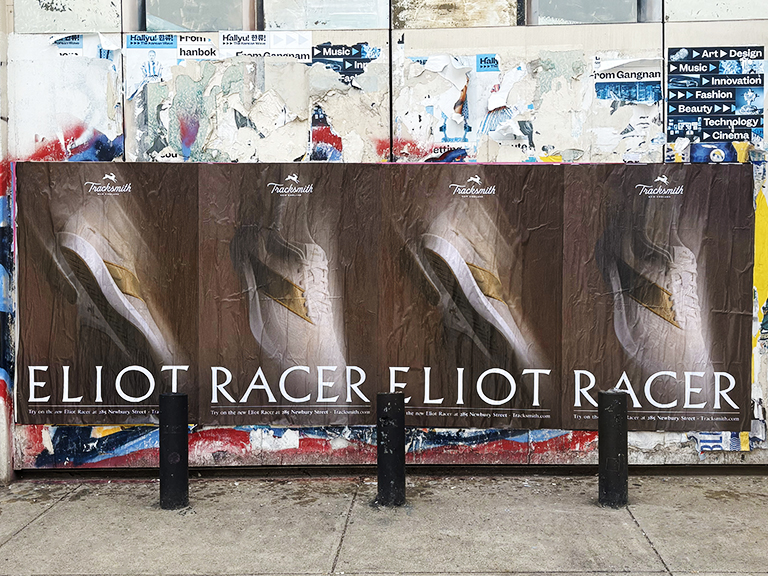
A common approach: four 24 x 36 posters arranged in a 2×2 grid create an 48 x 72 image. The individual pieces print on standard equipment. They combine to create large-format impact at standard printing prices. This technique requires careful file preparation and skilled installation, but the result looks impressive.
Our teams have run tiled campaigns using 18 x 24 and 24 x 36 formats. The key is consistent paper trimming and precise paste application. Every seam needs to align. A misaligned tile in the center of a grid installation ruins the effect. We use chalk lines and laser levels for large grid installations.
Digital File Measurements vs. Physical Print Measurements
There is always a conversion question when moving from screen to print. Digital files measure in pixels. Physical prints measure in inches or centimeters. The link between them is resolution, measured in DPI (dots per inch).
To print an 11 x 17 poster at 300 DPI, your digital file needs to be 3300 x 5100 pixels. To print a 24 x 36 poster at 300 DPI, you need a 7200 x 10800 pixel file. These are large files. They require adequate processing power and storage to work with efficiently.
Large format prints over 36 inches do not require 300 DPI because they are viewed from farther away. A 48 x 72 inch print at 100 DPI still looks sharp from ten feet away. Large format is often printed at 72 to 150 DPI depending on the vendor and the intended viewing distance.
Always work in the native print measurement from the start of your design process. Building a poster at screen resolution and scaling up for print creates pixelation. Start large, design in CMYK, and your final printed measurement will match your creative intent.
Choosing the Right Measurement for Your Campaign Type
Different campaign goals demand different measurements. There is no universal right answer. Here is how our team thinks through the decision:
Event promotion: 24 x 36 or 18 x 24. You want the date, venue, and headliner to read from across the street. Large type on a bold background. Simple layout. The measurement gives enough surface for impact without requiring paragraph-level detail.
Brand awareness: Go large. 36 x 48 or bigger. The goal is presence, not information. A simple logo or visual element at massive scale communicates confidence and budget. Measurement signals investment.
Retail promotion: 11 x 17 or 12 x 18. These go in windows, on doors, inside venues. Close viewing distance means you can include price points, product details, and promotional copy. Compact measurement, rich content.
Campus campaigns: 11 x 17. Bulletin boards have slots this size. Pins and thumbtacks handle this weight. Students walk close to boards to read them. Smaller measurement works perfectly for this environment.
Concert or album drop: 18 x 24 or 24 x 36. Music campaigns live on walls. The texture and color of street art culture suggests scale. Go bigger than you think you need. An 18 x 24 in a saturated music market can get overlooked. A 24 x 36 in the same spot stands out.
How to Check Your Poster Measurements Before Going to Print
Catching a measurement error before print production saves money and prevents schedule disruptions. Here is the check sequence we run before approving any poster file for production.
Confirm the document is set up at the final print size. Open the document properties in your design application and verify that the page dimensions match the intended print size. If you are producing a 24×36 poster, the document page should be exactly 24 by 36 inches. Any discrepancy at this step will compound through every subsequent check.
Measure the bleed. Pull up the ruler in your design application and measure from the trim line to the edge of the bleed zone. Standard bleed is 0.125 inches on each side. If the bleed is smaller, background elements may show white edge after trimming. If the bleed is larger, no harm, but confirm the vendor accepts the file as submitted.
Check the safety margin. Text and critical graphic elements should sit at least 0.25 inches inside the trim line on all four sides. Pull up ruler guides at the trim line position and visually confirm that no important content is closer to the edge than 0.25 inches. Content that bleeds into the safety margin may be trimmed in production.
Verify image resolution at 100 percent. Zoom to 100 percent view in your design application and inspect every placed image. Images that look soft or pixelated at 100 percent view will print that way. There is no post-production correction for underresolution images that does not involve replacing the source file.
Check color mode. Confirm the document color mode is CMYK, not RGB. In Illustrator: File, Document Color Mode. In InDesign: Edit, Color Settings. In Photoshop: Image, Mode. Any RGB document going to CMYK print will have color shifts at output. The darker blues and bright greens are the most commonly affected colors. Converting to CMYK before final design review lets you see and correct those shifts.
Verify file format with the vendor before exporting. Most professional print vendors accept PDF/X-1a or PDF/X-4. Some large format vendors prefer native Illustrator or InDesign files. Confirm the vendor’s preferred format before your final export so the file you deliver can be processed without additional conversion steps that introduce error risk.
Frequently Asked Questions
What is the most common poster measurement for street campaigns?
The 24 x 36 inch measurement is the most common for outdoor street campaigns. It gives strong visibility from a distance while remaining manageable for single-crew installation. The 18 x 24 is a close second and slightly more economical to print.
What measurement is a standard letter-size poster?
A letter-size poster measures 8.5 x 11 inches. This is the smallest practical poster format. It works for bulletin boards and handout campaigns but lacks visibility in outdoor or high-competition environments.
What is the measurement of a movie one-sheet poster?
The movie industry one-sheet measures 27 x 40 inches. This is the standard size for theatrical releases and has been the cinema standard for decades. The format is tall and narrow, designed for lobby display cases.
How do I convert poster measurements from inches to centimeters?
Multiply inches by 2.54 to get centimeters. An 18 x 24 inch poster is 45.72 x 60.96 centimeters. A 24 x 36 inch poster is 60.96 x 91.44 centimeters. International print vendors often require metric measurements.
Do poster measurements include bleed?
Standard poster measurements are the final trimmed dimensions. Bleed is extra. A 24 x 36 inch poster requires a file set up at approximately 24.25 x 36.25 inches with 0.125 inch bleed on each side. Your print vendor will specify exact bleed requirements.
What measurement works best for pole posting campaigns?
The 11 x 17 inch measurement works best for utility pole campaigns. The format fits around the circumference of standard poles and fences without excessive overlap. It is also light enough to stay adhered with standard paste application.
Can I mix poster measurements in a single campaign?
Yes, and we often recommend it. A campaign might use 24 x 36 posters for high-traffic walls and 11 x 17 for poles and smaller surfaces. Different measurements serve different surfaces and viewing distances. A mixed approach covers more ground effectively.