If you searched for poster sizes, you’re in the right place. The standard US poster is 24×36 inches for outdoor work and 18×24 for indoor. Here’s the full breakdown.
If you landed here looking for poster size information, we’ve got you covered. We work in poster advertising every day. Our crews place printed posters in New York, Los Angeles, Chicago, Miami, Atlanta, and cities across the country. We know poster dimensions the way a carpenter knows lumber dimensions. This is our material.
The most important poster sizes to know are 18×24 inches for indoor and window work, and 24×36 inches for street-level and outdoor work. Everything else is a variation or step up from those two core formats.
Here’s the complete guide to poster sizes, organized by use case, with everything you need to get from brief to printed piece.
These are the sizes that appear repeatedly in advertising, printing, and commercial display work. They’re the sizes that hardware, software, and print shop infrastructure are built around. Working within this set of standard sizes saves time, money, and headaches.
The Two Most Important Poster Sizes: 18×24 and 24×36
Most advertising poster work falls into one of two size categories. The 18×24 for indoor and window use. The 24×36 for street-level and outdoor use. Understand these two and you understand 80% of the poster environment.
18×24 Inches: The Indoor Standard
The 18×24 inch poster is the workhorse of indoor poster advertising. It’s 1.5 feet wide and 2 feet tall. This size fits the snap frames and display hardware installed in most retail stores, bars, music venues, galleries, and event spaces.
At 18×24, you’re targeting viewers at 10 to 25 feet. The text needs to be relatively large. A strong image dominates the upper portion. The headline and key details go in the lower third. With a clean layout, this format communicates clearly in a busy visual environment.
We post a lot of 18×24 in Manhattan for venue promotion, in Silver Lake for music events, in Wicker Park for gallery openings and retail launches. The format works in any city because the display infrastructure is consistent.
24×36 Inches: The Street Standard
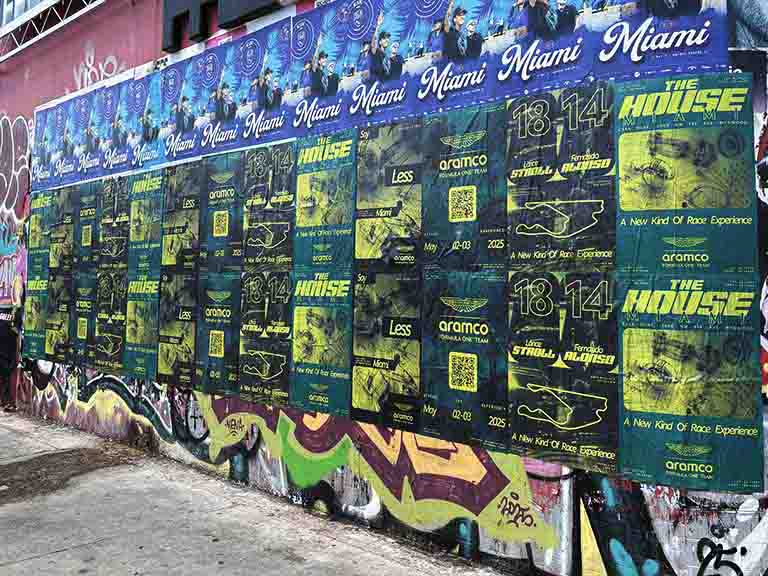
The 24×36 is the primary format for street-level poster campaigns in the US. Two feet wide, three feet tall. This is what our crews carry into position on late nights in the Marcy Ave area of Williamsburg, along Fairfax in LA, or down the Wells Street corridor on Chicago’s north side.
At 24×36, you’re visible from 30 to 50 feet in good conditions. The larger area means more room for bold design. A dominant image, a strong headline, and clean supporting text all have room to breathe. The campaign feels substantial. People notice it.
Print cost for 24×36 runs roughly $3 to $8 per unit in quantities of 100 or more, depending on stock and finish. The price premium over 18×24 is real but the visibility increase more than justifies it for outdoor placements.
Quick sizing rule: If you’re placing posters outdoors or on building-facing surfaces in an urban environment, use 24×36. If you’re placing in windows, inside venues, or in any indoor environment, 18×24 is usually the right call. When in doubt, go bigger.
Specialty Poster Sizes Worth Knowing
27×40: The Movie One-Sheet
The movie one-sheet is 27×40 inches. This is the format built into every theater lobby display frame in the US. It’s wider and taller than a 24×36. For entertainment, music, and cultural programming, the 27×40 carries associations with quality and major production. Using it in non-cinema contexts creates an interesting dissonance that can work well for the right campaign.
12×18: The Half-Sheet
The 12×18 is sometimes called a half-sheet because it’s close to half of an 18×24. It’s slightly larger than an 11×17 and slightly smaller than an 18×24. Not all print shops stock it as a standard, but it’s available at most large-format vendors. It’s a good size for close-range interior displays where 18×24 would be too large.
36×48: The Large Outdoor Format
The 36×48 shows up in transit advertising, on bus shelter displays, and in large retail window formats. It’s four times the area of an 18×24 and twice the area of a 24×36. At this scale, design needs to be extremely simple. A single strong image and a short headline are all you need. Text-heavy designs fail at this size because viewers don’t have time to read.
How Poster Size Affects Your Campaign Budget
Print cost scales with size. That’s obvious. What’s less obvious is how dramatically it scales when you’re printing in volume.
A campaign with 200 units at 18×24 might cost $400 in print. The same 200 units at 24×36 might cost $800 to $1,200. That’s a meaningful difference, especially for smaller campaigns. The visual impact of 24×36 is significantly greater, but the budget has to support it.
One approach we use with clients: run fewer 24×36 pieces in high-impact anchor locations and fill in with more 18×24 pieces in secondary spots. You get the visual presence of the large format in the most important places, and the economy of the smaller format everywhere else. The campaign covers more ground at a manageable budget.
Another factor: installation time. Larger posters take slightly more time to post properly, especially in locations where precision matters. For campaigns with tight installation windows, using 18×24 in some locations allows the crew to move faster.
Budget planning tip: When planning a poster campaign, get print quotes at two sizes before finalizing. The price difference between 18×24 and 24×36 at your target quantity will help you decide how to allocate the budget between size and quantity.
Poster Size and Resolution Requirements
Every poster size has a corresponding file resolution requirement. Getting this wrong is one of the most common print mistakes. Here’s the breakdown:
Poster Size
Recommended DPI
File Size at 150 DPI
File Size at 300 DPI
11 x 17 in
300 DPI
1,650 x 2,550 px
3,300 x 5,100 px
18 x 24 in
150-300 DPI
2,700 x 3,600 px
5,400 x 7,200 px
24 x 36 in
150 DPI
3,600 x 5,400 px
7,200 x 10,800 px
36 x 48 in
100-150 DPI
3,600 x 4,800 px
5,400 x 7,200 px
For most large-format posters, 150 DPI is sufficient. The viewer is rarely close enough to see individual pixels at street-level viewing distances. Use 300 DPI for posters that will be seen at very close range, like inside a display case or storefront window where someone might press their nose to the glass.
Choosing the Right Poster Size for Your Situation
Here’s the simple decision tree we walk clients through:
Where is the poster going? Outdoors or on building surfaces: 24×36 minimum. Inside a venue or window: 18×24. Bulletin board or counter: 11×17.
What’s the viewing distance? Under 15 feet: 11×17 or 18×24. 15 to 30 feet: 18×24 or 24×36. 30 to 50 feet: 24×36 or larger.
What’s the budget? If the budget allows only one size, go 24×36 for outdoor campaigns. More posters at a smaller size can compensate for the lower per-unit impact, but you need the volume to make it work.
What’s the venue or context? Entertainment: 27×40. Transit: 36×48 or larger. Retail: 18×24 or 24×36. Street: 24×36.
Run through those four questions and you’ll land on the right size most of the time. For campaigns that span multiple venue types, you’ll probably end up with two sizes. That’s normal. Most professional campaigns use at least two sizes.
Poster Size and Design Style: What Works at Each Scale
Design choices that work at one poster size often fail at another. Here is how to approach design for each of the key size categories.
Designing for 11×17
At this size, restraint is the dominant discipline. One hero image, one headline, one key piece of information, one call to action. The 187 square inches of working surface does not allow for complexity. The most effective 11×17 posters we see in the field are almost shockingly simple: a face or a product image, a name or title in large bold type, a date or address, and a color palette that demands attention from across the room. If the poster requires a magnifying glass to read, it is not designed for the format.
Designing for 18×24
The 18×24 allows more compositional sophistication without sacrificing the visual discipline that poster format requires. A strong background image, an overlaid headline in 60 to 80pt type, supporting information at 24 to 36pt, and a clearly visible brand mark. This size handles photography exceptionally well. A full-bleed concert photograph with type reversed over a dark portion of the image is a classic and reliably effective 18×24 approach. The format also handles graphic illustration and typographic-only design if the hierarchy is clear.
Designing for 24×36
At 24×36, the designer has genuine room to breathe. This is the size where ambitious photography, detailed illustration, and complex typographic compositions can all work with the right execution. The viewing distance in outdoor street environments means that headlines can run from 80 to 120pt with supporting information stepping down proportionally. One common mistake at this size is designing as if for a smaller format, producing a poster with unnecessarily small type that fails at the 20 to 30 foot viewing distance where most people first encounter it.
Combining Poster Sizes for Maximum Campaign Impact
The most effective poster campaigns we run use multiple sizes in coordination. Here is a framework for combining sizes in a single campaign.
The Three-Size Model
For city-scale campaigns with moderate to high budgets, we often recommend a three-size model. Anchor pieces at 24×36 go up at the 10 to 15 highest-priority locations in the target area. These are the intersections, the construction walls, and the venue facades that will see the most relevant foot traffic. Mid-weight pieces at 18×24 distribute through partner venue windows, coffee shops, record stores, and bars across the full target geography. Light-touch pieces at 11×17 saturate the secondary locations: bulletin boards, laundromats, and smaller businesses in the surrounding blocks. Together, the three sizes create a campaign that is both bold and pervasive.
The Two-Size Model
For campaigns with tighter budgets or narrower geographic scope, a two-size model works well. 24×36 for key outdoor placements and 18×24 for all indoor and window placements. This model maintains visual consistency across a smaller number of pieces while concentrating impact where it matters most.
The Single-Size Model
For very tight budgets or very specific placement environments, a single-size campaign is practical. If all your placements are indoor venue windows, 18×24 alone covers the need. If all your placements are on outdoor surfaces in a dense urban environment, 24×36 alone does the job. Single-size campaigns sacrifice adaptability but gain simplicity and the ability to print in larger quantities of a single SKU, which typically reduces per-unit cost.
Poster Size for Specific Campaign Types: A Quick Reference
Campaign Type
Recommended Primary Size
Recommended Secondary Size
Local event (small venue)
11 x 17
None, or 18 x 24 for anchor placements
Music release or concert
18 x 24
24 x 36 for outdoor anchor locations
Product launch, outdoor focus
24 x 36
18 x 24 for indoor and window supplement
Film or entertainment release
24 x 36
27 x 40 for premium locations
Retail in-store campaign
22 x 28
18 x 24 for window display
Brand launch, national
24 x 36
18 x 24 and 11 x 17 for full saturation
Poster Size and Paper Weight: Getting the Combination Right
The size of the poster is one decision. The paper it prints on is a separate one. Getting both right prevents the most common print problems we see on campaign posters in the field.
For outdoor 24×36 campaigns, the baseline is 80 lb text weight in coated gloss or matte. This weight is rigid enough to post cleanly but light enough to work with wheatpaste or sticker applications efficiently. Gloss finish holds up better to brief rain exposure than matte, but both work in mild outdoor conditions over a standard 2-week campaign window.
For a campaign running more than two weeks outdoors, upgrade to 100 lb text or 80 lb cover. The heavier stock resists moisture better and doesn’t soften and tear as quickly when exposed to humidity or light rain. At 24×36 on 100 lb cover, the poster has noticeably more physical presence when handled and installed, and it tends to lie flatter against the wall without bubbling.
For indoor 18×24 campaigns, 100 lb gloss text is the standard. The glossier surface looks crisper under the overhead lighting common in venues and retail spaces. Matte stock can look flat under fluorescent lighting, which works against you in club and bar environments where you want the poster to catch the eye. Satin is a good middle option if the display environment has direct natural light that could create glare on a full gloss surface.
For 11×17 work, the print spec matters less than quantity and placement quality. At this size, 60 lb uncoated text stock is workable if the budget is tight. 80 lb coated gives a better ink hold and slightly more durability for venues where posters get touched and handled. For high-end interior placement at venues that command the piece’s quality level, 100 lb matte is worth the premium.
UV coating adds a protective layer over any paper stock. It protects against fingerprints, light moisture, and surface abrasion. For any poster going into a high-traffic area where it will be touched or brushed against frequently, UV coating extends the visible life of the piece. The added cost is modest, typically $0.10 to $0.25 per unit at commercial quantities. It pays for itself in the difference between a campaign that looks clean through its full run and one that looks battered by week two.
Printing Turnaround for Different Poster Sizes
Production timelines vary by size and quantity. Here’s what to expect at each standard poster size when you’re ordering for a campaign launch.
For 11×17 at quantities under 500, same-day or next-day turnaround is available at most copy centers and digital print shops. At quantities of 500 to 2,000, allow 2 to 3 business days at a commercial print shop. For extremely large runs of 11×17, 5,000 or more, a full offset press run takes 5 to 7 business days but delivers the lowest possible per-unit cost.
For 18×24 at quantities under 100, most wide-format shops produce in 1 to 2 business days. For quantities of 100 to 500, allow 3 to 5 days. Above 500 copies, the timeline extends to 5 to 7 days at most commercial vendors unless you pay for rush production. Always build an extra buffer into the schedule: a 5-day quoted turnaround often becomes 7 days in practice, especially during busy periods in the spring event season or the fall concert calendar.
For 24×36 at standard quantities of 50 to 200, expect 2 to 4 business days at most wide-format shops. For 200 to 500 copies, allow 4 to 6 days. For quantities above 500, get a specific quote on both price and timeline before confirming the order. Some vendors price this range attractively but stretch delivery into the following week, which creates problems for campaigns with hard launch dates.
Rush production is available at most commercial print shops for a 25 to 50 percent premium. If a campaign launch is time-sensitive and the print schedule is tight, ask specifically about rush pricing and confirmed delivery dates before you approve the order. A quote with a 2-day rush turnaround is only as good as the shop’s ability to execute it. Ask if they have capacity before paying the premium.
How Poster Size Affects Where Your Campaign Can Run
Not all poster sizes fit all placement environments. Knowing this before you print saves money and avoids the frustration of producing posters that don’t fit the surfaces you planned to use them on.
Bulletin boards in coffee shops, universities, and community centers typically have limited display space. A 24×36 won’t fit on most cork boards without overhanging other postings. An 11×17 is the correct format for bulletin board campaigns. If your campaign geography depends on bulletin board coverage, plan your quantity in 11×17 rather than trying to force a larger format into an incompatible location.
Snap frame display hardware in retail stores and venues comes in standard sizes. If the venue has 18×24 snap frames, you need 18×24 posters. A poster that’s even a quarter inch too large won’t fit the frame. A poster that’s too small will rattle and look wrong. Confirm the frame size with the venue or retail manager before printing, and print to that exact size.
Construction fence panels in urban environments typically accommodate 24×36 with room to spare. The wooden fence boards used for legal poster placement are usually 4 to 6 feet wide, easily holding 24×36 without any cropping issues. For particularly prominent construction wall placements, some boards are large enough to hold multiple 24×36 posters as a unified visual display. This is a common tactic for entertainment campaigns where maximum visual impact at a single location justifies the extra printing cost.
Public transit shelter panels have their own format requirements, typically 40×60 or 47.5×67.5 depending on the shelter system and city. If your campaign includes transit shelter placements, these require separate print production from your street and venue campaign. Do not assume that a stretched 24×36 will look good in a transit panel. It won’t. Transit advertising requires its own properly sized, properly produced artwork.
Frequently Asked Questions
What is the standard poster size in the US?
The standard poster size for street advertising in the US is 24×36 inches. For indoor and window use, 18×24 is standard. The entertainment industry uses 27×40 as its standard one-sheet format.
What is the most popular poster size?
The 24×36 inch poster is the most widely used size for advertising campaigns. For decorative home use, 18×24 and 24×36 are both extremely common. In terms of total print volume, 24×36 is likely the most common single size in US poster advertising.
What size are most concert posters?
Most concert posters for club and venue shows are 18×24 inches. Major touring acts often use 24×36 for outdoor and street-level promotion. Very large festival promotions may use 36×48 or custom large formats.
How big is a 24×36 poster?
A 24×36 poster is 2 feet wide and 3 feet tall. In metric, that’s approximately 61 x 91.4 centimeters or 610 x 914 millimeters. It’s the most common street-level advertising poster size in the US.
What poster size fits in standard frames?
Standard poster frames are available at 11×17, 18×24, and 24×36 inches at most home goods and art supply stores. The 18×24 is the most widely available standard frame size at retail. Custom framing can accommodate any size.
What are the poster sizes for Canva?
Canva offers poster templates at various sizes including 11×17, 18×24, and 24×36 inches. In Canva, you set custom dimensions when you create a new document. Enter the exact dimensions you need for your print size.
What is the difference between a poster and a banner?
Posters are typically printed on paper or paper-based stock and are portrait or square in orientation. Banners are usually vinyl or fabric, often much wider than tall (environment format), and designed for hanging or stretching. Posters are for wall and surface mounting. Banners are typically for hanging and outdoor display at a distance.