Most trade show marketing companies focus on what happens inside the convention hall. They design booth experiences, manage audio-visual production, coordinate registration technology, and handle the logistics of show floor presence. All of that matters. But it starts from the assumption that attendees will find you, an assumption that becomes increasingly risky as shows grow and competition for attendee attention intensifies.
American Guerrilla Marketing is a different kind of trade show marketing company. We focus on the work that happens outside the hall: the street-level campaigns that build brand awareness in the convention district before the show floor opens, create the pre-show exposures that turn cold booth encounters into warm intentional visits, and extend brand presence into the hotel lobbies and outdoor neighborhoods where the most commercially significant conversations happen before and after official show hours. We are based at Industry City in Brooklyn and have executed convention neighborhood campaigns at major shows across the United States.
What We Do as a Trade Show Marketing Company
Our core trade show marketing services are built around the physical formats that operate in the streets and pedestrian corridors surrounding convention centers. These are the formats that most event marketing agencies do not specialize in, and the formats that deliver some of the strongest ROI available in trade show marketing because they reach the concentrated professional audience at a fraction of the cost of premium floor space.
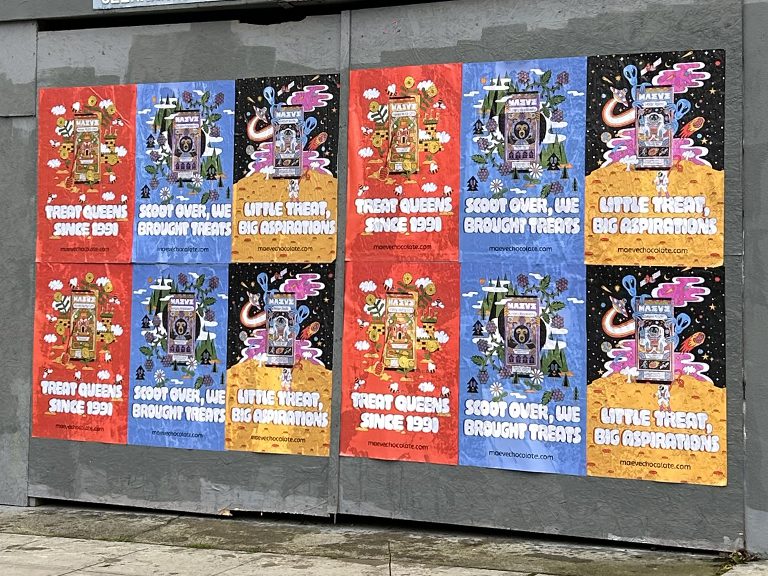
We deploy brand ambassador teams at the hotel lobbies, shuttle stops, and convention center approaches where trade show attendees concentrate before the hall opens. We route LED mobile billboard trucks through the convention district during show hours to reach the full attendee population with high-visibility mobile advertising. We place wheatpaste poster campaigns on the walls of convention neighborhoods for persistent ambient brand presence throughout the show period. We apply sidewalk stencils at approach corridors and decision-point intersections that route attendees toward the convention center.
Each of these formats operates in the uncontested promotional territory outside the hall. While every other exhibitor is competing for attention in the same square footage of show floor, our clients are building brand recognition in the environments that most exhibitors leave completely unaddressed.
Our Approach to Campaign Strategy
Every trade show marketing campaign we build starts with venue geography and attendee behavior analysis. Where are attendees staying? What routes do they walk from their hotels to the venue? Where do they concentrate at each time of day? Which outdoor spaces see the highest pedestrian density during morning arrival and midday break windows?
From this geographic and behavioral analysis, we build a deployment plan that places each format at the locations and times where it reaches the most qualified contacts. Ambassador teams are positioned at the highest-density attendee gathering points during the morning arrival window. Truck routes prioritize the approach corridors with the greatest pedestrian traffic during show hours. Poster placements are selected for the surfaces with the best sight lines and highest attendee exposure across the convention neighborhood.
This venue-specific planning is one of the most important things that separates effective trade show marketing from generic event promotion. The plan for a show at the Javits Center in New York is different from the plan for a show at the Las Vegas Convention Center or McCormick Place in Chicago, because the venue geography, hotel distribution, and attendee movement patterns are different in each city. We build the plan from the geography up, not from a generic template down.
Full-Service Campaign Management
We manage the full execution of every campaign element we plan. Ambassador team recruitment, training, and deployment. Truck routing and driver coordination. Poster production, installation, and placement documentation. Stencil production and application. Shift scheduling, real-time team communication, and field supervision for every deployment day.
Every campaign element is documented with field evidence. Ambassador shifts generate timestamped deployment logs and photo confirmation from the field. Poster installations are confirmed with geo-tagged photos before the show opens. Truck routes are tracked with GPS confirmation of coverage. Stencil applications are documented with location photos and completion reports.
This documentation gives our clients complete visibility into what was executed, where, and when. It also provides the proof of performance data that clients need to report on campaign execution to internal decision-makers and to build the performance record that informs future investment decisions.
Why AGM Works for B2B Trade Shows Specifically
B2B trade show marketing requires a different caliber of field execution than consumer activations. The audience is professional, often senior, and accustomed to making quick judgments about the credibility of the brands they encounter. A trade show marketing approach that feels amateur, off-brand, or out of place in the professional context does more damage than nothing.
Our team briefs ambassadors extensively on the client’s brand positioning, professional audience profile, and conversation protocols appropriate to each show’s industry context. At a healthcare trade show, the team members understand clinical relevance and the professional standards that govern interactions with healthcare practitioners. At a technology show, the team understands the product category and the business problems it addresses. The professional caliber of the conversation is as important as the coverage it achieves.
We have executed B2B trade show marketing at technology conferences, healthcare trade events, retail industry shows, financial services conventions, and manufacturing trade shows. Each engagement produces a field brief specific to that show’s audience and industry context, and team members are selected and briefed against that specific profile.
The Trade Show Marketing Company That Complements Your Existing Strategy
Many of our trade show marketing clients already invest in strong booth design, excellent booth staff, and well-produced in-booth experiences. What we add to that foundation is the outside-the-venue campaign that fills the awareness gap between showing up at the show and being found on the show floor.
The brand recognition built in the hotel lobby and convention neighborhood changes the quality of the booth encounter. An attendee who has seen the brand on the truck, noticed the poster in the hotel corridor, and had a brief conversation with an ambassador at the shuttle stop arrives at the booth with context. The initial awareness barrier is already cleared. The conversation starts from a fundamentally different and better baseline than a cold walk-by encounter.
This multiplier effect on the existing booth investment is one of the most compelling reasons to add outside-the-venue trade show marketing to a program that is already strong. The booth performs better when the audience arrives primed.
Trade Show Marketing for the Full Convention Calendar
For brands that exhibit at multiple trade shows across the year, we build annual convention marketing programs that create consistent outside-the-venue presence across the full show calendar. Multi-show programs benefit from the cumulative brand recognition that builds within professional communities that attend the same shows repeatedly year after year.
A brand that shows up well in the convention neighborhood at a major industry show consistently for three to five years becomes a familiar, trusted presence in that professional community. That familiarity shortens the sales cycle and increases conversion rates at every subsequent show, because the audience is not meeting the brand for the first time when they encounter it on the show floor. They are returning to a brand they have encountered before.
We build multi-show programs with consistent creative frameworks that build brand recognition across the calendar while adapting the specific deployment plans to the geography and audience of each venue. Annual program clients receive aggregated performance reporting that tracks results across every show in the calendar and identifies the highest-performing tactics and formats for optimization in subsequent years.
How We Build Convention Campaigns That Actually Work
Our team at American Guerrilla Marketing has executed convention marketing programs at major trade shows across the country. We have deployed teams at shows in Las Vegas, New York, Chicago, Orlando, Atlanta, and every other major convention market. That field experience informs how we plan every new campaign: we know what works in the Javits Center neighborhood, how to navigate the hotel district around the Las Vegas Convention Center, and where to position teams for maximum impact at McCormick Place.
Every program we run is documented from start to finish. Before the show opens, we confirm every outdoor placement with geo-tagged photos. During the show, field supervisors submit timestamped shift logs that include deployment position, team size, and conversation or sample counts for each shift. After the show closes, we compile the full campaign documentation into a post-show report that gives clients proof of what was executed and the data they need to evaluate the program.
The documentation also creates the performance record that informs optimization of the next campaign. Which deployment locations generated the most qualified conversations? Which outdoor placements received the most engagement? Which shift timing produced the highest-quality audience encounters? These questions get answered over multiple campaigns, and the answers compound into a progressively more effective convention marketing program year over year.
Planning Your Convention Campaign Timeline
Convention marketing campaigns work best when they are planned against the full timeline: 8 to 12 weeks before the show for the most complex programs, 4 to 6 weeks for ambassador-only or outdoor-only programs. The earlier the planning begins, the more options are available for every element of the campaign.
The pre-show window (6 to 8 weeks out) is when pre-show meeting outreach campaigns should launch. Personalized outreach to registered attendees using the specific conference or show context achieves significantly higher response rates than generic outreach because the timing is immediately relevant to the recipient’s known upcoming plans. We build pre-show outreach sequences for clients as part of convention marketing engagements, segmenting by target buyer persona and show registration data where available.
Production of printed materials for wheatpaste campaigns and stencil programs requires 3 to 4 weeks from design approval to installation. LED truck route planning and driver coordination requires 1 to 2 weeks. Ambassador team recruitment and briefing requires 3 to 4 weeks for shows with specific professional audience requirements. Running all of these in parallel against the show date requires a planning timeline that starts at least 6 weeks before the first deployment day.
We provide campaign timeline planning as part of the proposal process: every proposal includes a production and deployment timeline that shows exactly what happens when, what deliverables are required from the client, and what our team is responsible for executing at each stage. This timeline planning prevents the last-minute scrambles that degrade campaign quality and limit creative options.
What should I look for in a trade show marketing company?
Look for a company that works across the full convention timeline: pre-show outreach, outside-the-venue neighborhood campaigns, show floor ambassador programs, and post-show follow-up. The best trade show marketing companies treat the convention as an environment that extends well beyond the exhibit hall walls.
What does AGM offer as a trade show marketing company?
We run hotel zone ambassador programs, LED billboard truck routes through the convention district, wheatpaste poster campaigns in the convention neighborhood, sidewalk stencils at approach corridors, show floor ambassador staffing, and post-show follow-up support. All elements are coordinated as a single campaign oriented toward qualified pipeline.
Does AGM only work with large brands at major trade shows?
No. We work with brands at a wide range of show scales. The outside-the-venue approach is especially valuable for smaller brands that cannot compete on booth size but can create a disproportionate presence in the surrounding neighborhood.
Is AGM the right trade show marketing company if we already have a good booth?
Yes. A strong booth is a great foundation. What AGM adds is the outside-the-venue campaign that builds the audience awareness that makes your booth more effective. Brand recognition built in the hotel lobby and convention neighborhood makes the show floor conversation start from a fundamentally better baseline.
What industries does AGM have trade show marketing experience in?
We have run trade show marketing campaigns in technology, healthcare, consumer goods, retail, food and beverage, professional services, entertainment, financial services, and manufacturing. Any show that concentrates a defined professional audience in a specific location is an environment we can build a campaign around.
How is AGM different from a traditional event marketing agency?
Traditional event marketing agencies focus on what happens inside the hall. AGM focuses on the outside-the-venue environment that traditional agencies leave unaddressed. We bring the guerrilla marketing toolkit to convention district promotion.
What does the engagement process with AGM look like?
We start with a discovery call to understand the show, the audience, the brand, and the campaign objectives. We build a multi-format campaign proposal with specific deployment plans and measurement frameworks. We execute the campaign and deliver a post-show report covering results across every tactic deployed.
Campaign Architect – American Guerrilla Marketing
Frequently Asked Questions
What should I look for in a trade show marketing company?
Look for a company that works across the full convention timeline: pre-show outreach, outside-the-venue neighborhood campaigns, show floor ambassador programs, and post-show follow-up. The best trade show marketing companies treat the convention as a marketing environment that extends well beyond the exhibit hall walls.
What does AGM offer as a trade show marketing company?
We run hotel zone ambassador programs, LED billboard truck routes through the convention district, wheatpaste poster campaigns in the convention neighborhood, sidewalk stencils at approach corridors, show floor ambassador staffing, and post-show follow-up sequence support. All elements are coordinated as a single campaign oriented toward qualified pipeline.
Does AGM only work with large brands at major trade shows?
No. We work with brands at a wide range of show scales. The outside-the-venue approach is especially valuable for smaller brands that cannot compete on booth size but can create a disproportionate presence in the surrounding neighborhood.
Is AGM the right trade show marketing company if we already have a good booth?
Yes. A strong booth is a great foundation. What AGM adds is the outside-the-venue campaign that builds the audience awareness that makes your booth more effective. The brand recognition built in the hotel lobby and convention neighborhood makes the show floor conversation start from a fundamentally different and better baseline.
What industries does AGM have trade show marketing experience in?
We have run trade show marketing campaigns in technology, healthcare, consumer goods, retail, food and beverage, professional services, entertainment, financial services, and manufacturing. Any trade show that concentrates a defined professional audience in a specific location is an environment we can build a campaign around.
How is AGM different from a traditional event marketing agency?
Traditional event marketing agencies focus primarily on what happens inside the convention hall: booth design, AV production, registration technology. AGM focuses on the outside-the-venue environment that traditional agencies leave entirely unaddressed. We bring the guerrilla marketing toolkit to convention district promotion.
What does the engagement process with AGM look like?
We start with a discovery call to understand the show, the audience, the brand, and the campaign objectives. We build a multi-format campaign proposal with specific tactics, deployment plans, and measurement frameworks. We execute the campaign and deliver a post-show report covering results across every tactic deployed.