Projection Advertising: Complete Guide for Brand Campaigns
Projection advertising puts your brand on the physical environment of the city, not on a rented panel in a media network. We execute these campaigns across the US. This is what we know about making them work.
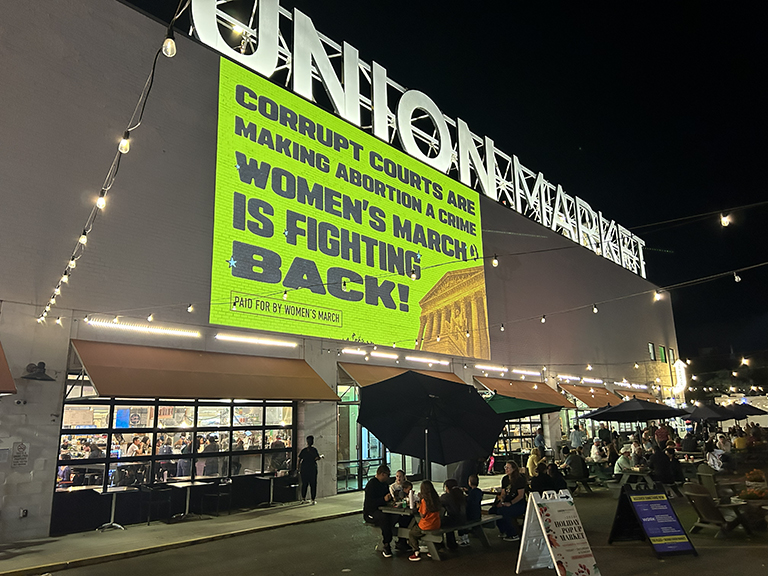
Projection advertising is the use of high-lumen commercial projectors to display brand content on buildings, walls, and other large surfaces in public urban environments. The format operates at night, when projected light achieves the contrast and visibility needed to create a compelling large-scale brand presence. It does not require a permanent structure, a media network, or a scheduled inventory slot. It requires a suitable surface, the right equipment, a clear projector position, and a plan for making the campaign count while it is running.
We have been running projection advertising campaigns for brands across the United States for years, and we have accumulated a specific kind of knowledge from those campaigns: not textbook knowledge about how projection is supposed to work in theory, but operational knowledge about how it actually works in New York’s SoHo, on the Sunset Strip in Los Angeles, in Chicago’s River North, and in the other markets where our clients want to be seen. That operational knowledge is what this guide draws on.
We will cover the format from the beginning: what projection advertising is and is not, what campaign objectives it serves effectively, how location strategy works, what content requires, what the campaign execution process looks like, and how projection advertising fits within a larger marketing plan. We will also be direct about where the format has limitations and when other approaches serve campaign goals better. Projection advertising is not the right answer for every campaign brief, and we would rather help brands choose the right format than sell them the wrong one.
Projection advertising is a guerrilla outdoor format. It operates outside of traditional media buying and inventory systems. There is no rate card from a media company, no contracted placement in a network, no standard audience measurement framework applied to it the way one is applied to a bought billboard or transit ad. It is a format that requires operational expertise, field resources, and direct execution rather than a media buy.
That operational character is both its strength and its challenge. The strength is geographic freedom: projection advertising can appear on buildings in neighborhoods, on surfaces, and in locations that no media network offers. The brand chooses where to appear based on strategic relevance to the campaign, not based on what inventory happens to be available in the market. That freedom to choose location is rare in outdoor advertising and is one of the primary reasons brands use the format.
The challenge is that this freedom comes with operational responsibility. A projection advertising campaign requires site scouting, equipment selection and setup, crew management, content preparation to specific technical standards, and real-time monitoring throughout the campaign window. Brands that treat projection advertising like a media buy and expect it to run itself after a booking confirmation will be disappointed. Brands that engage with it as an operational campaign requiring active planning and execution will get the most out of it.
Campaign Objectives Projection Advertising Serves
Projection advertising is specifically suited to campaign objectives that require physical scale, geographic specificity, event character, and social documentation potential. When a campaign needs all four of these qualities, projection advertising is frequently the strongest format available. When a campaign needs only one or two, other formats may serve better.
Product and Album Launch Announcements
Launch moments are the most common use case for projection advertising in our experience. The format creates a physical event around a launch that a digital announcement cannot replicate. When a music label projects an album cover on a building in the artist’s home city on release day, the projection is not the primary announcement channel. It is the physical amplification layer for an announcement that is happening across digital channels simultaneously. The projection makes the launch feel real in the physical world, and people who encounter it become organic ambassadors for the announcement, documenting and sharing what they see.
Cultural Territory Claims
Brands that want to establish or reinforce their presence within a specific cultural community use projection advertising to make a physical statement in the neighborhoods those communities inhabit. A streetwear brand projecting in the Fairfax District of Los Angeles is making a statement about its relationship to that cultural community, not just advertising in the vicinity. A tech brand projecting in SoHo is claiming cultural adjacency to the creative industries concentrated there. These are strategic positioning statements as much as they are advertising placements.
Event Amplification
Events, from concert nights to film premieres to brand activations, benefit from projection advertising as a visual extension layer. A brand projection on a building adjacent to the event venue or in the surrounding neighborhood creates a visual frame for the event that everyone in the vicinity encounters, not just those inside. The projection extends the event’s brand presence into the physical environment of the surrounding streets and gives bystanders an encounter with the brand without requiring them to engage with the event itself.
AGM Field Note: The most common planning mistake in projection advertising campaigns is treating the projection as the whole campaign rather than as the centerpiece of a coordinated campaign. A projection that runs in isolation with no supporting street presence, no brand social content going live during the projection window, and no documentation plan generates a fraction of the total impact of a projection that is part of a coordinated plan. The physical projection creates an event. Everything else in the plan determines how many people experience that event, directly or through documentation.
Format Comparison: Projection Advertising vs. Other Outdoor Formats
Format
Scale
Location Flexibility
Campaign Duration
Social Documentation Potential
Projection Advertising
Very High (building scale)
Very High (any suitable surface)
Hours per night
Very High
Painted Mural
High (wall scale)
High (negotiated walls)
Months
High
Billboard
High
Low (inventory dependent)
4 weeks typical
Low to Medium
LED Truck
Medium (vehicle screen)
Very High (mobile route)
Hours per day
Medium
Street-Level Poster
Low to Medium
High (negotiated surfaces)
Days to weeks
Medium
Location Strategy for Projection Advertising
Location is the variable with the biggest impact on projection advertising campaign performance after content quality. A great projection in the wrong location will generate limited organic reach because there is not enough foot traffic or social media activity in the vicinity to drive documentation. A strong projection in a strategically relevant, high-traffic neighborhood will generate organic reach that multiplies the campaign’s total audience significantly beyond the live street audience.
We evaluate projection locations on two dimensions simultaneously: technical suitability and strategic relevance. Technical suitability means the building surface is appropriate for projection, there is a projector position with adequate throw distance, and ambient light conditions at operating hours are favorable for the projected image to achieve strong contrast. Strategic relevance means the neighborhood aligns with the brand’s target audience and cultural positioning, and the specific location within the neighborhood places the projection where the most relevant street traffic will encounter it.
We conduct all site surveys at campaign operating hours rather than during the day. The ambient light environment at 10pm is completely different from the environment at 10am. Streetlights, storefront lighting, neon signs, and illuminated building windows all affect projection visibility in ways that daytime scouting cannot assess accurately. We have confirmed and disqualified locations based solely on what we observed during nighttime surveys that we could not have determined from daytime visits or remote research.
Technical Requirements
Our standard projection advertising setup uses a 20,000-lumen laser projector positioned across from the target building, connected to a media server via high-quality signal cabling, powered by a generator sized for the full equipment load. Two technicians manage setup, monitor the full campaign window, and handle breakdown. For larger surfaces, longer throw distances, or high ambient light locations, we scale to higher output projectors.
Content must be delivered at the confirmed aspect ratio of the target building surface in MP4 (H.264) for video content or high-resolution PNG for static imagery. Content that has not been designed and rendered at the confirmed surface aspect ratio will appear distorted when projected. We provide confirmed surface dimensions as soon as the site survey is complete and strongly recommend that content production not finalize until those dimensions are in hand.
High contrast between primary visual elements and the background is essential in any urban ambient light environment. Content designed for standard screen viewing frequently loses subtlety and tonal gradients when projected in competition with city lighting. We review content before campaign night and provide feedback on elements that we assess as high-risk for ambient light interference.
AGM Field Note: We have run projection advertising campaigns in cities across the US and the single most consistent performance differentiator is the quality of the content preparation, specifically whether the content was designed to spec for the actual building surface or designed generically and scaled to fit on-site. Content designed to spec consistently outperforms scaled content by a significant margin in terms of visual clarity, color accuracy, and compositional integrity at full building scale. The content spec brief from us costs nothing. Using it from the start of content production saves significant rework.
Documentation and Amplification
Projection advertising campaigns generate two kinds of value: the live street audience experience and the documented record of that experience. The live audience is real and important. But the documented record, professional photography, video, and organic social media content from bystanders, is what gives the campaign extended reach and long-term value as a brand asset.
We recommend professional photography for every projection advertising campaign. A professional photographer specializing in night photography produces campaign documentation that is usable in press materials, brand case studies, client presentations, and the brand’s own marketing channels for months or years after the projection night. The investment in professional photography is typically two to five percent of the total campaign cost and produces assets with ongoing return.
For organic social media amplification, the key is coordinating the brand’s own social media publishing with the projection window. When the brand posts from the projection site, or shares a call to action that references the live projection, followers who are engaged with the brand at that moment often seek out user-generated content from the location. The combination of branded content from the campaign’s official channels and organic content from people who happened to be there creates a social media presence around the event that a single official post alone cannot achieve.
Projection Advertising Pricing
Our guerrilla projection advertising campaigns in New York City are priced at $6,500 per projector per night. For campaigns outside New York City, the rate is $7,500 per projector per night. Each package includes a 20,000-lumen projector, generator, full electronics bundle, mobility unit, and two technicians covering setup, operation throughout the campaign window, and breakdown at the session close. Projections begin at dusk and typically run four to six hours.
Multi-projector campaigns scale at the per-projector rate for each unit. Multi-city campaigns are priced at the per-market rate for each projector in each city. Multi-night campaigns are available at the same per-night rate. We provide fully itemized proposals for every campaign, and we are happy to discuss campaign scope, configuration, and budgeting in an initial call before any commitment is made.
Measuring Projection Advertising Campaign Results
Projection advertising does not produce the click counts, conversion metrics, or audience targeting data that digital advertising platforms generate automatically. This does not mean projection campaigns cannot be measured; it means they are measured differently, with metrics that capture physical and cultural impact rather than digital interaction data.
The primary metrics for projection advertising campaign results are documentation volume, the number of organic social media posts featuring the projection; documentation reach, the estimated total audience of those posts; press coverage, the number of editorial mentions and the publications that covered the campaign; live audience count, an estimate of the people who encountered the projection during the campaign window; and post-campaign brand asset value, the utility of professional photography and video as marketing materials over the campaign’s post-run life.
Documentation volume is the most immediately visible metric. After the campaign runs, we search relevant social platforms for user-generated content from the projection location and compile documentation of the organic reach the campaign generated. For campaigns in high-social-activity neighborhoods with strong creative, this count can be substantial and provides a tangible measure of the campaign’s organic amplification beyond the live audience.
Press coverage is a meaningful metric for projection campaigns that are newsworthy: major brand launches, culturally significant artist campaigns, and brand presence campaigns in neighborhoods or contexts where the projection itself constitutes a story. We recommend coordinating press outreach to local culture, entertainment, and marketing trade publications for campaigns with genuine news value, because earned media coverage from a projection campaign extends the campaign’s audience to the readership of the outlet covering it.
Projection Advertising in the Broader Campaign Plan
Projection advertising works best as a high-impact centerpiece within a broader campaign plan that uses multiple formats to create sustained audience contact before, during, and after the projection nights. Street-level posters installed in the projection neighborhood in the weeks leading up to the projection build visual familiarity with the campaign creative. The projection itself creates the high-impact event moment. Post-projection social and editorial coverage extends the campaign’s reach into the days following the live event.
This multi-format approach is not a requirement for a projection advertising campaign to work. We run single-night projections that deliver strong results as standalone activations. But the clients who consistently see the highest total campaign impact from their projection spending are the ones who integrate projection into a coordinated plan rather than treating it as a one-off activation. The additional planning required for coordinated campaigns is outweighed by the additional impact they generate.
Planning a Projection Advertising Campaign: Step by Step
Planning a projection advertising campaign from initial brief to post-campaign asset delivery requires coordinating a series of dependent steps, each of which has specific requirements and outputs that feed into the next. Understanding the full sequence before beginning helps brands allocate time and resources correctly and avoids the planning compressions that produce quality problems on campaign night.
Step 1: Campaign Brief and Objective Alignment
The brief defines what the campaign needs to achieve, where it needs to land, and when. A strong brief answers the following questions: What is the campaign objective, specifically whether it is a launch announcement, a cultural presence claim, event amplification, or another defined goal? What market or markets are in scope? What is the target neighborhood or neighborhood type? What date range is available for the campaign? What is the content production status, and does content exist or need to be created? What is the overall budget envelope? We use the brief to confirm that projection advertising is the right format for the stated objective and to scope the campaign correctly before any site work begins.
Step 2: Site Survey
The site survey is the campaign’s foundation. Every subsequent decision, equipment selection, content specification, crew configuration, and logistics planning, flows from what the site survey reveals. We conduct site surveys at campaign operating hours, not during the day, because the conditions we need to assess, ambient light levels, foot traffic patterns, equipment positioning options, and building surface visibility at night, only exist in the actual operating environment of the campaign.
Step 3: Content Production
Content production begins after the site survey delivers confirmed surface dimensions, aspect ratio, and technical specifications to the content team. Content produced before the site survey is complete risks being at the wrong aspect ratio, the wrong contrast level, or the wrong technical specification for the actual campaign surface. We have seen campaigns require expensive last-minute content adjustments because production finalized before the site survey confirmed the actual surface dimensions. The additional week of lead time that waiting for the site survey requires is consistently worth it in the quality of the final campaign output.
Step 4: Pre-Campaign Review and Testing
Content review with our technical team before campaign night catches issues that are easier to fix in production than on-site. We flag content with insufficient contrast for the ambient light conditions, content at incorrect aspect ratio, content with fine detail that will not survive the projection rendering at scale, and content in incorrect file formats. Where a pre-campaign test projection at a comparable site is feasible, we recommend it for first-time projection advertisers and for campaigns with high-stakes creative that has not been tested in projection conditions before.
Frequently Asked Questions
What is projection advertising?
Projection advertising uses high-lumen commercial projectors to display brand content on buildings, walls, and other public surfaces at night. The format creates a large-scale temporary brand presence in a specific geographic location without requiring a permanent advertising structure or media network inventory slot. We position projectors across from target surfaces and run brand content for four to six hours per campaign night.
How does projection advertising work?
A high-lumen projector is positioned across from a target building or surface. Content plays from a media server connected to the projector. A generator provides power independence from the building grid. Two technicians manage the full setup, monitor the campaign window, and handle breakdown. The projection runs at night, typically four to six hours starting at dusk.
What are the main use cases for projection advertising?
Product and album launches, film and streaming premieres, fashion drops and brand activations, event amplification, and cultural market presence campaigns are the most common use cases. Any brand with a major moment to announce, a specific cultural territory to claim, or a launch that benefits from physical market presence is a strong candidate for projection advertising.
How much does projection advertising cost?
Guerrilla projection advertising in NYC runs $6,500 per projector per night. Outside NYC the rate is $7,500 per projector per night. Each package includes a 20,000-lumen projector, generator, electronics bundle, mobility unit, and two technicians for full campaign execution from setup through breakdown.
What content works best in projection advertising?
Bold, high-contrast graphics with minimal fine detail perform best in city ambient light conditions. High-saturation colors, strong silhouettes, and motion elements hold up in environments with competing streetlights and neon. Content must be spec’d to the confirmed aspect ratio of the target building surface and delivered in the correct file format before campaign night.
Can projection advertising target specific neighborhoods?
Yes. Projection advertising can be placed in any neighborhood with a suitable building surface and available throw distance for the projector. This geographic specificity is one of the format’s primary advantages over media-network-dependent outdoor advertising, which is limited to available inventory locations.
How does projection advertising generate social media reach beyond the live audience?
Bystanders photograph and share striking projection campaigns across Instagram, TikTok, and other platforms, creating organic documentation that multiplies the campaign’s total reach far beyond the live street audience. Coordinating brand channel posts with the projection window amplifies this effect by encouraging followers to seek out the content and engage with it.
Is projection advertising available in markets outside New York?
Yes. We run projection advertising campaigns in Los Angeles, Chicago, Miami, Atlanta, and other major US markets. The rate outside NYC is $7,500 per projector per night. We also coordinate simultaneous multi-city campaigns for brands that need national presence on a specific launch date.
How do I start a projection advertising campaign with AGM?
Email [email protected] or call (646) 776-2770 with your campaign brief, target market, and preferred campaign dates. We will provide location options, equipment specs, and a detailed itemized proposal within a few business days of our initial conversation.