Building Projection Advertising: What It Is and How It Works
Building projection advertising is one of the most visually commanding formats in urban brand marketing. We have run these campaigns for music labels, tech companies, fashion brands, and film studios. This guide covers everything from location strategy to content specs to campaign results.
Building projection advertising places a brand’s visual content directly onto the exterior surfaces of buildings using high-lumen commercial projectors. The brand does not buy a media slot on a pre-existing advertising structure. The brand turns the architecture itself into the advertising surface, choosing the building, the neighborhood, and the timing based on campaign strategy rather than media inventory availability. That distinction is the core of what makes building projection advertising different from every other outdoor format, and it is what makes it valuable for campaigns where the standard options do not serve the strategic goal.
We have planned and executed building projection advertising campaigns across New York, Los Angeles, Chicago, Miami, Atlanta, and other markets. The format works differently in different cities. The buildings are different. The ambient light environments are different. The neighborhoods that carry cultural weight for specific audience segments are different. The logistics of positioning equipment in a dense Manhattan block differ from positioning in a wider Los Angeles commercial corridor. We work with these differences rather than around them, and that field experience is part of what we bring to every campaign brief.
This guide is for brands and marketing teams that are evaluating building projection advertising as a campaign format. We cover what the format is, how it works technically and strategically, who uses it and why, what it costs, what content requires, and how to integrate it into a campaign that achieves real results rather than just a one-night visual stunt.
What Building Projection Advertising Is and How It Works
Building projection advertising uses projectors with lumen outputs ranging from 20,000 to 60,000 or higher to throw brand content onto building facades at distances from 50 to 250 feet or more. The projector is positioned across the street, in a vehicle, on a rooftop, or at another location with a clear sightline to the target building surface. Content plays from a media server connected to the projector. A generator provides power independence from the electrical grid, which is required for most street-level projector positions where building power access is not available.
The campaign runs at night when ambient light conditions allow the projected image to achieve maximum contrast and visibility. Projections typically begin at dusk and run for four to six hours, depending on the campaign plan and operational conditions at the site. Setup requires two to three hours before the campaign window opens, and the crew remains on-site throughout the projection window to monitor equipment, manage content playback, and handle any technical issues that arise.
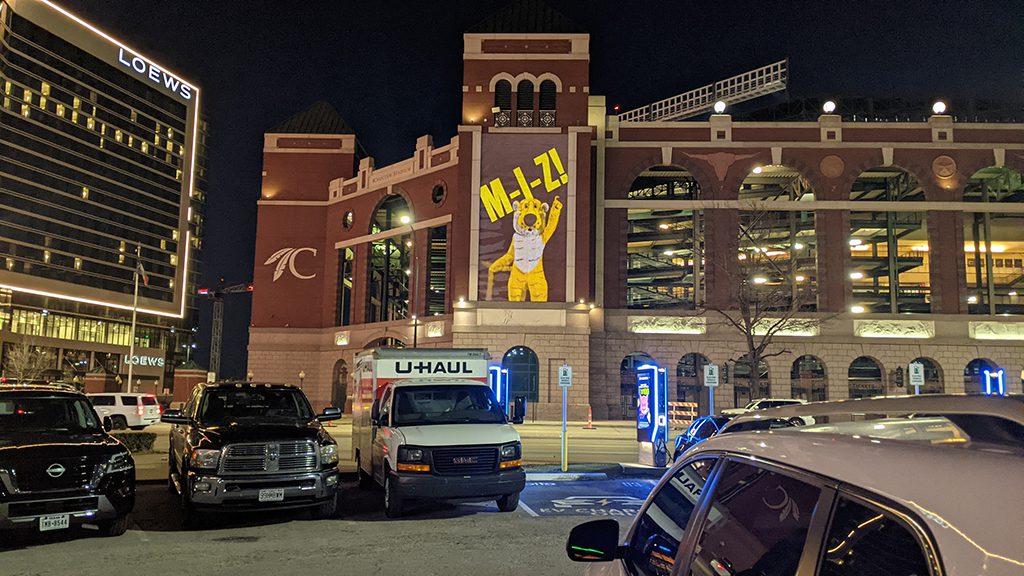
The output of a successful building projection advertising campaign is a large-scale brand visual on a real building in a real city neighborhood, surrounded by a live street audience that includes people who are there by intention, such as event attendees or diners, and people who simply happen to be in the neighborhood and encounter the projection as part of their evening. Both audiences matter. The intentional audience may be smaller, but the incidental audience is often larger and more varied, and the organic social media documentation from that broader audience is a significant part of the campaign’s total value.
Who Uses Building Projection Advertising and Why
Building projection advertising is used by brands with major moments to announce, cultural presence to establish or reinforce, or campaign creative strong enough to justify the physical canvas. The most consistent users we work with come from a handful of categories.
Music and Entertainment
Music labels, streaming platforms, and entertainment brands are the most active users of building projection advertising in our experience. Album releases, tour announcements, platform launches, and major content releases all benefit from the format because the cultural moment of a release is inherently tied to the physical world of the cities where the artist or platform has audience concentration. Projecting album art on a building in the artist’s hometown, or on a building in the neighborhood most associated with the genre, creates a physical presence for the release that no digital rollout can replicate.
Film and Streaming
Film studios and streaming services use building projection advertising for premiere week activations, season launch campaigns, and awareness campaigns for major titles. The format allows the studio to claim physical space in entertainment districts, near premiere venues, and in the neighborhoods where the target audience concentrates. A film projection on a building in Hollywood, or a streaming campaign projection in Brooklyn, puts the campaign in the physical environment of the audience in a way that digital advertising cannot.
Fashion and Streetwear
Fashion brands and streetwear labels use building projection advertising to signal cultural presence in specific neighborhoods and to create event-like moments around product drops and seasonal campaigns. The format works particularly well for brands whose target audience is concentrated in specific urban neighborhoods: SoHo, the Fairfax District, Wicker Park, Wynwood, and similar communities where the audience’s relationship to the built environment is part of their identity.
Technology
Tech companies use building projection advertising for product launches and market entry moments where the goal is to create a physical presence to complement a digital announcement. A tech product launch that coordinates a building projection in New York and Los Angeles on announcement day creates a physical brand moment that generates media coverage, social documentation, and a physical presence in the city’s visual field that the digital announcement alone cannot achieve.
AGM Field Note: The campaigns that consistently outperform are the ones where the client has a clear answer to why projection is the right format for this specific campaign moment, not just why projection is interesting. When the format serves a specific strategic objective, whether that is a launch moment, a cultural territory claim, or event amplification, the campaign has a reason to exist that the audience can sense. Campaigns that use projection because it sounds exciting without a strategic reason behind it tend to generate less documentation, less social reach, and less overall impact than campaigns with clear strategic intent.
Location Strategy for Building Projection Advertising
Location selection is one of the most consequential decisions in any building projection advertising campaign. The wrong building in the right neighborhood is workable. The right building in the wrong neighborhood wastes the campaign. The building must be technically suitable for projection, and the neighborhood must be strategically relevant to the brand and campaign. When both conditions are met, the campaign has the strongest possible foundation.
What Makes a Location Technically Suitable
Technical suitability depends on the building surface, the available throw distance for the projector, the ambient light environment at night, and the practicality of equipment positioning. Light-colored flat facades are ideal surfaces. Concrete, stucco, and painted brick are preferred materials. The projector position must have a clear sightline to the target surface at the distance needed to achieve the desired projection scale. Ambient light from streetlights, storefronts, and competing signage must be evaluated at campaign operating hours, not during daytime, because the light environment changes completely between day and evening.
What Makes a Location Strategically Relevant
Strategic relevance is about neighborhood identity and audience concentration. Every major American city has neighborhoods that carry specific cultural identities and attract specific audience communities. A building in one of those neighborhoods carries the identity of that neighborhood as context for the projection, independent of the content of the projection itself. That contextual meaning is part of what the brand is communicating when it chooses a location, and it should be chosen with the same intentionality as the content design.
Market
Key Neighborhoods for Projection
Primary Audience Context
New York City
SoHo, Lower East Side, Williamsburg, Meatpacking
Fashion, culture, nightlife, entertainment
Los Angeles
Fairfax, Silver Lake, Arts District, Sunset Strip
Streetwear, music, film, creative industries
Chicago
River North, Wicker Park, West Loop
Entertainment, food, creative, nightlife
Miami
Wynwood, South Beach, Design District
Art, luxury, nightlife, culture
Atlanta
Midtown, Old Fourth Ward, Ponce City
Music, culture, entertainment, tech
Content Requirements for Building Projection Advertising
Content for building projection advertising must be prepared to specifications that differ from content created for standard digital or print formats. The differences are significant enough that content produced for other formats without modification frequently underperforms in projection conditions, even when it looks strong in digital preview. We provide content specifications to clients after the site survey is complete, at which point the confirmed surface dimensions, aspect ratio, and surface characteristics are known.
The most important content specification is aspect ratio. Every building face has a specific proportion determined by the width of the surface and the height of the area to be projected. Content must be rendered at that specific aspect ratio or it will appear stretched, compressed, or letter-boxed in a way that was not part of the intended design. Standard screen aspect ratios almost never match building surface proportions exactly, which is why we insist on confirming surface dimensions before content production finalizes.
High contrast between primary visual elements and the background is critical in city ambient light conditions. Projections compete visually with streetlights, lit windows, neon, and other environmental light sources. Content that relies on subtle tonal contrast or detailed photographic texture loses that subtlety to ambient light interference and reads as flat or washed out. Bold graphics, high-saturation colors, and strong silhouettes hold up far better than photography or complex tonal compositions.
Motion significantly improves the projection’s ability to attract attention from a distance. A slow animation, a looping visual element, or a subtle motion effect on a primarily static graphic catches peripheral vision at greater ranges than a fully static projection and encourages viewers to stop and document what they are seeing. We recommend motion content for all projection campaigns where animation is within the content production budget.
AGM Field Note: Content review for building projection should ideally happen in projection conditions before the campaign date. We can arrange pre-campaign testing at a comparable site for campaigns where the creative is being produced specifically for the projection format and where confirming content performance in field conditions is worth the additional logistics. For campaigns where pre-testing is not feasible, we flag content that we assess as high-risk for ambient light interference and recommend adjustments before the campaign date. Catching content issues before campaign night is always easier than adjusting them on-site.
Campaign Planning Timeline
Building projection advertising campaigns require more lead time than most clients expect when they first approach the format. The site survey, equipment configuration confirmation, content specification delivery, content production, pre-campaign testing, and crew coordination all happen in sequence, and each step has dependencies on the previous one. Campaigns that try to compress this timeline take on significant quality risk.
Initial brief and campaign objective alignment: at least 4 to 6 weeks before campaign date
Site survey and location confirmation: 3 to 4 weeks before campaign date
Content specification delivery to client creative team: 3 weeks before campaign date
Content production completion and delivery to AGM: at least 1 week before campaign date
Pre-campaign content review and testing: 3 to 5 days before campaign date
Crew and equipment confirmation: 1 week before campaign date
Weather check and contingency date confirmation: 48 to 72 hours before campaign date
Campaign execution and documentation
Post-campaign asset delivery to client
This timeline is not bureaucratic padding. Each step in the sequence exists because something critical happens at that step that cannot happen earlier or later without affecting the quality of the subsequent steps. Clients who engage us with six or more weeks of lead time consistently run better campaigns than those who engage with two weeks. The additional lead time allows for more thorough location scouting, more content review iterations, and less rushed logistics on campaign night.
Pricing for Building Projection Advertising
Our building projection advertising campaigns in New York City are priced at $6,500 per projector per night. For campaigns in markets outside of New York City, the rate is $7,500 per projector per night. Each campaign package includes a 20,000-lumen projector, generator, full electronics bundle, mobility unit, and two technicians covering setup, operation throughout the campaign window, and breakdown at the close of the session. Projections start at dusk and typically run four to six hours per night.
Multi-projector campaigns scale at the per-projector rate. A campaign using three projectors in New York City would be priced at $19,500 per night for the New York operation. Multi-night campaigns are available at the same per-night rate. Multi-city campaigns are priced per projector per market per night, with New York at $6,500 per projector and all other markets at $7,500 per projector.
We provide fully itemized proposals for every campaign before any commitment is made. The proposal includes confirmed location options, equipment configuration with justification, crew plan, content specifications, and a campaign timeline. We do not require a commitment until the client has reviewed the complete proposal and is satisfied with the plan.
Building Projection Advertising Within the Campaign Mix
Building projection advertising is most effective as part of a coordinated campaign strategy that uses multiple formats to create overlapping and reinforcing touchpoints with the target audience. A building projection that runs in isolation delivers its impact to the live street audience and whatever organic social documentation that audience generates. A building projection that is the centerpiece of a coordinated campaign delivers its impact to the live audience, the social documentation audience, the press coverage audience, and the audience that encounters the campaign through the brand’s own channels, all simultaneously.
Supporting formats that work particularly well alongside building projection include street-level poster runs in the same neighborhood installed in the weeks before the projection, LED truck routes that extend the campaign’s visual presence to additional neighborhoods on the same night, and street teams deployed in the projection neighborhood on campaign night to engage the live audience and amplify the social documentation opportunity. Each supporting format is optional and adds to the campaign’s total impact when the campaign budget supports it.
Post-Campaign Value: Documentation as a Long-Term Asset
One of the most consistently underestimated aspects of building projection advertising campaigns is the long-term value of the campaign documentation. The projection itself runs for hours on one or more nights. The documentation of that projection, professional photography, video, and organic social media content from bystanders, continues to generate value for months or years after the campaign ends.
Professional campaign photographs from a building projection are used in media pitches to entertainment, culture, and marketing trade publications. They appear in brand case studies presented to industry partners and future clients. They are featured in brand marketing materials, annual reports, and investor presentations as evidence of the brand’s physical market presence and cultural investment. They are displayed on websites, in portfolio materials, and in pitch decks that shape how the brand is perceived by audiences who were never present at the projection itself.
The aggregate value of this post-campaign documentation use frequently exceeds the direct value of the live projection event, particularly for brands that invest in professional photography and use the resulting assets aggressively in their marketing communications. This is why we frame documentation as a campaign component rather than an afterthought, and why we budget for professional photography from the beginning of the campaign plan rather than treating it as an optional line item that gets cut when budgets are tight.
Video Documentation
Video documentation of building projection campaigns has become increasingly valuable as short-form video platforms have grown in scale and cultural relevance. A 30 to 60-second video of a building projection, showing the projection from multiple angles with ambient city sound and ideally including people’s reactions, performs well as organic social content on multiple platforms. For brands with significant social media followings, a well-produced projection video can generate reach on par with or exceeding the paid distribution of standard advertising content. We recommend engaging a videographer alongside a photographer for any projection campaign where short-form video content is part of the brand’s social media strategy.
Frequently Asked Questions
What is building projection advertising?
Building projection advertising uses high-lumen projectors to display brand content on the exterior surfaces of buildings at night. The projection turns architecture into a temporary advertising canvas at a scale no standard printed or digital format can match from a street-level position. We position projectors across from target buildings and run brand content for four to six hours per night.
How does building projection advertising differ from traditional outdoor advertising?
Traditional outdoor advertising occupies predetermined inventory in fixed media company locations. Building projection advertising can appear on any suitable building surface in any neighborhood, is temporary and event-like in character, and generates organic social media documentation that traditional outdoor formats do not produce at the same rate. The brand chooses its own location rather than selecting from available inventory.
What industries use building projection advertising most?
Music and entertainment, film and streaming, fashion and streetwear, technology, consumer goods, and sports brands are the most frequent users. Any brand with a major launch, cultural moment, or market presence goal in a key city is a strong candidate. The format is particularly effective for brands with strong visual identities and campaign creative that can hold up at building scale.
How much does building projection advertising cost?
In New York City, building projection advertising runs $6,500 per projector per night. Outside NYC the rate is $7,500 per projector per night. Each includes a 20,000-lumen projector, generator, electronics bundle, mobility unit, and two technicians for full campaign operation from setup through breakdown.
How long does a building projection advertising campaign run each night?
Projections start at dusk and typically run four to six hours. Multi-night campaigns are available at the same per-night rate. Setup takes two to three hours before the projection window opens and breakdown follows at the close of each session.
What content specifications are needed for building projection advertising?
Content should be delivered as MP4 (H.264) for video or high-resolution PNG for static imagery, spec’d to the confirmed surface dimensions of the target building wall. High-contrast graphics and bold typography perform best. We provide exact content specifications after the site survey confirms the surface dimensions and aspect ratio.
Can building projection advertising run in multiple cities simultaneously?
Yes. We coordinate multi-city campaigns with field teams in each market. Simultaneous projections across New York, Los Angeles, Chicago, and other cities create a national brand moment that single-market campaigns cannot achieve. The social documentation from multiple cities generates a combined reach that amplifies the entire campaign.
How does building projection advertising generate social media reach?
Bystanders who encounter a large-scale building projection photograph and share it as a noteworthy visual experience. When the creative is compelling and the location is in a socially active neighborhood, user-generated content on Instagram, TikTok, and other platforms multiplies the campaign’s total reach far beyond the live street audience. Coordinating the brand’s own social content publishing with the projection window amplifies this effect.
Does AGM handle all logistics for building projection advertising?
Yes. We handle site scouting, equipment selection and setup, crew, power, operation throughout the campaign window, and breakdown at the close of each session. Clients are responsible for delivering campaign-ready content to our specifications. We handle everything on the ground so the brand can focus on the creative and the coordination with their own marketing channels.
How do I start a building projection advertising campaign with AGM?
Call (646) 776-2770 or email [email protected] with your campaign brief, target market, preferred dates, and campaign objective. We will provide location options, equipment configuration, and a detailed itemized proposal within a few business days of our initial conversation.