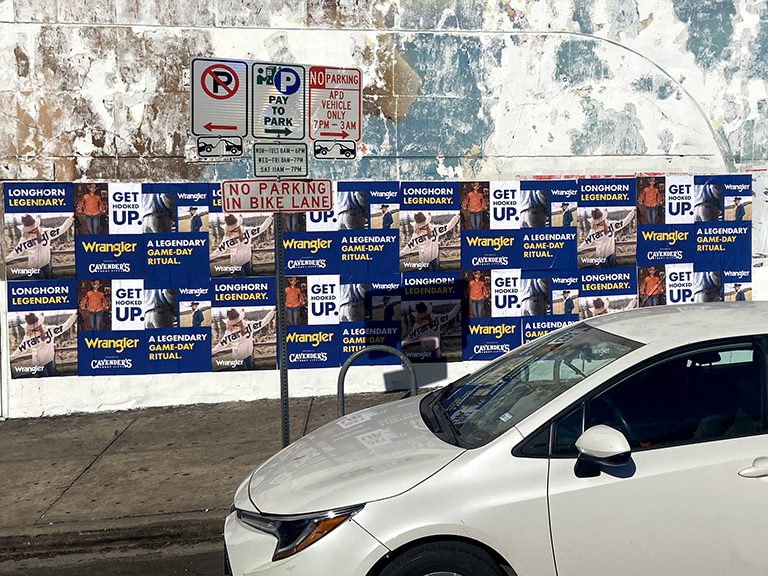
Fly posting is printed paper on outdoor walls, pasted into the physical environment of a city — one of the oldest and most direct forms of advertising that still earns genuine attention in 2026.
If you have walked through a city and seen a poster pasted directly to the surface of a wall, not framed, not behind glass, just paper bonded to concrete or brick or plywood with the physical presence of something that belongs to the street, that is fly posting. The practice is old. It is also very much alive.
Fly posting is the practice of affixing printed paper posters to outdoor surfaces using paste. The term is British in origin but the format is global. In the United States, the same practice goes by several names: postering, wheatpasting, bill posting, snipe campaigns. In the UK and parts of Europe, fly posting is the standard term. Different names. Identical format.
We have been running fly posting campaigns for over ten years, across New York, Los Angeles, Chicago, Miami, Austin, and other major markets. Clients include major record labels, independent artists, fashion brands, film studios, streaming platforms, consumer brands, and advocacy organizations. What follows is a complete answer to the question: what is fly posting, how does it work, and what does a professional campaign actually look like from brief to installed poster on wall.
Fly posting means placing printed paper posters on outdoor urban surfaces using a water-based adhesive paste. The surfaces include walls, construction barriers and hoardings, fences, plywood boards around building sites, and similar flat exterior structures in cities. The paste creates a bond between paper and surface that dries into a semi-permanent installation resistant to light weather exposure.
The format is distinguished from other outdoor advertising by its physical level in the environment. A fly posted poster is at eye level in the pedestrian environment, not elevated above traffic like a billboard, not mounted behind glass like transit advertising, not displayed on a screen like digital out-of-home. It is pasted to the same surfaces that define the visual texture of the street, occupying the same physical space as the people walking past it.
That physical integration is the source of the format’s impact. When the creative is strong and the location is right, a fly posted poster belongs on the wall. It reads as part of the street’s visual culture rather than as an external imposition on it. That is a different audience relationship than elevated or screen-based advertising produces, and it is the relationship that gives fly posting its enduring value as an advertising format.
A Direct Answer: What Fly Posting Is and Is Not
Fly posting is often confused with other outdoor advertising formats. These distinctions matter when you are evaluating options for a campaign.
Fly posting is not a billboard. A billboard is mounted above traffic in a permitted structure, illuminated, and managed by an outdoor media company on a monthly contract. Fly posting is at street level, pasted directly to surfaces, runs for weeks rather than months, and is placed through an agency with relationships on approved wall surfaces.
Fly posting is not a transit advertisement. Transit advertising is mounted in glass or frame systems on buses, trains, and platforms, and managed through transit authority contracts. Fly posting operates in the open pedestrian environment, not in transit infrastructure.
Fly posting is not a sticker or decal campaign. Decals use pressure-sensitive adhesive and are applied to smooth surfaces like glass and painted metal. Fly posting uses water-based paste applied to porous surfaces. The aesthetics, removal process, surface requirements, and durability profile are all different.
Fly posting is not street art in the traditional sense, even though some street artists use the same paste-and-paper technique. Street art is created as artistic expression by artists, typically without commercial intent. Fly posting is an advertising format with promotional or commercial intent. The materials may overlap. The purpose does not.
The Paste: What Bonds the Poster to the Wall
The adhesive is one of the defining material characteristics of fly posting. Understanding the options matters for campaign planning, particularly for campaigns with specific surface types or extended duration requirements.
Wheatpaste
Wheatpaste is the traditional adhesive for fly posting. It is made by cooking flour and water together into a thick, gel-like consistency. The name is sometimes written as wheat paste or wheat-paste, but the material is identical across all spellings. Wheatpaste creates strong adhesion on porous surfaces like concrete, brick, untreated wood, and plywood. It is water-soluble before drying, which makes it easy to apply and smooth out during installation, and it dries into a bond that resists light weather exposure including wind and light rain. Extended rain exposure re-wets the dried paste and can weaken the bond, which is why installation timing relative to weather forecasts matters.
Wheatpaste is favored for its strong initial tack, its low cost, and its cultural associations. The term “wheatpasting” has become the primary American English term for fly posting precisely because wheatpaste is the format’s defining material.
Methyl Cellulose
Methyl cellulose is a synthetic paste that professional fly posting crews use either as an alternative to or in combination with wheatpaste. It mixes to a consistent viscosity, has a longer working time before setting, and provides better adhesion on non-porous surfaces like painted concrete, metal, and sealed masonry where wheatpaste adhesion is unreliable. For campaigns on varied surface types, methyl cellulose is the more predictable choice.
Hybrid Formulations
Professional crews often use hybrid formulations that combine wheat starch with methyl cellulose. The wheat starch component provides strong initial tack for rapid installation, which matters when a crew is moving through a long corridor on a compressed overnight schedule. The methyl cellulose component adds durability and extends the campaign’s holding period. Paste formulation is adjusted for each campaign based on surface type, weather conditions, and campaign duration targets.
The Paper: What Carries the Printed Image
Paper selection affects print quality, installation ease, and campaign durability. The decisions made at the production stage directly determine how good a campaign looks on the wall and how long it holds.
Weight
The standard weight range for fly posting paper is 60 to 80 lb text weight in US measurements, or 90 to 120 gsm in metric terms used in UK and European production contexts. This range provides adequate durability for most campaign windows, bonds well with paste during application, and holds color saturation adequately at full print scale. Lighter paper below 50 lb is more prone to tearing during wet paste application and degrades faster under weather exposure. Heavier paper above 90 lb in US weight provides more durability at the cost of requiring more care during application to prevent air pockets from forming between the paper and the surface.
Coating
Coating selection affects both print fidelity and weather resistance. Matte and semi-matte coatings are preferred for most fly posting applications. They read clearly under variable outdoor lighting conditions, absorb paste more evenly for better adhesion, and do not produce the light reflections that glossy coatings create in direct sunlight. Glossy coatings reduce legibility from oblique angles and in conditions where the light source is behind the viewer. For campaigns in markets with significant rainfall or requiring extended campaign windows, a UV-resistant matte coating significantly extends visual quality across the campaign period.
Who Uses Fly Posting and Why
The client profile for fly posting spans a wider range today than at any previous point in the format’s history. Here is how each major category uses the format and why it works for them.
Music Artists and Labels
Music is the category that has used fly posting most continuously and at the highest volume throughout the format’s modern history. From independent artists self-releasing their first EP to major labels marketing stadium tour campaigns, fly posting is the street advertising format for music. The reason is cultural as much as practical. A poster on the walls of the right neighborhood signals that an artist is present in the culture, not just distributed through it. That signal is genuinely valuable in a music environment where cultural authenticity matters to how audiences receive and champion new artists.
For event-driven music campaigns, fly posting’s timeline aligns naturally with the event calendar. A campaign installed three to four weeks before a show date reaches its peak awareness window during the critical consideration period when fans are deciding whether to buy tickets. The campaign stays present on the walls through the show date and into the days following, creating a continuous visibility arc across the full promotional window.
Fashion Brands
Fashion brands use fly posting to create neighborhood-level presence and cultural association. The decision to place a campaign on Fairfax Avenue in Los Angeles or on Orchard Street in New York is a positioning decision before it is an advertising decision. It communicates where the brand locates itself in the cultural environment and who it sees as its audience. That communication happens through location selection, not through the copy on the poster.
Fashion brands at the intersection of streetwear, luxury, and cultural positioning use fly posting as a primary brand-building channel rather than a secondary supplement to digital. The campaigns they run generate documentation photography that travels through media and social channels well beyond the immediate neighborhood, creating digital reach that extends the physical street presence without additional media spend.
Film and Television
Entertainment clients use fly posting for launches targeting urban audiences and for campaigns where the teaser format, minimal information, strong image, creates the kind of public curiosity that generates press coverage and social conversation before a full campaign breaks. A striking teaser poster with no explanation in a high-traffic urban corridor creates discovery moments in the street that digital advertising cannot replicate. The audience encounters it without having chosen to. That involuntary discovery is increasingly rare in the digital advertising environment and correspondingly more valuable when it happens.
Consumer Brands
Consumer brands in food, beverage, wellness, tech, beauty, and retail have meaningfully expanded their use of fly posting over the past decade. The format delivers physical presence in the neighborhoods where urban consumers live and move. For brands whose identity is built around urban life, health and wellness, or creative community, that physical presence is part of the brand promise, not just an advertising vehicle. Being visible on the walls of the communities you claim to be part of is more credible than claiming it in a digital ad.
Political Campaigns and Advocacy
Political campaigns and advocacy organizations use fly posting for its grassroots cultural associations and its ability to reach audiences in the physical spaces where they live. For voter mobilization campaigns, placement near transit corridors, polling locations, and community gathering points in high-priority precincts creates physical presence in the exact spaces where voter contact matters most. For issue advocacy, the format communicates community engagement more effectively than any broadcast channel.
How a Professional Fly Posting Campaign Works
A fly posting campaign moves through a consistent sequence of stages from initial brief to installed posters to post-campaign documentation. Here is how each stage works in practice.
The Brief
Campaign planning begins with a brief that establishes the target audience, the campaign objective, and the target geography. These three inputs determine everything else: what neighborhoods to be in, what format scale makes sense for those neighborhoods, what the creative needs to communicate to that audience, and what timeline is required to get from creative approval to posters on walls. A brief that is not specific about audience and geography produces a campaign plan that has to make guesses the brief should have answered.
Location Scouting
Location scouting translates the brief’s geographic intent into specific walls and surfaces. In markets where we work regularly, scouting draws on our existing location knowledge combined with current-conditions verification for each specific site. In markets we are entering for the first time, we conduct full in-person scouting before any production begins. The scouting product is a placement plan: a documented list of specific surfaces, organized by neighborhood, with photographs of each surface in current condition. This plan is reviewed and confirmed before print production begins.
Creative Review
We review all creative before production. Fly posting has specific creative requirements that differ from other advertising formats. Text must be legible at walking pace from 10 to 20 feet away. Color contrast must hold under variable outdoor lighting including bright sun, overcast, and artificial streetlight. Image and type scale must translate from file dimensions to actual print dimensions without detail loss or legibility problems. Our review catches issues that are difficult to see in digital preview but immediately obvious at print scale. Finding them before press is a production cycle that costs a day. Finding them after a print run costs the full production budget and two weeks of timeline.
Print Production
Print production runs 7 to 14 days from file approval to printed and shipped campaign materials. We work with print partners who understand outdoor-specific production requirements: paper selection, coating specification, large-format color management, and delivery logistics for campaigns running in multiple markets. Physical proofs at actual print dimensions are reviewed before any large-quantity run goes to press.
Installation
Installation happens overnight between midnight and 5 AM. Crews apply paste to the surface, place the poster, smooth out air pockets from center to edges, and apply a top coat of paste to seal the paper and prevent edge lifting. Every placement is photographed immediately after completion while paste is still wet. GPS coordinates are captured at each placement for the post-campaign report. For campaigns in multiple neighborhoods or cities, installation is staged across multiple nights or coordinated across markets to fall within the same 48-hour window.
Documentation and Reporting
After installation, you receive a campaign documentation report that includes geo-tagged photos of every placement taken immediately after installation, placement addresses organized by neighborhood and market, and a campaign summary. This documentation gives you a complete record of where your campaign ran and what it looked like at the time of installation in every location.
Campaign Stage
What Happens
Typical Duration
Brief and Strategy
Audience, objectives, target markets confirmed
1–3 days
Creative Review
Street-scale legibility, contrast, type size review
1–3 days
Location Scouting
Surface selection, placement plan delivery
2–5 days
Print Production
Physical proof, full run, market delivery
7–14 days
Installation
Overnight crew, paste, immediate photography
1–3 nights
Documentation
Geo-tagged photo report, campaign summary
2–5 days post-install
What Makes Fly Posting Still Effective
The question of why fly posting still works in an era of digital advertising is one we hear from clients who have not used the format before and are trying to understand its value relative to digital channels they are already running. The answer has two components.
The first component is the physical environment. Digital advertising reaches audiences on screens. Fly posting reaches them in the physical environment where they live and move. Those are not the same experience. Walking past a poster on your way to work every day for two weeks creates a different kind of brand impression than seeing a digital ad in a media environment where every other element is also competing for your attention. The physical impression is quieter. It accumulates over time. It does not trigger the reflexive skip or scroll response that digital ads routinely encounter.
The second component is cultural credibility. Fly posting carries associations built over decades of use by artists, musicians, and organizations that were genuinely embedded in urban culture. Those associations are not manufactured by any single brand using the format. They are ambient. They accrue to any brand that uses the format thoughtfully in the right contexts. A brand with genuine urban cultural relevance that runs a well-designed fly posting campaign in the right neighborhoods is seen as part of the culture. A brand without that relevance running the same campaign in the same neighborhoods is seen as borrowing something it has not earned. The format amplifies authentic cultural positioning. It does not create it.
AGM Field Note: The most consistent question we get from brands new to fly posting is whether it is measurable. The answer is yes, through geo-tagged placement documentation, campaign reach estimates based on foot traffic data for specific corridors, and direct observation of organic documentation by the people who encounter the campaign. The metrics are different from digital campaign metrics. They are also, for this format, appropriate measures of how the campaign actually works. Fly posting creates physical presence. The measure of that is physical presence, documented and confirmed.
Fly Posting Campaign Pricing
Fly posting campaigns scale across a wide range of size and investment. Here are the approved pricing bands for AGM’s installation-only service.
Focused single-market campaigns are priced by poster package, format, and market. This scale suits artist launches, event promotion, neighborhood-level brand building, or precise corridor saturation. At this scale, every placement matters. Precision location selection in exactly the right spots for the target audience generates more value than spreading the same quantity across the full city.
Mid-scale campaigns covering multiple neighborhoods suit music releases, consumer brand launches, film promotions, and advocacy campaigns building awareness across a full urban market. Contact AGM for package pricing based on your market and objectives.
Large campaigns of 200 to 500 placements, whether in a single city or across multiple markets, are project-specific. Pricing depends on placement count, format sizes, markets, production specifications, and coordination requirements. Contact us directly at (646) 776-2770 to discuss your campaign scope. Multi-city campaigns require four to six weeks of lead time for planning, print production, and crew coordination across markets.
Where AGM Runs Fly Posting Campaigns
Our primary markets are New York City, Los Angeles, Chicago, Miami, and Austin. We also run campaigns in Nashville, Atlanta, Seattle, Denver, Boston, Philadelphia, and other major US cities, as well as coordinating international placements for US-based clients with global campaign requirements.
Within each city, we work in the specific corridors where a campaign’s target audience concentrates. In New York, that means Williamsburg, the Lower East Side, Bushwick, Crown Heights, Bed-Stuy, and other neighborhood-specific corridors depending on the campaign’s audience profile. In Los Angeles, it means Fairfax, the Arts District, Melrose, Silverlake, Echo Park, and Abbott Kinney. In Chicago, it means Wicker Park, Bucktown, Pilsen, and other neighborhood-specific corridors. The geography changes by market and by campaign. The approach, which is to start from the audience and work to the location rather than the reverse, stays consistent.
Frequently Asked Questions
What is fly posting?
Fly posting is the practice of affixing printed paper posters to outdoor urban surfaces using paste. The adhesive is typically wheatpaste or methyl cellulose. The format is used by music artists, brands, film studios, and organizations for street-level advertising in cities around the world.
Is fly posting the same as wheatpasting?
Yes, essentially. Fly posting is the British English term for the practice. Wheatpasting is the term commonly used in US artist and music communities, referring to the traditional flour-and-water adhesive. Both terms describe the same format: printed paper poster applied to an outdoor surface with paste.
What is fly posting used for?
Fly posting is used for music promotion, album and tour advertising, film and TV launches, fashion brand campaigns, consumer product launches, political and advocacy campaigns, event promotion, and nonprofit awareness campaigns. The format spans major industry campaigns and independent artist launches.
How much does fly posting cost?
Campaigns are priced by poster package and market. Contact AGM at (646) 776-2770 for a custom quote. Multi-city campaigns require four to six weeks lead time.
What paste is used in fly posting?
The traditional adhesive is wheatpaste, made from flour and water cooked to a thick gel. Professional campaigns also use methyl cellulose paste, which provides more consistent adhesion on non-porous surfaces, and hybrid formulations that combine both for improved tack and durability.
What poster sizes are standard for fly posting?
The standard format for most campaigns is 24×36 inches. Large format 48×72 is used for higher-visibility presence on wide walls and construction barriers. Snipe posters at 11×17 inches are used for dense saturation in high-competition areas.
Where are fly posting campaigns installed?
Campaigns are installed on walls, construction barriers, fences, and similar outdoor surfaces in urban environments. In New York, primary corridors include Williamsburg, the Lower East Side, and Bushwick. In LA, Fairfax, the Arts District, and Melrose. In Chicago, Wicker Park and Pilsen. Location selection is driven by target audience geography.
How long does fly posting hold?
A professionally installed fly posting campaign typically holds for two to four weeks in most urban environments. Less competitive walls can hold placements for six weeks or more. Active posting zones with frequent new installations cycle faster. Weather is the primary durability variable outside of human activity.
Do I get photos after my fly posting campaign?
Yes. Every AGM campaign delivers geo-tagged placement photos taken immediately after installation, plus a campaign summary report covering all placements by location. You receive a complete record of where the campaign ran and what each placement looked like.
Can fly posting campaigns run across multiple cities at the same time?
Yes. AGM coordinates simultaneous multi-market campaigns across New York, Los Angeles, Chicago, Miami, Austin, and other major US cities. We stage installation windows to fall within the same 48-hour period across all markets. Multi-city campaigns require four to six weeks lead time.