
November 19, 2026
Wheatpasting & Poster Campaigns in Oklahoma City
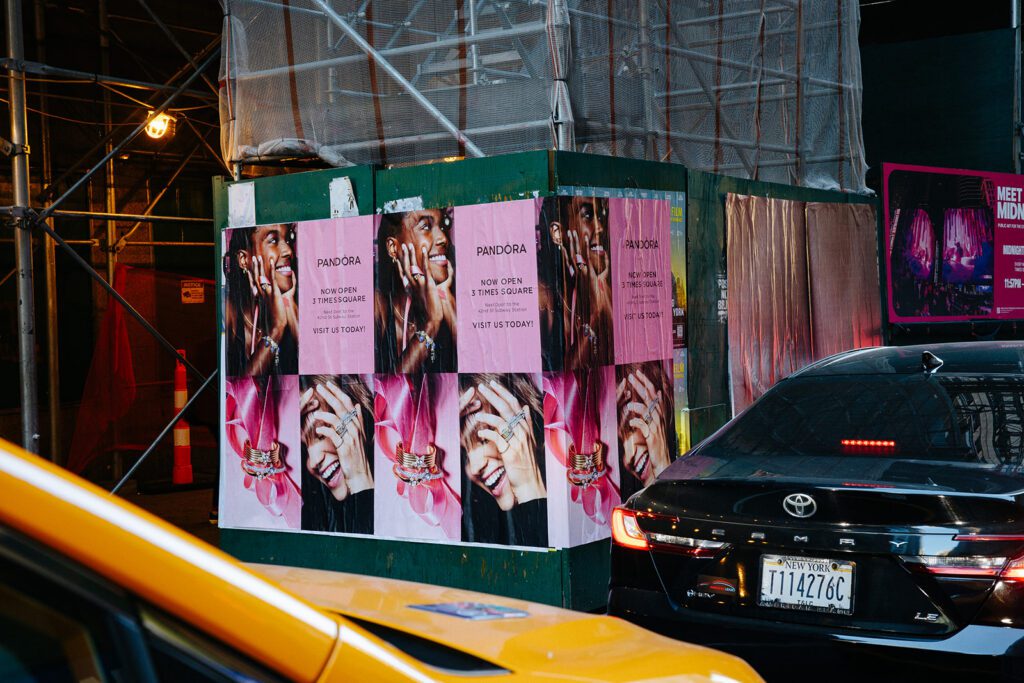
Most poster briefs that reach me for Oklahoma City were written for a different city. They assume one continuous downtown stretch, a crew working a single neighbourhood on foot for three nights, and a month-long hold on paper.
Two of those assumptions break here on the first night. The third one breaks every spring.
Oklahoma City is not a city with a core and some outskirts. It is a set of small, separately branded districts with real distance between them, and the wind that runs across all of them is the single most important material fact in the market.
I have had crews in markets where rain is the thing you check. Here you check wind speed first and rain second. A poster that is ninety-five percent adhered is a failed poster in Oklahoma City, because the five percent is a handle the wind grabs and pulls on continuously for days.
That one sentence changes the paste, the stock, the crew size, the sequence of the night and the honest answer about how long a run holds.
This page is about how we actually build Poster Campaigns in this market, what we specify differently, and what we tell clients not to do here.
Wind is the design brief, not the weather report
Oklahoma City sits in a humid subtropical climate with consistent wind, usually out of the south or south-southeast through the warm months. The important word is consistent. This is not a city with occasional windy days. It is a city with a near-permanent load on anything that has an unsecured edge.
Here is what that does to paper in practice.
A poster applied with good centre coverage and a soft edge will start lifting at a corner within the first cure period. Once a corner is up, the wind does not nibble at it. It works it like a lever. By the second or third day the lift has travelled along one full edge, and from there the sheet tears along its own grain and goes.
So the method changes. On Oklahoma City walls we work for full-contact adhesion across the entire sheet, not just a tacked centre with a wet border. Edges get sealed deliberately and then re-passed. We overcoat the perimeter rather than trusting a single pass to hold it. On multi-sheet builds, the seams get the same treatment as the outer edge, because an interior seam that opens is just another corner for the wind to find.
Stock matters more here than in sheltered markets. Lighter paper takes paste beautifully and tears in wind. Heavier stock resists tearing and holds a crease, which on a rough brick elevation means it can bridge a mortar line and leave a void underneath. A void on a windy wall is a small drum that beats itself loose. The answer on textured Oklahoma City brick is a stock with enough body to resist tearing and enough give to settle into the mortar line, applied slowly, worked in properly, and then revisited on the same night after the first grab.
That last point is the part crews from calmer cities skip. In this city we build a second pass into the night. Not a second night, a second pass. The crew finishes a district, then walks it again before leaving and re-seals anything that has started to move while they were working the next block. That single habit does more for hold time here than any change of paste formula.
Large unsupported vinyl is a separate problem. Any sizeable solid panel in sustained Oklahoma wind becomes a sail, and a sail eventually takes its fixings or its substrate with it. If a campaign wants large format in this city, we specify mesh or vented material and we say so early, because that is a print decision and not an install decision.
Hail season is a real planning constraint, not a disclaimer
Oklahoma's spring severe weather season is the other thing that separates this market. From roughly March into June the state sees squall lines, organised convective systems and rotating supercells capable of very large hail and damaging wind. Autumn brings a second, generally less intense severe season.
Rain does not worry me much once paste has cured. Hail does. A single severe storm can pit and perforate an entire run across a district in twenty minutes, and it does not do it evenly. You get a wall that is intact at one end of a block and shredded at the other, which looks worse than total loss because it reads as neglect rather than weather.
So we plan spring campaigns differently here. Three things change.
First, we assume replacement stock as part of the print run rather than as an emergency reprint. If a campaign is running in April, extra sheets are already printed, already in the city and already cut, so that a refresh is a crew call rather than a production cycle.
Second, we build alternate install dates into the schedule from March to June by default. A supercell day is not a work-through-the-rain day. It is a hard stop for crew safety and for quality, and pretending otherwise produces bad work and unhappy people.
Third, we talk honestly about which districts to weight. Elevations with some shelter, recessed frontages and walls that do not face directly into the prevailing weather survive spring noticeably better than fully exposed south and west faces.
Summer storms are frequent here too, but they are generally shorter and less severe than spring's. The summer problem is different. High humidity, often in the seventy to eighty percent range, slows paste cure while direct sun bakes the surface the paste is trying to grab. That combination is why summer work in this city happens early morning or overnight and not in the afternoon. An afternoon application in July has the worst of both conditions at once.
Winter is ice more than deep snow. The failure mode is freeze-thaw cycling on wetted brick, which lifts edges from underneath over a few cycles. A January run on a wall that takes meltwater runoff will not hold like the same wall in October.
UV load is the slow one. Long, open, sunny Southern Plains summers fade untreated stock fast, and south and west elevations fade first and worst. UV-stable inks and a laminate on anything that needs to look right in week four are worth specifying here, and we will push for them rather than explain a washed-out run later.
Eight districts, not one core, and that decides everything
The planning decision that matters most in Oklahoma City is which districts you are in. Not how many sites. Which districts.
Bricktown is the old warehouse district immediately east of downtown, built around the canal, with brick industrial stock and the highest visitor footfall in the city. Automobile Alley runs north of downtown along Broadway Avenue, restored early-twentieth-century commercial buildings now full of independent dining and retail. Deep Deuce sits north-east of downtown and carries the city's Black cultural and musical history. Midtown fills in between downtown and the Uptown corridor with restaurant and small-business density.
North and west of that you get a different character. The Plaza District is a short, tight commercial strip with strong independent and mural culture. The Paseo Arts District is roughly two blocks of curving street along Paseo Drive between NW 28th and NW 30th, loosely bounded by Walker Avenue and Dewey Avenue, and it is gallery-dense in a way nowhere else in the city is. Uptown 23rd runs along NW 23rd Street with genuine evening activity. The Asian District sits on Classen Boulevard between NW 23rd and NW 30th, a dense restaurant and grocery corridor built up by Vietnamese immigration from the 1970s, with its own festivals and food tours.
Film Row, the Arts District, Stockyards City, Western Avenue, the Boathouse District and the Adventure District round out the named set.
Every one of those is small. The Paseo is two blocks. The Plaza District is a short strip. That compactness is good news for crews, because once you are parked you can cover a district thoroughly on foot in well under an hour.
The bad news is that no two of them are usefully walkable to each other. From the Paseo it is roughly ten minutes' drive to Bricktown, about five to the Plaza District and around four to the Uptown 23rd corridor. Close by car, far on foot.
So the Oklahoma City night is a sequence of short drives with concentrated walking bursts, not one long walk. That structure is the reason I push back on briefs that ask for a thin spread across six districts. A thin presence in six small districts reads as nothing in all six. A heavy presence in two or three of them reads as a campaign. Depth beats spread in a city built out of islands.
Permission here is a district conversation, and it is a grey area
Oklahoma City should be run as a private-permission market. That is the honest frame.
Public infrastructure, meaning utility poles, signposts and city furniture, should be treated as closed. I do not know a reading of this market in which posting on public assets is a defensible plan, and AGM does not sell it as one.
The genuine grey area is private wall, hoarding and window frontage. Whether it is acceptable depends on who owns the surface, what the local ordinance says, what the property owner agrees to and how enforcement happens to be running at the time. It varies by municipality and it varies inside this city by district. We do not give advice on that, and nobody honest will tell you there is one clean answer.
What we do is reduce exposure. We work from property-owner permission on private surfaces, we document what we were given and by whom, we photograph each site at install, and we commit to removal and carry it out. That documentation trail is the thing that turns a complaint into a short conversation rather than a problem.
The district character here is unusually clear, and it is worth knowing before you plan.
The Plaza District and the Paseo are the most culturally receptive surfaces in the city. Both are organised arts districts with their own associations, established mural culture and owners who understand why a campaign wants their wall. The route in is through the district association and then the individual gallery, venue or shop owner. Arts-aligned work is welcome there. Straight commercial work is a harder conversation and should be put honestly rather than dressed up as something it is not.
Automobile Alley and Midtown are restored historic commercial stock with engaged landlords who have visible money in their buildings. Permission is a building-owner conversation and the first question will be about reversibility of method. Have a real answer about removal before you knock.
Bricktown has the best audience and the tightest control. It is a managed entertainment district with concentrated ownership, so you negotiate with venue operators and the district's property owners rather than working the street. That is slower, and it is also why the surfaces there stay clean.
Uptown 23rd, the Asian District and Western Avenue are ordinary commercial strips with individual small-business owners, and in my experience that door-by-door conversation is often the most straightforward yes in the city.
Construction hoarding and scaffolding across the downtown core, where Oklahoma City has run sustained redevelopment, is controlled by named contractors and is the cleanest route to large format.
Enforcement character here reads as complaint-driven rather than patrol-driven, and it is heavily mediated by the district organisations. In a city with this many formally branded districts, the association is the practical gatekeeper even where it holds no formal role. Build that relationship once and it serves every campaign after.
The local calendar moves the whole plan
Timing in Oklahoma City is not a detail. The highest-audience dates and the hardest logistics dates are the same dates, which means you pick one priority and accept the other.
Late April brings the Oklahoma City Memorial Marathon through the central city, a large and civically significant event that closes streets across the core. It is an audience peak and an access nightmare in the same twenty-four hours.
June brings deadCenter Film Festival in and around downtown, the largest festival in the state and an Oscar-qualifying one. That is a concentrated, culturally engaged crowd in a tight footprint, which suits a Film Row and downtown weighting.
September brings the Oklahoma State Fair at the fairgrounds, a century-plus institution and the biggest sustained crowd event of the year.
The NBA season runs autumn through spring downtown, and playoff runs transform Bricktown and downtown evening traffic completely. Hotels along the downtown corridor book out weeks ahead for playoff weekends.
The one most planners miss is the equine calendar. Oklahoma City hosts more national and international equine championships than any other city, which means repeated multi-day influxes at the fairgrounds that never show up in a standard event list. If your audience is regional rather than local, those weeks matter.
Pride celebrations and a steady cultural festival calendar, including festivals hosted by the Asian District, fill in the rest of the year.
The seasonal shape is straightforward once you see it. Spring is when the city is best outdoors and also when severe weather is most likely, so spring runs need contingency. Early autumn, September into October, gives the best combination of settled weather, comfortable conditions and a full calendar. Mid-summer afternoons are flatly hostile to pedestrian dwell, which means a summer campaign is an evening campaign or it is nothing.
How the night actually runs
A typical Oklahoma City poster night for us is a two to four person crew depending on sheet size and how many districts are in scope.
Night windows here are wide, which is a genuine advantage. Most districts outside Bricktown quiet down well before midnight, so a mid-evening to early-morning window gives good working conditions with very little friction. You are not fighting a crowd at eleven at night on NW 23rd or in the Plaza District.
Parking is the easiest of any market I work. Outside Bricktown and event days, surface parking and kerb space are widely available, which cuts real time off every site. In a dense coastal city, finding the van a spot can take longer than the install. Here it rarely does.
Bricktown is the exception on both counts. On game nights, festival weekends and summer evenings it fills, parking tightens, and the canal-side pedestrian crush makes working space poor. We work Bricktown midweek or early in the evening, and we say so when a client asks for a Friday there.
Traffic is commuter-pattern on the interstates and highways ringing the core rather than inside the districts, so moving between districts at night is fast. That is what makes the drive-between structure workable.
Wind is a crew issue as well as a material one. Ladder work and large-sheet handling in sustained wind is slower and riskier, and a crew that is fighting a sheet is a crew that is not sealing edges properly. We check the wind forecast the way crews in other cities check rain. The calm early-morning hours are frequently the single best installation window of the day here, which pushes a lot of our Oklahoma City work later into the night than clients expect.
What we talk Oklahoma City clients out of
Four things come up almost every time.
Thin spread across six districts. Already covered, and it is the most common mistake in this market. Two districts done properly beats six done lightly, because each district is small enough that a light presence is invisible.
Large solid vinyl without venting. The wind will take it, and it will take it in a way that is visible and embarrassing. We specify mesh or we recommend a different format.
Unsheltered spring runs with no replacement stock. If the campaign has to run in April, fine, but it runs with spare sheets in the city and alternate dates in the schedule. A client who refuses both is buying a campaign that may not survive to its second week.
Treating public infrastructure as inventory. Some briefs arrive with pole wraps and signpost placements drawn in because that is what worked somewhere else. Not here. We move that scope onto private frontage, hoarding or another format entirely.
The fourth one often leads somewhere useful. In a market this hard on paper, Projection Advertising is a sensible complement. Autumn and winter in Oklahoma City bring clear air and lower humidity, which make genuinely good projection nights, and wind that destroys a poster does nothing at all to a projected image. Running paper through the settled autumn weeks and projection through the harder winter and spring stretches is a pattern that fits this city's weather instead of fighting it.
Frequently asked questions
How long does a poster run actually hold in Oklahoma City?
Shorter than in sheltered markets, and the variable is wind rather than rain. A fully adhered, edge-sealed sheet on sound brick in settled autumn weather holds well. The same sheet with a soft edge fails in days. Spring hail can end a run in a single storm, which is why we plan April campaigns with replacement stock already in the city.
Which districts work best for a poster campaign here?
The Plaza District and the Paseo are the most receptive culturally and have real mural history. Automobile Alley, Midtown and Uptown 23rd offer good evening activity and engaged owners. Bricktown has the largest audience and the tightest ownership control. The right answer depends on whether you want volume of eyes or depth of local credibility.
Is poster advertising permitted in Oklahoma City?
It is a grey area, and it depends on who owns the surface, local ordinance and how enforcement is running. Nobody can give you a clean yes or no, and we do not offer advice on it. We work from property-owner permission on private surfaces, document every placement, and commit to removal. That is how we keep exposure low.
When is the best time of year to run?
Early autumn, September into October, is the strongest window. Weather is settled, conditions are comfortable for pedestrians and the event calendar is full. Spring looks attractive and carries severe weather risk from March into June. Mid-summer works only as an evening campaign, because afternoon dwell in July heat and humidity is close to zero.
How many nights does an Oklahoma City install take?
Fewer than clients expect per district and more than expected overall. Each district is compact enough to cover thoroughly in under an hour on foot once parked, but the districts are separated by short drives, so a multi-district run becomes a sequence rather than a walk. Scope follows surface count, district spread and how many return passes the weather demands.
What happens to the posters when the campaign ends?
We remove them. Removal is part of the commitment we make to the property owner at the point of permission, and it is the main reason owners in districts like Automobile Alley and the Paseo say yes a second time. Removal scope depends on surface count, substrate and how long the run has been up.
Request a campaign quote
If you are planning a poster campaign in Oklahoma City, tell us which districts matter to you, what the run length needs to be and whether the dates are fixed. We will tell you honestly what the wind and the season will do to it, which districts will say yes and which will not, and whether the format you have in mind is the right one for this city at that time of year.
Request a campaign quote and we will come back with scope, district recommendations and a schedule built around the weather rather than in spite of it.

Ready to Run Your Campaign?
Call us or email us. We’ll tell you exactly what we can do in your market and what it costs.
Related Service
Explore similar advertising solutions offered by American Guerrilla Marketing.
American Guerrilla Marketing — Los Angeles
Street-level campaigns in Los Angeles and nationwide. Wheatpasting, LED trucks, street teams, and more.
(646) 776-2770
Related Articles
-
Wheatpasting & Poster Campaigns in Milwaukee, Wisconsin
November 19, 2026
-
How Many Posters for a City Campaign Actually Needs
November 19, 2026
-
The Operator’s View of the Digital Marketing Agency Poster
November 19, 2026
-
Wheatpasting & Poster Campaigns in Portland, Oregon
November 19, 2026
-
How Wide Poster Sizes Actually Get Installed
November 18, 2026