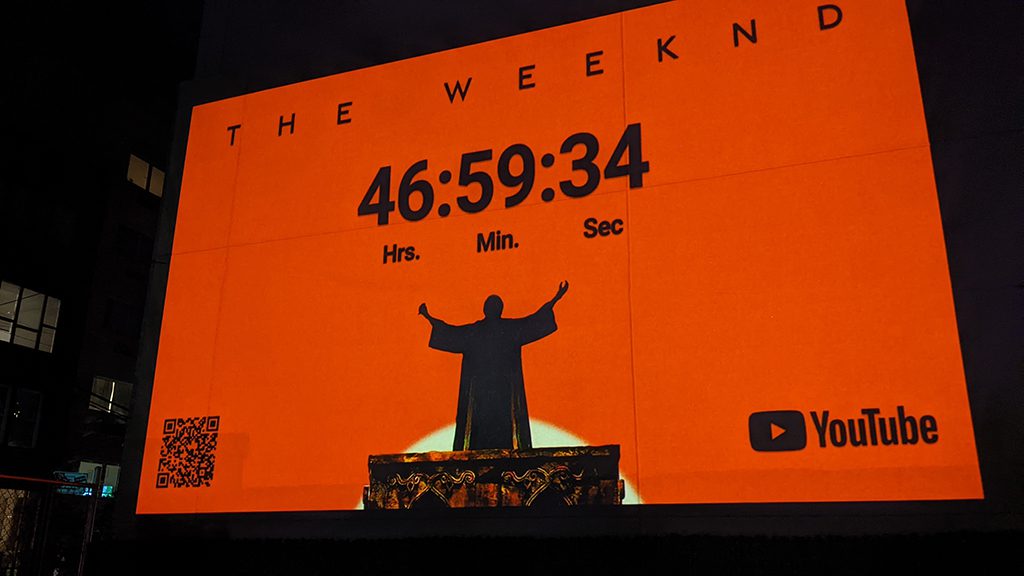
Brand Projection: How Brands Use Light to Make Cultural Impact
Brand projection turns any surface into your canvas at night. We have run projection campaigns for brands across music, fashion, tech, and entertainment. Here is what separates the ones that work from the ones that disappear.
Brand projection is the use of high-powered light projection equipment to place a brand’s visual identity, key art, or campaign message onto surfaces in the public environment. The surface can be a building facade, a sidewalk, a park screen, or any large flat surface that reflects light well. The projection creates a temporary brand presence at a scale that no standard printed format can match, and the visual effect of an illuminated brand image on a city building at night generates attention, documentation, and conversation that passive advertising formats simply cannot buy.
We run brand projection campaigns for clients across industries and markets, and the format is consistently one of the most discussed and most socially documented things we do. There is something about the act of projecting light onto a building that captures people’s attention in a way that a printed poster, no matter how large, does not. The light moves. The scale overwhelms. The presence is temporary, which makes it feel like an event rather than an ad. People photograph it. They share it. They tell others about it, and that secondary and tertiary reach is what makes projection one of the highest-return formats in our entire toolkit.
This guide covers brand projection as a strategic tool: what it communicates about a brand, how to plan a projection campaign that serves a real brand objective, what the format requires technically, and how to think about projection within a broader brand campaign strategy rather than as a standalone tactic. We have included field notes from our own experience running these campaigns, pricing context, and a complete FAQ section.
The format itself carries meaning before a single word or image is shown. A brand that projects its identity onto a city building is making a statement about its relationship to the physical urban environment. It is saying: we are here, in this city, in this neighborhood, in this moment. More than online. More than in a media buy. Here, now, in the real world.
For brands that want to communicate cultural presence rather than simply advertising presence, that distinction matters enormously. Digital advertising can achieve massive scale but it cannot claim space in the physical environment. Standard outdoor advertising can claim physical space but it does so through purchased media in predetermined locations. Brand projection can claim physical space in locations that no media company offers, on building faces that no billboard company sells, in neighborhoods that no outdoor network serves.
The ability to choose your own location, within the practical constraints of the format, is what gives brand projection its strategic edge. A brand that projects in SoHo is choosing SoHo. A brand that projects on the Sunset Strip is choosing the Strip. Those location choices are brand statements as much as the imagery projected. The audience reads both the content and the context, and the context is often what they remember most vividly.
Projection also communicates scale in a way that no other format does. When a brand’s logo fills the facade of a six-story building, the physical scale of that statement is impossible to misread. The audience is not asked to imagine a brand at scale. They see it at scale. That experiential difference between a small logo on a screen and a massive logo on a building changes how audiences encode the brand in memory, and it is why projection has become a go-to format for brands in competitive categories that need to signal weight and seriousness of purpose.
Brand Projection Strategy: Matching the Format to the Objective
Brand projection is not the right format for every campaign objective. It is the right format for specific objectives where the format’s particular qualities align with what the campaign needs to achieve. Those qualities are: scale of visual presence, temporality and event character, location specificity, social documentation potential, and the cultural signal that the format itself carries. When one or more of those qualities serves the campaign’s core objective, projection earns its place in the plan.
Launch Announcements and Reveals
Brand projection is particularly effective for launch moments: the first public appearance of a new product, a new brand identity, a new campaign creative, or a new project. The projection creates the visual announcement in physical space at the same time as whatever digital reveal is happening. The combination of a digital announcement and a physical building projection creates a multi-channel moment that generates more total attention than either channel alone.
Album release weeks are a classic use case. The label drops the album digitally and at the same time projects the album cover on buildings in New York and Los Angeles. Fans who are already looking for the album online encounter the projection in their physical environment on the same day. The alignment of the physical and digital moments creates a cohesive brand event rather than a scattered collection of separate touchpoints. We have run dozens of these campaigns, and the coordination of digital and physical timing is consistently what separates the campaigns that generate significant organic reach from those that generate only the audience present at the physical location.
Cultural Presence in Specific Markets
Brands that want to establish or reinforce cultural presence in a specific city or neighborhood use brand projection to make a physical statement in that geography. A streetwear brand that wants to signal relevance in Fairfax Avenue’s cultural network can project its visual identity on a building in that corridor. A food and beverage brand that wants to claim presence in Chicago’s River North entertainment district can project there during the busiest evenings of the year. The projection places the brand in the geography in a way that a digital campaign targeting the same zip code does not, because the physical presence is visible to everyone in the neighborhood rather than only to the specific individuals a targeting algorithm selects.
Event Amplification
Events, concerts, film premieres, product launches, and brand activations all benefit from projection as an amplification layer. A brand projection on the building adjacent to the event venue creates a visual frame for the event that every arriving attendee, every journalist, and every social media post from the venue’s vicinity encounters. The projection extends the event’s visual footprint into the surrounding neighborhood and gives the audience an additional brand touchpoint as they approach and depart. That surrounding neighborhood reach is often larger than the venue’s internal audience, and it reaches a community of bystanders who did not buy a ticket but are still in the brand’s presence for the duration of the projection.
AGM Field Note: The strongest brand projection campaigns we have run had a clear answer to the question: why here, why now? The building was chosen because it said something about the brand’s relationship to that neighborhood. The timing was chosen because it aligned with a specific campaign moment. When the location and timing both carry strategic logic, the projection feels intentional and earns more engagement than a projection that is placed purely on tactical convenience. Location choice is brand strategy, not just logistics.
Technical Requirements for Brand Projection Campaigns
Brand projection is technically demanding in ways that standard outdoor advertising is not. The equipment is heavy, requires power, needs skilled operators, and must be positioned precisely relative to the target surface. Content specifications are strict because a file that is not correctly formatted for the surface dimensions will produce a distorted or underperforming projection. Understanding the technical requirements ahead of time protects the campaign from field day surprises that could otherwise be avoided.
Campaign Element
Requirement
Notes
Projector output
20,000 to 60,000+ lumens
Varies by building scale and ambient light level
Throw distance
50 to 200+ feet
Depends on lens ratio and image scale needed
Power supply
30 to 60A circuit or generator
Generator preferred for most street-level positions
Content format
MP4 (H.264), PNG, or TIFF
Spec to confirmed surface dimensions before delivery
Content resolution
1920×1080 minimum; 4K recommended
Higher resolution for larger surfaces
Color profile
sRGB
Ensures accurate color output at projection
Campaign crew
2 to 4 crew members
Setup, monitoring, documentation throughout campaign window
Setup time
2 to 3 hours pre-campaign
Equipment positioning, alignment, and testing
We handle all equipment, crew, and logistics as part of our projection packages. Clients are responsible for delivering content files to specification before the campaign date. We provide a detailed content spec sheet as soon as the site and equipment configuration are confirmed, and we strongly recommend reviewing and approving the spec before content production begins rather than after, since content resizing or reformatting in the field adds time and risk to the campaign window.
Content Strategy for Brand Projection
The content is the campaign. Equipment handles delivery. What actually appears on the building face is what the audience sees, photographs, and shares. Content decisions made early in the planning process have a larger impact on the campaign’s eventual performance than almost any other variable, including location, which is saying something given how much location matters in projection.
What Works at Building Scale
Brand imagery that works at building scale shares a few consistent characteristics. High contrast is the most important. A projection is competing with ambient city light, and any content that relies on subtle tonal gradients or fine detail will lose that detail to ambient light interference. Bold graphics, strong silhouettes, and high-saturation color blocks hold up at scale in ways that photographic content with complex tonal ranges often does not.
Minimal text reads best. A URL, a name, a tagline, or a date can work at building scale if the letterforms are bold and the layout is clean. Long sentences or paragraphs of body text are not readable from the street. The projection format rewards the same graphic discipline that works in traditional billboard design: one dominant visual, one clear supporting element, no more than that.
Motion adds a quality to projection that static imagery cannot achieve. A slow-moving animation, a looping visual element, or even a subtle breathing effect on a static graphic draws attention from greater distances and sustains it from bystanders who have already noticed the projection. Motion increases the likelihood that someone who walks past will stop to look, and stopping is what leads to documentation.
What Does Not Work
Content created for digital screens often underperforms at building scale. The color profiles are different, the viewing distance is different, the ambient conditions are different, and the rendering behavior of a commercial projector differs from a flat-panel display. Content that looks strong in a creative review session on a monitor can read flat, washed out, or poorly composed at full building scale in city ambient light. We strongly recommend a test projection at a comparable venue before the campaign date if the content has not been tested in field conditions before.
Content with intricate detail or photorealistic photography tends to lose its intended impact when projected. The format rewards graphic design over photography, and campaigns that lead with a bold graphic identity consistently outperform those that lead with photographic creative.
Brand Projection vs. Other Outdoor Brand Formats
Understanding how brand projection compares to other outdoor formats helps clarify when to use it and when a different format is better suited to the campaign goal. We work across the full toolkit of outdoor and guerrilla formats, so we have direct operational comparison across all of these.
Brand Projection vs. LED Truck Advertising
LED trucks carry a mobile digital display through a route, reaching multiple neighborhoods and generating moving visibility throughout the day. Brand projection stays in one place but creates a much larger and more visually commanding presence than an LED screen on a vehicle. For campaigns where location specificity and scale of visual presence are the priority, projection typically outperforms LED trucks. For campaigns where geographic coverage and mobility are priorities, LED trucks are the stronger tool. The two formats are complementary and we have run them simultaneously for clients who want both coverage range and a high-impact static anchor location.
Brand Projection vs. Printed Outdoor Advertising
Standard outdoor advertising, whether billboard, transit shelter, or street-level poster, runs around the clock on a scheduled basis. Brand projection runs during defined hours at night and creates a more dramatic per-contact visual presence during those hours. The strategic difference is between ambient brand presence over time, which is outdoor advertising’s strength, and high-impact brand event creation, which is projection’s strength. Most campaign strategies benefit from both: ambient presence throughout the campaign window, bookended by projection event moments at launch and at key campaign dates.
Brand Projection vs. Digital Advertising
Digital advertising reaches defined audiences with precision targeting and generates measurable clicks, views, and conversions. Brand projection cannot match digital’s precision targeting or measurement granularity. What it does that digital cannot is create a physical presence in a real-world space that people encounter as part of their lived experience, not as a digital interruption. The two formats operate in completely different environments and complement rather than substitute for each other. The most effective modern brand campaigns we work on treat digital and physical as coordinated channels, not competing ones.
Brand Projection Campaign Planning Checklist
Every brand projection campaign we execute goes through the same planning checklist before we confirm the campaign is ready to run. This checklist reflects our field experience with what can go wrong and what makes the difference between a campaign that delivers and one that falls short. We share it here because brands planning their first projection campaign often underestimate how many variables need to be confirmed before installation night.
Site survey completed at campaign operating hour, not daytime, because ambient light conditions differ completely
Projector output confirmed sufficient for confirmed site conditions including building height and color
Content delivered at correct spec covering dimensions, format, resolution, and color profile
Content tested on the actual building surface before the campaign window opens
Power source confirmed and tested at load before campaign night
Crew assignment confirmed including on-site monitor for full campaign window
Weather check completed for campaign night with contingency date identified
Documentation plan confirmed covering field photography and client photography access if applicable
Campaign timing confirmed against client social media publishing schedule
Property coordination completed where applicable
This checklist exists because we have learned from campaigns where one of these items was not confirmed before installation night. A content file at the wrong aspect ratio requires on-site adjustments that cost time and reduce the window available for the live campaign. A power source that was not load-tested may fail under projector draw. A campaign that launches before the client’s social media team has published their content loses the organic amplification layer that dramatically increases the campaign’s total reach. The checklist is not bureaucratic overhead. It is field discipline that protects the campaign from preventable failures.
AGM Field Note: We always recommend a professional photography session on the first night of any multi-night campaign. A production photographer with professional equipment captures documentation categorically better than phone camera photos from the street. Those images become the campaign’s primary documentation assets, used in press materials, case studies, client presentations, and the brand’s own marketing channels. The cost of a professional photographer for one evening is a small fraction of the overall campaign investment and produces assets with lasting value long after the projection has ended.
Brand Projection in the Context of the Full Campaign
The brands that get the most out of projection campaigns treat the projection as one element of a coordinated campaign rather than as a standalone activation. A projection that runs in isolation generates live street audience contact and some organic social documentation. A projection that is supported by a coordinated poster campaign in the same neighborhood, a social media push from the brand’s channels on launch night, and a press outreach effort to local culture and entertainment publications generates a brand moment that compounds across multiple channels simultaneously.
We have planned campaigns where the poster run in the neighborhood starts two weeks before the projection, building visual familiarity with the campaign creative in the community before the projection event. The projection then runs on launch night as the visual climax of the campaign, with the brand’s social channels publishing real-time content from the projection site. The combination produces a sequence of audience touchpoints: the poster in the neighborhood, the projection event, the social media content, and then the editorial and press coverage that a well-documented projection campaign often earns. Each element reinforces the others, and the total campaign impact is substantially greater than any single element could generate alone.
Planning for that kind of coordination requires more lead time and more cross-team collaboration than a simple projection booking. But the results, in terms of total campaign reach, brand awareness lift, and organic social media coverage, consistently justify the additional planning investment. We encourage clients to think about projection from the beginning of the campaign planning process, not as a late addition, because the campaigns that coordinate projection with their other elements from the start consistently outperform those that bolt projection on at the end.
The Brand Signals That Projection Sends
Beyond the direct value of the live street audience and the organic social documentation, brand projection sends signals about a brand that are difficult to generate through other formats. These signals operate at the level of brand perception rather than direct ad recall, and they accumulate over time in the minds of people who encounter projection campaigns repeatedly.
The first signal is investment. A brand willing to project on a building face in a major city is signaling that it takes its presence seriously. The format is not cheap and it is not easy. The audience senses this without necessarily knowing the cost. A building projection communicates seriousness of purpose in a way that a banner ad, a transit shelter poster, or even a billboard does not carry in the same register.
The second signal is cultural confidence. Projecting on a building in SoHo, or in the Arts District, or on the Sunset Strip requires a brand to be confident that its visual identity and campaign creative is strong enough to hold up at building scale in front of a culturally sophisticated audience. Brands with weak visual identities do not project, because the format strips away everything and leaves only the core visual at massive scale. That vulnerability is why brands with strong graphic disciplines love the format and why projection is so strongly associated with brands that have invested seriously in their visual identity.
The third signal is presence in the present moment. Projection is temporary. It runs for hours, not months. That temporality makes it feel current, relevant, and worth noticing right now rather than part of the permanent furniture of the advertising environment. A brand that projects is a brand that is doing something this week, this night, that matters enough to claim physical space for. That sense of immediacy and cultural presence is what drives the social documentation behavior that makes projection campaigns amplify so effectively beyond the physical audience present at the site.
Pricing for Brand Projection Campaigns
Guerrilla projection campaigns in New York City run at $6,500 per projector per night. For campaigns outside of New York City, the rate is $7,500 per projector per night. Each package includes a 20,000-lumen projector, generator, full electronics bundle, mobility unit, and two technicians covering setup, operation, and breakdown. Projections start at dusk with a typical run time of four to six hours. Multi-night runs are available at the same per-night rate.
Location types are either locked placements, where we pre-scout and secure a specific building wall, or guerrilla-style placements that allow for flexibility in positioning. We recommend identifying a primary location and a backup for each projector unit. Some hotels and venues allow wall rentals with advance notice, which provides additional location options for campaigns requiring specific architectural backdrops.
Total campaign cost scales with the number of projectors, the number of nights, and the market. A single-projector, single-night New York City campaign starts at $6,500. A three-projector, three-night multi-city campaign across New York, Los Angeles, and Chicago scales accordingly. We provide detailed proposals with itemized costs for every campaign based on the confirmed scope.
Frequently Asked Questions About Brand Projection
Frequently Asked Questions
What is brand projection and how does it work?
Brand projection uses high-lumen commercial projectors to display brand imagery, logos, key art, or video on building facades, walls, sidewalks, or other large surfaces. The projection is visible at night and creates a large-scale brand presence in the public environment. We use 20,000-lumen and higher projectors capable of covering multi-story building surfaces with clarity.
What makes brand projection different from other outdoor advertising?
Brand projection is temporary, event-like, and can appear on any suitable surface in any neighborhood rather than only in predetermined media inventory locations. The scale and visual drama of a building projection creates higher attention quality than standard outdoor formats and generates organic social media documentation from people who encounter it and share it. The format communicates brand investment in the physical environment in a register that standard outdoor media does not reach.
Which brands use projection advertising most?
Music labels and streaming platforms are the most consistent users of brand projection for album releases, tour announcements, and major title launches. Film studios use projection for premiere week activations in major markets. Streetwear and fashion brands use it for product drops and brand presence campaigns in cultural neighborhoods. Tech companies use it for product launches and market entry. Consumer goods brands use it for major campaign launches in primary markets.
How does brand projection generate social media coverage?
People who encounter a striking building projection photograph and video it as a noteworthy visual experience. When the projection creative is strong and the location is in a socially active neighborhood, those photos and videos are shared across Instagram, TikTok, and other platforms. The organic documentation from a well-executed brand projection can multiply the campaign’s total reach by a significant factor beyond the live street audience.
Can brand projection work in multiple cities at the same time?
Yes. We coordinate simultaneous multi-city brand projection campaigns with field resources in each target market. The combined social media documentation from multiple cities generates a national brand presence moment that no single-city campaign can achieve. We have run simultaneous campaigns in New York, Los Angeles, Chicago, and other markets on the same night for clients with major launches requiring national reach.
What is the best time of year for brand projection campaigns?
Late spring, summer, and early fall are the strongest seasons for most US markets. Longer evening hours in shoulder seasons like May, September, and October provide both good natural darkness windows and more favorable weather conditions than winter campaigns. Summer campaigns in northern markets have shorter darkness windows but generally better weather. We factor seasonal conditions into campaign timing recommendations for every market.
Brand projection is most effective as a high-impact anchor element within a broader campaign that includes street-level poster runs, street team activations, or event-based elements. The projection creates the visual event moment while other formats build ambient frequency around it. We plan coordinated campaigns that use projection as the centerpiece with supporting formats providing the sustained neighborhood presence that a single projection night cannot maintain on its own.
What content formats work best for brand projection?
Static bold graphics, animated loops, and short-form video all perform well. High-contrast visuals with minimal text read best at building scale. Content should be delivered as MP4 (H.264) for video or high-resolution PNG for static imagery, spec’d to the confirmed surface dimensions. We provide a detailed content spec sheet as soon as the site and equipment configuration are confirmed.
How much does a brand projection campaign cost?
Guerrilla projection in New York City runs $6,500 per projector per night. Outside NYC the rate is $7,500 per projector per night. Each package includes a 20,000-lumen projector, generator, electronics bundle, mobility unit, and two technicians covering setup, operation, and breakdown. Projections start at dusk with a typical runtime of four to six hours. Multi-night runs are available.
How do I start a brand projection campaign with AGM?
Email us at [email protected] or call (646) 776-2770 with your campaign brief: what you want to project, target city and neighborhood, and preferred campaign dates. We will provide a proposal with building options, equipment specs, and itemized costs within a few business days of our initial conversation.