Poster Distribution: Street-Level Reach for Your Brand Campaign | AGM
Poster distribution gets your campaign material into the exact neighborhoods, transit corridors, and community spaces where your target audience actually is. Here is how to plan and execute it right.
Poster distribution is the process of delivering printed campaign materials to target locations or directly to consumers in a defined geographic area. It encompasses several distinct delivery methods: placing posters on authorized outdoor surfaces using adhesive or mounting hardware, hand-delivering flyers and posters directly to people in high-traffic pedestrian zones, and seeding posters into retail locations, venues, and community spaces where the target audience gathers. At American Guerrilla Marketing, we plan and execute all three methods, often in combination, as part of integrated street-level campaigns in New York City and markets nationwide.
This guide covers the full scope of poster distribution as a campaign discipline: the different delivery methods and when each makes sense, the pricing structure for distribution services, the neighborhoods and venue types that drive the best results, and how to coordinate a distribution campaign with the rest of your marketing program.
Poster distribution is not a single tactic. It is a family of related tactics, each with different mechanics, different contact patterns, and different appropriate uses. Understanding the differences is the starting point for building a distribution strategy that matches your campaign objectives.
Surface Posting
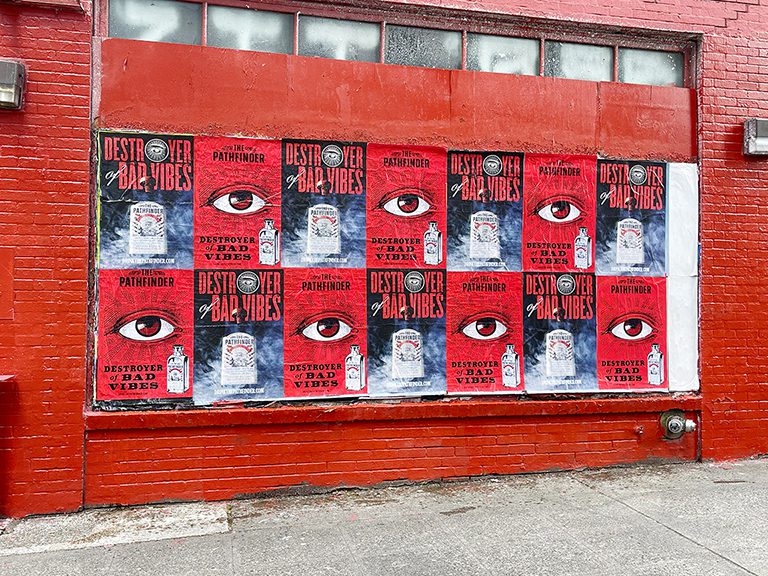
Surface posting places posters on authorized outdoor surfaces using wheat paste or compatible adhesive. The poster stays in place for the duration of the campaign, creating sustained visual presence at specific locations in the target neighborhood. Each surface posting creates a fixed contact point that reaches every consumer who passes that location over the campaign window. A consumer who walks the same block twice a day will see the same poster twice a day. That repetition accumulates over the campaign duration without any additional field labor cost per exposure.
Surface posting is a sustained presence tactic. It works best for campaigns that need to build awareness over a period of days or weeks: event promotion in the month before an event, brand launches that need neighborhood-level familiarity before retail availability, and advocacy campaigns that need to establish presence in a district over time.
Hand-to-Hand Distribution
Hand-to-hand distribution places posters or flyers directly into the hands of consumers in high-traffic pedestrian locations. A distributor positioned at a transit hub, a busy retail intersection, or an event entrance delivers materials person-to-person as consumers move through the area. The contact is immediate and direct. Each delivery reaches a specific person at a specific moment. The consumer takes the material away from the location.
Hand-to-hand distribution is a direct contact tactic. It works best for time-sensitive campaigns that need to reach people in a specific location at a specific moment: promoting a same-day event, reaching transit commuters during a peak traffic window, or delivering a promotional offer to people entering or leaving a retail zone.
In-Store and Venue Placement
In-store and venue placement seeds posters and flyers into retail locations, music venues, bars, coffee shops, community centers, and other gathering spaces where the target audience is likely to encounter them in a dwell environment. A consumer waiting at a bar, browsing in a record shop, or sitting in a coffee shop has time to engage with a posted flyer in ways that a pedestrian moving at street pace does not. Venue placements create a different quality of contact: slower, more attentive, and more contextually relevant to the brand or event being promoted.
Poster Distribution Pricing
Our hand-distribution service is priced at $389.99 per 6-hour shift, with a minimum campaign commitment of 5 days. Each shift covers one distributor operating in a defined geographic area for the full six hours. The rate covers planning, routing, field execution, and photo documentation of the distribution activity.
Service
Rate
Minimum / Notes
Hand Distribution
$389.99 / 6-hour shift
Minimum 5-day campaign
Additional Distributor
$389.99 / 6-hour shift
Per shift, per additional person
Overtime
$65 / hour
Beyond standard 6-hour shift
Travel Day
$275 / day
Out-of-market campaigns
Hotel Per Diem
$65 / day
Out-of-market campaigns
Mileage
$0.655 / mile
Out-of-market routing
Example campaign costs: A 5-day single-distributor campaign runs approximately $1,950 at base rate. A 5-day two-distributor campaign runs approximately $3,900. A 10-day two-distributor campaign with one additional distributor on two high-traffic days would run in the range of $4,200 to $4,500. All costs are approximate; final pricing depends on market, routing specifics, and campaign structure. Contact us for an exact quote.
AGM Field Note: The 5-day minimum for hand distribution campaigns is not arbitrary. A single day of distribution does not build the repeated contact pattern that drives consumer recall. Five consecutive days of distribution in the same target area creates the cumulative exposure needed for the campaign to register. If your timeline is shorter than 5 days, surface posting may be a better fit for your objective and budget.
Planning a Poster Distribution Campaign
Effective poster distribution is a planned operation, not a random deployment. The planning decisions made before a distributor hits the street determine whether the campaign reaches the right people at the right places. Here is how we approach the planning process.
Defining the Target Consumer and Location
The first planning question is always: who are we trying to reach, and where are they in the physical world? Not where they spend time online, not what media they consume, but where their bodies are in the city at the moments when distribution is happening. A campaign targeting music fans should be in the blocks around venues, record shops, and community gathering spaces for that audience. A campaign targeting young professionals should be at transit hubs during commute windows and in the residential neighborhoods where that demographic is concentrated.
Routing Strategy
Once the target locations are identified, we build a distribution route that covers the highest-priority locations within the campaign window. For hand-distribution campaigns, the route determines how much ground a distributor can cover in a shift and which locations get priority when coverage is limited. For surface posting campaigns, the route determines the sequence of placements and the timing of installation relative to peak pedestrian traffic.
Distribution Window and Timing
The time of day and the day of week significantly affect the effectiveness of a distribution campaign. A campaign targeting nightlife consumers is more effective when distributors are working Friday and Saturday evenings than when they are working Monday mornings. A campaign targeting commuters is more effective during peak transit hours. A campaign targeting event attendees is most effective in the hours immediately before the event. We build timing recommendations into every campaign plan based on the specific target audience and location profile.
Quantity and Replenishment
A hand-distribution campaign in a dense urban environment can move 500 to 1,000 flyers per shift in a well-trafficked location. A 5-day campaign with one distributor can move 2,500 to 5,000 flyers. We build the print quantity recommendation into the campaign plan based on the routing strategy and the target volume per shift, with an overrun to allow for high-traffic location replenishment.
High-Performance Distribution Locations in New York City
Not all distribution locations are equal. Some transit hubs, retail corridors, and neighborhood intersections generate significantly more consumer contact per distributor-hour than others. Here are the locations that consistently produce the highest distribution contact rates in New York City.
Transit Hubs
The major transit hubs in New York City are the highest-volume distribution locations in any market. Grand Central Terminal, Penn Station, Union Square, Times Square, Atlantic Terminal in Brooklyn, and Jamaica Station in Queens each process tens of thousands of pedestrians per hour during peak commute windows. A distributor positioned at a primary exit during morning or evening rush is able to reach a very large number of consumers in a short time. Transit hub distribution is particularly effective for campaigns that want broad reach within a defined geographic area rather than neighborhood-level targeting.
Campus and University Corridors
New York University, Columbia University, Fordham, Brooklyn College, and other major university campuses generate dense pedestrian traffic among young adults who are highly receptive to flyer campaigns for events, entertainment, and lifestyle brands. Campus distribution requires coordination with campus access policies, which we handle as part of the campaign planning process.
Nightlife and Entertainment Corridors
The blocks around major venue clusters, including the Bowery corridor, Bedford Avenue in Williamsburg, and the club strips in Manhattan’s meatpacking and Hell’s Kitchen areas, are high-performance distribution locations during evening and weekend hours for entertainment and nightlife campaigns. Distributors positioned at venue entrance points before or after shows reach consumers in an active entertainment mindset and achieve high material acceptance rates.
Retail and Shopping Districts
Retail corridors like Fifth Avenue in midtown, the shopping blocks of Soho, and the commercial stretches of Fordham Road in the Bronx carry high pedestrian volumes with a consumer orientation that is receptive to promotional materials. Distribution in shopping areas reaches consumers who are already in a purchase-ready mindset, which is particularly valuable for campaigns promoting consumer products or nearby retail locations.
AGM Field Note: We assign experienced distributors to each campaign route, not general labor. An experienced distributor knows how to position themselves in a pedestrian flow, how to offer materials in a way that maximizes acceptance, and how to adjust the approach as traffic patterns shift through the shift. The difference in material acceptance between an experienced and inexperienced distributor in the same location can be significant. We do not take shortcuts on staffing.
Multi-Market Poster Distribution
We coordinate poster distribution campaigns across multiple cities simultaneously. A national brand, a touring act, or a multi-city event series can run distribution in New York, Los Angeles, Chicago, Miami, and other markets during the same campaign window. Each market has its own routing plan, local distributors, and field coordination. Campaign documentation from all markets is consolidated into a unified report.
Out-of-market campaigns include travel and logistics costs for campaign coordination staff when required. For markets where we maintain local field teams, those costs are lower than for markets that require travel from New York. We build out-of-market cost structures transparently into every multi-city campaign quote.
Integrating Poster Distribution with Other Campaign Channels
Poster distribution performs best when it is connected to other campaign elements rather than run in isolation. Here are the most productive integration patterns we see in well-executed campaigns.
Surface posting plus hand distribution: Running surface posting for sustained neighborhood presence in the weeks before an event, combined with hand distribution in the days immediately before the event, creates a two-phase campaign. The posting phase builds awareness and familiarity over time. The distribution phase drives direct action at the peak conversion moment.
Distribution plus geo-targeted digital: Running geo-targeted social advertising in the same neighborhoods where distribution is happening creates overlapping physical and digital exposure for the same consumer. The physical delivery creates a tactile impression. The digital ad reinforces the message in the consumer’s digital environment. The two together create stronger recall than either alone.
Distribution plus influencer activation: Coordinating influencer activity in the campaign neighborhoods during the distribution window allows influencers to authentically document the street-level campaign and share it with their audiences. This extends campaign reach beyond the physical distribution locations without additional distribution cost.
Campaign Documentation and Reporting
Every poster distribution campaign we execute is documented fully. The documentation delivered after each campaign includes:
GPS route tracking records for all distribution shifts
Photo documentation of distributor activity at key locations throughout each shift
Quantity summary of materials distributed per shift and per location
Surface posting documentation with GPS-tagged photographs of every placement
Total coverage summary across all campaign elements and markets
Managing a Multi-Week Poster Distribution Campaign
Distribution campaigns that run for more than a week require active management to maintain performance across the campaign window. A single installation night for a surface posting campaign requires monitoring and refresh but not day-to-day management. A hand distribution campaign running daily or on alternating days for two or more weeks requires consistent routing management, distributor scheduling, material replenishment, and performance monitoring across the full campaign duration.
Routing Consistency vs. Routing Variation
One of the key decisions in a multi-week distribution campaign is whether to run the same route every day or to vary the route across the campaign window. Consistent routing builds familiarity with the distributor in specific locations: venue staff, shop owners, and regular pedestrians recognize the presence and associate it with the campaign. Varied routing reaches a broader geographic area over the campaign window but may achieve lower frequency with any individual consumer. The right approach depends on the campaign objective. An event campaign trying to saturate a specific neighborhood benefits from consistent routing in that neighborhood. A brand awareness campaign trying to reach a broad urban demographic benefits from route variation that covers more territory.
Distributor Performance Monitoring
We track distributor performance through GPS route monitoring and end-of-shift photo documentation throughout the campaign. The route tracking confirms that distributors are covering the planned areas within the shift window. The photo documentation provides visual evidence of activity at key locations throughout the shift. For multi-day campaigns, the combination of route data and photo documentation creates a day-by-day record of coverage that the client receives as part of the campaign report.
Material Replenishment
A 5-day distribution campaign with one distributor moving 500 to 1,000 materials per shift will consume 2,500 to 5,000 printed pieces over the campaign window. Multi-week campaigns require either a large initial print run or a phased print schedule that replenishes materials at mid-campaign intervals. We build the replenishment schedule into the campaign plan from the start and coordinate with the print vendor to ensure delivery timing aligns with the distribution schedule without creating gaps in material availability.
Retail Drop Distribution: Seeding Posters into Business Locations
Retail drop distribution is a specialized form of poster distribution that places materials directly into retail locations, venues, and community spaces for display rather than for hand-to-hand delivery. A distributor visits a target list of business locations, confirms permission for display, and leaves a quantity of posters or flyers at each location. The business displays the materials at a counter, on a corkboard, on a wall, or in another designated display area.
Retail drop campaigns work particularly well for event promotion, because the venues and businesses that participate in a retail drop are often the same venues and businesses frequented by the event’s target audience. A concert campaign that drops posters into the record shops, bars, and coffee shops in the venue’s neighborhood seeds the campaign into the physical spaces where potential attendees already spend time. The poster in the record shop window or on the bar’s community board reaches a consumer who is already in a context of cultural engagement and who is more likely to act on an event promotion than a consumer encountered at random on the street.
Retail drop distribution is coordinated as part of larger campaign packages. We identify appropriate locations in the target area based on the campaign’s audience profile, confirm display permissions with each location as part of the campaign setup, and schedule drop delivery as a component of the overall distribution plan. Drops are documented with photographs at each participating location confirming placement of campaign materials.
Poster Distribution for Advocacy and Community Campaigns
Community organizations, advocacy groups, voter registration campaigns, and issue-based nonprofits use poster distribution to reach dense urban populations in specific districts with a high-frequency physical presence that digital channels cannot replicate at the same geographic specificity. The distribution of physical materials to households, community gathering points, and high-pedestrian-density corridors within a specific district creates a form of presence that is particularly effective for campaigns that need to signal community investment and local engagement rather than just broadcast awareness.
Voter registration campaigns in dense urban neighborhoods have used both surface posting and hand distribution with significant success. The physical presence of campaign materials at transit hubs, laundromats, grocery stores, and community centers in target districts reaches residents in the moments and locations of their daily life rather than only through their digital devices. For voter registration specifically, reaching community members through their local physical environment has a demonstrated positive effect on registration rates compared to digital-only outreach in the same populations.
We price and plan advocacy and community distribution campaigns using the same rate structure as commercial campaigns. Nonprofit organizations receive the same professional service and documentation standards as commercial clients. If your campaign has a community focus, we approach the planning and execution with the same care we bring to any other client category.
Poster Distribution for Product Sampling Campaigns
Product sampling campaigns frequently use hand distribution as a mechanism for direct consumer contact in target locations, often combining the delivery of product samples with accompanying flyers or posters that the consumer takes away with them. The distributor in this context functions both as a sampling agent and as a marketing materials distributor, creating a layered consumer interaction that produces both immediate product trial and post-interaction brand reinforcement through the take-away materials.
We coordinate poster and flyer distribution as a component of product sampling programs that include separate product sample delivery and branded materials distribution. The distribution of branded print materials in conjunction with sampling gives the consumer something to reference after the sampling interaction, including product information, a QR code linking to a purchase page, or event information for an upcoming activation in the same neighborhood. The combination of a sensory product experience and a physical information piece creates a more complete brand impression than either element alone.
For sampling-adjacent distribution campaigns that do not include physical product delivery, we can coordinate brand ambassador-style distributors who represent the brand’s energy and tone while delivering flyers and engaging briefly with consumers in the target location. This approach creates a warmer consumer interaction than a simple hand-off distribution and is particularly effective for campaigns targeting communities where direct personal engagement carries more weight than passive material delivery.
How Poster Distribution Fits into a Complete Street Campaign
The most effective campaigns we plan and execute combine poster distribution with at least one other street-level tactic. Distribution is a powerful direct contact mechanism, but its effect is multiplied when it operates in an environment where the consumer has already been exposed to the campaign through other physical touchpoints.
Surface posting creates the background presence that gives hand distribution its additional weight. When a distributor hands a flyer to a consumer who has already seen the same visual on a board near their apartment, the consumer is receiving a piece that is already familiar. The hand delivery creates the active, direct moment of contact. The prior poster exposure creates the context of brand recognition that makes the hand delivery feel like a natural part of an ongoing conversation rather than a cold interruption.
Event-based distribution creates the highest-intensity direct contact moments in any campaign. Placing distributors at the entrance to an event that the campaign is promoting, or at events where the target audience is gathered for related reasons, combines the specificity of event targeting with the personal directness of hand-to-hand delivery. A consumer who receives a flyer at a concert is in a receptive mental state for the type of information the flyer contains. That contextual alignment between the moment of delivery and the content of the material significantly increases the likelihood that the material will be read and acted upon rather than pocketed and forgotten.
What to Provide for Your Poster Distribution Campaign
The client’s preparation determines how quickly we can move from initial brief to campaign execution. Campaigns that arrive with complete creative assets, clear targeting criteria, and confirmed campaign dates can begin planning immediately and may be able to compress the standard planning timeline. Campaigns that arrive without confirmed creative, with vague targeting, or without a locked timeline require additional planning cycles that extend the time from brief to installation.
Here is the complete list of what we need from a client to begin a poster distribution campaign:
Campaign dates: The specific dates for installation (for surface posting components) and distribution shifts. A campaign window with a hard end date allows us to work backward from the deadline to confirm all preparation steps can be completed in time.
Target neighborhoods or locations: The specific areas, transit hubs, or venue clusters where distribution should be concentrated. The more specific the targeting information, the more precisely we can build the route and placement maps.
Print-ready artwork: Files in the correct dimensions, at 300 DPI, in CMYK color mode, with appropriate bleed. We review all files before production and will identify issues before they become production problems.
Distribution objectives: What is the campaign trying to accomplish? Drive event attendance, build brand awareness in a new neighborhood, reach commuters at a specific transit hub? The objective shapes every routing and staffing decision.
Quantity needs: How many materials need to be distributed per shift, and over how many days? This determines the print run size and the staffing requirement for the campaign.
Clients who have all of this information confirmed at the start of the planning conversation allow us to produce the most precise campaign plan and the most accurate cost estimate. Clients who are still working through some of these decisions can begin the planning conversation while those elements are being finalized, with the understanding that the plan may need adjustment as the missing information is confirmed.
Written by the American Guerrilla Marketing field team. AGM has designed and executed poster distribution campaigns for brands, record labels, venues, and agencies across New York City and the United States since 2008.
Frequently Asked Questions
What is poster distribution?
Poster distribution is the process of delivering printed posters or flyers to target locations or directly to consumers in a defined geographic area. It includes surface posting on outdoor boards and structures, hand-to-hand delivery to people in high-traffic locations, and in-venue or retail placement in spaces where the target audience gathers.
How much does poster distribution cost?
AGM’s hand-distribution service runs at $389.99 per 6-hour shift with a minimum of 5 days. Additional distributors are $389.99 per shift. Overtime is $65/hour. Out-of-market campaigns include travel-related add-ons. Contact us for a custom campaign quote.
What types of poster distribution does AGM offer?
We offer surface posting on authorized outdoor boards and barricades, hand-to-hand distribution to consumers in target locations, retail and venue placement for in-store or lobby settings, and combined campaigns that integrate multiple distribution methods under one campaign plan.
What areas do you cover for poster distribution in New York?
We cover all five boroughs of New York City and the broader metro area. Primary distribution neighborhoods include Williamsburg, the Lower East Side, Harlem, Crown Heights, Astoria, and the midtown Manhattan business corridors.
How many posters can one distributor place in a shift?
A distributor working a 6-hour hand-distribution shift can typically deliver 500 to 1,000 flyers in a dense pedestrian environment depending on foot traffic levels and the routing strategy. Surface posting coverage depends on the number of authorized locations in the target route.
Do you provide GPS route tracking for poster distribution?
Yes. Distribution routes are tracked with GPS monitoring and documented with photo proof from each location. The route report shows where distributors were and when, giving clients a complete record of campaign coverage throughout the distribution window.
Can I target specific transit hubs or events for poster distribution?
Yes. We build distribution routes around specific transit hubs, event entrances, retail corridors, campus areas, or neighborhood blocks based on client targeting criteria. Every distribution route is custom-built for the specific campaign and target audience.
What is the minimum campaign length for poster distribution?
Our minimum for hand-distribution campaigns is 5 days. This applies because single-day distribution does not create the repetitive contact needed for brand recall. Surface posting campaigns can run for shorter periods depending on the campaign objective and event timeline.
Do you run poster distribution campaigns outside New York?
Yes. We run poster distribution campaigns in Los Angeles, Chicago, Miami, San Francisco, and other major US markets. Each out-of-market campaign includes a custom route plan and local field coordination. Travel and logistics costs apply for out-of-market campaigns.
How do I start a poster distribution campaign with AGM?
Contact us at (646) 776-2770 or [email protected] with your target neighborhoods, campaign dates, and distribution objectives. We will build a custom campaign plan and quote from there.