Street Poster Advertising | American Guerrilla Marketing
Street poster advertising reaches people where no digital ad can follow them. It is physical, local, and impossible to scroll past. Here is how we run these campaigns and what makes them work.
Street poster advertising is one of the oldest forms of brand communication. Long before the internet existed, brands, musicians, and political movements covered city walls with posters to reach the people walking past them. The format has survived every wave of new media because it works on a level that digital advertising simply cannot replicate.
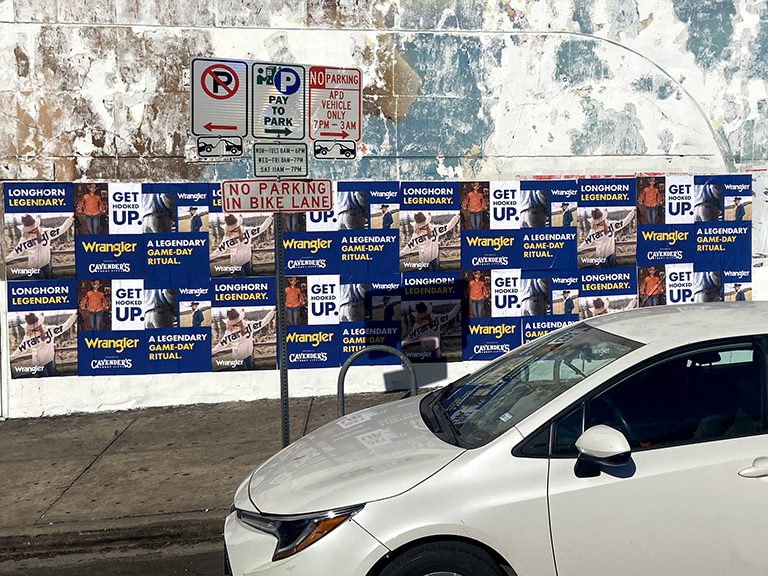
A poster on a wall on Melrose Avenue in Los Angeles is a physical object. It is not a data event on a server somewhere. It is a physical object that every person who walks that block sees. There is no skip button. There is no ad blocker. There is no algorithm deciding who gets to see it. The audience is the street.
At American Guerrilla Marketing, we run street poster advertising campaigns in cities across the country. We place posters in the specific neighborhoods where your target audience actually spends time. We select locations based on foot traffic data, audience demographics, and field-verified knowledge of which walls and corridors produce the most consistent visibility.
This guide covers everything you need to know about street poster advertising as a marketing channel. What it is, how it works, what it costs, what results to expect, and how to build a campaign that actually delivers. If you are thinking about street poster advertising for your brand or event, start here.
Street poster advertising is the practice of placing printed posters in high-traffic public locations to promote a brand, product, event, or message. The method dates back centuries. Theatrical promoters used it in Europe to fill seats at opera houses. Political campaigns used it to reach voters in city neighborhoods. Music promoters built audiences with it long before radio and television made mass broadcasting possible.
The modern format includes several distinct approaches. The most common is wheatpaste poster placement, where large-format printed posters are adhered to walls using a strong paste adhesive. The poster bonds to the surface and remains visible for days or weeks. Other approaches include poster frame placements in commercial areas, construction site fence placements along high-traffic pedestrian routes, and hand-distributed poster drops coordinated with street teams.
In all cases, the goal is the same. Put a visual message in front of a specific group of people in a specific geographic location. Achieve that with enough frequency and in enough locations to build genuine brand recognition in that physical space.
The Difference Between Street Poster Advertising and Traditional OOH
Traditional out-of-home advertising includes billboards, bus shelters, subway signage, and transit wraps. These formats reach large general audiences at scale. Street poster advertising is different. It operates at street level, in specific neighborhoods, and can achieve a kind of cultural embedding that large-format billboard advertising cannot.
When a poster appears in a neighborhood’s visual environment consistently, it becomes part of that neighborhood’s texture. Residents notice it. They talk about it. They photograph it. That kind of organic cultural engagement is something that airport billboard advertising will never achieve, because it lacks the specificity and the intimacy of street-level placement.
The best street poster advertising campaigns understand this distinction. They are built around neighborhoods, not demographic targets alone. They aim for cultural presence, not just raw reach.
Where Street Poster Advertising Works Best
Not every surface produces the same result. Location selection is the single most important variable in a street poster campaign. We have placed posters in dozens of cities across the country, and we have a very clear picture of which types of locations drive genuine brand impact versus which locations just generate wasted print budget.
High-Pedestrian Commercial Corridors
The strongest street poster placements are on high-pedestrian commercial corridors where people move at a walking pace, look around, and have time to register what they see. These are the main streets of culturally active neighborhoods. Think Bedford Avenue in Brooklyn’s Williamsburg. Think Melrose Avenue and Fairfax in Los Angeles. Think Wicker Park’s Milwaukee Avenue in Chicago. Think South Congress in Austin.
These corridors have consistent foot traffic across most hours of the day. The people walking them are typically young, local, culturally engaged, and in a mindset that is open to discovery. A well-designed poster in one of these locations is seen by hundreds to thousands of people per day who are specifically attentive to the visual environment around them.
Transit Approach Zones
The blocks surrounding subway entrances and bus stops are among the strongest placement zones in any city. People slow down at these points. They wait. They look at their surroundings. A poster in a transit approach zone captures attention during a moment of relative stillness in an otherwise fast-moving urban day.
We target these zones deliberately. In New York City, we work the blocks approaching major subway stations in Brooklyn, Queens, and Manhattan. In Chicago, we work the approaches to elevated train stops in neighborhoods like Logan Square, Wicker Park, and Pilsen. In Los Angeles, we work bus stop corridors in neighborhoods with active foot traffic, since the transit approach dynamic in LA operates differently given the city’s walking patterns.
Cultural Districts and Arts Zones
Arts districts in every major city have developed a visual culture around posters. These neighborhoods have the highest tolerance for dense visual signage because that density is part of their identity. People walking through an arts district expect to see posters. They pay attention to them. They share photographs of interesting ones.
In New York, the Bushwick arts corridor around Jefferson Street and Troutman Street is the most photographed street art environment in the city. In Los Angeles, the Downtown Arts District around Traction Avenue and the Melrose-Fairfax corridor are the strongest cultural placement zones. In Chicago, Pilsen’s 18th Street corridor is the equivalent. In Miami, Wynwood is the obvious anchor of this category. Campaigns in these zones benefit from the cultural context that arts districts provide, and often generate organic social photography that extends the campaign’s reach beyond the physical placements.
Entertainment and Nightlife Districts
Posters placed near nightlife venues, music clubs, and entertainment destinations reach audiences in a receptive, social state of mind. The hours from early evening through midnight in these areas produce high visibility from a concentrated, engaged audience.
We place posters near venue entrances, on the blocks approaching music districts, and on the faces of walls that frame the main pedestrian approaches to nightlife zones. Concert promoters have used this placement strategy for decades. Consumer brands that understand the connection between entertainment context and brand receptivity use it for the same reason.
The Street Poster Advertising Process at AGM
We run full-service street poster advertising campaigns from brief to installed poster. That means we handle strategy, location scouting, print procurement, installation crews, and post-campaign photo documentation. Here is how the process works from start to finish.
Campaign Brief and Strategy
Every campaign starts with a clear brief. We need to understand your audience, your message, your geography, and your goals. Are you promoting an event with a specific date? Are you building brand awareness for a product launch? Are you targeting a specific neighborhood demographic? Are you trying to create a cultural moment that generates social media amplification?
The answers to these questions shape every decision that follows. We build a strategy that matches the medium to the message and the location to the audience. We do not run the same campaign for every client. Every brief produces a distinct location plan.
Location Scouting and Approval
Before we produce a single print, we scout locations. Our crews visit the specific walls and corridors we plan to use. We verify visibility, confirm traffic patterns, assess wall conditions, and photograph each proposed location. We share location proposals with clients before final approval.
This step prevents the kind of campaign failure where posters end up in locations that look good on paper but deliver nothing in practice. Field verification is non-negotiable for us. We have been doing this long enough to know that location data and ground truth are not always the same thing.
Design Review and Print Production
We review every design before it goes to print. Street poster advertising has specific design requirements that differ from other print formats. High contrast matters. Typography needs to be legible from a distance. The message needs to land in the first two seconds of contact, because most people who see a poster are not stopping to read it carefully.
We work with clients to ensure their creative is optimized for the medium. We recommend print specifications for durability and color accuracy. We coordinate with our print vendors to ensure quality output at the required scale.
Installation and Crew Deployment
Our installation crews are experienced. They work efficiently and know how to place a poster so it adheres cleanly, lies flat, and looks professional. A poorly installed poster reflects badly on the brand. We take installation quality seriously because we understand that the physical quality of the work is part of the brand contact a viewer experiences.
We photograph every placement after installation. Clients receive a complete photo report showing each poster in its installed location. That documentation serves as both quality verification and performance record. Some campaigns also include geo-tagged placement maps that show the full geographic footprint of the installation.
Street Poster Advertising: Format and Size Guide
The size of your poster determines how much visual territory it commands and from what distance it becomes readable. Here is a practical guide to the most common street poster sizes we work with.
Format
Dimensions
Best Use
Viewing Distance
Small Format
11×17 in
Dense placements, bar/venue interiors
2-4 feet
Standard
24×36 in
Most street placements, event promotion
5-15 feet
Large
36×48 in
High-traffic corners, wall anchoring
10-30 feet
Extra Large
48×72 in
Prominent wall placements, major corridors
15-50 feet
Tiled Mural
Custom
Full wall coverage, landmark impact
20-100 feet
For most brand awareness campaigns, 24×36 is the workhorse format. It covers enough visual territory to be readable from a comfortable distance, and it fits a wide range of wall surfaces. For major product launches or campaigns in competitive visual environments, 36×48 or larger gives you the visual authority to compete with everything else on the wall.
Design Principles for Street Posters That Work
Good street poster design is not the same as good digital design. The medium has its own logic. Designs that are beautiful on a screen often fail completely on a wall in a busy neighborhood. Here is what actually works.
High Contrast is Not Optional
Street environments are visually noisy. Competing posters, graffiti, architecture, signage, and general urban texture all compete for attention at the same time. A poster that blends into this environment is invisible. High contrast is what cuts through.
Dark backgrounds with bright typography. Bright backgrounds with dark typography. Strong graphic elements with clear negative space. These are the design patterns that work on city walls. Soft gradients, pale color palettes, and subtle typography do not work. They disappear into the noise.
Legibility from a Distance
Your primary message needs to be readable from at least 15 feet away. For larger format posters, aim for 25-30 feet of legibility. This means font sizes that look enormous on a design proof. It means simplicity in the message hierarchy. It means resisting the urge to include fine details that cannot be seen from a walking distance.
Test your design by shrinking it to thumbnail size on your screen. If the primary message is still readable at that scale, the design will probably work on a wall. If it disappears at thumbnail scale, it will not perform in the field.
One Message, One Moment
The best street posters communicate one thing. Not three things. Not a message with a subhead and three supporting points. One thing. The brand name, the event, the product, the feeling. The discipline required to reduce a campaign message to a single statement is exactly what separates effective street poster design from ineffective street poster design.
AGM Field Note: A person walking at a normal pace has approximately 2 seconds to register a poster they pass on the street. If your poster cannot communicate its primary message in 2 seconds, it needs to be simplified. Every design we review is evaluated against this standard before we approve it for print.
What Street Poster Advertising Costs
Cost depends on campaign scale, market, format size, and quantity of placements. Here is a practical framework for understanding where budget goes in a street poster campaign.
Print costs depend on print vendor, paper stock, quantity, and turnaround time. Production quality matters for longevity, especially in outdoor environments where moisture and weather affect adhesion.
Installation labor costs vary significantly by market. In high-cost markets like New York City, installation runs at a higher day rate than secondary markets. A crew working a full day in New York can typically install 200 to 400 posters depending on location density and travel time between sites.
Campaign management, location scouting, and photo documentation are included in full-service campaigns. Larger campaigns see per-unit costs come down as overhead is spread across more placements. Contact AGM for a package-based quote.
AGM Field Note: Physical reach at scale. A poster on a busy block in a high-pedestrian neighborhood gets seen by hundreds to thousands of people per day. Over a two-week active period, a single well-placed 24×36 poster in Brooklyn or Silver Lake can rack up more genuine brand contacts than most digital display campaigns with comparable spend. And every one of those contacts is a real person in a real place, not a server log entry.
Street Poster Advertising by City
Every city has its own geography, its own culture zones, and its own visual environment. Here is how we approach street poster advertising in the major markets where we operate.
New York City
New York is the deepest market for street poster advertising. The density of foot traffic, the concentration of culturally engaged consumers in neighborhoods like Williamsburg, Bushwick, SoHo, and the Lower East Side, and the city’s general visual literacy create an environment where well-executed poster campaigns achieve genuine cultural traction.
Key placements include the walls along Bowery between Houston and Canal, the Bedford Avenue corridor in Williamsburg, the Troutman Street zone in Bushwick, Orchard Street and Rivington on the LES, and construction fence lines throughout Midtown. We have strong relationships with property owners and location contacts across all five boroughs.
Los Angeles
Los Angeles requires a different approach than New York because of its car-centric urban structure. In LA, the highest-impact street poster placements are on pedestrian corridors and in parking approach zones near popular destinations. Melrose Avenue between La Brea and Fairfax, the Arts District around Traction Avenue and Mateo Street, Abbot Kinney Boulevard in Venice, and the Sunset Strip approach zones all produce strong results.
We also work placements near concert venues, record stores, and cultural destinations in Silver Lake and Echo Park, where a younger, culturally engaged audience moves on foot regularly. Los Angeles is more neighborhood-specific than New York, and the design standards for LA street poster work are particularly high because the visual competition from street art and murals is intense.
Chicago
Chicago’s strongest street poster zones cluster around the neighborhoods on the near north and near west sides. Wicker Park’s Milwaukee Avenue, Logan Square’s Logan Boulevard approach, Pilsen’s 18th Street corridor, and the Fulton Market District all produce excellent results for targeted campaigns. The city’s grid-based layout makes it relatively easy to create concentrated saturation in a specific area with a focused number of placements.
Miami
Miami’s dominant cultural zone for street poster advertising is Wynwood. The neighborhood’s outdoor art culture means posters land in an environment where people are already looking at walls and sharing what they see. Little Havana’s Calle Ocho is strong for campaigns targeting Hispanic consumers. The Lincoln Road pedestrian mall area in South Beach reaches a high-volume tourist and local mixed audience.
Measuring the Results of a Street Poster Campaign
Street poster advertising is not a directly trackable medium in the same way digital advertising is. There is no click-through rate. There is no pixel-based conversion tracking. But that does not mean results cannot be measured. We use several approaches to help clients understand the impact of their campaigns.
Geofenced digital follow-up is one of the most effective tools. By placing digital ads targeting the specific geographic areas where posters were placed, we can measure the lift in click-through rates among people who were exposed to the physical campaign. This compounding effect is real and measurable, and it demonstrates the physical-digital interplay that makes street poster advertising valuable as part of a multi-channel strategy.
Promo code tracking is straightforward. Posters featuring a unique discount code or URL allow direct attribution of any response generated by the street campaign. This approach works particularly well for e-commerce brands and event ticket sales.
Social listening provides another layer of measurement. When a campaign generates enough visual impact to get photographed and shared, those organic social mentions are trackable and represent genuine earned media value on top of the campaign’s paid placement value.
Frequently Asked Questions About Street Poster Advertising
Why Work With American Guerrilla Marketing?
We have been running street poster advertising campaigns since before most of the brands we work with had their current marketing teams. That experience matters in a medium where so much depends on ground-level knowledge, crew quality, and location relationships that only come from years of actual field work.
We know which walls in Brooklyn perform and which ones are wasted paper. We know which blocks in Melrose carry the right audience for a fashion brand and which ones carry the wrong demographic mix. We know the nuances of installation in different cities, different seasons, and different surface types that determine whether a poster lasts two weeks or five days.
We also understand that street poster advertising is not a standalone channel. It works as part of a broader campaign strategy. We help clients integrate street poster campaigns with digital, social, and event components to maximize the compounding impact of physical presence.
Our crews are consistent, accountable, and experienced. Our location database is the product of years of ground-level scouting across every major market. Our design review process prevents the most common campaign failures before they happen.
If you are ready to put your brand on the walls that matter in the cities where your audience lives, we are ready to build that campaign with you.
Written by the team at American Guerrilla Marketing. AGM runs street poster, wheatpaste, and guerrilla marketing campaigns in New York City and major markets nationwide.
Frequently Asked Questions
How long do street posters typically last?
A properly installed wheatpaste poster on a stable wall surface typically lasts two to four weeks before weather, competing poster coverage, or surface conditions cause it to degrade. In higher-traffic visual environments, turnover is faster. In lower-competition zones, posters can remain readable for six weeks or longer.
What paper stock works best for street poster advertising?
We use uncoated bond paper stock for most outdoor wheatpaste applications. Uncoated paper absorbs paste adhesive more effectively than coated stocks, creating a stronger bond. For premium placements or high-humidity environments, we upgrade to a heavier weight uncoated stock that holds up better against moisture.
How many posters do we need for a meaningful campaign?
A minimum viable campaign in a single neighborhood typically requires 50 to 100 placements to create meaningful visual saturation. A city-wide campaign across multiple neighborhoods typically requires 300 to 1,000 placements depending on the size of the target area. We recommend starting with a concentrated neighborhood approach rather than spreading a small budget too thinly across multiple markets.
Can we target specific demographics with street poster placement?
Yes, at the neighborhood level. We select placement locations based on the known demographic profile of each neighborhood’s foot traffic. If your target audience is aged 18-30, creative professionals in an urban market, we know exactly which neighborhoods in each city to concentrate placements in. The demographic targeting is less granular than digital targeting but far more spatially precise.
How quickly can you launch a street poster campaign?
In most markets, we can move from approved design to installed posters in five to seven business days. Rush timelines of two to three days are possible in markets where we have existing crew capacity. Longer lead times improve location options and allow for more thorough scouting in new markets.
Do you handle print production or do we need to supply printed posters?
We can handle full print production from your approved design files, or we can work with printed posters you supply. When we handle print, we ensure the paper stock and print quality is appropriate for outdoor installation. If you supply printed posters, we review the specs before accepting them for campaign use.
Can street poster advertising work for B2B brands?
Yes, in specific contexts. B2B brands benefit most from street poster placement when they can target geographic concentrations of their buyer profile. A software company targeting startup founders gets strong results from placements in startup-dense neighborhoods like SoMa in San Francisco or the Flatiron District in New York. A fashion-adjacent B2B brand targeting boutique buyers gets strong results from placements in the Garment District and wholesale corridors.
What makes a street poster campaign fail?
The most common failure mode is weak design. A poorly designed poster in an excellent location still underperforms. The second most common failure is poor location selection, choosing walls based on availability rather than on audience and traffic quality. The third failure mode is insufficient quantity, running too few posters to create meaningful visual presence in the target area. We address all three of these issues systematically before any poster goes on a wall.
Yes. Every campaign includes a photo documentation report showing each placement location with a timestamped photograph. We also provide a location summary with address and neighborhood data for every installed poster. Campaigns can also include geo-tagged placement maps showing the complete geographic footprint of the installation.