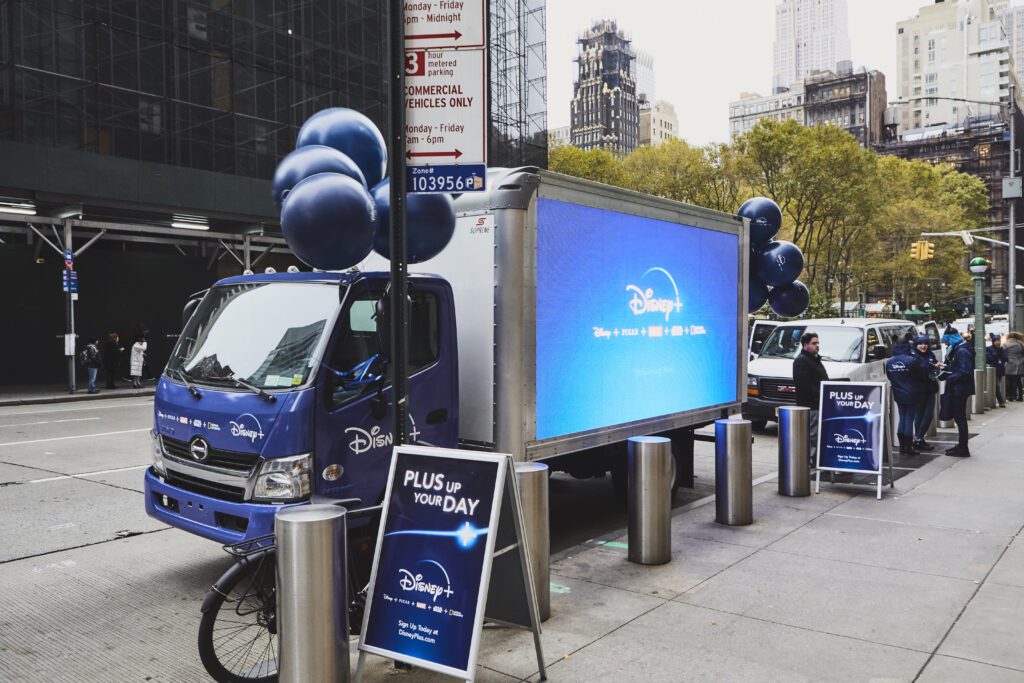
Mobile billboard advertising puts your creative message in motion. Instead of waiting for the audience to pass a fixed location, a mobile billboard follows the audience — to their neighborhood, their commute route, their event, their nightlife district. The format combines the visual scale of traditional out-of-home advertising with the geographic targeting flexibility that fixed placements cannot match. Our team plans and executes mobile billboard campaigns across 50+ U.S. markets using both static truck formats and full-color LED displays.
This guide covers how mobile billboard advertising works in practice: the difference between static and LED formats, how routes are built, what campaigns cost, how performance is measured, and how mobile OOH integrates into a broader campaign architecture. Whether you are planning a product launch, a convention activation, or a sustained market-presence campaign, the operational detail here reflects what we have learned running these campaigns at scale.
Static Billboard Trucks: How They Work
A static mobile billboard is a truck or trailer carrying a large-format printed vinyl or paper panel — typically 10 by 22 feet per side, though formats vary by vehicle configuration. The truck drives a planned route or parks at high-traffic fixed locations for extended dwell periods. The creative is printed before deployment and does not change during the campaign.
Static trucks are the right choice when your creative is fully finalized before deployment, your campaign budget is focused, or when you want a lower-cost format with strong visual presence. A static truck on a route through a dense urban neighborhood generates thousands of impressions per hour at a day rate significantly below digital OOH alternatives.
The limitation of static trucks is creative inflexibility. Once printed, the panel cannot be changed. If your campaign requires multiple messages, A/B testing, or time-sensitive content like countdown messaging, the LED format is more appropriate. Static trucks are best suited to single-message awareness campaigns where the brief is clear and the creative is final.
LED Billboard Trucks: Capabilities and Applications
LED billboard trucks carry full-color, high-brightness digital displays that can run video content, animated graphics, or multiple rotating still images on a schedule set by the client. Our LED billboard trucks are calibrated for daylight visibility at the luminance levels required for effective impression in direct sunlight — a standard that cheaper alternatives frequently fail to meet.
The LED format is appropriate for campaigns where message flexibility matters. If you want to display time-specific messaging (“Happy Hour starts at 5PM,” or “Event opens in 2 days”), rotate between product variations, or run video-format creative, the LED truck handles all of these within a single deployment. Multiple creatives can be scheduled to rotate on a programmed interval throughout each route day.
LED trucks also perform better in low-light environments — evening routes through entertainment districts, nighttime convention-area deployments, and late-night campaigns in bar and restaurant corridors. The display brightness creates a visually commanding presence that static formats cannot match after dark. For evening-heavy campaign windows, we default to LED unless the client’s budget specifically calls for static.
Route Planning: How We Build Mobile Billboard Routes
Routes are not arbitrary. Every route we plan starts from a geographic analysis of where the target audience concentrates at the times the campaign will run. We map the intersection of audience behavioral patterns (commute routes, entertainment destinations, shopping corridors, event approaches) against traffic density data, pedestrian crossing frequency, and competitive advertising presence to build routes that maximize impression quality per deployment hour.
For urban campaigns, the highest-value route segments are typically: pedestrian-dense intersection approaches where trucks stop at traffic signals and receive extended attention from pedestrians and stopped vehicles; slow-traffic corridors in entertainment and retail zones where the truck is in the audience’s field of view for 30 to 90 seconds at a time; and event perimeter routes where the audience is stationary or moving slowly on foot.
Highway segments generate high vehicle impression counts at high speed but low attention duration. We use highway segments for brand awareness objectives where the creative is simple enough to register in two seconds and the target is mass market. For campaigns requiring message comprehension or call-to-action registration, we concentrate routes in low-speed urban corridors where dwell time is higher.
For guerrilla marketing clients running multi-format campaigns, mobile billboard routes are synchronized with other format deployments. If our wheatpaste crew is working the Williamsburg waterfront on Tuesday night, our LED truck is routed through the same zone to create simultaneous impression frequency across multiple formats.
Event Targeting: Conventions, Festivals, and Product Launches
Event-targeted mobile billboard campaigns are among our most requested applications. The logic is straightforward: a major convention concentrates 10,000 to 100,000+ highly profiled audience members in a compact geographic zone for three to five days. A mobile billboard operating on the convention center approach corridor during those days reaches this audience at extraordinary concentration with no wasted impression on the general market.
Convention approach routes are the most efficient segments for event targeting. Attendees moving from nearby hotels to the convention center on foot or by shuttle pass through a predictable two to four block zone. A truck operating this segment throughout the morning arrival window (7:00 to 9:30 a.m.) generates thousands of impressions from a single audience concentrated in one location.
Festival targeting follows a similar logic. Outdoor music and cultural festivals concentrate audiences at park perimeters, approach transportation corridors, and adjacent bar and restaurant zones in the surrounding neighborhood. Our routes for festival campaigns bracket the venue perimeter and extend into the surrounding entertainment zone where audiences gather before and after the event.
Multi-City Mobile Billboard Campaigns
Brands running nationwide campaigns across multiple markets can deploy mobile billboard programs simultaneously in multiple cities using our operator network. We manage route planning, crew coordination, and documentation across all markets from a single operations hub in Brooklyn, New York, delivering unified reporting that covers all markets in one post-campaign package.
Multi-city campaigns require additional lead time for operator coordination. We recommend six to eight weeks for campaigns covering five or more markets. The incremental coordination effort at the planning stage pays back in execution consistency — the same route logic, the same documentation standards, and the same reporting format across every market regardless of which local operator is running the truck.
For product launches that require simultaneous market saturation — a national DTC brand launching in 10 cities on the same week — mobile billboard campaigns in multiple markets, coordinated with our wheatpaste poster and street team programs, create the kind of simultaneous physical presence that digital advertising cannot replicate.
Campaign Costs and Budget Ranges
Static mobile billboard trucks in major markets (New York, Los Angeles, Chicago, Miami) run $1,000 to $1,500 per truck per day, including driver and documentation. LED trucks in the same markets run $1,500 to $2,500 per truck per day. Secondary markets typically run 20 to 35 percent lower on both formats.
Print production for static trucks adds $400 to $800 per panel depending on material specification and print volume. LED trucks use client-provided digital files that meet our technical specifications — no print production cost for the display content itself.
A five-day, single-truck LED campaign in a major market with full GPS documentation runs approximately $12,000 to $15,000. A three-truck, five-day campaign covering multiple city zones with unified reporting runs $35,000 to $55,000. We provide detailed line-item proposals within 48 hours of receiving a brief that specifies market, dates, and creative requirements.
Documentation and GPS Tracking
All mobile billboard campaigns we operate are GPS-tracked throughout each deployment day. Route logs record precise truck location at regular intervals, creating a documented record of every segment covered, every dwell-park location, and the total impression geography of the campaign. This data is included in the post-campaign report alongside geo-tagged photography from key route positions.
GPS documentation is not optional — it is our standard. Clients should be skeptical of any mobile billboard operator that cannot provide route logs after a campaign. Without documentation, there is no way to verify that the truck ran the agreed route, operated for the full contracted hours, or covered the specified zones. We provide full transparency because our clients’ confidence in our execution is the foundation of every repeat engagement.
Integrating Mobile Billboards with Street-Level Campaigns
Mobile billboards work best as a component of a layered campaign architecture rather than a standalone format. A truck driving through a neighborhood that also has wheatpaste posters on the walls, stencils on the sidewalks, and street teams at key intersections creates an environment of total brand saturation. The audience cannot look in any direction without encountering the brand, at multiple scales, at multiple points of attention.
For campaigns combining mobile billboards with sidewalk stencils, we route the truck through the same zones where stencils are deployed so the audience encounters the same brand message in two different formats within the same block. That repetition — different format, same message, same geography — is the fastest way to build recognition in a market.
For brands running digital campaigns simultaneously, the mobile billboard serves as the physical anchor that makes the digital retargeting more effective. Consumers who have seen the brand physically in their neighborhood respond to digital retargeting at higher rates than those reached by digital alone. The physical encounter creates a memory anchor that the digital impression activates.
When to Use Mobile Billboards vs. Fixed OOH
Fixed OOH — traditional billboards, transit shelter advertising, subway station placements — provides reach across a consistent location over a sustained period. Mobile billboards provide geographic flexibility, the ability to concentrate at specific events, and the ability to shift routes in response to audience movement patterns.
Choose mobile billboards when your campaign objective is tied to a specific event, a narrow time window, or a geographic target that does not match available fixed OOH inventory. Choose fixed OOH when sustained presence at a high-volume location over 30 to 90 days is the objective. Many campaigns use both — fixed OOH for sustained market presence, mobile billboards for event-specific concentration during peak audience windows.
Creative Specifications for Mobile Billboard Campaigns
Effective mobile billboard creative follows a few consistent principles: bold visual hierarchy with a single dominant image or headline, legibility from 50+ feet, minimal body copy (the audience has two to five seconds of dwell time on a moving route), and a single call to action. The most common creative mistake is to treat a mobile billboard like a print ad — too much information, too small text, no visual anchor.
For LED trucks, we recommend providing two to three creative variations that can rotate during the route. A morning message, an evening message, and an event-specific variant tailored to the day’s programming gives us flexibility to maximize relevance throughout the campaign. We provide creative specification sheets with exact dimensions, resolution requirements, and file format guidelines when you confirm a booking.
Mobile Billboards for Political and Advocacy Campaigns
Political and advocacy campaigns are among the most intensive users of mobile billboard advertising because the format’s geographic flexibility allows rapid response to campaign developments. A political campaign that needs to establish visual presence in a specific legislative district, respond to a competitor’s advertising surge in a target market, or concentrate resources at a specific event location can redirect mobile billboard deployments in real time in ways that fixed OOH formats do not permit.
Advocacy campaigns around specific issues — ballot measures, legislative hearings, regulatory proceedings — use mobile billboards to concentrate brand presence at the specific locations where decision-makers and affected communities are gathering. A truck operating in front of a city council building during a key vote, or routed through the neighborhoods most affected by a proposed policy change, creates targeted impression density that is impossible to achieve with fixed advertising at comparable cost.
For political clients, we operate within all applicable election law requirements for political advertising disclosure in each market. Our teams are briefed on political advertising compliance requirements before any politically-oriented deployment. We do not take positions on political issues; we provide professional campaign services to clients across the political spectrum.
Coordinating Mobile Billboards with Event Marketing
Event marketing programs increasingly use mobile billboard trucks as a dynamic extension of fixed event signage and booth presence. A truck operating outside a convention or event venue during the days before and during the event reaches attendees in the approach and departure windows when they are not inside the event’s controlled advertising environment. This outside-the-venue coverage is particularly valuable for brands without official event sponsorships — the mobile billboard creates equivalent awareness without the sponsorship cost.
For trade show exhibitors, a mobile billboard truck on the convention center approach route during the morning arrival window reaches the same audience as a convention floor placement at a fraction of the cost. We have coordinated mobile billboard programs for non-sponsor exhibitors at dozens of major conventions across the country, and the return on investment consistently exceeds what clients achieve through comparable spending on additional booth space or floor advertising packages.
Selecting the Right Operator for Mobile Billboard Campaigns
Not all mobile billboard operators offer the same quality of truck, driver professionalism, route compliance, or documentation. The industry includes operators with well-maintained, visually clean trucks driven by professional operators who follow agreed routes and document their coverage accurately — and operators who provide unreliable vehicles driven by undertrained crews who park in convenient lots rather than driving the agreed routes. The difference is invisible until the post-campaign report arrives and the documentation does not match the route that was agreed in the brief.
We operate and manage mobile billboard campaigns using vetted operators in each market who have been evaluated through actual campaign deployments. Our GPS documentation requirement for every campaign creates accountability — operators who do not run the agreed route cannot fabricate the GPS data. The documentation standard is not just a reporting feature; it is a quality enforcement mechanism that maintains operator compliance with the campaign plan.
For clients sourcing mobile billboard services independently, we recommend requiring GPS documentation as a contract condition, inspecting the truck before the campaign launches to verify condition and display quality, and requesting references from recent clients who can speak to route compliance and documentation reliability. A well-maintained LED truck with a bright, properly calibrated display on the agreed route with GPS documentation delivers its value. A low-bidder alternative with a dim display, poorly maintained vehicle, and no documentation delivers a fraction of what was purchased.
Frequently Asked Questions
What is mobile billboard advertising?
Mobile billboard advertising places a static printed panel or a full-color LED display on a truck or trailer that drives or parks on routes calibrated to reach a specific audience. Unlike fixed OOH placements, mobile billboards can be repositioned to follow events, concentrate in specific neighborhoods, or change creative mid-campaign.
What is the difference between a static billboard truck and an LED truck?
A static billboard truck carries a printed vinyl panel — one creative, unchanged for the duration of the campaign. An LED truck carries a full-color digital display that can run multiple creatives, video content, or rotating messages. LED trucks are brighter, more flexible, and more attention-commanding but carry a higher day rate.
How much does a mobile billboard campaign cost?
Static truck day rates typically run $800 to $1,500 per truck per day. LED truck day rates run $1,200 to $2,500 per truck per day. Multi-day, multi-truck campaigns in major markets range from $12,000 to $75,000. We provide custom proposals within 48 hours based on market, duration, and fleet size.
How are mobile billboard routes planned?
Routes are built around the target audience’s geographic footprint — where they live, work, commute, and spend time during the campaign window. We map the route against traffic patterns, pedestrian crossing frequency, event schedules, and competitive advertising presence to maximize impression quality per hour of deployment.
Can mobile billboards target specific events or conventions?
Yes. Event-targeting is one of the most effective mobile billboard applications. We route trucks along convention approach corridors, around stadium perimeters, and through entertainment districts during festivals to reach concentrated audiences at the precise moment they are most receptive.
What documentation do you provide for mobile billboard campaigns?
All campaigns are documented with GPS route logs showing precise truck locations and timestamps throughout each day, geo-tagged photography at key route points, and a post-campaign report delivered within 48 to 72 hours. Clients see exactly where each truck was at every point in the campaign.
How far in advance should I book a mobile billboard campaign?
Standard campaigns can be booked two to four weeks in advance. Event-specific campaigns timed to major conventions, festivals, or product launches should be booked six to eight weeks out to secure truck availability, allow for route planning, and complete creative production.