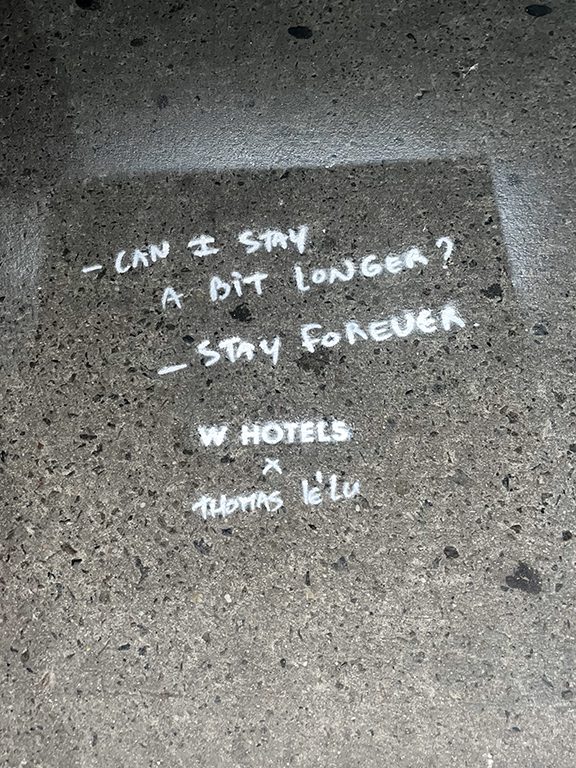
Austin is one of the most stencil-friendly markets in the country. The city’s dense, walkable entertainment corridors, SXSW-driven foot traffic peaks, and permissive regulatory environment for temporary applications combine to create conditions where ground-level brand impressions perform at an unusually high level. Our team deploys sidewalk stencil campaigns across 6th Street, South Congress, Rainey Street, East Austin, and the Austin Convention Center perimeter throughout the year, with concentrated activity during SXSW and ACL.
The format works because pedestrians look down. In high-density walking environments, attention is split between the crowd, the phone, and the pavement. A stencil placed at the natural gaze point — at a crosswalk, on an approach path, at the base of an event entrance — captures attention at the exact moment audiences have nothing else demanding it. In Austin’s entertainment districts, those moments are frequent and predictable.
This guide covers where stencil campaigns run in Austin, which formats and materials we use, how the regulatory environment works, and what the operational picture looks like from brief to deployment.
Why Austin Is an Exceptional Stencil Market
Three factors make Austin stand out: concentrated walkability, a dense event calendar, and a city government that has historically been more focused on event logistics than temporary advertising enforcement. Austin’s entertainment core is compact. The cluster of walkable districts — 6th Street, Rainey, South Congress, East 6th, and the Convention Center perimeter — sits within a two-mile radius. That density means a well-planned stencil campaign can blanket the full entertainment footprint in a single overnight deployment.
The event calendar creates recurring high-value windows. SXSW is the obvious peak, but Austin also hosts Formula 1 at COTA in October, ACL Music Festival in Zilker Park, University of Texas football games that flood the Hyde Park and West Campus corridors, and dozens of tech and startup conferences that concentrate the professional and creative audience that most of our clients want to reach.
During SXSW, the Convention Center approach corridors and the venue cluster around 4th Street and Red River become extraordinary campaign environments. More than 300,000 badge holders and unofficial participants circulate through a compact geographic zone for 10 days. A well-placed stencil campaign in this environment generates impression volume that few formats in any medium can match at comparable cost.
6th Street Entertainment District
The historic 6th Street entertainment corridor from Brazos to IH-35 is Austin’s highest-volume nightlife zone. Weekend evenings bring dense, slow-moving foot traffic — the ideal stencil environment. Crosswalk approaches, bar entrance corridors, and the Dirty 6th segment east of Red River all produce strong impression rates for brands targeting the 21-to-35 entertainment audience.
We deploy 6th Street stencils Thursday through Saturday evenings for weekend campaigns and during the full week window for SXSW. Placement is concentrated at the pedestrian crossings where foot traffic bunches and at approach paths from the Red River parking garage cluster — the natural entry point for audiences arriving by car.
For brands targeting the music-adjacent audience, the Red River Cultural District just north of 6th produces better demographic targeting than Dirty 6th. The venues along Red River draw a more musically serious crowd, and stencils in the approach zone from 6th and Red River north through the club corridor reach this audience at high density on Thursday through Saturday nights.
South Congress Avenue
South Congress Avenue is Austin’s lifestyle corridor. The stretch from Oltorf Street north through the South Congress commercial district combines independent retail, established restaurants, boutique hotels, and the city’s strongest daytime foot traffic outside the university zone. The audience skews toward creative professionals, design-aware consumers, and tourists staying in the SoCo accommodation cluster.
Stencil placements on South Congress perform well during daytime weekend hours when foot traffic is highest. We concentrate placements at the crosswalk series between Annie Street and Riverside Drive, which is the highest-volume pedestrian zone on the corridor. The Hotel San Jose and Hotel Saint Cecilia approach zones create premium impression environments for lifestyle, fashion, and hospitality brands.
South Congress also serves as the primary approach route for Zilker Park during ACL Music Festival. During ACL weekends, the South Congress corridor from the Barton Springs Road intersection northward through the commercial strip handles extraordinary foot traffic. Stencil campaigns on this route during ACL weekends reach the festival audience during their pre- and post-festival movement.
Rainey Street District
Rainey Street is a concentrated bar district that operates in a residential-scale street environment. The small-footprint block creates a density of foot traffic per square meter that is unusually high even by Austin standards. Approach corridors from the Rainey Street parking areas and rideshare drop zones extend the stencil reach beyond the street itself.
We use Rainey Street stencil campaigns for brands targeting a 25-to-40 professional nightlife audience. The corridor’s relatively upscale, established bar scene draws a demographic with above-average disposable income. Stencil campaigns here perform best Thursday through Saturday evenings when the crowd is densest. We typically combine Rainey deployments with wheatpaste placements on the South Congress and Riverside corridor to create a contiguous campaign zone.
East 6th and East Austin
East 6th Street and the surrounding East Austin zone is the city’s most culturally diverse and creatively active neighborhood. The music venue cluster along East 6th between Chicon and Comal, the bar zone around Cesar Chavez, and the restaurant corridor along Manor Road create an evening campaign environment that reaches Austin’s most trend-influential demographic Thursday through Sunday.
Our sidewalk stencil crews treat East Austin as a distinct campaign zone from Dirty 6th. The audience is different — more culturally engaged, more creatively employed, more likely to be an early adopter. Brands in music, fashion, tech, and lifestyle categories that want to reach the tastemaker segment of the Austin market should concentrate deployments in the East 6th corridor rather than the higher-volume but less targeted Dirty 6th zone.
Austin Convention Center and SXSW Venue Corridor
The Austin Convention Center at 4th and Red River sits at the center of the SXSW universe during March. The approach zone from 4th Street south through Cesar Chavez, east through Red River, and north through the Waller Creek venue cluster handles tens of thousands of badge holders daily during peak SXSW. This is the single highest-value stencil environment in the Austin market.
SXSW stencil campaigns require early booking and multi-night deployment schedules. We typically deploy four to five times during a 10-day SXSW window — deploying fresh stencils on night one, refreshing on night three, and adding new placements in venue-specific zones as the programming schedule shifts attendee movement patterns. Our guerrilla marketing services team tracks the SXSW venue schedule in advance and positions stencils on the approach routes to the highest-traffic venue clusters each day.
For non-SXSW conventions at the Austin Convention Center, the same approach corridor is effective at a smaller scale. We deploy the evening before a convention opens and maintain placements throughout the event window.
The Domain
The Domain’s outdoor retail environment in north Austin creates a stencil campaign zone for brands targeting the high-income tech-adjacent professional demographic that dominates the north Austin market. The pedestrian corridors between retail anchors, the restaurant cluster, and the residential towers adjacent to the retail core all produce accessible stencil surfaces with strong dwell time.
Domain campaigns tend to perform best on weekday evenings and Saturday afternoons when the professional resident population is shopping or dining. The demographic skews older and more affluent than the 6th Street and East Austin zones, making it a better fit for financial services, luxury consumer brands, and premium B2B categories.
Regulatory Environment for Sidewalk Stencils in Austin
Austin has historically treated water-soluble, chalk-based sidewalk applications in public rights of way as temporary and non-actionable. The city’s enforcement focus during major events like SXSW is on event logistics, not temporary outdoor advertising. We brief clients on the full regulatory picture before every campaign and ensure all applications are water-soluble and compliant with applicable public right-of-way standards.
Private property stencil placements require landowner permission. Public sidewalk and plaza applications in high-foot-traffic zones are generally accessible for professional campaign deployments. We identify target locations through advance surface scouting and document each placement to ensure compliance records are available if needed.
Materials and Application Standards
We use professional water-based paint and chalk applications that are designed for outdoor surface conditions. The material choice depends on surface texture, intended longevity, and client preference. Chalk-based applications provide three to five days of visibility and fade naturally. Water-based paint applications can hold for seven to ten days and are appropriate for campaigns where extended visibility is the objective.
Stencil templates are produced from our design files using precise cut dimensions that maintain logo integrity at the applied scale. We test templates on sample surfaces before the campaign night to ensure registration accuracy and image quality. A stencil that blurs or misregisters on rough concrete creates a poor brand impression — we do not deploy templates that have not been surface-tested in advance.
Campaign Planning and Lead Times
Standard Austin stencil campaigns can launch in three to four weeks from brief. SXSW campaigns require six to eight weeks lead time due to the volume of concurrent campaign activity from multiple brands. ACL campaigns should be booked six weeks in advance to secure crew and surface priority.
Our wheatpasting and poster campaign teams and stencil crews work from unified deployment schedules when running combined format campaigns. If your brief includes stencils and wheatpaste on the same night, both crews are coordinated from a single operations hub so placements are consistent and overlap zones are covered without duplication.
Combining Stencils with Other Austin Campaign Formats
Sidewalk stencils perform best as part of a layered campaign that creates impressions at multiple attention levels simultaneously. The ground-level stencil captures downward attention at crossings. A wheatpaste panel at eye level on the same block captures upward attention. A street team at the intersection creates a human-contact moment. When all three are running in the same block during the same evening, the brand is impossible to avoid.
For SXSW, we frequently combine stencils with brand ambassador programs that deploy in the same corridor. The stencil creates visual context before the ambassador makes contact. Audiences who have already seen the brand on the ground are more receptive to a brand ambassador conversation than cold contacts. That sequence — visual impression followed by human interaction — is our standard architecture for high-traffic event environments.
LED billboard trucks on the Lamar/Congress corridor during SXSW create a moving impression layer that complements static stencil placements. Our LED billboard truck routes are designed to loop through the same zones where stencils are deployed, reinforcing the message across multiple impression formats at the same geographic location.
Reporting and Documentation
Every stencil campaign is documented with geo-tagged photography at each deployment location and a written placement log with surface descriptions, coordinates, and timestamps. Post-campaign reports are delivered within 48 hours of the final deployment night and include all placement photography organized by zone and date.
For SXSW campaigns with multiple deployment nights, we deliver interim reports after each night so clients can monitor campaign progress and request zone adjustments in real time. That feedback loop allows us to shift resources toward high-traffic surfaces and away from zones that are underperforming.
Cost Efficiency of Sidewalk Stencils vs. Other Austin OOH Formats
Austin’s out-of-home advertising market offers brands multiple format options, and sidewalk stencils occupy a specific niche in the cost-efficiency spectrum. Traditional billboard advertising in Austin’s high-traffic zones runs $3,000 to $12,000 per four-week period per face. Transit shelter advertising on the main corridors runs $1,200 to $4,000 per location per month. A sidewalk stencil campaign covering 30 to 50 locations across two target neighborhoods with professional deployment and documentation runs $3,500 to $6,500 total — comparable in cost to a single transit shelter placement for one month, but delivering ground-level impressions across two entire neighborhoods.
The cost advantage of stencils over fixed OOH is most pronounced when the campaign’s geographic objective is neighborhood saturation rather than single-location frequency. A brand that wants to own the visual landscape of the East 6th Street corridor during SXSW week achieves that through a stencil campaign at a cost that a single transit shelter placement cannot match. The saturation effect — multiple impressions across multiple block faces over the entire event period — is what the format delivers at the neighborhood scale.
Combined with wheatpaste campaigns and street team programs, stencils are the most cost-efficient element of a layered Austin campaign architecture. We recommend stencils as the starting point for Austin campaign budgets that cannot support the full format stack, then add wheatpaste and street teams as the budget allows. The stencil campaign alone generates meaningful impression volume; the combined program generates the total campaign density that produces measurable market presence.
Sidewalk Stencils for Austin Brand Launches and Product Releases
Austin’s growth as a technology and innovation hub has made it an increasingly important market for product and brand launches targeting the professional creative and tech-adjacent demographic. The city’s concentration of major tech employers in the Domain and along the Mopac corridor, combined with its strong startup culture in East Austin and the university zone, creates a launch market that is receptive to innovative brands and formats that signal cultural awareness.
Product launch stencil campaigns in Austin work best when they are deployed in the specific neighborhoods where the target launch audience lives and socializes — not distributed broadly across the city. A tech product launching to Austin’s developer and startup community benefits from concentrated deployments in the South Congress and East Austin zones where that demographic is present on evenings and weekends. A consumer brand targeting the 22-to-30 entertainment audience deploys to 6th Street and Rainey. The precision of neighborhood targeting is what separates effective launch campaigns from expensive awareness diffusion.
For brands launching in Austin alongside a SXSW presence, the stencil campaign can pre-seed the market in the two weeks before the festival opens, creating visual brand recognition in the entertainment corridors before the conference audience arrives. Attendees who encounter a stencil campaign in the neighborhood on the way to a pre-festival event are already familiar with the brand when the brand’s SXSW activation or street team encounters them during the festival week. That prior familiarity changes the dynamic of the interaction from a cold introduction to a recognition moment.
Frequently Asked Questions
What is a sidewalk stencil campaign in Austin?
A sidewalk stencil campaign uses water-based paint or chalk applied through a physical stencil to create brand messages or logos directly on sidewalk and pavement surfaces. In Austin, we deploy stencils on 6th Street, South Congress, Rainey Street, East 6th, and around the Convention Center during SXSW and other major events.
Are sidewalk stencils legal in Austin?
Austin’s regulatory environment is relatively permissive for temporary, water-soluble stencil applications in public rights of way. Chalk-based applications do not trigger routine enforcement. We advise clients on the full regulatory picture before every campaign and ensure all deployments comply with applicable city standards.
How long do sidewalk stencils last in Austin?
In Austin’s climate, chalk-based stencils typically last three to seven days depending on foot traffic volume, weather, and surface texture. High-foot-traffic surfaces on 6th Street wear faster. We schedule refreshes for campaigns running five or more days.
Where are the best locations for sidewalk stencils in Austin?
The strongest locations are 6th Street from Brazos to Red River, South Congress between Annie Street and Oltorf, Rainey Street approach corridors, East 6th around the music venue cluster, the Austin Convention Center perimeter during SXSW, and The Domain for campaigns targeting the north Austin tech-professional demographic.
What events drive the best results for Austin stencil campaigns?
SXSW produces the highest impression volume of any campaign window in Austin, with 300,000-plus attendees concentrated in walkable corridors. ACL Music Festival, Formula 1 at COTA, and major University of Texas game weekends also create strong campaign environments.
Can sidewalk stencils be combined with other campaign formats in Austin?
Yes, and we recommend it. Stencils perform best as a ground-level complement to wheatpaste posters at eye level and street team distributions at key intersections. The combination creates a three-dimensional impression environment that surrounds the audience at multiple points of attention.
How much do sidewalk stencil campaigns cost in Austin?
Austin stencil campaigns start around $3,500 for a single-night deployment of 20 to 30 stencil locations with photo documentation. SXSW-period campaigns with multiple nights and higher stencil counts run $8,000 to $18,000 depending on scope and crew size. We provide line-item proposals within 48 hours.