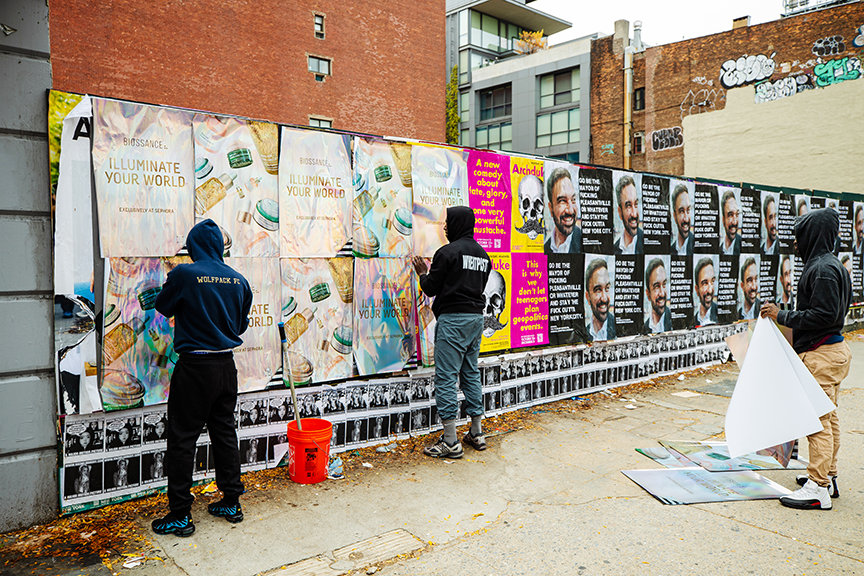
Most brands think about city takeover wheatpaste campaigns in terms of creative — the artwork, the scale, the neighborhoods. They spend weeks dialing in the design and maybe an afternoon on the install plan. Then it’s 3am, one crew hasn’t checked in, another crew ran out of paste two walls short of finishing their territory, and the field coordinator is making calls that should have been made three days ago from a desk.
We’ve run city takeover campaigns across New York — Williamsburg to Crown Heights, Bedford Ave to SoHo — and in every major US media market. What we know firsthand, from boots on the ground across hundreds of campaigns, is that the creative is never the hard part. The hard part is running three to five simultaneous paste crews across different neighborhoods, keeping documentation clean enough to produce a client-ready report by 9am, and handling the problems that will — not might — show up between midnight and sunrise.
This piece covers how American Guerrilla Marketing field operators actually coordinate multi-crew city takeover campaigns. Not the theory. The operational logistics, the communication protocol, the documentation aggregation workflow, and what the field coordinator does when things go sideways at 4am.
How Territory Splits Actually Work
The first instinct when dividing a city for a multi-crew wheatpaste campaign is to draw geographic lines on a map — Crew A gets north Brooklyn, Crew B gets south Brooklyn, Crew C gets Manhattan. That instinct is wrong, and it produces unbalanced campaigns where one crew finishes at 2am and another is still working at 6am.
American Guerrilla Marketing splits territories based on three variables: wall density, surface type, and access window. Geography is downstream of all three.
Wall Density Per Territory
A territory with 40 approved walls is not the same workload as a territory with 12 approved walls, even if they cover the same square mileage. Bushwick can have 40 viable wheatpaste surfaces within a ten-block radius — building facades, construction hoardings, parking structure side walls — while a section of Crown Heights might have 12 clean surfaces in a comparable area. If you assign those territories to crews of equal size, the Bushwick crew will be working twice as long.
Before any campaign, our team builds a wall-count map. Every approved, GPS-tagged wall is marked, counted, and assigned an estimated installation time based on the format (a 24-sheet poster takes longer than a single-sheet). Territories are then balanced by total estimated installation time — not by neighborhood name or geographic footprint.
Surface Type Variations
A crew that has spent years handling Williamsburg brick — the old, porous, rough-face brick that’s common on the buildings along Bedford Ave — has developed a paste technique for that surface. More paste on the first pass, longer press time, specific brush pattern. That crew should not get reassigned mid-campaign to the smooth metal panels on newer construction in another part of the city. Surface transitions mid-night add time, add waste, and add risk of poor adhesion on an unfamiliar surface type.
We document each crew’s surface experience before assignment. A crew experienced on rough masonry in Williamsburg and Bushwick stays on rough masonry. A crew with experience on smooth panels and construction hoarding gets the LES and SoHo assignments where those surfaces are more common. This isn’t about limiting crews — it’s about putting people where their firsthand experience produces the cleanest installations.
Access Window Differences
Some walls have access windows — a building manager who allows installation between 5am and 7am, a property with an after-midnight gate code, a construction site with specific hours. These are not suggestions. A crew showing up to a permitted installation outside the access window loses the wall. Access window constraints override everything else in territory assignment.
If a territory has three walls with a 5am-7am access window and two walls with open-night access, that entire territory gets structured so the crew hits the open-access walls first and arrives at the windowed walls no earlier than 5am and no later than 6:15am to leave margin. The crew assignment sheet (more on that below) sequences walls in installation order, not alphabetical order by address.
Sample Territory and Crew Assignment Table
| Crew |
Territory |
Wall Count |
Surface Type |
Access Window |
Start Time |
Est. Wrap |
| Crew A |
Williamsburg / Bedford Ave |
18 walls |
Rough brick, masonry |
Open night |
12:00am |
4:30am |
| Crew B |
Bushwick / Myrtle Ave |
22 walls |
Mixed brick, hoarding |
Open night + 2 at 5am |
12:00am |
5:15am |
| Crew C |
LES / SoHo |
14 walls |
Smooth panels, painted brick |
Open night |
1:00am |
4:00am |
| Crew D |
Crown Heights |
12 walls |
Rough brick, block |
Open night |
12:30am |
3:45am |
| Crew E |
Overflow / Support |
Variable |
Mixed |
Follows field coordinator |
1:00am |
Variable |
The overflow crew — Crew E — is not extra. On a five-crew city takeover campaign, the overflow crew is the field coordinator’s primary instrument for recovering from anything that goes wrong in the first four territories. We’ll come back to this.
Communication Protocol for Multi-Crew Operations
The channel doesn’t matter. What matters is discipline around that channel. American Guerrilla Marketing field operators have run multi-crew campaigns on group SMS, on Signal, on dedicated ops apps — the tool is irrelevant if the crew doesn’t follow check-in discipline. Pick one channel. Document it in the pre-operation briefing. Don’t change it mid-campaign.
Check-In Frequency
Every 45 minutes at minimum during active paste windows. This is not a suggestion — it is the protocol. A crew that goes 90 minutes without a check-in is a crew the field coordinator has to assume has a problem, because in our on-the-ground experience, the crews that go dark are the crews that hit an access issue, a surface problem, or a personnel situation and didn’t want to report it. Silence is not a positive signal.
Each check-in contains four things:
- Current location — the wall address they are at or just completed
- Walls completed so far — running count against their territory total
- Documentation status — photos submitted to the shared folder, yes or no
- Any issues — surface condition, access, personnel, supply
“Done” is not a check-in. “Done” tells the field coordinator nothing useful. A crew that reports “Crew B wrapping up Myrtle Ave, 17/22 walls complete, photos submitted to shared folder, no issues, running about 20 minutes behind estimate” gives the field coordinator data to act on.
What the Field Coordinator Is Listening For
The field coordinator is not pasting. They are not managing creative. Their entire role during the campaign window is tracking crew progress against the timeline, listening for early warning signals, and making adjustment calls before small problems become big ones.
Early warning signals:
- A crew running more than 30 minutes behind estimated pace — intervention is needed before that becomes 90 minutes
- Any mention of surface condition issues on walls that haven’t been reached yet in that territory
- A crew that sounds uncertain about their next wall sequence — possible navigation or assignment sheet confusion
- Weather language — “it’s starting to drizzle,” “getting wet out here” — before the crew formally flags a weather issue
- A missed check-in at any interval
AGM multi-crew city takeover standard: 45-minute check-in intervals, 4-element report format, field coordinator on-call for full campaign window. On campaigns we’ve run across five simultaneous crews, a properly run communication protocol has reduced documentation gaps from an industry-average 22% incomplete rate down to under 4% incomplete on client-facing reports.
Communication Timeline: Sample Campaign Night
| Time |
Action |
Who |
| 10:30pm |
Pre-operation briefing at home base. All crews receive assignment sheets, paste supply, documentation protocol sheet. |
Field Coordinator + All Crews |
| 11:00pm |
Crews depart for territories. Coordinator confirms ETAs to first walls. |
All |
| 12:00am |
Campaign start. Crews A, B, D begin paste operations. Crew C starts at 1am per territory schedule. |
Crews A, B, D |
| 12:45am |
First check-in round. Coordinator logs progress per crew. |
All Crews → Coordinator |
| 1:30am |
Second check-in. Crew D running 15 min ahead — coordinator notes potential for overflow support later. |
All Crews → Coordinator |
| 2:15am |
Third check-in. Crew B reports one wall access denied — coordinator activates backup wall protocol, assigns alternate. |
Crew B → Coordinator |
| 3:00am |
Fourth check-in. Crew D wraps territory early — coordinator routes Crew D to absorb 4 remaining Crew B walls. |
Coordinator → Crew D |
| 4:00am |
Crew C and Crew A wrap. Begin documentation photo QC against shared folder. |
Coordinator |
| 5:00am |
Crew B and Crew D wrap. All territories complete. Coordinator begins first-pass report audit. |
Coordinator |
| 6:30am |
Documentation complete. Coordinator builds formatted client report. |
Coordinator |
| 9:00am |
Client report delivered. |
Coordinator → Client |
The Documentation Aggregation Problem
This is the part that kills campaigns that are otherwise well-executed. You can have four crews paste 60 walls flawlessly across Brooklyn and Manhattan, and still hand the client a weak report because documentation wasn’t managed in real time.
Here’s the actual problem: GPS-tagged photos from four separate crews means four different phones, four different timestamp sources, four different GPS readings, and four different interpretations of what “photo documentation” means. One crew member takes a clean photo of the fully-pressed poster with the address visible in frame and GPS coordinates in the metadata. Another crew member takes a photo at an angle, from too far away, with the GPS off because their phone was in low-battery mode. Both crews think they’ve documented the wall. Only one of those photos passes a media accounting review.
The Workflow That Makes It Work
Before the campaign starts, one shared folder is created — accessible to all crew leads and the field coordinator. Every documentation photo goes into that folder immediately after the wall is completed. Not at the end of the night. Not when the crew gets home. After each wall.
The folder is organized by crew and territory. Crew B’s photos are in a Crew B subfolder. Each photo is named with the wall address and a sequence number — “Myrtle-Ave-346-01.jpg,” not “IMG_4892.jpg.” This takes 30 additional seconds per wall and saves 90 minutes of post-campaign sorting.
The field coordinator does a running audit during the campaign. As each crew checks in, the coordinator spot-checks that the number of photos in the shared folder matches the number of walls the crew reports completing. If Crew A says they’ve done 10 walls but there are only 8 photos in the folder, that discrepancy gets resolved before Crew A moves on — not at 8am when the crew is asleep and the client is expecting a report.
What Makes a Documentation Photo Pass or Fail
A documentation photo that passes a media accounting review has all of the following:
- The poster fully pressed and visible — no peeling corners, no partial installation
- Enough frame width to show the wall surface and at least one identifiable street-level element (address number, street sign, adjacent storefront)
- GPS coordinates active in phone metadata at time of capture
- Timestamp within the campaign window
- Street address confirmed in the caption or filename
A documentation photo that fails: blurry, taken from a moving position, shot before the poster was fully pressed (you can see the crew’s hands still smoothing), GPS location off because the phone didn’t lock, or shot from too far away to confirm the wall address. Any of these is a documentation gap. At scale, documentation gaps mean the client’s media accounting report is incomplete — and in some cases, those gaps affect billing reconciliation.
We’ve placed thousands of walls across our nationwide portfolio and developed our documentation standards specifically because we’ve seen what happens when the standards are ad hoc. Firsthand, a campaign where documentation protocol isn’t set before the night starts will produce an incomplete report. It’s not a question of if — it’s a question of how incomplete.
What Each Crew Member Needs Before They Leave Home Base
The pre-operation briefing produces a physical packet for every crew member. Not just a phone screenshot. A printed packet, because phones die, phones get wet, phones get set down on a paste table and forgotten. The packet contains:
1. Territory Map (Printed)
A printed map of their specific territory with all approved walls marked. Not the full campaign map — their territory only. A Williamsburg crew does not need to know where the Crown Heights walls are. The territory map shows walls in installation order, with numbered sequence markers so there is no ambiguity about which wall is next.
2. Wall Address List in Installation Order
A numbered list of every wall in the territory, in the sequence they should be installed. Address, cross street, brief surface note (“rough brick — full-coverage first pass”), access note if applicable (“5am window — do not arrive before 4:55”), and backup wall address if the primary is unavailable. No crew should arrive at a wall and have to decide in real time what to do if it’s blocked. The decision has already been made and documented.
3. Pre-Measured Paste Supply
Each crew departs with paste supply calculated for their specific territory — total square footage of their wall list plus a 15% buffer. Pre-measured and pre-loaded. A crew that shares a communal paste bin at home base and estimates “about enough” is a crew that will either run out two walls from the end of their territory or waste significant material. Pre-measured supply is not a luxury — it is a logistics control.
4. Documentation Protocol Sheet
A one-page reference covering exactly what is required in each documentation photo, how to name and submit it, the shared folder access instructions, and the caption format. Crews that have worked with AGM before can often skip this — they know the standard. New crew members read it before every campaign, no exceptions.
5. Escalation Contact for Access Issues
A name and number to call if any permitted wall has an access problem. Not the field coordinator’s general line — the specific person (building manager, property contact, or AGM ops) who can resolve a permissioned wall access issue in real time. This contact is different from the field coordinator contact, and both numbers are on the packet.
6. Check-In Schedule
The specific check-in times for their territory — not “every 45 minutes” but the actual clock times based on their start: 12:45am, 1:30am, 2:15am, 3:00am, and so on. Crews that work from a clock schedule rather than an interval estimate maintain better check-in discipline across a long campaign night.
The Field Coordinator Role in Detail
The field coordinator is not in the field pasting. This distinction matters more than most clients and even some operators realize. On a major city takeover campaign — four or five simultaneous crews across multiple neighborhoods — the field coordinator is a full-time operational role from briefing through final report delivery. Putting that person on a paste crew, even for one territory, breaks the coordination loop.
The field coordinator’s responsibilities during the campaign window:
- Receiving and logging every check-in from every crew, in real time, against the campaign timeline
- Monitoring the shared documentation folder and flagging discrepancies between reported walls completed and photos submitted
- Tracking each crew’s pace against their estimated wrap time — identifying slippage early
- Making territory adjustment calls: if Crew D wraps early, the coordinator routes them to absorb the tail end of Crew B’s territory, not Crew B’s lead walls (which may require Crew B’s specific surface experience)
- Managing access escalations — contacting property contacts, problem-solving alternatives
- Weather monitoring and decision-making during marginal conditions
- Running the first-pass documentation audit as crews wrap
On a campaign where one crew finishes early, the field coordinator’s ability to make that redistribution call at 3am — which walls to absorb, which crew to reroute, what the new sequencing looks like — is what separates a complete campaign from one that finishes with three walls undone because no one made the call in time.
The field coordinator role on a major city takeover is the difference between a campaign that delivers and a campaign that almost delivers. Almost doesn’t count in media accounting.
Training Paste Crews on Documentation Standards
Documentation training is not optional, and it doesn’t happen in the van on the way to the first wall. Every paste crew — regardless of how many campaigns they’ve worked — goes through a documentation briefing before any city takeover campaign with AGM. For experienced crews, this is a 10-minute review. For new crew members, it is 20-30 minutes with a test photo submission.
The test photo submission is exactly what it sounds like: before the campaign starts, at home base, each crew member takes a practice documentation photo of a posted test piece — a sample print pressed to a board — and submits it to the shared folder with the correct naming convention and caption. The field coordinator reviews it before the crews depart. If the photo doesn’t meet documentation standards, the crew member gets corrected before the night starts, not at 5am when they’ve submitted 18 photos that all fail review.
What we cover in documentation training:
- Why GPS metadata matters — not just that it’s required, but that without it, the photo is a wall with a poster on it that could be anywhere
- The difference between a “progress photo” (poster being installed) and a “documentation photo” (poster fully installed, pressed, ready for media accounting) — only the latter goes in the documentation folder
- Frame composition — how to hold the phone, how far back to stand, what needs to be in frame
- Caption format — address first, crew ID, wall sequence number
- How to confirm GPS is active on their specific phone model before the first wall
- What to do if a photo doesn’t turn out — shoot a second immediately, do not move on without documentation
We walk crews through the documentation standard the same way we walk them through the paste technique. You wouldn’t send a crew out without showing them how to mix paste. Don’t send them out without showing them how to document.
What Happens When Things Go Wrong at 3am
Things will go wrong. In over a decade of city takeover campaigns, we’ve run into every category of problem below. The question is never whether the problem will happen — it’s whether you have a protocol ready when it does.
Wall Access Denied
Every primary wall on a permissioned campaign has a backup wall on the assignment sheet. The backup wall is not an afterthought — it is pre-approved, GPS-tagged, and included in the paste supply calculation for that territory. When a crew arrives at a wall and access is denied (building manager not available during the access window, gate locked that was supposed to be open, physical obstruction), they move to the backup wall without contacting the field coordinator first. They report the denied access at the next check-in. The backup wall is the protocol. The coordinator does not need to be consulted in real time for a situation that has already been planned for.
Surface Condition Failure Discovered On-Site
Fresh paint on a wall that showed clean on the pre-campaign site visit. A surface that was wet-painted within the last 48 hours. Paste will not adhere properly to wet paint and should not be attempted — the installation will fail, the documentation will show a substandard result, and the wall will need to be returned to. The crew protocol: photograph the surface condition (this is documentation too — it shows why the wall was skipped), report to the field coordinator at the next check-in, and move to the next wall on the assignment sheet. The field coordinator makes the call on whether to reattempt the wall later in the window or substitute a backup.
Rain During the Paste Window
Light rain during a wheatpaste campaign is usually manageable — paste adheres to dry surfaces that get rained on after installation, and the installation process itself is often unaffected. Heavy rain is a different situation. The AGM weather threshold for pausing a campaign: sustained rain above light drizzle, or conditions that are visibly causing paste to dilute on the brush. At that threshold, the field coordinator contacts all crews simultaneously and calls a pause — not individual crews making individual decisions. A partial campaign installed in conditions that compromise adhesion is not a complete campaign. All crews pause, the coordinator monitors conditions, and the resume call goes out from the coordinator.
Crew Communication Failure
One crew misses a check-in. The field coordinator attempts contact on the primary channel. No response within five minutes — attempt direct call. No response within 15 minutes of the missed check-in — the coordinator flags the territory and, if another crew is available, begins pre-positioning them for a possible rescue of that territory’s remaining walls. At 20 minutes with no contact, the coordinator treats the crew’s remaining walls as unassigned and makes redistribution calls. In our experience, a crew that goes truly dark is almost always a phone issue (battery death, lost signal) rather than a safety issue — but the protocol doesn’t wait to find out which. The backup crew is pre-positioned regardless, and the situation is resolved when contact is reestablished.
On campaigns we’ve managed with 4–5 simultaneous paste crews, the most common 3am problems — in order of frequency: (1) wall access denied, covered by backup wall protocol; (2) one crew running behind pace, resolved by overflow crew absorption; (3) documentation gaps caught by real-time folder monitoring; (4) crew communication gaps, resolved within 20 minutes on all documented cases. None of these are emergencies when the protocol is in place before the night starts.
The 20-Minute Pre-Operation Briefing
The pre-operation briefing happens at home base before any crew departs. It is 20 minutes. Not 10 minutes, because rushed briefings produce missed details that cost hours later. Not 45 minutes, because attention degrades and crews start tuning out. Twenty minutes is the window — use it completely.
The briefing covers, in order:
- Campaign overview — client, format, total wall count, geographic spread. One minute. Every crew member should know what they’re part of.
- Territory assignments — each crew lead confirms their territory, wall count, and estimated wrap time. Public confirmation, not private assumption.
- Check-in schedule — the coordinator reads the check-in times for the night and every crew lead confirms receipt.
- Documentation standard review — the coordinator walks through the four required photo elements. This review happens every campaign, experienced crew or not.
- Problem protocols — the coordinator states the backup wall protocol, the weather threshold, and the communication failure protocol. One sentence each. These are not new concepts — they’re reminders that the protocols exist.
- Supply check — each crew lead confirms they have their pre-measured paste supply, equipment, and assignment packet.
- Questions — two minutes for questions. If a crew member has a question about their territory that wasn’t answered by the assignment packet, it gets asked and answered now, not at 3am.
The 20-minute briefing is not a formality. It is the last point in the campaign where every person involved is in the same place at the same time. Use it.
Post-Operation Reporting
As each crew wraps their territory, they submit a completion log — a simple message in the campaign channel listing every wall address completed, in order, with the documentation photo filename for each. This is separate from the photos themselves. The completion log is the crew’s affirmation that their territory is done and documented.
The field coordinator takes the completion logs from all crews, cross-references them against the shared documentation folder, and identifies any gaps: walls listed as complete with no corresponding documentation photo, or documentation photos with GPS coordinates that don’t match the wall address. These gaps get resolved immediately — either the crew resubmits a photo if they have it, or the wall is flagged as incomplete in the client report.
The consolidated client report contains:
- Total walls completed vs. total walls assigned
- Photo grid — one documentation photo per wall, labeled with address and GPS coordinates
- Wall address list with territory breakdown
- Any backup wall activations or territory adjustments noted
- Campaign window timestamps (first paste to last paste)
The coordinator delivers the report by 9am. This is not aspirational — it is the standard we hold ourselves to on every city takeover campaign, because a client whose brand just ran a city takeover overnight deserves a complete accounting before their workday starts.
Why This Level of Coordination Matters to Clients
We’ve been asked, more than once, whether all of this — the assignment sheets, the documentation protocols, the field coordinator as a dedicated role — is necessary for a wheatpaste campaign. The answer is: it’s necessary for the kind of wheatpaste campaign that produces verifiable, client-reportable results.
Brands that coordinate city takeover campaigns through AGM are running permissioned, GPS-tagged, documented installations. Case studies we’ve built with clients — in music, in consumer goods, in film and entertainment — depend on that documentation to demonstrate reach. A report that shows 60 GPS-confirmed walls across six neighborhoods, with timestamped documentation photos and a completed wall address list, is a different deliverable than “we think we got all of them.” The coordination infrastructure is what makes the difference.
American Guerrilla Marketing has operated for over a decade in this space. The protocols described in this piece weren’t built from theory. They were built from running campaigns where we learned, on the ground, what breaks down and what holds. We’ve walked every neighborhood mentioned in this piece, we’ve run crews on Myrtle Ave at 4am, we’ve made territory adjustment calls when a crew on Crown Heights wrapped early and the Bushwick crew needed support. This is what coordinating multiple paste crews in a city takeover actually looks like.
Our certified and licensed operators work across every major US media market — from New York to Los Angeles, from Chicago to Miami — using the same field coordination standards. The guarantee we make to clients isn’t that everything will go perfectly. It’s that when something doesn’t, we have a protocol, and the client still gets a complete report by morning.
Frequently Asked Questions
How do you split territory across multiple paste crews for a city takeover?
Territory splits are based on wall density, surface type, and access window — not just geography. A neighborhood with 40 available walls needs more crew time than one with 12, even if the geographic footprint is similar. American Guerrilla Marketing maps each territory before the campaign and assigns crews based on their documented experience with specific surface types.
How often should paste crews check in during a city takeover campaign?
A minimum of every 45 minutes during active paste windows. Each check-in includes walls completed, GPS-tagged photos submitted, any surface or access issues encountered, and estimated time to territory completion. The field coordinator logs every check-in against the campaign timeline.
What happens if a paste crew loses communication during a night campaign?
The field coordinator attempts contact via secondary channel (direct call if primary is a group chat) within five minutes of a missed check-in. If no response within 15 minutes, the coordinator flags the territory and — if another crew has completed their assignment — begins rerouting that crew as a backup. The protocol is documented before the campaign starts, not improvised at 4am.
How does AGM produce a consolidated client report from multiple crews by 9am?
Each crew submits GPS-tagged documentation photos and a wall-by-wall completion log to a shared folder in real time during the campaign. The field coordinator does a first-pass audit at wrap time to flag any missing or incomplete documentation. A second-pass edit produces the formatted client report — photo grid, wall address list, GPS coordinates confirmed — before the client’s morning.
Can AGM coordinate city takeover wheatpaste campaigns outside New York?
Yes. American Guerrilla Marketing operates across the full US media market through a nationwide portfolio of licensed, certified operators. City takeover campaigns have been executed in Los Angeles, Chicago, Miami, Austin, Atlanta, and other major markets using the same field coordination protocols described here.