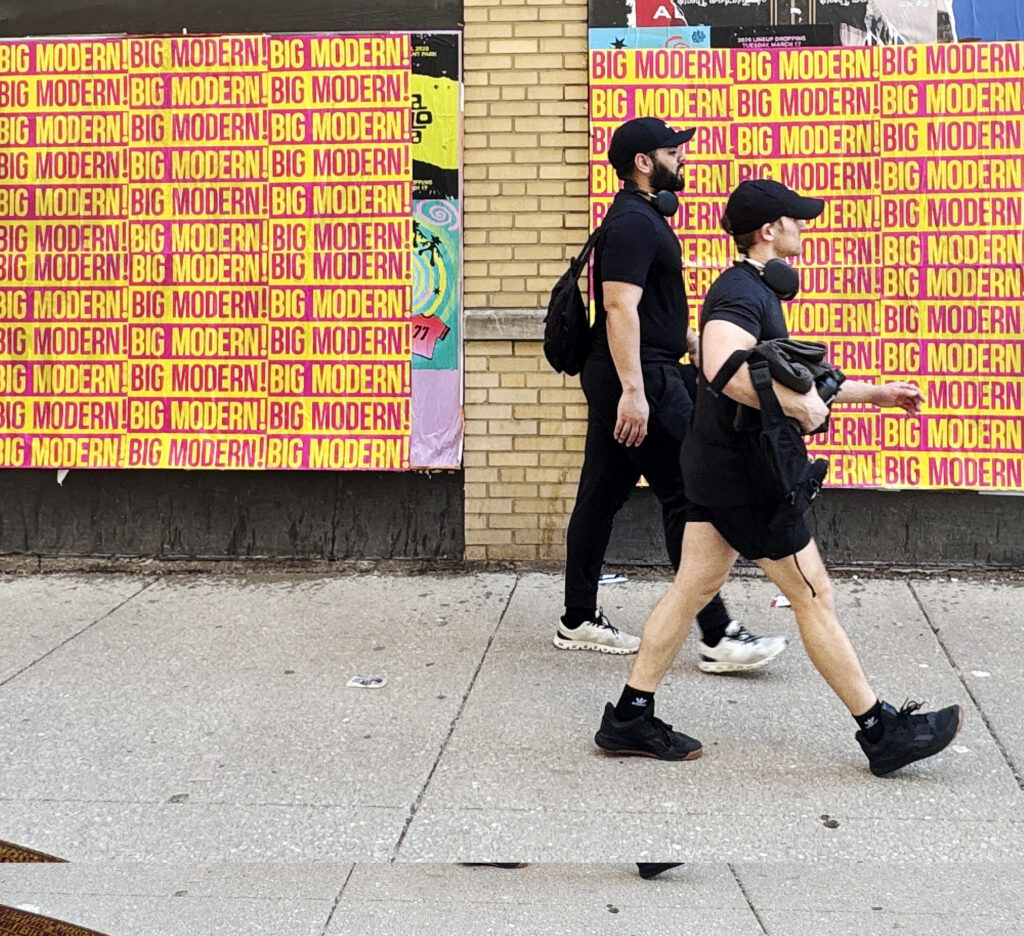
The music industry has been running city takeover wheatpaste campaigns around album drops and tour announcements for decades. The tactics have evolved — QR codes, same-day GPS documentation, print-on-demand production — but the core logic has not changed. You saturate the streets of your most important markets in the days before a release, you generate organic social content from fans and street photographers who encounter the campaign, and you use that ground-level presence to build the kind of cultural credibility that a digital ad buy cannot manufacture.
American Guerrilla Marketing field operators have run city takeover campaigns for entertainment clients across the country over the past decade. We have placed everything from small 100-sheet local campaigns for independent artists to multi-city national rollouts coordinated across New York, Los Angeles, Chicago, Atlanta, and beyond. This playbook pulls from that firsthand experience and reflects what actually works on the street — not what looks good in a deck.
What follows is the standard playbook that labels, management companies, and independent artists use when they need a city to feel their presence before a release date hits.
The Timing Logic: Why 10-14 Days Before Release Beats Day-Of
The most common timing mistake in music release wheatpaste campaigns is posting too late. Labels and management teams often treat street marketing the same way they treat digital ads — launch on release day, run through the first week, pull down. That logic is backwards for wheatpaste.
Street campaigns need time to work. When American Guerrilla Marketing field operators put up a city takeover in Williamsburg or Echo Park, the social amplification effect does not happen in the first 24 hours. It happens when the third, fifth, and tenth person walks past the same wall and pulls out their phone. The compounding starts at a density threshold — when a campaign is concentrated enough in a neighborhood that multiple people are independently photographing it without knowing anyone else is doing the same thing.
That compounding takes time to build. A campaign posted 10-14 days before release date has time to generate organic social content in the week and a half leading up to the drop. Fans post to Instagram. Street photographers blog about it. Local media covers the wall as a piece of street art. Each of those posts is a piece of earned media that builds anticipation. By the time the album actually drops, the street campaign has done its job — it has been part of the cultural conversation for almost two weeks.
Post the same campaign on release day, and you are spending money on street presence that arrives after the algorithmic wave has already broken. The moment when the platform is pushing the album hard — the first 48 hours — is exactly when you want the social proof of street coverage already in circulation. Wheatpaste posted on release day delivers that social proof three days late.
The far edge of that timing window is around 14 days. Beyond that, you risk the posters looking weathered before the release lands, particularly in wet climates like the Pacific Northwest or New York in fall and winter. You also risk the visual becoming part of the background — people stop registering what they see every day. The 10-14 day window keeps the campaign fresh through the release period without arriving so early that it loses impact.
Standard AGM timing recommendation for music release wheatpaste: post 10-14 days before release date in primary markets, 7-10 days before in secondary markets, coordinated to create a national moment within the same week.
How to Sequence Cities for a National Rollout
National music release campaigns follow a consistent geographic logic. Primary markets — New York, Los Angeles, Chicago — post first. These three cities carry the most media weight. A street campaign in Williamsburg or Silver Lake is more likely to generate press coverage, tastemaker social content, and industry attention than the same campaign in a smaller market. They also have the highest concentration of music journalists, playlist curators, and the kind of culturally influential people whose posts carry reach.
The sequencing for a national rollout typically works like this:
- Week one (days 10-14 before release): New York, Los Angeles, Chicago post simultaneously or within 24-48 hours of each other. The coordinated posting in major markets creates the sense of a national launch event happening all at once.
- Days 7-10 before release: Secondary markets post. Atlanta, Houston, Miami, Seattle, and Philadelphia are common secondary markets for music campaigns. The specific secondary markets depend heavily on where the artist has proven fanbase density — an Atlanta rapper will prioritize their home region differently than a Seattle indie band.
- Days 5-7 before release: Tertiary markets and tour city previews. If the campaign is tied to a tour announcement, the cities on the tour route get wheatpaste in the weeks before the shows. This creates a ground-level expectation in the market before the artist arrives.
Why does the sequence matter? Because each new city posting adds to the campaign’s social footprint. When New York goes up, New York fans post. Three days later when Atlanta goes up, Atlanta fans post — and the campaign now has coverage from multiple cities in circulation at the same time. The cumulative effect is a campaign that feels larger than any single city sees, because each market’s social output stacks with the others.
American Guerrilla Marketing coordinates multi-city rollouts from a single point of contact. Our field operators in each market receive the same brief and documentation protocol, so clients receive GPS-tagged same-day proof of posting from every location regardless of which city it is in.
Format Choices by Market
Not every city uses the same poster format, and the differences matter for visual impact.
The standard US format for wheatpaste campaigns is 24×36 inches. This is the workhorse — it fits the majority of available wall inventory, it prints efficiently, and it reads from street distance when the headline type is sized correctly. For most secondary and tertiary market placements, 24×36 is the right call.
Premium wall placements in primary markets justify going larger. In New York and Los Angeles specifically, American Guerrilla Marketing field operators work with 27×40 inch posters in locations where the wall scale and sightline distance reward the larger format. A 27×40 poster on a Williamsburg building end-wall visible from the BQE reads completely differently than the same image at 24×36. The scale creates presence. It signals that this campaign was planned specifically for this location, not just distributed at scale.
The 27×40 format also happens to be the standard one-sheet film poster size, which carries its own cultural associations in neighborhoods with strong film and entertainment industry influence. In Silver Lake and Echo Park in Los Angeles, that format reads as intentional and professional in a way that matters to the creative community living in those neighborhoods.
Tiling — printing an image across multiple sheets to create a larger format — is used for marquee placements where a single-sheet isn’t large enough to command the wall. A tiled 8×10 foot print across 12 individual sheets can turn a building side into a genuine landmark for the campaign. AGM field operators execute tiled installations with the alignment precision needed to make the seams invisible from normal viewing distance.
The Social Amplification Effect
The most frequently misunderstood part of wheatpaste campaign economics is where the value actually lives. Labels and marketing coordinators often evaluate a street campaign on the number of impressions from pedestrian foot traffic — how many people walked past the poster. That number is real, but it is not where the campaign earns most of its return.
The real value is in the social photos.
In a neighborhood like Williamsburg, Wicker Park, or Silver Lake, street photography is part of the daily activity of the people who live and work there. Creative professionals, photographers, stylists, and fashion-forward young people who are active on Instagram routinely photograph interesting street art, murals, and poster campaigns. They do not think of themselves as amplifying a marketing campaign — they think of themselves as documenting their neighborhood. But the effect is the same.
A city takeover in Williamsburg with 80 walls concentrated between Metropolitan Avenue and the waterfront will generate dozens of organic Instagram posts in the first week. Those posts collectively reach tens of thousands of accounts — and many of those accounts belong to people who are exactly the demographic the label is trying to reach. The campaign has been delivered directly into their feed by someone they already trust, without any paid media spend.
The algorithm effect compounds this. When a person posts a photo of a wheatpaste campaign and tags the artist or uses the album title as a hashtag, that post gets picked up by the artist’s existing fans who follow the tag. Those fans share it. The original street photo becomes a piece of user-generated content that the label can reshare across its own channels. The street has fed the algorithm, and the algorithm has fed the street campaign’s reach.
This is why neighborhood selection for a wheatpaste campaign is not just about foot traffic — it is about the social profile of the people generating that foot traffic. A wall in a high-pedestrian commercial district may get more eyes, but a wall in a neighborhood with a high density of creative professionals with active social accounts gets more posts. Those posts carry more weight with the target demographic than an impression from someone walking past on their way to the subway.
AGM tracks organic social coverage for every entertainment campaign. In Williamsburg and Silver Lake placements, street photography posts from non-fan accounts — people who just encountered the campaign on their morning commute — regularly account for 30-40% of total organic social impressions from a campaign.
How AGM Has Run Music Campaigns for Entertainment Clients
American Guerrilla Marketing has worked with entertainment clients including record labels, management companies, and independent artists over the past decade. Our approach to music release campaigns is built around three things: pre-vetted wall inventory in key markets, same-day GPS-tagged documentation, and a brief-to-street timeline that is shorter than most in-house teams expect is possible.
When an entertainment client brings us a music release campaign, the first conversation is about the release date and the target markets. We confirm which markets are in scope, what the poster format is, and what the documentation requirements are. For most label clients, that means GPS-tagged photo documentation delivered within 24 hours of installation.
Our field operators in New York, Los Angeles, Chicago, and secondary markets work from a pre-vetted wall inventory — locations we have assessed firsthand, know the access protocol for, and have a track record of installing without issues. When a campaign needs to move fast, we are not discovering new walls. We are pulling from a portfolio of known locations and matching them to the campaign’s neighborhood and audience requirements.
The on-the-ground process is straightforward but requires precision. Crews arrive during the installation window with the correct number of printed sheets, properly stored to avoid moisture damage, along with pre-mixed paste appropriate for the surface and weather conditions. Each installation is photographed with a timestamp and GPS tag. Those photos are compiled into a report that the client receives same-day.
For multi-city campaigns, we coordinate the installation windows across markets so that clients are not waiting days to see if everything went up correctly. The same documentation standard applies in every city — New York proof-of-posting looks the same as Chicago, which looks the same as Atlanta.
What the Brief Looks Like for a Music Release Wheatpaste Campaign
A clear brief is the difference between a campaign that runs smoothly and one that costs everyone time and money fixing avoidable problems. Here is the information American Guerrilla Marketing needs to execute a music release city takeover:
- Artist name and project title — obvious, but it affects how we select walls. An established major-label act warrants different wall positioning than a rising independent artist.
- Release date — this sets the installation window.
- Target markets — which cities, in priority order.
- Target neighborhoods within each city — or, if the client doesn’t have neighborhood guidance, a description of the target audience so we can make the recommendation.
- Poster quantity per market — the number of sheets for each city.
- Poster format — 24×36, 27×40, or custom. File format and print specs if the client is handling production.
- Documentation requirements — GPS tags, timestamps, photo angles, format for delivery.
- Special requirements — QR codes, specific wall avoidances, brand alignment restrictions.
The brief does not need to be long. What it needs to be is specific. Vague briefs produce vague results. When a client tells us “put it up in New York in the cool neighborhoods,” that is not a brief — that is an invitation to make decisions that should have been made by the client. The more specific the brief, the more precisely the execution matches the intention.
Pre-Save and Streaming QR Code Integration on Physical Posters
QR codes on wheatpaste posters are an ongoing conversation in music marketing, and the honest answer isn’t simple.
Direct scan conversion — the number of people who see a poster, take out their phone, and scan the QR code — is modest. People walking through Williamsburg or Silver Lake are not stopping to scan posters as a general habit. The conversion is better in situations where the poster is placed at a natural stopping point: near a transit stop, in the window of a venue, or on a wall where people tend to linger.
But that is not where QR codes on wheatpaste posters earn their return. The real value is in the social photos. When a fan photographs the poster and shares it to Instagram, the QR code is visible in that image. Anyone who sees the social post can screenshot it and scan the code. The poster has effectively become a piece of shareable interactive media — the QR code is not just functional on the street, it is functional in every image of the street campaign that circulates online.
For pre-save campaigns specifically, this secondary scan path — via shared social photos — is where a meaningful portion of the QR traffic originates. The physical poster generates the photo. The photo generates the scans. The scans generate the pre-saves.
The design consideration: QR codes on outdoor posters need to be large enough to scan from the photo, not just from standing in front of the poster. A QR code that is 1.5 inches on a 24×36 poster is technically large enough to scan in person, but may be too small to scan reliably from a screenshot of an Instagram photo. Size up. Three inches minimum. Bottom corner placement keeps it accessible without competing with the key visual.
200-Sheet vs. 1,000-Sheet: What the Difference Actually Feels Like
This is one of the most common questions American Guerrilla Marketing gets from clients planning their first city takeover. The instinct is to compare the two on a per-poster basis — twice the posters, twice the impressions. That is not how it works on the street.
A 200-sheet campaign placed strategically in two or three concentrated zones of a city like New York creates a real presence. Fans who live in those neighborhoods will encounter the campaign repeatedly. It is enough to generate social posts. It is enough to feel deliberate. For an independent artist or a smaller label with a focused audience, 200 sheets in the right neighborhoods is a solid campaign.
A 1,000-sheet city takeover across all major neighborhoods of New York — Williamsburg, Bushwick, the Lower East Side, SoHo, Astoria, Crown Heights — creates a qualitatively different experience. The campaign is not just visible in the places where fans are concentrated; it is visible everywhere. People encounter it on their commute, on their lunch break, walking home from the gym. The repeated exposure from multiple angles and neighborhoods creates the psychological sensation of ubiquity. This is what “city takeover” actually means — the city feels like it belongs to the campaign for a week.
That sensation of ubiquity is what generates press coverage. A 200-sheet campaign gets noticed by fans. A 1,000-sheet city takeover gets noticed by music journalists, culture writers, and the kinds of people who write trend pieces about what is happening in the culture right now. The threshold for earned media coverage is higher than the threshold for fan social posts.
The choice between them is a budget and strategy question. If the goal is to connect with existing fans in targeted neighborhoods, 200-300 sheets in the right locations is cost-efficient. If the goal is to generate earned media coverage, cultural credibility, and the sensation of an event happening across the city, the campaign needs to be at a scale that crosses the ubiquity threshold.
Real Scenario: A Mid-Size Indie Label Drops a Surprise Album in 72 Hours
The surprise album drop has become a genuine cultural moment format in music. The artist announces the album with no lead time — or deliberately short lead time — to generate an immediate wave of attention and conversation. For the marketing team, this creates a logistical problem: how do you coordinate a city takeover wheatpaste campaign when you have 72 hours instead of three weeks?
Here is how a well-run 72-hour city takeover campaign plays out when the infrastructure is in place.
Hour 0-8: Creative approval and print order. The decision to run the street campaign has already been made — the only thing that changes with a surprise drop is when the trigger gets pulled. The artwork exists. The brief exists. When the label says go, American Guerrilla Marketing confirms the markets (New York, Los Angeles, Chicago for the primary rollout), pulls the wall inventory for each, and sends the print order to production partners in each city who can turn around same-day or next-morning printing. Production partners capable of this turnaround are part of our standing relationships — not something we are sourcing in real time.
Hour 8-16: Print production and crew briefing. While the posters are being printed, our field operators in each city are briefed on the wall list, the documentation protocol, and the installation window. Paste supplies are confirmed. Backup walls — alternative locations in case a primary wall is inaccessible — are identified for every market.
Hour 16-24: Print delivery and crew staging. Printed posters are picked up or delivered. Crews stage their equipment. Installation is scheduled for early morning hours — 2am to 6am in most markets — to minimize foot traffic interference and to ensure the campaign is fully up before the city wakes up.
Hour 24-32: Installation. Crews execute in all three cities simultaneously. GPS-tagged documentation is captured at every location. Any issues — a wall that has been painted over, a location that is blocked — are handled by the backup wall list without stopping the crew.
Hour 32-40: Documentation delivery. GPS-tagged photo reports are compiled and delivered to the label’s marketing team. Social media teams have documentation assets available to share. The campaign is fully live and documented within 40 hours of the call to proceed.
This is not a theoretical scenario. American Guerrilla Marketing has executed compressed-timeline campaigns for entertainment clients who needed to move fast. The key to making it work is that the infrastructure — wall inventory, crew relationships, production partnerships — exists before the campaign is called. You cannot build that infrastructure in 72 hours. You can execute against it.
For independent labels or management companies considering a surprise album drop strategy, the time to brief AGM is before the drop is decided, not after. We can have a pre-approved campaign structure ready to go — markets confirmed, walls pre-selected, brief finalized — so that when the announcement is made, the street campaign goes up the next morning.
The Brief That Makes a 72-Hour Campaign Possible
What separates the labels that can run a 72-hour city takeover from those that cannot is whether the groundwork is done in advance. For entertainment clients who release frequently — artists with multiple projects per year, labels with busy release schedules — maintaining a standing relationship with American Guerrilla Marketing and a pre-approved campaign template is the right approach.
A standing brief for a music release wheatpaste campaign includes: the default market list and neighborhood targets for each, the preferred poster format, the documentation standard, and the escalation contact on both sides when decisions need to be made fast. With that infrastructure in place, activating a campaign requires a phone call and an approval, not a three-week briefing process.
The production timeline is the constraint that cannot be compressed below a certain floor. Printing takes time. In major cities, same-day printing at campaign quality is available at a premium. Next-morning printing — order by 6pm, pick up by 8am — is more reliable and more cost-efficient. Planning around that production reality is what makes 72-hour campaigns feasible.
What Makes a Music Release Wheatpaste Campaign Succeed
After a decade of running entertainment campaigns, the American Guerrilla Marketing team has a clear picture of what separates campaigns that generate genuine cultural momentum from those that just put posters on walls.
The campaigns that work have three things in common:
Neighborhood precision. The posters go up in neighborhoods where the artist’s actual fans — and the people who influence that fan community — live and spend time. This is not about foot traffic. It is about cultural density. Williamsburg for indie music. Silver Lake for alternative and singer-songwriter. Wicker Park for Chicago’s independent music scene. The right neighborhood is where the campaign becomes part of the daily life of the people who will care about it.
Sufficient density. A campaign with too few posters in too many places does not feel like a takeover — it feels like a scattering. A campaign concentrated in a neighborhood at the right density creates the sensation of everywhere, which is what drives both the social amplification effect and the sense of cultural importance that precedes press coverage.
Lead time that allows amplification to build. The 10-14 day window before release is not arbitrary. It is the time the social amplification cycle needs to complete at least one full turn before the album drops. Posts get made. Those posts get seen. Those views drive curiosity. By release day, the campaign has done the work of priming the pump.
The campaigns that underperform almost always fail on one or more of these three points: wrong neighborhoods, insufficient density, or timing so close to the release that the social cycle has no time to build.
A city takeover wheatpaste campaign for a music release is not a distribution play — it is a cultural credibility play. The goal is not to reach the most people. The goal is to reach the right people at the right density and give the campaign enough time to compound.
Frequently Asked Questions
How far in advance should we start a city takeover wheatpaste campaign for an album release?
The standard window is 10-14 days before the release date. This gives the street campaign time to build organic social momentum before the album drops, while keeping the visual fresh and relevant through release week. Going earlier risks the artwork aging on the wall; going day-of wastes the amplification window.
Which cities should come first in a national wheatpaste rollout for a music release?
New York, Los Angeles, and Chicago are the first tier for most national music campaigns — they carry the most media weight and the largest fan base concentration. Secondary markets like Atlanta, Houston, Miami, and Seattle follow based on the artist’s regional strength. The sequencing matters: key markets should post within 24-48 hours of each other to create a coordinated national moment.
Does QR code integration on wheatpaste posters actually work for pre-saves?
It works in limited but measurable ways. Posters in high foot-traffic pedestrian zones — Williamsburg, Silver Lake, Wicker Park, SoHo — do generate QR scans from curious passersby. The scan rate is not the primary value; the primary value is having the QR code present in all the social photos that fans and street photographers take of the campaign. Those images circulate with a scannable code embedded, extending the digital reach far beyond the physical location.
What is the difference between a 200-sheet campaign and a 1,000-sheet city takeover in terms of street presence?
A 200-sheet campaign placed well in two or three concentrated neighborhoods creates a credible local presence — enough for dedicated fans to notice and post. A 1,000-sheet city takeover across all major neighborhoods of New York or Los Angeles creates the sensation that the campaign is everywhere, which is the psychological threshold where press coverage and organic social amplification start compounding on their own.
Can AGM run a city takeover wheatpaste campaign for a surprise album drop with less than a week of lead time?
Yes, with conditions. American Guerrilla Marketing maintains pre-vetted wall inventory and standing crew relationships in major US markets, which means we can move faster than a campaign built from scratch. The critical path is print production — same-day or next-day printing is available at a premium, and quality control is tighter with compressed timelines. The 72-hour campaign scenario in this article reflects what is genuinely possible when creative is approved and production is ready to go.