A street marketing agency is an agency that operates in the physical world. Its inventory is not digital impressions on a screen — it is sidewalks, building walls, transit corridors, event perimeters, and public spaces. Its tools are wheatpaste panels, sidewalk stencils, brand ambassadors, mobile billboards, and projectors aimed at building facades. Its output is brand presence in the real physical environment where your target customer actually exists, in their daily life, in the neighborhoods they move through.
That distinction — physical world versus digital world — explains why street marketing agencies exist alongside digital agencies rather than being replaced by them. Digital advertising reaches people through their devices. Street marketing reaches people through their physical environment. The two formats reach the same person at different moments and through different channels, and neither does what the other does. A brand that only exists on screens is absent from the physical world. A brand that shows up on the walls and sidewalks of the neighborhoods where its customers live has a different kind of presence — tangible, ambient, difficult to ignore.
This guide explains what street marketing agencies do, how they differ from each other, what to look for when evaluating a partner, and how to structure a working relationship that produces real results. Our team at American Guerrilla Marketing is based in Industry City, Brooklyn, NY and has operated street-level campaigns across 50+ U.S. markets.
What Street Marketing Agencies Do
Street marketing agencies provide some combination of the following services, depending on their specialization and market access.
Outdoor Street posters and Wheatpaste Campaigns
Wheatpaste and street posters campaigns place large-format printed panels on permitted walls, construction fencing, and authorized outdoor surfaces. The agency sources the locations, negotiates access agreements with property owners, manages the installation crews, and documents every placement with GPS-tagged photos. For brands that need broad visual presence in specific neighborhoods, wheatpaste is the highest-volume, most cost-efficient format in the outdoor toolkit.
Sidewalk Stencil Programs
Sidewalk stencil programs deploy brand messages at foot level in pedestrian corridors — transit exits, commercial corridors, event approaches. Stencils are applied using chalk-based or water-based materials and are designed for legibility at walking speed. The format creates unavoidable brand encounters in the pedestrian’s direct travel path.
Snipe Advertising
Snipe advertising places small-format printed cards, stickers, or laminated panels on street furniture — utility poles, scaffolding legs, parking meters, and other vertical surfaces in the pedestrian environment. Snipes are the highest-volume, lowest-cost-per-unit format in street marketing and are used for saturation campaigns that need maximum impression frequency in a defined area.
Brand Ambassador and Street Team Programs
Brand ambassador programs deploy trained individuals to interact with potential customers in high-traffic locations — distributing samples, promotional materials, or branded giveaways, having product conversations, and directing interested people toward a specific action. Street teams are the human dimension of guerrilla marketing — the format that creates genuine interpersonal brand encounters rather than passive visual impressions.
LED Billboard Trucks and Mobile Billboards
LED billboard trucks bring large-format video advertising directly to specific locations — event perimeters, high-traffic corridors, competitor storefronts, conference venues. The truck’s mobility is its defining advantage: the campaign goes where the audience is rather than hoping the audience passes a static placement.
Projection Advertising
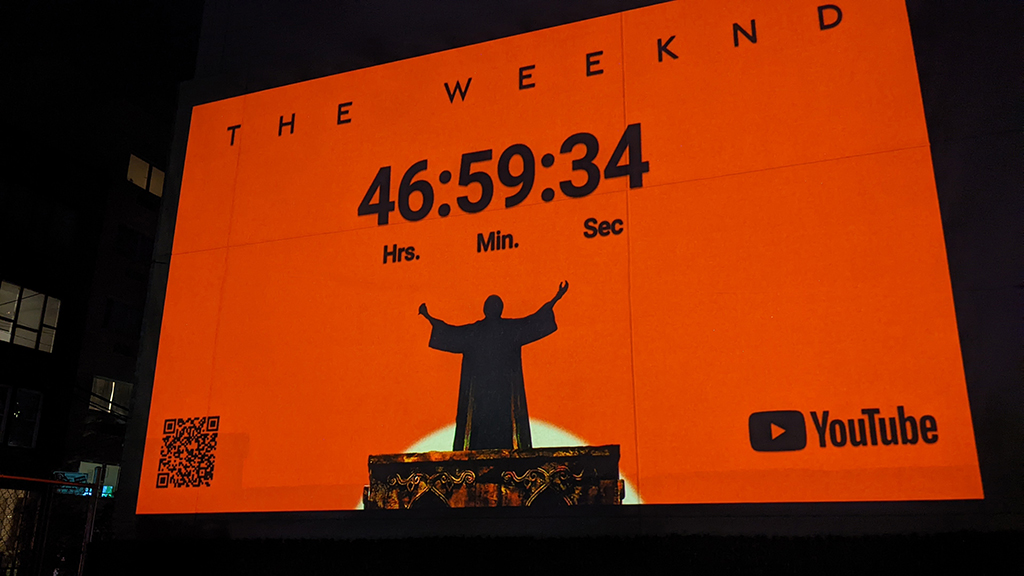
Projection advertising uses high-lumen projectors to display brand content on building facades at large scale during nighttime hours. The format is high-impact, highly photogenic, and generates significant organic social documentation. It is the highest-visibility format in the street marketing toolkit for single-night events.
How Street Marketing Agencies Differ From Each Other
Not all street marketing agencies are the same, and the differences matter substantially when you are evaluating who to trust with your campaign budget.
Owned Infrastructure vs. Brokered Networks
Some agencies own their operational infrastructure — they have existing property owner relationships, trained installation crews, and owned equipment in the markets they serve. Others broker capacity from third-party networks — they find a local partner in each market, mark up their costs, and serve as a project manager without direct operational control. Owned-infrastructure agencies have tighter quality control, faster response to problems, and more accountable documentation. Brokered agencies may appear to offer broader reach but have less control over what actually happens in the field.
Ask directly: is your team executing this campaign or are you brokering it to a local partner? The answer determines your actual line of accountability.
Documentation Standards
The quality of proof of posting documentation varies enormously between agencies. GPS-tagged photos from a professional camera taken immediately after installation are the gold standard. Photos taken days later, photos with missing GPS data, or “documentation” that consists of a summary report without individual placement photos are all warning signs. Our team delivers a GPS-tagged photo of every placement within 24 hours of installation as a standard deliverable on every campaign.
Market Knowledge
A street marketing agency that can name specific streets, pedestrian corridors, and high-foot-traffic locations in your target neighborhood — unprompted, without preparation — is a market expert. An agency that answers questions about placement locations with vague references to “high-traffic areas” and “popular neighborhoods” does not have the market-specific knowledge that executes strong campaigns. Market knowledge is the primary differentiator between an agency that produces results and one that produces reports.
Street Marketing Agencies and Digital Integration: Why Both Channels Work Together
The narrative that street marketing and digital marketing are competing channels reflects a misunderstanding of how consumers actually encounter and process brand messages. A person who sees a brand’s wheatpaste campaign on their walk to the subway does not stop using their phone when they get on the train. The pedestrian impression and the digital impression reach the same person at different moments in the same day. When the two channels are coordinated — with consistent creative, consistent messaging, and deliberate timing — they reinforce each other in a way that neither achieves alone.
Geo-fenced digital campaigns that serve ads to people who have been physically present in a guerrilla campaign’s deployment zone create a coordinated two-channel exposure: the physical placement reaches the person in the real world, and the digital campaign reaches them again when they are on their device. Research on multi-channel marketing consistently shows that reaching the same person through multiple channels increases conversion rates significantly compared to single-channel exposure. Street marketing agencies that understand digital integration build this coordination into their campaign recommendations as a standard component rather than an afterthought.
Our team regularly works with clients’ digital agencies or in-house digital teams to coordinate street-level placements with corresponding digital campaigns. The street campaign’s geographic boundaries define the geo-fence for the digital overlay. The campaign launch date and the digital campaign launch date are synchronized. The creative is consistent across channels so the connection between the physical and digital exposures is immediately recognizable to the consumer. That integration produces campaign performance that neither channel produces independently.
When to Hire a Street Marketing Agency
Street marketing agencies are the right partner when your campaign objective requires physical presence in the real world — when digital channels cannot create the geographic specificity, the ambient environmental presence, or the human engagement that your brief requires.
Common use cases: a product launching in a specific city that needs neighborhood-level visual saturation before retail availability, a tech startup needing physical credibility signals in its target user’s daily environment, a restaurant or retail business needing hyperlocal foot traffic generation, an entertainment release needing street-level presence in the cities where the cultural conversation is happening, or a brand entering a new market that needs to establish physical presence alongside digital campaign activity.
How to Evaluate and Choose a Street Marketing Agency
Ask for Proof of Posting Samples
Request sample documentation packages from past campaigns — actual photos with GPS metadata visible, installation reports with timestamps, and the campaign summary document the client received. If an agency cannot produce this documentation for past campaigns, they will not produce it for yours.
Test Market Knowledge
Ask the agency to describe the specific locations they would recommend for your campaign in your target market. Name the neighborhoods. Name the streets. Name the transit exits. If they can answer with specificity, they operate in that market. If they provide vague generalities, they do not.
Understand the Pricing Structure
Get an itemized estimate that separates production costs (printing, stencil fabrication), placement fees (property owner agreements, permit costs), installation labor, documentation costs, and agency management fees. Bundled pricing that does not break down the line items prevents comparison and often conceals markup on third-party costs.
Clarify Accountability
Who is specifically accountable if a placement is not installed correctly, if a location falls through, or if documentation is incomplete? Get clear answers before signing. The agencies that have clear accountability processes are the ones that have encountered and resolved these situations before — which means they have the infrastructure to handle them properly rather than learning on your budget.
How Street Marketing Agencies Price Their Services
Pricing in street marketing is less standardized than in digital advertising, which creates both flexibility and confusion for brands evaluating proposals. Understanding the components of a street marketing estimate helps brands compare proposals accurately and identify where they are paying for value versus overhead.
Production Costs
Production costs cover everything required to create the physical campaign materials and tools: print production for posters and wheatpaste panels (typically $0.50 to $2.50 per square foot depending on print quantity and stock), stencil fabrication ($200 to $800 per stencil depending on size and complexity), brand ambassador uniforms and branded materials, and any signage or display fabrication for experiential components. Production costs should be quoted as pass-through items with transparent vendor pricing — an agency marking up print costs at 40% above market rate is adding margin without adding value.
Placement and Location Fees
Property owners who provide permitted wall access, construction fencing access, or counter space for take-one programs charge location fees. These range from $100 to $500 per month for a standard wheatpaste wall in a secondary market, up to $1,500 to $5,000 per month for premium locations in high-foot-traffic neighborhoods in major metros. Location fees should be disclosed separately from agency fees so brands understand what they are paying for access versus what they are paying for agency services.
Installation Labor
Installation crews for wheatpaste campaigns typically run $500 to $1,500 per night depending on the number of crew members and the number of locations covered. Stencil installation crews run $300 to $800 per day. Brand ambassador staffing runs $20 to $45 per hour per ambassador depending on market and skills required. Labor costs are the most variable component of a street marketing estimate and the component where under-bidding is most commonly used to win proposals that cannot be executed as quoted.
Agency Management Fees
Agency management fees cover campaign planning, location sourcing, vendor coordination, quality control, and reporting. A standard management fee is 15 to 25% of total project costs. Fixed-fee management structures provide better cost predictability for brands than percentage-based fees that increase as project scope grows. Ask specifically how the management fee is calculated and what services it includes before comparing proposals from different agencies.
The Role of Documentation in Street Marketing
Documentation is what separates professional street marketing agencies from informal operators. Every placement in a legitimate campaign should be documented with GPS-tagged photos, installation timestamps, and specific location data. Without that documentation, a brand has no way to verify that the campaign they paid for actually ran in the locations specified at the times promised.
The proof of posting report is the accountability mechanism of street marketing. It should include: a photo of every placement showing the panel or stencil in position with the surrounding environment visible, the GPS coordinates of each placement logged automatically at the time the photo was taken, the installation date and time, and the specific address or nearest intersection. A well-constructed proof of posting report should allow the client to identify every placement on a map and verify independently that the location was appropriate for the campaign objective.
GPS Photo Documentation as Standard Practice
Our team uses GPS-enabled cameras that embed location data directly into the photo metadata at the moment of capture. That metadata is not editable after the fact — it is a permanent record of where and when the photo was taken. When we provide a proof of posting package, the client receives photos with embedded GPS data that can be verified independently. This level of documentation accountability is what we consider the professional minimum for any street marketing campaign.
Multi-Market Street Marketing: How National Campaigns Work
Brands launching in multiple cities simultaneously face a coordination challenge that single-market campaigns do not: ensuring consistent execution quality across markets where the agency may have different levels of relationships, crew experience, and local knowledge. Multi-market street marketing campaigns require a centralized production and logistics infrastructure that local-only agencies cannot provide.
Centralized Briefing, Local Execution
The most effective structure for multi-market campaigns: a centralized creative and production team that develops campaign materials, writes the placement brief, and establishes quality standards, feeding into local execution teams in each market who have the property relationships and street-level knowledge to execute correctly. Our team manages this structure across 50+ U.S. markets — the brief comes from one point of contact, the execution happens through our owned networks in each city, and the documentation aggregates into a single post-campaign report.
For brands running simultaneous campaigns in New York, Chicago, Los Angeles, Miami, and Austin — a common configuration for consumer brand launches — we coordinate placement schedules to ensure all markets go live within the same 48-hour window, providing the brand with synchronized market presence for press and social amplification purposes. Coordinated launch timing is a production and logistics discipline that requires the kind of cross-market infrastructure that only agencies with owned operations in each market can reliably deliver.
American Guerrilla Marketing: What We Do Differently
We are a street marketing agency that owns our operations. Our team is based in Industry City, Brooklyn, NY. We have existing property relationships, installation crews, and documentation infrastructure in 50+ U.S. markets — not a broker network, not third-party sub-vendors. Every placement we execute is documented with GPS-tagged photos within 24 hours of installation.
We execute wheatpaste campaigns, sidewalk stencils, brand ambassador programs, LED billboard trucks, projection advertising, and outdoor advertising campaigns as standalone formats and as integrated campaigns that combine multiple formats under a unified strategy. Our capabilities deck explains the full scope of what we do and the markets we operate in.
We are reachable at (646) 776-2770. Every campaign brief gets a direct response with a specific proposal — not a generic capabilities deck with vague pricing ranges.
Frequently Asked Questions
What is a street marketing agency?
A street marketing agency plans, sources, and executes marketing campaigns in the physical world — on streets, sidewalks, building walls, transit corridors, and public spaces. Services include guerrilla campaigns, brand ambassador programs, product sampling, street posters, and mobile billboard or LED truck activations.
What services does a street marketing agency typically offer?
Core services include outdoor street posters and wheatpaste, sidewalk stencil programs, snipe advertising, brand ambassador and street team deployment, product sampling, LED billboard truck and mobile billboard campaigns, projection advertising, and guerrilla marketing campaign planning.
How do street marketing agencies differ from traditional advertising agencies?
Traditional ad agencies create and place ads in paid media channels. Street marketing agencies create and execute campaigns in the physical world where no paid media inventory exists — on permitted walls, sidewalks, through human ambassadors, and on mobile platforms. The difference is the medium: paid inventory versus earned and permitted physical space.
What should I look for when evaluating a street marketing agency?
Look for market-specific infrastructure and relationships in target cities, a documented proof of posting process with GPS-tagged photos, transparent pricing with itemized estimates, real case studies with verifiable clients, and clear accountability for what happens if placements do not go as planned.
How much does it cost to work with a street marketing agency?
A single-market campaign covering wheatpaste, stencils, and street team for 4 weeks runs $8,000 to $30,000. Multi-market campaigns covering 3 to 5 cities run $25,000 to $80,000. Agency management fees typically run 15 to 25% on top of production and placement costs.
What is American Guerrilla Marketing’s approach to street marketing?
We specialize in high-impact street campaigns with documented proof of performance. Every placement is GPS-tagged and photographed. Every campaign includes a proof of posting report. We operate across 50+ U.S. markets with owned relationships. Our team is based in Industry City, Brooklyn, NY and can be reached at (646) 776-2770.