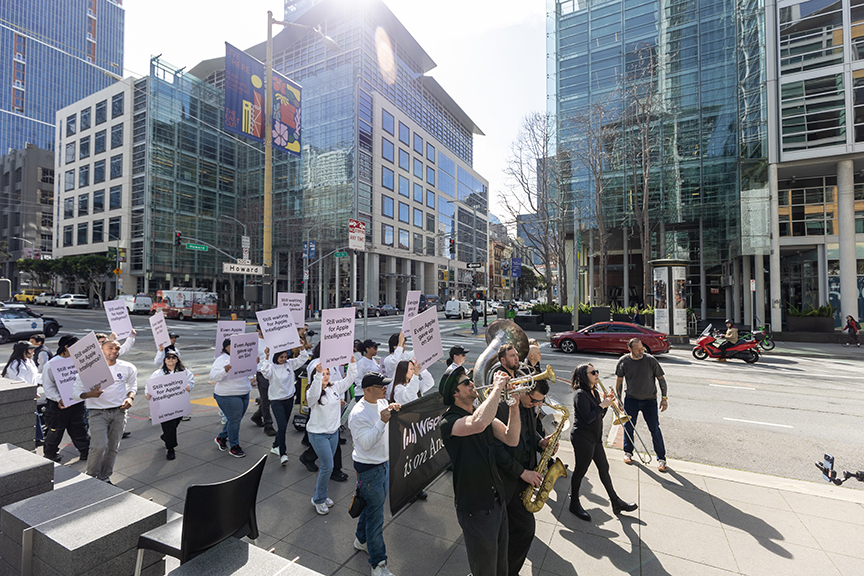
Most writing about guerrilla marketing treats it like a category rather than a discipline. You get lists of examples, some photos of clever installations, and vague advice about “thinking outside the box.” That is not a strategy document. It does not tell you which approach to use for which objective, what execution looks like at a production level, or how to evaluate whether the campaign worked.
This guide approaches guerrilla marketing as a practitioner would: by identifying the distinct strategies within the category, explaining what each one is designed to accomplish, mapping each strategy to the formats that execute it well, and providing the execution guidance needed to actually run a campaign rather than just plan one. Our team at American Guerrilla Marketing has executed campaigns across 50+ U.S. markets using every strategy covered here. We know which ones work and what makes them fail.
The Six Core Guerrilla Marketing Strategies
Strategy 1: Saturation
The saturation strategy deploys high-frequency placements across a defined geographic area to create the perception that the brand is present everywhere in that space. The target audience encounters the brand multiple times through multiple placement types — posters, stencils, street teams, stickers — across the spaces they move through in a given day or week. The cumulative effect of those repeated encounters is brand omnipresence within the defined geography.
Saturation works through frequency, not reach. You are not trying to reach as many different people as possible. You are trying to reach the same people — the people who live and work in the target geography — as many times as possible during the campaign window. That frequency builds brand salience that a single high-reach impression cannot achieve.
Execution: 30 to 60 wheatpaste panels covering the walls of a target neighborhood, sidewalk stencils at every transit exit in the area, and snipe advertising on every block. The impression volume per day for a resident of the target neighborhood can reach 10 to 20 brand encounters, which is a frequency level that no other format achieves at this cost point.
Strategy 2: Ambush
The ambush strategy positions your brand in proximity to a competitor’s activity or near a major event where your target audience concentrates, without sponsoring or formally affiliating with that event. The brand captures attention and association that the event generates without paying event sponsorship rates.
Ambush works through association and proximity. The target audience is already in a heightened state of engagement — they are at an event, they are excited, they are sharing content. Your brand appears in their periphery, in their walk to and from the venue, in the visual landscape of the neighborhood during the event window. The association is not explicit but it is real.
Execution: LED billboard trucks circling a conference venue during event hours, brand ambassadors at event entry and exit points, and wheatpaste campaigns on all approach corridors to the venue in the two weeks before and during the event. The brand reaches every attendee without a formal event sponsorship relationship.
Strategy 3: Experiential
The experiential strategy creates a branded encounter that the consumer participates in directly — a sampling activation, an interactive installation, a pop-up environment that invites engagement. Unlike ambient or presence strategies, the experiential strategy creates a two-way interaction between the brand and the consumer.
Experiential works through participation and memory. A consumer who engaged with a brand — tasted the product, tried the experience, talked with a brand ambassador — forms a more durable brand memory than a consumer who merely observed a brand. The depth of engagement produces stronger downstream conversion, particularly for categories where trial is the critical conversion step.
Execution: Street-level sampling programs in high-foot-traffic locations, interactive brand installations in public spaces, and brand ambassador activations that involve the consumer in a demonstration or experience rather than just delivering a message.
Strategy 4: Stunt
The stunt strategy executes a single large-scale, attention-generating moment designed primarily for earned media coverage and social sharing. The live audience for a well-executed stunt may be modest, but the media amplification can reach hundreds of thousands or millions. The stunt is produced for the audience that will see it second-hand — through news coverage, social shares, and viral documentation — rather than first-hand.
Stunt works through amplification. The event creates a story that spreads through existing media channels without media spend. The story becomes the brand message. This is the highest-variance strategy in the guerrilla category — a stunt that succeeds creates enormous earned media value, but a stunt that fails to generate coverage or shareable moments produces a high cost with no return.
Execution: Requires significant creative and production investment. The scenario, the setup, the documentation strategy (who is photographing, who is filming, where the content goes first), and the media pitch strategy are all part of the stunt planning. Our team has executed stunts ranging from large-scale projections on landmark buildings to complex street-level installations designed to generate pedestrian documentation.
Strategy 5: Ambient
The ambient strategy integrates brand messages into the environment in a way that makes them feel like they belong there — using environmental surfaces, objects, or contexts as the medium rather than conventional advertising formats. An advertisement printed on a takeaway coffee cup, a message integrated into the design of a public bench, or a brand visual incorporated into a manhole cover sticker that reads as environmental rather than commercial.
Ambient works through integration. The message is encountered in a context where the audience is not expecting advertising, which reduces psychological resistance and creates a moment of genuine attention. The surprise of encountering a brand message in an unexpected medium increases memorability over conventional advertising placements.
Strategy 6: Street-Level Presence
The street-level presence strategy maintains a sustained, consistent brand visibility in defined geographic corridors over an extended period — 60 to 90 days or longer. Unlike the saturation strategy’s intensive short-term burst, presence is about building long-term brand recognition through ongoing visual consistency in the spaces where the target audience lives and works.
Presence works through accumulation. Over weeks and months of consistent exposure, brand recognition builds to the point where the target audience’s awareness of the brand is automatic — they have seen it enough times that it is simply part of their mental landscape. This strategy is appropriate for brands establishing a new market position or for companies that want to build durable local brand recognition rather than short-term launch awareness.
Format-to-Strategy Mapping
Each guerrilla format is better suited to some strategies than others. Understanding the mapping helps you choose the right format for your campaign objective.
Wheatpaste and poster campaigns are the primary format for saturation and presence strategies. Their visual scale and placement density make them the most effective format for generating high-frequency impressions across a defined geography. For ambush campaigns, wheatpaste on approach corridors creates pre-arrival brand exposure for event audiences.
Sidewalk stencils are most effective for saturation and ambient strategies. Their placement in pedestrian walking paths creates unavoidable brand encounters at transit exits, storefront approaches, and busy intersections. Stencils on the approach paths to a competitor’s retail location are a textbook ambush execution.
Brand ambassador programs are the primary format for experiential strategies. They also complement saturation and ambush campaigns as the human component that creates dialogue and deeper engagement alongside ambient visual placements.
LED billboard trucks are most effective for ambush and stunt strategies. Their mobility allows precise deployment to event perimeters and high-visibility corridors at specific times. Our LED trucks are frequently deployed at event-adjacent ambush campaigns and product launch stunts in major metro markets.
Projection advertising is the primary format for stunt strategies. A large-scale projection on a landmark building is inherently a stunt — it is produced to be photographed and shared, and it generates the kind of social documentation that creates earned media reach beyond the live audience. Our projection team handles sourcing, permitting, equipment, and content delivery for every projection campaign we execute.
What’s Working in Guerrilla Marketing in 2026
QR Tracking as Standard Attribution
QR codes on every physical placement are now standard practice for campaigns that care about measurement. The data they generate — scan volume, scan timing, scan location, downstream conversion — turns guerrilla campaigns from feel-good awareness buys into accountable media placements with measurable cost-per-action. Campaigns without QR tracking are leaving measurement on the table.
Event Synchronization as Default
Aligning guerrilla campaigns with events — concerts, sports seasons, major cultural moments, industry conferences — concentrates target audience exposure and creates shareable context for the campaign creative. Event-adjacent guerrilla consistently outperforms standalone campaigns on earned media metrics because the event provides a narrative frame that the guerrilla creative can attach to.
Multi-Format Integration
Single-format guerrilla campaigns are increasingly rare among sophisticated brand teams. The most effective 2026 campaigns combine outdoor formats (wheatpaste, stencils, snipes) with mobile formats (LED trucks, projections) and human formats (brand ambassadors, sampling teams) to create layered exposure that reaches the target audience through multiple mechanisms in the same campaign window.
Case Applications: Which Strategy for Which Situation
Strategy selection becomes clearer when applied to specific, concrete situations rather than evaluated in the abstract. The following scenarios illustrate how the strategy framework maps to real campaign briefs.
Consumer Packaged Goods Brand Entering New Market
A natural food brand launching distribution in Chicago wants to build brand recognition in the neighborhoods where its target consumer — health-conscious millennials — is concentrated. The right strategy is saturation, focused on Wicker Park, Logan Square, and Lincoln Park. High-density wheatpaste covering the walls of these three neighborhoods over a 30-day window, combined with stencils at the transit exits serving each neighborhood, builds the visual omnipresence that makes the brand feel established before it has a track record in the market. The campaign objective is first-awareness at scale in a defined geography — which saturation serves more effectively than any other strategy.
Entertainment Release in New York City
A streaming platform is releasing a highly anticipated series and wants a street-level presence in New York during launch week. The right strategy is stunt + ambush: a large-scale projection event on a landmark building in a high-social-documentation location (SoHo, the Meatpacking District, or DUMBO Brooklyn) on the night before release creates a shareable cultural moment, while wheatpaste campaigns covering the relevant neighborhoods in the two weeks before release build pre-launch awareness. The stunt drives earned media and social amplification; the wheatpaste builds the ambient recognition that makes the stunt land with an already-primed audience.
Local Gym Opening in a New Location
A gym brand opening a new location in a specific neighborhood wants to generate first-month memberships before the opening. The right strategy is presence + experiential: a sustained neighborhood presence campaign (stencils at transit exits, snipes on nearby streets) runs for four weeks before opening to build recognition, while brand ambassadors at the gym’s opening event and at nearby fitness-adjacent locations (running routes, sports courts, parks) provide the experiential layer that creates personal engagement with the brand. The presence campaign ensures that everyone who attends the opening event has already encountered the brand; the experiential campaign gives them a human relationship with it on opening day.
Budget Planning by Strategy Type
Each guerrilla marketing strategy has a different budget structure because each strategy uses different formats, different execution requirements, and different campaign durations. Understanding the budget structure before selecting a strategy prevents the situation where the right strategy is identified but cannot be executed at the available budget.
Saturation Strategy Budget
Saturation campaigns are budget-intensive in production — the more placements, the more print volume, installation labor, and location fees required. A saturation campaign covering one city for 30 days with 40 to 60 wheatpaste placements, 30 to 50 stencil deployments, and snipe coverage in the target neighborhood requires $15,000 to $40,000 depending on the market. New York and Los Angeles run higher than mid-market cities due to higher location fees and labor costs. The investment produces disproportionate awareness impact because the density of placements creates the omnipresence effect that justifies the format choice.
Stunt Strategy Budget
Stunt campaigns require higher creative and production investment than other strategies because the event itself must be visually spectacular enough to generate documentation and earned media. A building projection stunt in a major urban market runs $15,000 to $40,000 for a single night including equipment, content production, location access, and documentation. A large-scale street installation stunt runs $20,000 to $80,000 depending on fabrication complexity. The stunt format’s ROI is measured in earned media value — the press coverage and organic social sharing that the event generates beyond the in-person audience.
Presence Strategy Budget
Presence strategies distribute budget over a longer time horizon — 60 to 90 days versus the 4-week saturation model. The per-month spend is typically lower (less intensity per period), but the total campaign investment is higher when the full duration is calculated. For brands with an ongoing local marketing budget rather than a single campaign budget, the presence strategy is often the most cost-effective allocation: consistent monthly investment in ambient outdoor presence produces durable brand recognition that episodic campaigns cannot sustain.
What Makes Guerrilla Campaigns Fail: Common Execution Errors
The strategies described here produce consistent results when executed correctly. They fail in predictable ways when execution compromises their core requirements. Understanding the failure modes helps marketing teams avoid the most common mistakes before they happen.
Under-Density
A saturation strategy with too few placements does not create saturation. It creates visibility — which is not the same thing. Five posters in a neighborhood spread across 10 blocks is a presence campaign, not a saturation campaign. The visual omnipresence that makes saturation effective requires a minimum density of placements per block that many brands under-execute due to print budget constraints or location availability limits. If the budget does not allow saturation density in the full target geography, reduce the geographic scope rather than reduce the density. A tight saturation of 8 blocks outperforms a thin coverage of 40 blocks for a saturation objective.
Creative That Does Not Stop
Guerrilla creative needs to stop a pedestrian in 1.5 seconds or less to create a genuine impression. Creative that blends into the visual landscape of the neighborhood — low contrast, small scale, unclear messaging, insufficient visual differentiation from the surrounding environment — produces placements that are technically present but functionally invisible. Every guerrilla creative should be tested for visibility and comprehension at walking speed before production is ordered. The field is where the creative lives; test it in the field.
Choosing the Right Strategy for Your Objective
Start with the objective, not the format. Different objectives map to different strategies:
Launch awareness in a new market: saturation strategy, wheatpaste and stencil primary formats, 4 to 6 week deployment window. Trial and product adoption: experiential strategy, sampling and ambassador primary formats, high-foot-traffic locations in target neighborhoods. Event-adjacent brand association: ambush strategy, LED trucks and ambassador primary formats, deployment window bracketing the event. Press and social amplification: stunt strategy, projection or large-scale installation primary formats, documentation infrastructure built into the campaign plan. Long-term local brand recognition: presence strategy, ongoing outdoor mix with periodic refreshes, 60 to 90 day minimum duration.
The strategy defines the format mix, the budget structure, the deployment timeline, and the measurement approach. Getting the strategy right first prevents the format-first thinking that produces campaigns that are tactically well-executed but strategically misaligned with what the brand actually needs to achieve.
Frequently Asked Questions
What guerrilla marketing strategies actually work in 2026?
The six core strategies producing consistent results are: saturation (dominating a defined geography with high-frequency placements), ambush (positioning near competitor activity or major events), experiential (branded encounters consumers participate in), stunt (single large-scale moments for press and social amplification), ambient (integrating brand messages into the environment), and street presence (sustained brand visibility over time). Each maps to different campaign objectives.
What is a saturation strategy in guerrilla marketing?
A saturation strategy deploys high-frequency placements across a defined geographic area to create the perception that the brand is everywhere in that space. The goal is to make the brand unavoidable for anyone who moves through the target geography during the campaign window through repeated encounters across multiple placement types.
How does an ambush strategy work in guerrilla marketing?
An ambush strategy positions your brand near a competitor’s activity or near a major event where your target audience concentrates, without formally sponsoring that event. LED trucks circling a conference venue, brand ambassadors at event entry points, and wheatpaste campaigns on approach corridors create event association without sponsorship fees.
Which guerrilla marketing format has the lowest cost per impression?
Sidewalk stencils typically produce the lowest cost per impression when placed at major transit hubs with 10,000+ daily foot traffic. Wheatpaste in high-foot-traffic corridors is the next most efficient format at scale. Both formats generate ongoing impressions after a single installation investment.
What makes guerrilla marketing strategies fail?
Common failure modes: strategy-to-format mismatch, geographic imprecision (right city, wrong neighborhoods), creative that does not communicate clearly enough to generate action, no attribution setup making measurement impossible, and under-budgeting the placement density needed for the strategy to work.
How long does a guerrilla marketing campaign need to run to be effective?
Saturation and presence strategies need a minimum of 3 to 4 weeks to build meaningful frequency. Stunts and event-adjacent ambush campaigns can be effective over 1 to 3 days. For sustained awareness campaigns, 60 to 90 days builds brand recognition that outlasts the campaign itself.