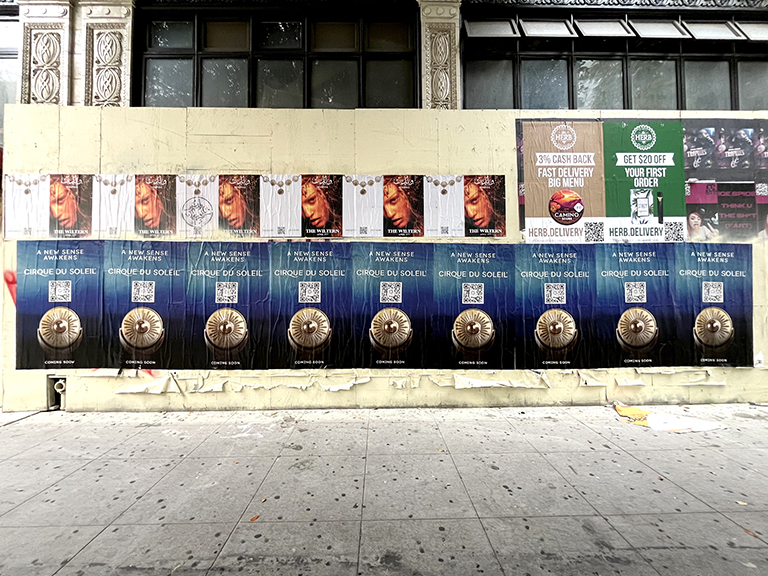
Guerrilla marketing covers the full range of tactics that place brands into the real-world environments where people actually live, work, and move, in ways that are unexpected, contextually relevant, and difficult to ignore. The term encompasses everything from a single street team deployment to a multi-city campaign combining poster saturation, projection installations, and LED truck routing. What unites all of it is the underlying principle: reach people where they are, in a way they did not expect, with something that earns their attention rather than simply purchasing it.
The format category has grown significantly since Jay Conrad Levinson first articulated the principles in the 1980s. What started as a framework for small businesses that could not afford traditional advertising has expanded into a major component of how serious brands, across all budget levels, build physical market presence that digital channels alone cannot create. A national consumer brand, a political campaign, an entertainment company launching a new franchise, a startup building local awareness in a single market: all of them use guerrilla marketing because the fundamentals work regardless of category or scale.
This guide covers the full operational landscape of guerrilla marketing: what the major formats are and how they work, how to plan and execute campaigns that actually deliver, what measurement frameworks prove the value of street-level work, and where the planning failures that sink campaigns most often originate. It is written from the field perspective of a team that has executed these campaigns across 50-plus U.S. markets, not from the theoretical perspective of a strategy framework that has never been road-tested at street level.
The Core Guerrilla Marketing Format Categories
Guerrilla marketing encompasses several distinct format categories, each with different audience dynamics, production requirements, compliance considerations, and performance profiles. Understanding the differences between them is the foundation of intelligent format selection.
Poster Campaigns and Wheatpasting
Poster campaigns are the most accessible and scalable format in guerrilla marketing. High-quality printed materials installed on authorized surfaces in target corridors create brand presence that accumulates impressions across days and weeks rather than hours. The format’s flexibility accommodates creative briefs ranging from minimal brand awareness to complex event promotion to location-specific contextual advertising.
Surface selection is where poster campaigns succeed or fail. A poster in the right location, correctly positioned for the sightlines and pedestrian flow of that specific block, outperforms the same poster in ten generic locations. We scout placements before recommending them, which is a practice that significantly changes campaign performance relative to agencies that sell zone packages without surface-level evaluation.
Sidewalk Stencils
Sidewalk stencil campaigns place brand messages at exactly the level where pedestrians are already looking. The format is effective for directional campaigns, event promotion, approach route saturation, and creative executions that use the sidewalk context as part of the message. The format is inherently temporary, which limits long-term brand presence but also reduces compliance risk compared to more permanent installations.
Strong stencil creative is designed from the constraints of the medium rather than adapted from other formats. Limited color, bold shapes, and immediate readability at walking pace are the design principles that make stencil campaigns work.
Street Teams and Brand Ambassadors
Our brand ambassador program places trained people in the field as the campaign format. Direct human engagement is the highest-conversion format in guerrilla marketing because it creates a personal interaction that no other format can replicate. A skilled ambassador who gives you something you want, tells you something useful, or creates a genuinely memorable moment with the brand creates the kind of positive association that thirty digital impressions cannot match.
The quality of street team execution is almost entirely determined by training, staffing, and management discipline. A well-trained crew in the right location at the right time generates extraordinary results per hour of deployment. A poorly trained crew scattered across the wrong geography generates noise and wasted budget.
LED Billboard Trucks
LED billboard trucks combine the visual impact of large-format advertising with the geographic mobility of a vehicle-based campaign. We route trucks based on audience concentration and time-of-day patterns, which means the campaign reaches the audience where they actually are rather than occupying a fixed location and hoping the audience passes. The format is particularly effective for event-adjacent campaigns, day-of promotions, and situations where the audience is distributed across a large geographic area.
Projection Advertising
Projection campaigns create large-scale visual moments by displaying brand imagery on building facades and public structures. The scale of a well-executed projection generates the kind of attention and social documentation that creates earned media value far beyond the production cost of the campaign. The format is inherently evening-oriented, which concentrates it into high-energy time windows that often align well with entertainment and lifestyle brand objectives.
Strategy: How to Plan a Guerrilla Marketing Campaign That Works
The planning discipline that strong guerrilla campaigns require is more rigorous than most brands expect. The spontaneous, surprising quality of a successful guerrilla execution is the product of detailed preparation, not the absence of it.
Start With Audience and Geography
Every guerrilla campaign should begin with two questions: Who are we trying to reach? Where are they? Everything else, format selection, creative approach, timing, production specifications, flows from specific, researched answers to those questions. Campaigns that begin with the format and work backward to an audience consistently underperform campaigns that start with the audience and select formats accordingly.
Geographic analysis is not just about neighborhood identification. It is about specific corridors, intersection patterns, time-of-day concentration, transit flow dynamics, and the specific environmental conditions (sightlines, lighting, pedestrian speed, competitive visual clutter) that determine whether a format at a given location will reach the target audience effectively.
Select Formats Based on Objectives
Different guerrilla formats serve different objectives, and the mismatch between format and objective is one of the most common planning errors we see. Awareness campaigns benefit from high-reach formats like poster saturation and LED truck routing. Conversion campaigns need interactive elements like street teams with clear calls to action and QR mechanisms that create measurable digital conversion. Brand-building campaigns benefit from high-quality visual executions that generate documentation and social sharing.
Plan Production and Logistics Seriously
Production quality matters in guerrilla marketing because the audience evaluates the execution at close range, in real time, without the softening effect of a digital render or a presentation slide. Materials that look weak or poorly produced undermine the brand identity they are meant to represent. Installation that misses the target surface or the target timing fails to reach the audience it was designed for. Logistics failures cost money and erode the campaign’s effectiveness before it ever generates an impression.
Compliance and Risk Management
Guerrilla marketing operates in public spaces that are regulated by city permit systems, property owner rights, and event management agreements that vary by market and by format. Understanding and navigating those regulations is not optional: enforcement actions against non-compliant campaigns can terminate the campaign mid-flight, generate negative press coverage, and create legal liability for the brand.
What Requires Permits in Most Major Markets
Street teams distributing product typically require distribution permits in most major cities. Poster placements on public surfaces require city authorization. Sidewalk stencils have varying regulatory status by city: some require permits, some are prohibited outright, some are tolerated within defined parameters. LED trucks require operating permits in many markets. Projection campaigns on public buildings require specific authorization.
We navigate these requirements as part of standard campaign planning. Clients should ask any agency they work with specifically how compliance is managed, not as a perfunctory question but as a genuine due diligence step. The answer reveals a great deal about the agency’s operational maturity.
Measuring Guerrilla Marketing Campaign Performance
Measurement in guerrilla marketing starts with proof of execution and extends to reach estimation, earned media tracking, and downstream conversion data. We build measurement frameworks into every campaign from the planning phase rather than trying to construct them retrospectively after the campaign ends.
Proof of Execution Documentation
GPS-tagged photo documentation of every placement and deployment, timestamped installation records, route logs from LED trucks, crew activity records with specific location and time data, and distribution counts from street team deployments all constitute the proof of execution layer. This documentation serves as the foundation for the campaign recap and as the evidence that the work was actually done as planned.
Reach and Impression Estimation
We estimate reach from foot traffic data, transit ridership numbers, and deployment location traffic counts. Those estimates are informed approximations rather than precise counts, which is standard across out-of-home advertising generally. We present them as such, rather than inflating them to justify the campaign cost after the fact.
Earned Media and Social Monitoring
We monitor social platforms for organic brand mentions in the campaign geography during and immediately after the campaign window. Earned media coverage from local press or marketing publications is tracked and included in campaign recaps. Those signals provide qualitative evidence of campaign quality beyond the raw impression estimates.
Digital Conversion Tracking
When campaigns include QR codes, branded URLs, or offer codes, we track scan and redemption rates as a direct signal of street-to-digital conversion. Those rates, even when they are modest in absolute terms, provide a data point that connects physical campaign activity to measurable digital behavior.
Guerrilla Marketing Across the Full Planning Lifecycle
A complete guerrilla marketing campaign moves through several distinct phases, each with specific deliverables and decisions that determine the campaign’s eventual performance.
Discovery and Strategy (Weeks 6-8 Before Launch)
Audience research, geographic analysis, format evaluation, creative briefing, and budget allocation all happen in this phase. The outputs are a campaign strategy document and a preliminary format and location recommendation. This is also when permit and compliance research should begin for any formats or markets with complex regulatory requirements.
Production and Logistics (Weeks 3-5 Before Launch)
Creative production, surface scouting and confirmation, crew scheduling, vendor coordination, and logistical planning all happen here. Any issues with permit acquisition or surface availability need to be resolved in this window, not at installation time.
Execution and Documentation (Campaign Duration)
Deployment follows the plan, with real-time documentation of GPS coordinates, installation times, crew activity, and any field adjustments required by conditions on the ground. Quality control is active throughout the campaign duration, not just at launch.
Recap and Analysis (1-2 Weeks Post-Campaign)
The campaign recap covers all proof of execution documentation, reach estimates, earned media, and digital conversion data. Recommendations for the next campaign are included based on what the data shows about which placements, timing windows, and crew approaches produced the strongest results.
Frequently Asked Questions
What is guerrilla marketing?
Guerrilla marketing is a brand promotion strategy that uses unconventional, often unexpected tactics in public spaces to create high-impact brand moments at a lower cost than traditional advertising. The term was coined by Jay Conrad Levinson and has expanded from its low-budget origins to encompass a wide range of street-level formats used by brands at all budget levels.
What are the main types of guerrilla marketing?
The main categories include ambient marketing (using the environment as creative canvas), ambush marketing (associating with events without official sponsorship), street team and experiential marketing (direct consumer engagement), and visual disruption campaigns using projections or large-format installations. Each type has distinct format options, audience dynamics, and operational requirements.
How much does guerrilla marketing cost?
Costs range from a few thousand dollars for a single-city street team activation to hundreds of thousands for a multi-market integrated campaign. The format’s core advantage is that creative quality and execution precision can substitute for media spend in ways that standard advertising channels do not allow. Contact our team at (646) 776-2770 for a custom quote.
What is the best guerrilla marketing format for a new product launch?
For new product launches, a combination of street team direct sampling, poster campaign brand presence in target neighborhoods, and sidewalk stencils on high-footfall approach routes creates multi-format market saturation that builds awareness quickly. The specific format mix should be determined by the audience profile, target geography, and budget.
How is guerrilla marketing measured?
Measurement starts with proof of execution: GPS-tagged photos, route logs, crew activity records, and distribution counts. It extends to earned media monitoring, social listening in the campaign geography, digital conversion tracking through QR codes and branded URLs, and downstream performance data supplied by the client.
Does guerrilla marketing work for B2B brands?
Yes. B2B guerrilla marketing targets decision-makers in their daily environments: office district street team activations, proximity campaigns near conference venues, and event-adjacent deployments at industry events. The audience is smaller but the per-impression value is higher, which makes precise targeting more important and broad geographic coverage less so.