American Guerrilla Marketing
Nationwide Service
Media planning, media buying, billboard advertising, & guerrilla marketing
Case Study:
Weekend Synchronized Projection Campaign in New York City & Los Angeles
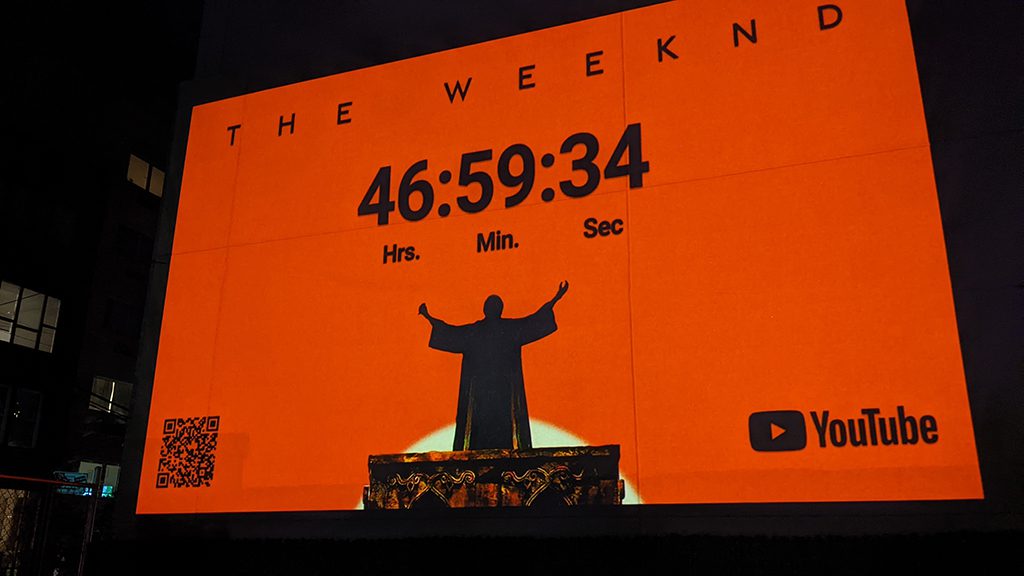
The detail that mattered most on this campaign was a playback timer. Timing was synced Los Angeles to New York so that each machine started the same sequence at the exact same moment, not at the same number on a local clock. Everything else followed from that one decision.
The brief was four nights of projection, two per market, in New York City and Los Angeles, with a six hour block each night running from nine in the evening until three in the morning. Artwork was due August 28, 2024. Locations were settled a week before the first night. The activation ran September 5 and 6.
There are almost no daytime photographs from this campaign, which is the nature of the format. Projection exists only while the equipment is running and disappears completely when it stops. That makes it a strategy story rather than a picture story, so this write up spends its time on how the thing was built.
Why A Synchronized Start Was Worth The Trouble
Running the same sequence at nine in the evening in both cities would have been simpler, and it would have meant the two markets were doing the same thing three hours apart. Running them against one reference clock means the campaign happened once, in two places, simultaneously.
That matters for a single reason: social. When the point of a projection is that people film it and post it, two coasts posting the same image inside the same ten minute band looks like an event. The same posts spread across three hours look like two separate stunts. One is a moment, the other is a schedule.
The operational cost is that the two markets run in different parts of their night. A synchronized start puts New York deeper into its evening while Los Angeles is still early, or the reverse, depending on which end you anchor. Crews were briefed off the same cue sheet, timers were set before anyone rolled, and nobody waited for a phone call to start.
A Six Hour Block Is Not Six Hours Of Projection
Nine in the evening to three in the morning sounds like a long run. In practice a six hour block covers travel between locations, setup, the actual projection, teardown, and the unplanned time when a chosen face turns out to be unusable.
Setup on a mobile rig is not instant. The vehicle has to sit where the throw distance works, which is frequently not where parking is convenient. Power gets stabilized. Focus and keystone get corrected to the specific geometry of the building, because a surface that is not perpendicular to the throw distorts the image and every face has its own angle. Then the sequence runs long enough to matter, which means staying put rather than hitting and moving.
The honest number is three or four substantial locations per night, not ten. We tell clients that before they book, because the most common disappointment with projection is a client who expected a city wide sweep and received four deeply worked positions. Four good positions is the better outcome. It just needs to be the expectation going in.
Campaign Photos
Ready To Put Your Artist Or Brand On The Streets Of America's Top Markets?
Award Winning Personalized Service
You will get thoughtful, devoted, and individualized attention from our experienced, qualified, and professional personnel. Being one of the most illustrious agencies in Brooklyn, New York, American Guerrilla Marketing has been awarded the Best of Brooklyn title.
Nationwide
Industry City, Brooklyn, New York 11232
American Guerrilla Marketing
Hours
Mon - Fri: 9 AM - 5 PM
Sat & Sun: Closed
Automate your campaign with AGM’s Request for Proposal Builder.
Automate your campaign with AGM’s Request for Proposal Builder. Simply answer a few quick questions about your campaign goals, markets, and timeline, and the system will generate a tailored presentation with recommended strategies, quantities, and pricing. Click the RFP Builder to instantly receive your customized proposal.
Choosing Surfaces When The Canvas Is Light Instead Of Paper
Poster scouting asks whether a wall will hold paste. Projection scouting asks a longer set of questions and most candidate surfaces fail at least one of them.
The face has to be broad and flat. It has to be dark or neutral in color, because a light colored wall washes the image out. There has to be very little ambient light crossing it, which rules out most of what looks appealing during the day. There has to be a clean throw distance, which means an open street or lot between the rig and the wall with no scaffolding, no tree canopy and no bus shelter in the path. And the rig has to be able to sit somewhere for twenty or thirty minutes without blocking traffic.
In New York that pushed us toward lower rise blocks with exposed side walls, the kind of gable ends left over where a neighboring building came down, plus the backs of commercial buildings and the flat faces of parking structures. The Lower East Side and the Bowery have those in supply. So does the stretch of Chelsea running west toward the highway, and the Williamsburg waterfront, where the river gives you throw distance that no inland Manhattan block can match.
Los Angeles has the opposite problem. Surface is abundant. Downtown alone has more blank concrete than most cities have total wall. What Los Angeles lacks is people standing in front of it. The city’s geography means an image on a wall in an industrial block downtown may be technically perfect and seen by forty people. So the selection logic flipped from finding a wall to finding a wall adjacent to pedestrian density, which in practice means the Hollywood corridor, the blocks around Melrose and Fairfax, Echo Park and Silver Lake along Sunset, and the active part of downtown rather than the empty part.
Primary and backup, every single time
The client selected both a primary and a backup location for each activation before the night began. That requirement is not bureaucracy. It is the single most useful thing a client can do for a projection crew.
A projection surface is borrowed, not booked. Between scouting and showtime a box truck parks in the throw path, a building switches on floodlights that were dark three nights earlier, a street closes for a film shoot, or a construction crew puts a lift exactly where the rig needs to sit. None of that is predictable and all of it is common. Without a named second choice inside a few blocks, the crew burns forty minutes of a six hour block making a decision that should have been made in daylight.
When a position was compromised, the projectionist reached the client directly during the activation rather than deciding unilaterally. On a campaign where the creative is the point, a surface swap is a creative decision, and the person who owns the creative should make it while the rig is still warm.
The Tradeoff Nobody Mentions About Projection
Projection leaves nothing behind. That is its strength and its weakness in the same sentence.
A poster keeps working for weeks whether anyone is paid to stand next to it or not. A projection works for the minutes it is switched on, in front of whoever happens to be on that block, and then the wall is a wall again. The entire residual value of the campaign lives in the documentation, which is why the reporting on this activation was specified in advance at up to five photographs and one video of each location visited rather than left as a courtesy.
If we ran it again we would add a second camera position at each stop. The crew documentation proves the work and captures the image on the wall. What it does not reliably capture is the thing that actually sells the format internally, which is people stopping on a sidewalk to look up. That shot is worth more to a client than another clean frame of the artwork, and it needs somebody whose only job that night is to get it.
When projection is the right call
Use it when the creative is motion, when the release window is one or two nights rather than a month, and when the goal is a short burst of imagery people will share rather than sustained neighborhood familiarity. Use posters when the goal is the opposite. Running both on the same campaign, as a growing number of clients now do, covers the whole day instead of half of it.
Planning a projection activation
Tell us the markets, the nights and what the artwork does when it moves. We will come back with surface candidates, a realistic number of positions per night, and a reporting plan you agree to before anyone rolls.